Understanding the Unique Challenges for IMGs in ENT
Otolaryngology (ENT) is one of the most competitive specialties in the US, and this is especially true for international medical graduates. A deliberate, data‑driven program selection strategy can make the difference between matching and going unmatched—even for strong applicants.
Before choosing where to apply, you need to understand:
- How competitive ENT is overall
- How ENT programs view IMGs
- What aspects of your application matter most
Why ENT Is Highly Competitive
Compared with many other specialties, ENT offers:
- High case volume and procedural diversity
- Strong earning potential and lifestyle opportunities
- Early and sustained operative exposure
This leads to:
- Fewer positions nationwide (relative to applicants)
- Strong applicant pool (mostly highly ranked US MD seniors)
- Higher expectations for research, scores, and letters
For an IMG, this means you must be even more strategic about where and how widely you apply.
How Programs Typically View IMGs in ENT
ENT has historically had lower IMG representation than internal medicine, pediatrics, or family medicine. Common realities:
- Many programs rarely or never interview IMGs
- Some programs occasionally interview but rarely rank IMGs high enough to match
- A smaller subset actively considers IMGs, especially those with:
- Prior US experience (research or clinical)
- Strong US letters of recommendation
- High USMLE/COMLEX scores
- Significant ENT research or advanced degrees
Your program selection strategy must focus on identifying and prioritizing this last category.
The Core IMGs ENT Program Selection Framework
Think of ENT program selection as three steps:
- Know yourself – your competitiveness profile
- Know the landscape – which programs realistically consider IMGs
- Match the two – build a balanced, tailored list based on data
The remainder of this IMG residency guide will walk through each step in depth, with concrete examples and checklists.
Step 1: Honestly Assess Your Competitiveness
A smart program selection strategy starts with a clear-eyed self-assessment. ENT program directors will evaluate you across several domains; you should do the same.
Key Metrics ENT Programs Care About
For an international medical graduate, these domains are especially critical:
- USMLE/COMLEX Scores
- Research Productivity (especially ENT-focused)
- US Clinical Experience (USCE) and ENT exposure
- Letters of Recommendation (LORs) from US ENT faculty
- Medical school pedigree and graduation year
- Visa needs and immigration status
- Communication skills and English proficiency
1. Objective Metrics: USMLE/COMLEX
Even with Step 1 now pass/fail, test performance still matters.
- Step 2 CK is heavily scrutinized:
- 250+: Very strong, opens more doors
- 240–249: Competitive, still strong
- 230–239: Possible, but must compensate with strong research and US experience
- <230: ENT becomes very challenging; consider strengthening your profile or alternative pathways (e.g., research year, preliminary surgery, other specialties)
As an IMG, programs often use higher informal cutoffs for Step 2 CK than for US MDs. This reality should shape how widely you apply and which programs to prioritize.
2. Research Productivity
ENT is research-oriented, especially at academic programs.
Useful metrics:
- Total publications (first author, middle author)
- ENT-specific publications or abstracts
- Presentations at ENT meetings (AAO-HNS, COSM, Triological)
- Involvement in US-based ENT research, ideally with ENT faculty who can write strong letters
A dedicated ENT research year in the US is one of the strongest ways an IMG can improve competitiveness.
3. US Clinical and ENT Experience
Programs look favorably on:
- ENT observerships, electives, or sub-internships in the US
- Rotations at academic centers with residency programs
- Exposure to the US healthcare system (even if not ENT-specific)
Without any USCE or ENT exposure, it is difficult to stand out or obtain convincing letters.
4. Letters of Recommendation
For ENT, the most valuable letters are:
- From US academic otolaryngologists
- Who know you personally and can comment on:
- Clinical skills
- Work ethic and reliability
- Communication and English language skills
- Research contributions and team behavior
Aim for:
- At least 2–3 strong LORs from US ENT faculty
- If possible, at least one from a program with an ENT residency
5. Medical School and Graduation Year
Programs often prefer:
- Recent graduates (within 5 years of graduation is ideal)
- Schools with a track record of strong preparation and prior successful IMGs
Older graduates (e.g., >5–7 years) can still match, but it becomes increasingly critical to show recent, US-based clinical or research involvement.
6. Visa Status
For many programs, visa sponsorship is a key filter:
- Some do not sponsor any visas
- Some sponsor only J-1
- Fewer sponsor H-1B, and these often have stricter score expectations
You must know your visa eligibility and preferences before building your list.
Step 2: Understand the ENT Program Landscape for IMGs
Once you’ve honestly assessed your profile, the next element of a strong program selection strategy is understanding the current ENT landscape.

Categories of ENT Programs by IMG-Friendliness
Broadly, ENT residency programs can be grouped into:
Historically IMG-Unfriendly Programs
- No IMGs in recent years
- Public statements that they don’t review IMG applications
- No visa sponsorship
- Very limited positions, extremely competitive US MD focus
Occasionally IMG-Friendly Programs
- Rare IMGs in current or recent classes
- May consider strong IMGs with exceptional profiles (research year, high scores, strong US letters)
- Visa sponsorship may be variable
Consistently IMG-Friendly Programs
- Multiple IMGs in current or recent classes
- Clear history of interviewing and ranking IMGs
- Typically sponsor J-1 visas, sometimes H-1B
- Often value research, persistence, and US experience
Your program selection strategy should aim to identify and prioritize category 3, then selectively add category 2 programs that fit your profile.
Tools and Data Sources to Identify IMG-Friendly ENT Programs
Use multiple data sources to build your list:
Program Websites
- Check current residents’ profiles:
- How many are IMGs?
- From which countries or schools?
- Look for mentions of visa sponsorship policies.
- Review faculty interests for alignment with your research.
- Check current residents’ profiles:
FREIDA and Program Directories
- Use filters for:
- Visa types accepted
- IMG eligibility
- Confirm with program websites; FREIDA can be outdated.
- Use filters for:
NRMP and Specialty Reports
- Review annual otolaryngology match reports.
- Look at data for IMGs (both US-IMG and non-US IMG) to understand national trends.
Networking and Word of Mouth
- Current or recent ENT residents (especially IMGs)
- Faculty mentors from your research lab
- Alumni from your medical school who matched ENT
Social Media and Program Outreach
- ENT programs often post:
- Resident spotlights
- Match lists
- Stories about IMG residents
- These can reveal openness toward IMGs and help gauge culture.
- ENT programs often post:
Program Types and How They Affect IMGs
Understanding program types helps refine your program selection strategy:
Highly Prestigious Academic Centers
- Often heavily research-focused
- Extremely competitive; may prefer US MDs with significant research
- Some will consider IMGs with exceptional US research portfolios and strong connections
Mid-tier Academic Programs
- Vary widely in IMG-friendliness
- Often the best balance of academic rigor and IMG opportunity
Community-Based or Hybrid Programs
- May be more open to IMGs
- Often prioritize clinical performance and reliability
- May have fewer research demands but still require strong fundamentals
Being realistic about which tiers match your profile is essential to using your resources effectively.
Step 3: Determining How Many Programs to Apply To
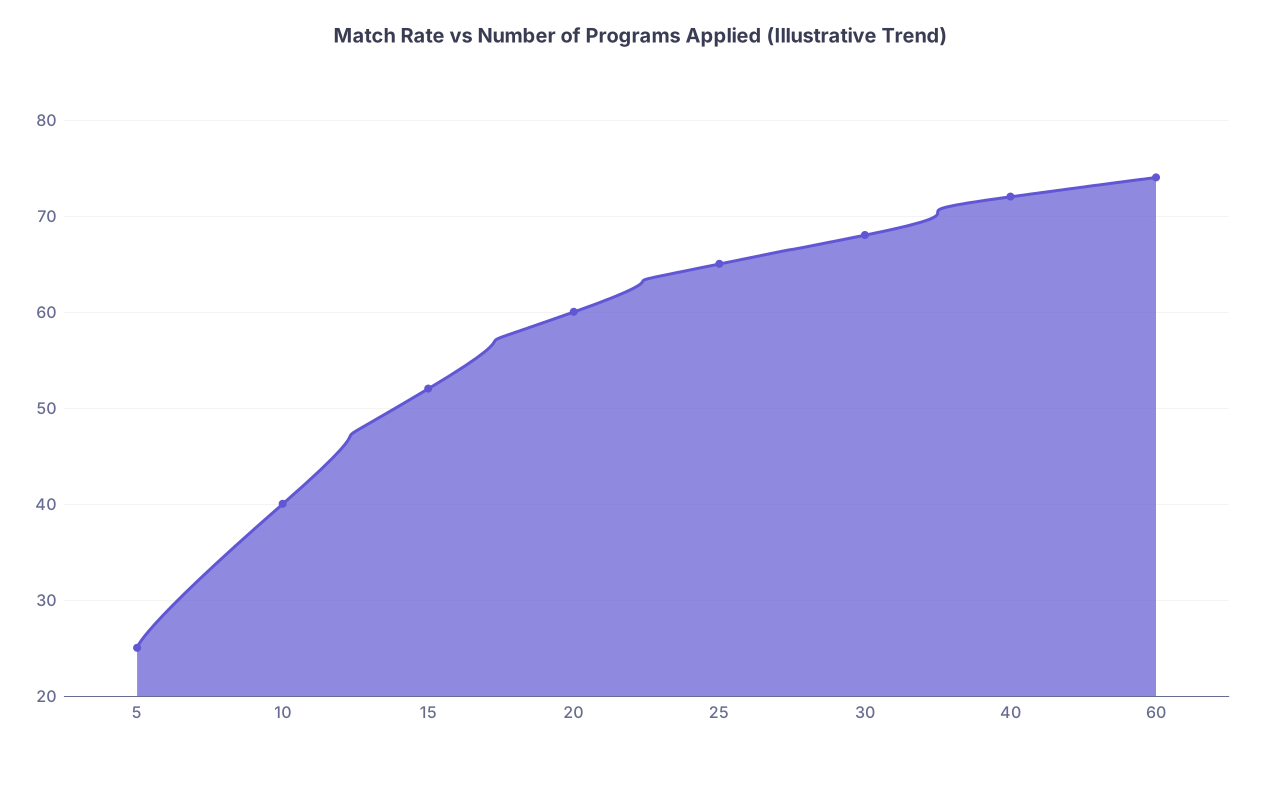
One of the most common questions in any IMG residency guide is how many programs to apply to. For ENT as an international medical graduate, the answer is usually “more than you think”—but not blindly “as many as possible.”
General ENT Numbers vs. IMG Reality
For US MD seniors in ENT, many advisors suggest:
- Around 40–60 applications for average candidates
- Fewer for very strong candidates, more for weaker profiles
For IMGs, you must adjust upward due to:
- Lower interview rates
- Higher competition
- More programs filtering based on citizenship/visa or school
ENT IMG Application Range by Profile
These are approximate ranges and should be tailored to your specific circumstances and budget.
Assuming there are ~120+ ENT programs (numbers may change slightly each year):
Highly Competitive IMG (Step 2 CK ≥255, US ENT research year, multiple ENT publications, US ENT LORs, no visa needed or J-1 OK)
- Recommended range: 80–110 programs
- Focus: Every IMG-friendly and neutral program, plus selected stretch academic centers where you have connections.
Moderately Competitive IMG (Step 2 CK 240–254, some US research—ideally ENT, 1–2 US ENT LORs, requires J-1)
- Recommended range: 100–130 programs
- Focus: All clearly IMG-friendly programs plus a long list of programs where IMGs are possible but not common.
Less Competitive IMG (Step 2 CK 230–239, limited ENT research, minimal USCE, requires visa, possibly older grad)
- Recommended range: 120+ programs (nearly all that accept IMGs/visas)
- May need to simultaneously develop a parallel plan:
- Dedicated US research year
- Preliminary surgery year or alternative specialty (e.g., internal medicine) as backup
These ranges highlight how many programs to apply to logically grows as your competitiveness decreases. More applications increase your probability of crossing filters and finding the programs that will seriously review your file.
Balancing Budget and Strategy
Application fees to ERAS rise quickly with volume. To make a rational decision:
- Set a maximum budget for ERAS + NRMP + interview travel/relocation.
- Prioritize ENT applications, but also consider if you need a backup specialty (e.g., internal medicine) and allocate slots accordingly.
- Ask:
- Would adding 20 more ENT programs meaningfully improve my odds?
- Am I better off applying to 10–20 backup specialty programs instead?
For most IMGs trying ENT, a parallel strategy (ENT + backup specialty) is safer than ENT-only unless your profile is exceptionally strong.
Step 4: Building a Targeted ENT Program List
Once you know approximately how many programs to apply to, you need a structured program selection strategy to decide which ones.

Create a Program Selection Spreadsheet
Build a spreadsheet (Excel, Google Sheets, Notion) with columns like:
- Program name
- Program type (academic, hybrid, community)
- Location (state, region)
- IMG presence (Yes/No; number of IMGs in recent years)
- Visa sponsorship (None / J-1 / H-1B)
- USMLE minimums or stated preferences
- ENT research emphasis (High/Moderate/Low)
- Your personal ties to the region (family, prior work, rotations)
- Prior contact (research, emails, conferences, meetings)
- Fit score (1–5 subjective rating)
- Tier (A: priority, B: secondary, C: reach/low yield)
This structure turns a confusing process into a systematic program selection strategy you can refine over time.
Prioritizing Programs: A, B, and C Tiers
Use your spreadsheet to rank programs:
Tier A: High Priority
- Clearly IMG-friendly (current IMG residents)
- Visa sponsorship compatible with your needs
- Reasonable competitiveness fit (not far above your profile)
- Geographic or personal preference match
Tier B: Realistic but Less Proven
- Limited data on IMGs, but no explicit exclusion
- Research or mentor connection gives you an edge
- Scores/experience are near or slightly below typical range
Tier C: Aspirational / Long-Shot
- Few or no IMGs historically
- Very prestigious or highly competitive
- You have a unique asset (major research, mentor connections, strong Step 2 CK) that might help
A healthy program selection strategy for an IMG in ENT might look like:
- 30–40% Tier A programs
- 40–50% Tier B programs
- 10–20% Tier C programs
Adjust these proportions based on your competitiveness and risk tolerance.
Considering Non-Academic Factors
Beyond match probability, you should consider:
- Geographic preferences – Are there places you cannot live long term?
- Climate and cost of living – Especially if relocating with family
- Program culture and resident happiness – Check social media, alumni, or personal contacts
- Operative volume and training focus – Balance between academic research and clinical hands-on experience
Remember: Your goal is not just to match anywhere, but to match somewhere you can thrive for 5 years.
Step 5: Advanced Tactics to Improve ENT Match Odds as an IMG
Program selection and “how many programs to apply to” are only part of the otolaryngology match equation. You can strategically influence how your application is perceived.
Leverage Connections and Mentors
- Ask US ENT mentors:
- Which programs are IMG-friendly?
- Can they email or call program directors on your behalf?
- Attend national ENT meetings and:
- Present research
- Introduce yourself to faculty from IMG-friendly programs
- Follow up by email with your CV and a brief, targeted message
Programs are far more likely to seriously review an IMG application when a trusted colleague advocates for you.
Tailor Your Application Materials
Personal Statement
- Emphasize your commitment to ENT specifically
- Highlight your experience in US healthcare and ENT research
- Address visa and IMG status briefly and confidently, not apologetically
ERAS Application
- Clearly categorize research: ENT vs non-ENT
- Quantify contributions (e.g., “drafted manuscript,” “collected data on 200 patients”)
- Use your experiences section to demonstrate:
- Adaptability to new systems
- Cultural competence
- Communication skills
Contacting Programs (Selectively)
Cold emailing every program is inefficient and risks being ignored. Instead:
- Prioritize:
- Programs where you have a real connection (mentor, research, geographic tie)
- Programs clearly IMG-friendly where you are on the border of their typical metrics
Emails should be:
- Short, respectful, professional
- Highlight:
- Mentor connection (if any)
- ENT research
- US clinical or research experience
- Never demand or expect an interview—simply express interest and attach your CV.
Parallel Planning and Risk Management
Because ENT is so competitive for international medical graduates, an intelligent program selection strategy often includes:
- Secondary specialty applications (e.g., internal medicine, general surgery, prelim surgery)
- Plan B timeline if you don’t match:
- Pursue a US ENT research fellowship/year
- Improve publications and network
- Consider reapplying next cycle with a much stronger profile
This is not a sign of weakness; it is smart risk management in a competitive field.
Putting It All Together: A Sample Strategy for an IMG
To make this concrete, consider a hypothetical applicant:
- IMG from a reputable international school
- Step 1: Pass; Step 2 CK: 245
- 1 year of US ENT research, 2 ENT publications
- 2 strong US ENT letters, 1 additional US faculty letter
- Requires J-1 visa
A realistic program selection strategy:
How many programs to apply to?
- Aim for 100–120 ENT programs
Program mix
- ~35–40 Tier A: Known IMG-friendly, J-1 sponsoring, mid-tier/hybrid/academic
- ~50–60 Tier B: Mixed history with IMGs, reasonable fit scores, mentors have weak–moderate ties
- ~15–20 Tier C: Highly prestigious academic centers where applicant’s research mentor is known
Backup plan
- 15–20 applications to a backup specialty (e.g., internal medicine)
- Continue ENT research during application year
- Prepare to repeat the ENT application if unmatched, now with more publications and possibly improved networking
This illustrates how an evidence-based, structured program selection strategy can significantly improve your chances as an IMG interested in otolaryngology.
FAQs: IMG Program Selection Strategy for ENT
1. As an IMG, is ENT realistic for me, or should I avoid it entirely?
ENT is challenging but not impossible for IMGs. You are more competitive if you have:
- High Step 2 CK
- US-based ENT research
- Strong US ENT letters
- Some US clinical or observership experience
- Reasonably recent graduation
If you lack most of these, consider building your profile first (research year, USCE) and/or planning for a parallel specialty.
2. How do I figure out which ENT programs are truly IMG-friendly?
Look for:
- Current residents who are IMGs on program websites or social media
- Programs that clearly state they accept IMGs and sponsor your visa type
- Guidance from US ENT mentors who know which programs have matched IMGs recently
- Patterns, not one-off cases—repeated IMGs across multiple classes is more meaningful than a single IMG 10 years ago
Combine this with your own spreadsheet to systematically track and score programs.
3. Should I email programs to tell them I applied?
Only selectively. Email:
- When you have a true connection (research mentor, prior rotation, geographic tie)
- After you’ve submitted ERAS
- With a short, professional message expressing specific interest and attaching your CV
Mass, generic emails to all programs rarely help and can sometimes hurt your perception.
4. If I don’t match ENT as an IMG, what is my best next step?
Common effective next steps include:
- US ENT research fellowship or dedicated research year, especially at a program that is IMG-friendly
- Improving your academic CV with more ENT publications and presentations
- Applying for a preliminary surgery or categorical position in another specialty, while continuing ENT involvement
- Working closely with ENT mentors to reassess your profile and refine your strategy for the next cycle
Reapplicants with significantly strengthened profiles and strong mentor advocacy can and do match ENT.
A thoughtful, structured program selection strategy—grounded in self-assessment, data, and realistic expectations—gives you the best possible chance to succeed as an international medical graduate pursuing an otolaryngology (ENT) residency.