Understanding the Unique Nature of Preliminary Medicine for IMGs
Preliminary Internal Medicine (prelim IM) is a one-year training program that often serves as:
- A required clinical year before advanced specialties (e.g., Neurology, Anesthesiology, Radiology, PM&R)
- A stepping stone to re-apply for categorical Internal Medicine or another specialty
- A way for international medical graduates (IMGs) to enter the US system, build experience, and strengthen future applications
This makes program selection strategy especially critical. You’re not just asking “Where can I get in?” but also:
- “Will this prelim year support my long-term goals?”
- “Will I survive and grow in this environment?”
- “Will I be competitive for my advanced or categorical goal afterwards?”
As an IMG, you face additional layers: visa sponsorship, limited US clinical experience, and sometimes geographic or family constraints. This IMG residency guide will walk you through a structured, evidence-based program selection strategy specifically tailored to the preliminary medicine year.
We will cover:
- How many programs to apply to as an IMG aiming for prelim IM
- Key filters and how to choose residency programs wisely
- How to build and prioritize your list
- Strategies for different IMG profiles (strong, average, at-risk)
- Common pitfalls and FAQs
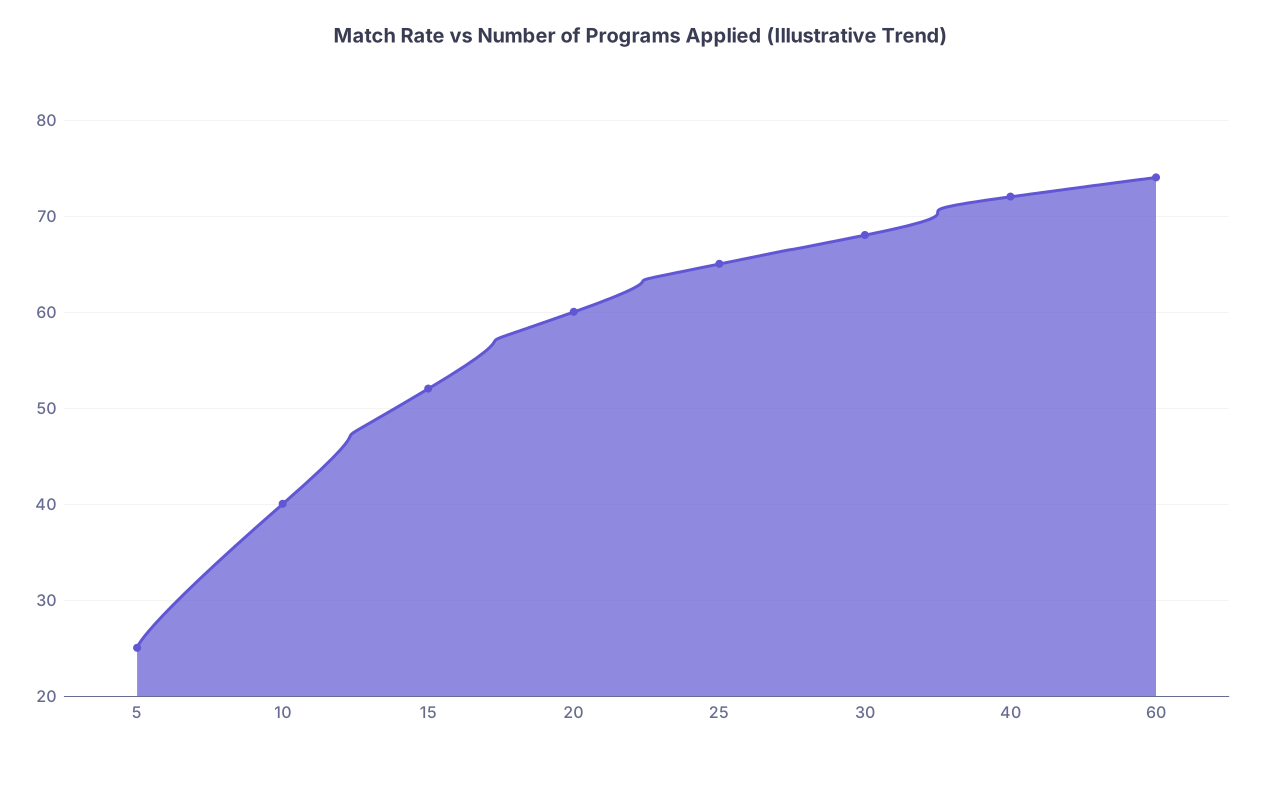
How Many Programs to Apply to for a Preliminary Medicine Year?
When IMGs ask how many programs to apply to for a prelim IM year, the answer depends on three main factors:
- Your overall competitiveness (scores, attempts, YOG, USCE, research)
- Your visa and geographic constraints
- Whether you also have an advanced position secured (pre-matched or via NRMP) or are applying to advanced programs simultaneously
Typical Application Ranges for IMGs in Prelim IM
While individual circumstances vary, the following ranges are a practical starting point:
Very strong IMG profile
- USMLE: 245+ both steps (or high OET/PLAB equivalent if relevant context), no failures
- YOG ≤ 3 years
- 2+ strong US clinical experiences in IM or related fields
- At least 1+ US letter from IM faculty or program director
- Visa: Either green card/citizen or broad J-1/CPT eligibility
- Recommended prelim IM applications: ~25–40 programs
- If also applying advanced specialties: total (prelim + advanced) usually 50–70 applications
Average IMG applicant (most IMGs fall here)
- USMLE: 225–245, no more than one attempt
- YOG 3–7 years
- Some US clinical experience (observerships, externships, research)
- Mixed letters (home + US)
- Needs J-1 visa sponsorship
- Recommended prelim IM applications: ~40–60 programs
- If also applying to advanced programs: total often 70–100+ depending on specialty competitiveness
At-risk IMG profile
- USMLE: <225, or multiple attempts
- YOG >7–10 years
- Minimal USCE; mostly home-country experience
- Requires visa and limited geographic flexibility
- Recommended prelim IM applications: 60–80+ programs
- If also applying to advanced programs, total can exceed 100 applications
These are not rigid rules but practical ranges. Your program selection strategy should balance:
- Risk management (applying widely for safety)
- Financial reality (ERAS fees increase with every additional program)
- Time investment (customizing applications, interviews, travel or virtual prep)
How Many Programs Is “Too Few” or “Too Many”?
Risky low numbers for most IMGs:
- <25 prelim IM programs, unless you are extremely strong, flexible on geography, and/or already matched to an advanced program via SOAP/early sign.
Diminishing returns for many IMGs:
90 total programs (prelim + advanced) may start yielding fewer incremental interviews per dollar spent—unless you have major red flags and broad geographic flexibility.
A smarter approach than simply asking how many programs to apply is to design a tiered list (reach, target, and safety) and allocate your applications proportionally across these tiers.
Core Filters: How to Choose Residency Programs for Prelim Medicine
Before you build an application list, you must define what matters for you in a prelim IM year. The main filters for IMGs are:
- Visa and IMG-friendliness
- Program type and structure (Prelim-only vs linked advanced, size, call schedule)
- Geographic and lifestyle factors
- Academic vs community vs hybrid environment
- Outcomes and support for your long-term goals
1. Visa and IMG-Friendliness
For international medical graduates, visa policy is often a non-negotiable filter. Start here.
Key questions to check in FREIDA / program websites:
- Do they sponsor J-1 visas? H-1B visas?
- Are IMGs currently or recently part of the resident workforce?
- Do they explicitly say “US graduates only” or “We do not sponsor visas”?
Practical strategy:
- Early in your search, generate a long list of prelim IM programs from:
- FREIDA (filter for Preliminary Internal Medicine)
- NRMP “Participating Programs” list
- Institutional GME pages
- Exclude programs that:
- Do not sponsor any visas (if you need one)
- Explicitly say they do not consider IMGs
- Mark “IMG-friendly” programs by:
- Counting current/pre-recent IMG residents
- Checking resident bios and match lists (do they have Caribbean, South Asian, Middle Eastern, Latin American graduates?)
- Looking for program descriptions that highlight diversity or specific mention of IMGs
This first pass can rapidly reduce 150+ possible prelim programs to 80–100 serious contenders.

2. Program Type and Structure
Not all preliminary medicine years are the same. Understanding differences is crucial.
Types of prelim IM programs:
Standalone Preliminary Medicine
- 1-year program; graduates are expected to move on to advanced positions or reapply.
- Often used by applicants going into Neurology, PM&R, Radiology, Ophthalmology, etc.
- Some programs have a mixture of “designated prelims” (tied to an advanced program) and “undesignated” prelims (open).
Prelim linked to a specific advanced specialty within the same institution
- Example: A Neurology program includes a linked IM prelim year.
- If you match into the linked advanced program, you usually automatically get the prelim slot.
- Standalone IMGs applying only for prelim IM may have limited or no access to these seats.
Selection strategy implications:
If you already have an advanced position:
- Prioritize prelim programs in the same region and hospital network, if possible.
- Apply mostly to programs with a stable track record of supporting advanced residents.
If you are still applying for advanced programs:
- Apply to a mix of:
- Standalone prelim IM programs
- Categorical IM (as back-up)
- Advanced specialty programs (your ultimate goal)
- Consider whether the prelim program has:
- Mentors in your target specialty
- Good exposure to your future field (e.g., Neurology consults if you’re aiming for Neuro)
- Apply to a mix of:
3. Geographic and Lifestyle Considerations
Geography can impact both match chances and your quality of life.
Reality for IMGs in prelim IM:
- You are often coming into the system for the first time.
- The prelim year is intense and relatively short; burnout risk is real.
- Some areas are more saturated and competitive (Northeast major cities, California, certain academic hubs).
Practical guidance:
Be flexible geographically when possible, especially if:
- You have red flags (low scores, attempts, older YOG).
- You require a visa and are an average applicant.
Consider expanding beyond:
- Manhattan, Boston/Cambridge, the Bay Area, Los Angeles, Chicago core.
Actively include:
- Midwest, South, and smaller-city or regional programs
- University-affiliated community hospitals (these can be excellent for IMGs)
Lifestyle aspects that matter during a prelim year:
- Cost of living vs PGY1 salary
- Public transportation vs driving requirements
- Family support, schools, or spouse job prospects
- Weather and personal preferences, especially for mental health during a high-stress year
4. Academic vs Community vs Hybrid Settings
Your choice here should match your long-term goals.
Academic-heavy prelim programs:
- Pros:
- Strong research environment
- Many subspecialty services and exposure
- Good for those aiming for competitive advanced specialties or future fellowships
- Cons:
- Often more competitive, fewer IMG spots
- Potentially more service-heavy and demanding schedules
- May prioritize categorical residents over prelims
Community-based prelim programs:
- Pros:
- Often more IMG-friendly
- May provide more hands-on procedural experience
- Closer mentorship with attending physicians in smaller teams
- Cons:
- Less research infrastructure
- Fewer subspecialty clinics and academic conferences
- May not carry the same “brand” value for future applications
Hybrid (university-affiliated community) programs:
- Often the best compromise for IMGs:
- Reasonable chances of matching
- Access to academic resources from affiliated medical school
- Opportunities for US letters from academic faculty
Align your program selection strategy with your end goals:
- If reapplying to categorical IM or Cardiology fellowship in the future → lean towards programs with strong IM departments, good fellowship matches.
- If going into Neurology, PM&R, Radiology, Anesthesia → focus on programs with active services in those fields and supportive leadership.
5. Outcomes and Support for Future Plans
A prelim year is a bridge. You must ask: What happens after this one year?
Important questions to research or ask during interviews:
Do prelim residents:
- Successfully match into advanced or categorical programs the next year?
- Receive strong letters from faculty?
- Get protected time or flexibility to interview for their next positions?
Does the program:
- Allow you to attend interviews without major penalties?
- Have a culture where prelims are valued, not exploited?
- Have any internal opportunities to transition to categorical spots if available?
Programs that can articulate a track record of helping prelims advance are usually better choices for IMGs.
Building, Tuning, and Prioritizing Your Program List
Once you understand your filters, it’s time to build a structured, tiered list. This is the core of an effective program selection strategy.
Step 1: Generate the Long List
Use:
- FREIDA: Filter for “Internal Medicine — Preliminary”
- NRMP website: Check prior year participating prelim IM programs
- Program websites and GME lists: Confirm prelim IM positions and visa policies
For each program, gather:
- Location and setting (city, state, academic vs community)
- Visa policy (J-1/H-1B/none)
- IMG representation among current residents
- Minimum score requirements and attempts policies (if stated)
- Size of prelim class and how many are undisignated vs designated
Create a spreadsheet with columns for each factor.

Step 2: Categorize into Tiers (Reach, Target, Safety)
Use your assessed competitiveness to segment your list:
Reach programs
- More competitive locations (big cities, highly-ranked centers)
- Stricter score cut-offs
- Fewer IMGs historically
- Strong research or academic prestige
Target programs
- Historically take IMGs
- Scores and YOG criteria roughly match your profile
- Balanced workload, some academic features
Safety programs
- Clearly IMG-friendly with multiple IMGs in current residents
- Located in less competitive areas (Midwest, some Southern or smaller cities)
- More flexible on scores or YOG, or less explicit cut-offs
Approximate allocation (for average IMG):
- 20–30% Reach
- 40–50% Target
- 30–40% Safety
For example, if you plan to apply to 50 prelim IM programs:
- 10–15 Reach
- 20–25 Target
- 15–20 Safety
Step 3: Align Prelim List with Advanced/Categorical Strategy
If you’re also applying to:
Advanced specialties (e.g., Neurology, Radiology, PM&R):
- Use a parallel tiered approach for those specialties.
- Ensure some prelim programs are in the same geographic regions as your intended advanced programs to support future networking and logistics.
Categorical Internal Medicine as backup:
- Consider overlapping institutions where you can apply to both prelim and categorical tracks.
- However, be realistic: some programs prioritize their categorical lists and may not rank prelim-only IMGs highly.
Step 4: Fine-Tune Based on Personal Priorities
You might adjust your list to:
Increase safety programs if:
- You have multiple attempts, low scores, or older YOG.
- You need visa sponsorship and have limited geographic flexibility.
Add more reach programs if:
- You are strong academically and have robust USCE and US letters.
- You’re aiming for highly competitive future paths (e.g., Radiology in top institutions).
Drop programs that:
- Have toxic culture red flags (e.g., very high attrition, poor support for prelims).
- Do not allow time off for interviews or have extremely punitive policies.
Practical Examples of Program Selection Strategies for Different IMG Profiles
To make this IMG residency guide more concrete, here are sample strategies.
Case 1: Strong IMG Aiming for Neurology
Profile:
- YOG: 2 years ago
- USMLE: 250/255, both first attempt
- 3 months USCE (including Neurology elective and IM sub-I)
- Needs J-1 visa
- Applying to Neurology (advanced) + Prelim IM
Strategy:
- Neurology applications: 30–40 programs (mix of academic and strong community)
- Prelim IM applications: 30–35 programs
- ~10 reach (top programs in Northeast, Midwest major centers)
- ~15 target (IMG-friendly university-affiliated community)
- ~10 safety (smaller cities in Midwest/South with historical IMGs)
Rationale:
- Competitive enough to keep total applications in the 60–70 range.
- Balanced risk—enough safety prelims to secure an intern year even if Neurology match is uncertain.
Case 2: Average IMG Reapplying to Categorical IM Later
Profile:
- YOG: 5 years ago
- USMLE: 232/238, one attempt on Step 1
- 1 month USCE (observership), good home-country IM experience
- Needs J-1 visa
- No advanced specialty yet; prelim year to strengthen profile and reapply to categorical IM
Strategy:
Focus on Prelim IM applications: 45–60 programs
- 10–12 reach (bigger cities, some academic centers)
- 20–25 target (IMG-friendly mid-tier programs)
- 15–20 safety (smaller, community-based institutions with multiple IMGs)
Also apply to:
- 15–20 categorical IM programs (including some at same institutions as prelim list)
Rationale:
- Larger prelim pool improves odds of having at least one position.
- Some categorical applications as an upside opportunity.
- Choosing prelim programs that:
- Offer strong mentorship and letter-writing support.
- Have internal pathways or history of converting prelims to categorical when positions open.
Case 3: At-Risk IMG with Older YOG
Profile:
- YOG: 10 years ago
- USMLE: 219/224, two attempts on Step 1
- Extensive home-country IM practice, minimal USCE
- Requires visa, but flexible on geography
- Will re-apply for IM or another field after prelim year
Strategy:
Prelim IM applications: 70–80 programs
- 10 reach (IMG-friendly but somewhat competitive locations)
- 25–30 target (documented history of accepting IMGs with older YOG)
- 35–40 safety (smaller markets, strong IMG presence)
Limited categorical IM (optional) applications: 10–15 as a stretch.
Rationale:
- Broad, safety-heavy strategy due to multiple red flags.
- Geographic flexibility is used as a major advantage.
- Focus on programs that are transparent about welcoming non-traditional applicants and foreign-trained physicians.
Common Pitfalls and How to Avoid Them
Over-focusing on prestige
- Applying mostly to high-ranked academic programs with minimal evidence of IMG-friendliness can lead to very few interviews.
- Solution: Keep reach programs, but anchor your list in realistic target and safety options.
Neglecting visa and IMG-friendliness filters
- Many IMGs waste money applying to programs that will never rank them due to visa or policy constraints.
- Solution: Rigorously screen program policies and current residents before applying.
Ignoring the role of prelim culture
- Some programs treat prelims as expendable service providers with minimal mentorship.
- Solution: During interviews, ask current prelims about:
- Faculty support
- Ability to attend interviews
- Fairness of workload compared to categoricals
No alignment with long-term goals
- Choosing a prelim IM program that does not help you towards your target specialty can make future applications harder.
- Solution: Select programs with:
- Exposure to your future field
- Faculty who can write specialty-relevant letters
- A record of sending prelims into similar paths
Applying too narrowly (geographically or program type)
- Limiting yourself to one or two states or mostly academic centers reduces your chances significantly.
- Solution: Prioritize matching over ideal location for the prelim year; career and future mobility come later.
Frequently Asked Questions (FAQ)
1. Should I apply to both preliminary and categorical Internal Medicine programs as an IMG?
Yes, many IMGs do. Categorical IM offers a full three-year pathway, while prelim IM is only one year. If your ultimate goal is to practice Internal Medicine in the US, categorical should be your primary track, with prelim IM as a potential backup. If your target specialty is advanced (e.g., Neurology, Anesthesia), then prelim IM is often your main focus, with categorical IM as an optional safety net.
2. Is it harder to match into a preliminary medicine year than categorical IM as an IMG?
It depends on the institution and region. Some competitive academic centers have prelim positions closely linked to advanced specialties and may prioritize US graduates. However, many community and hybrid programs use prelim residents extensively and may be quite IMG-friendly. Overall, prelim IM can be slightly more accessible in certain regions, but it is not automatically “easy.” A careful program selection strategy and broad, realistic list are still essential.
3. Can I transition from a prelim IM position to a categorical IM spot in the same program?
Sometimes, but it is not guaranteed. A few programs occasionally convert prelims to categorical if a position opens (e.g., a resident leaves or transfers). During interviews, you should ask:
- How often does this happen?
- What is the process?
- Are prelims considered fairly for these openings?
Never assume that a prelim spot will automatically convert to categorical. Plan as if you will need to reapply.
4. How many programs should I apply to if my budget is very limited?
If you must limit the number of applications due to cost, focus on maximum efficiency:
- Apply primarily to IMG-friendly, visa-sponsoring programs in less competitive regions.
- Reduce reach programs, prioritize target and safety programs.
- For many budget-limited IMGs, 30–40 highly selected prelim IM programs can still be reasonable—if chosen wisely.
- Use every free resource to identify true IMG-friendly programs (alumni networks, forums, mentorship groups, program rosters).
If possible, consider setting aside slightly more funds for applications; the prelim year is a pivotal investment in your career trajectory.
A thoughtful, data-driven program selection strategy will significantly improve your chances as an international medical graduate seeking a preliminary medicine year. Treat this process as both a risk-management exercise and a long-term career decision, and build a list that is broad enough to match yet targeted enough to truly fit your goals.