Understanding the Unique Landscape of Medicine-Psychiatry for IMGs
Medicine-Psychiatry (Med-Psych) is a small, highly specialized niche that combines Internal Medicine and Psychiatry into a single five-year training pathway. As an international medical graduate, you face additional layers of complexity: visa needs, clinical experience expectations, and potential bias against IMGs in some programs. A thoughtful, structured program selection strategy is not optional—it’s essential.
This IMG residency guide will focus specifically on:
- How to analyze the Med-Psych landscape as an IMG
- How to choose residency programs that truly fit your profile and goals
- How many programs to apply to in this combined specialty
- Concrete steps and tools to build a realistic, targeted list
While examples will be specific to medicine psychiatry combined training, the framework applies broadly to dual and categorical programs.
Step 1: Know the Medicine-Psychiatry Training Pathway and Its Implications
Before any program selection strategy makes sense, you must clearly understand what Med-Psych is and how it differs from applying categorically.
What is Medicine-Psychiatry?
Medicine-Psychiatry is a five-year, ACGME-accredited combined residency that leads to board eligibility in both Internal Medicine and Psychiatry. Graduates can:
- Practice as hospitalists comfortable managing complex psychiatric comorbidity
- Work in integrated care, consultation-liaison, or collaborative care models
- Work in academic medicine, especially in psychosomatic medicine and primary care psychiatry
- Pursue fellowships in IM (e.g., cardiology, ID) or Psychiatry (e.g., CL, addiction), depending on program structure and your career trajectory
For an IMG, the long-term stability and flexibility of dual board eligibility can be a significant advantage—but it also means:
- Fewer total positions
- Smaller number of programs (often fewer than 20 nationwide)
- Highly variable experience with and openness to international medical graduates
Why Program Selection Matters More in Med-Psych
Because medicine psychiatry combined training is limited in size:
- You cannot use a “mass apply to 100+ programs” approach strictly within Med-Psych—there are not that many programs.
- Every application is more visible; programs often know their applicant pool well.
- “Fit” and alignment with the program’s mission matter even more than in large categorical tracks.
Your program selection strategy should therefore be layered:
- Core Target: Med-Psych programs that genuinely fit you
- Categorical Backup: Internal Medicine (and/or Psychiatry) programs
- Stretch & Safety Choices: Based on your specific profile, metrics, and visa status
Step 2: Honestly Assess Your Profile as an IMG
Before you can decide how many programs to apply to or which ones, you must understand your own strengths and limitations. This will define your realistic range of options.
Key Components of an IMG Profile
Exam Performance
- USMLE Step 1: Pass/Fail (but programs still see score if taken before switch)
- USMLE Step 2 CK: Critical for IMGs
- OET/IELTS (if applicable)
Time Since Graduation (YOG)
- Many programs prefer ≤5–7 years since graduation
- Combined programs may be slightly more flexible if you bring strong assets (e.g., significant integrated care experience), but this is variable
Clinical Experience in the US
- US clinical experience (USCE) is often crucial for IMGs
- Rotations in Internal Medicine, Psychiatry, or integrated behavioral health are especially valuable for Med-Psych
- Letters of recommendation from US faculty in IM and/or Psychiatry are highly influential
Research and Academic Involvement
- Research in consultation-liaison psychiatry, primary care psychiatry, or chronic disease with psychiatric comorbidity can be a plus
- Publications, posters, and abstracts signal academic interest—many Med-Psych programs are university-based and research-oriented
Visa Status and Needs
- Some programs sponsor J-1 only, some J-1 and H1B, some do not sponsor visas at all
- As an IMG, your program selection strategy must filter for visa policies early in the process
Language, Communication, and Cultural Competence
- Med-Psych residents work closely with vulnerable populations; communication skills matter
- Strong personal statement and interview performance are essential
Self-Sorting: Competitive, Moderate, or High-Risk Profile
Create a simple classification to guide how many programs to apply to and how broad you must go:
More Competitive IMG Profile
- Step 2 CK ≥ 245–250
- ≤3–4 years since graduation
- Multiple strong USCE experiences in IM and Psychiatry
- 2–3 US letters (ideally at least one Psychiatry, one Internal Medicine)
- Some research or scholarly activity
Moderate IMG Profile
- Step 2 CK around 230–245
- ≤5–7 years since graduation
- Some USCE, at least one in a core specialty
- 2+ letters with at least one US-based
- Limited research or local audits/QI projects
Higher-Risk IMG Profile
- Step 2 CK < 230 or multiple attempts
7 years since graduation
- Minimal or no USCE
- Limited or non-US letters of recommendation
- Significant CV gaps or career interruptions
Your category is not a verdict; it’s a planning tool. Be honest with yourself—overestimating your competitiveness leads to under-applying and missing the Match.

Step 3: Understanding How Many Programs to Apply to (Realistically) as an IMG in Med-Psych
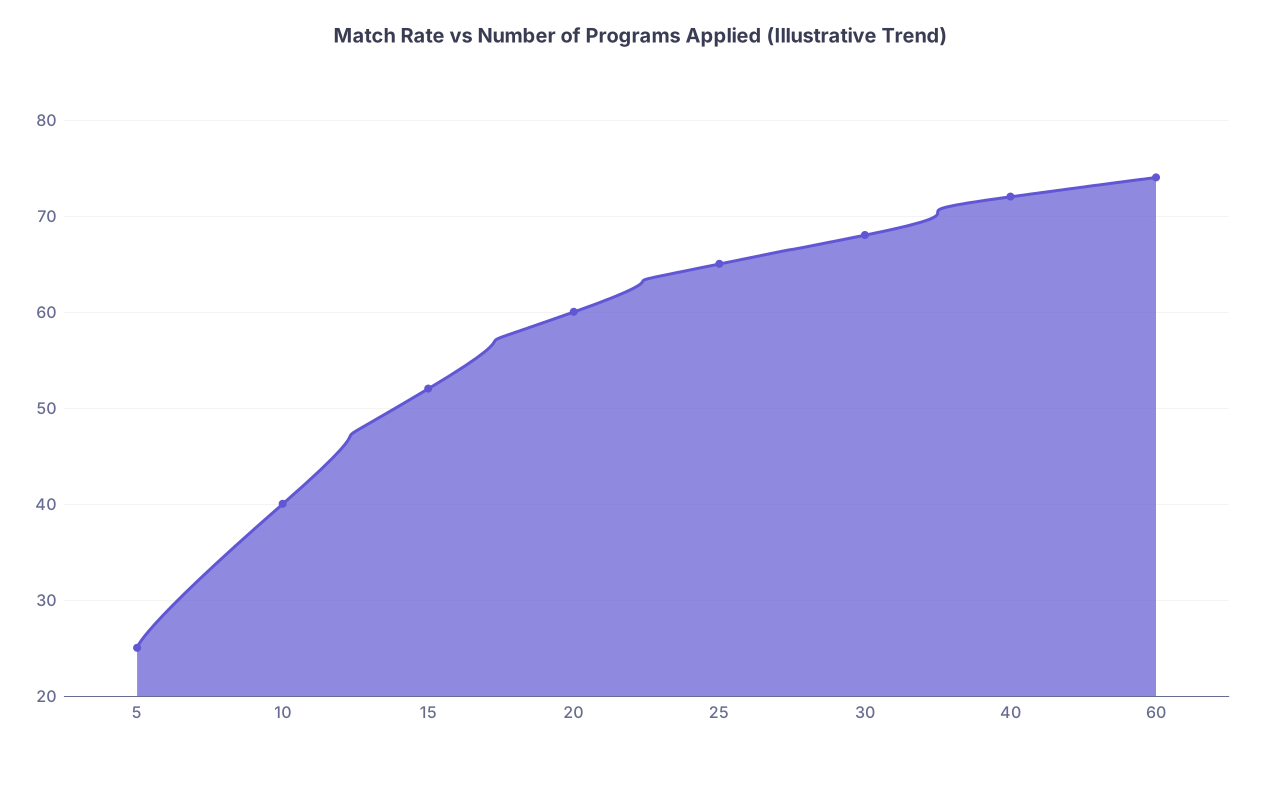
A central question for many IMGs is: how many programs to apply to? For Med-Psych, the answer requires nuance because the pool is small.
The Structural Reality: Very Few Med-Psych Programs
At any given cycle, there are typically fewer than 20 medicine psychiatry combined programs in the US, with total positions often under 100 nationwide. This means:
- You should consider applying to almost all Med-Psych programs you are eligible for, unless a program is clearly incompatible (e.g., no visa sponsorship, strong US grad preference stated).
- Unlike large specialties like categorical Internal Medicine, your upper limit is set more by program availability than by application fatigue.
Recommended Application Ranges for Med-Psych (Core List)
Adjust these estimates based on your profile category:
More Competitive IMG
- Core Med-Psych applications: 10–15 programs (i.e., nearly all available)
- You can be slightly more selective with geography but still broadly inclusive.
Moderate IMG
- Core Med-Psych applications: 12–18 programs (essentially all that consider IMGs or sponsor visas)
- Avoid excluding programs solely because they are highly reputed; apply widely if you meet basic criteria.
Higher-Risk IMG
- Core Med-Psych applications: All Med-Psych programs that accept or have historically interviewed IMGs
- However, you should not rely solely on Med-Psych; stronger backup strategy is critical.
The Essential Role of Categorical Backup
Because Med-Psych positions are limited and competitive, your IMG residency guide should always include a robust backup plan.
Common backup combinations:
- Med-Psych + Categorical Internal Medicine
- Good if you enjoy hospitalist medicine, subspecialty options, and integrated care
- Med-Psych + Categorical Psychiatry
- Good if your primary identity is psychiatric care and you want IM background for context
- Med-Psych + Both (IM and Psych)
- Strongest hedge, especially for moderate or higher-risk profiles
Approximate total number of applications (Med-Psych + categorical) often recommended for IMGs:
More Competitive IMG
- Total: 60–80 programs
- Example: 12 Med-Psych + 30–40 IM + 15–25 Psych
Moderate IMG
- Total: 80–120 programs
- Example: 15 Med-Psych + 40–60 IM + 25–40 Psych
Higher-Risk IMG
- Total: 120–160+ programs
- Example: 15 Med-Psych + 60–90 IM + 40–60 Psych
These numbers are not strict rules but reasonable ranges based on common IMG match data and the small size of medicine psychiatry combined programs. Your program selection strategy should reflect your budget (ERAS fees, time, and energy) while avoiding under-application.
Step 4: Building a Data-Driven Program Selection Strategy
Once you know your personal profile and approximate range of applications, you need a systematic approach to identify and prioritize individual programs.
Step 4.1: Create a Program Spreadsheet
Set up a spreadsheet with columns such as:
- Program name
- Institution and city/state
- Program type (Med-Psych, IM, Psych)
- IMG-friendliness (based on historical data, websites, word of mouth)
- Visa sponsorship (J-1, H1B, none)
- USMLE requirements (cut-offs, first-attempt policies)
- Time since graduation preference
- Number of positions
- Research emphasis (low/medium/high)
- Rotations in integrated care, CL psychiatry, addiction, etc.
- Your subjective interest (1–5 scale)
- Notes (e.g., alumni from your country, faculty interests, etc.)
This becomes the backbone of your program selection strategy and lets you compare programs objectively.
Step 4.2: Identify Med-Psych Programs and Their Profile
Start with official sources:
- ACGME list of combined Internal Medicine-Psychiatry programs
- Individual program websites
- FREIDA, residency explorers, and other databases
For each Med-Psych program, investigate:
IMG Presence
- Do current or recent residents include international medical graduates?
- Program websites sometimes list resident bios and medical schools.
Visa and Eligibility
- Explicit statements: “We sponsor J-1 only,” “No visa sponsorship,” or “H1B considered.”
- If unclear, you can email the program, but do this selectively and professionally.
Structure and Emphasis
- Strong emphasis on: CL psychiatry, primary care, inpatient medicine, substance use, integrated behavioral health?
- Does this align with your career goals (e.g., academic vs community practice)?
Research and Academic Environment
- Affiliated with a major academic center?
- Are there Med-Psych faculty with published research in your interest areas?
Step 4.3: Categorize Programs by Competitiveness and Fit
Within your spreadsheet, mark each program by:
- Competitiveness level (estimated): High / Medium / More Open
- Based on reputation, number of positions, and IMG history
- Objective fit:
- Meets your visa needs (Y/N)
- Accepts IMGs historically (Y/N)
- Compatible with your YOG and exam profile (Y/N)
- Subjective fit:
- Aligns with your interest in integrated care, CL psychiatry, addiction, or severe mental illness with comorbid medical disease
- Geography acceptable (consider climate, cost of living, social support, etc.)
Rank them as:
- Tier 1 (High-Priority Target): Strong fit, realistic based on your profile
- Tier 2 (Moderate Fit / Stretch): Good programs, possibly more competitive, but still worth applying
- Tier 3 (Lower Fit / Safety Categorical): Where you might be somewhat overqualified or less excited, but they offer a safety net
Your goal: A balanced distribution of Tier 1, 2, and 3 programs across Med-Psych and categorical lists.

Step 5: Tailoring Your Application to Medicine-Psychiatry Programs as an IMG
Program selection is not just choosing where to apply; it’s also deciding how to present yourself strategically to those programs.
Align Your Story with the Med-Psych Mission
Most Med-Psych programs look for residents who truly understand and want the dual discipline combination. In your personal statement and experiences, highlight:
- Clinical scenarios where medical and psychiatric complexity overlapped (e.g., delirium, chronic pain with depression, diabetes with severe mental illness).
- Any exposure to integrated care models, liaison work, or community mental health linked to chronic medical disease.
- Long-term career vision: how you will use dual training (e.g., academic CL psychiatrist with IM background, medical director for integrated behavioral health in primary care, etc.).
Avoid generic statements like “I love both medicine and psychiatry.” Provide concrete examples from your rotations and patient encounters.
Letters of Recommendation Strategy
For Med-Psych specifically:
- Aim for at least one strong Internal Medicine letter and one strong Psychiatry letter.
- If possible, obtain a letter from someone who has seen you work at the interface (e.g., CL psychiatry attending, inpatient medicine team managing psychiatric comorbidities).
- As an IMG, US-based letters carry more weight, particularly from academic faculty familiar with US training standards.
For your categorical backup programs, you may use a slightly different mix (e.g., more IM letters for an IM-leaning backup list), but most letters can be reused if they are strong and relevant.
Adapting Your Program Selection Strategy Based on Application Strength
If, during the season, you observe that:
You receive very few interview invitations early (especially from Med-Psych programs), consider:
- Expanding your categorical applications (if deadlines allow)
- Reviewing your ERAS filters (did you underestimate exam cut-offs or visa policies?)
You receive many interviews from Med-Psych:
- You might not need to attend every categorical interview, but be cautious about canceling until you are certain about your risk tolerance.
As an IMG, flexibility during the season is part of an effective program selection strategy.
Step 6: Practical Tips and Common Pitfalls for IMGs Applying in Med-Psych
Practical Tips
Start Early (12–18 Months Ahead)
- Arrange US clinical experience in both IM and Psychiatry if possible.
- Plan your Step 2 CK timing to have scores ready before ERAS opens.
Use an IMG Residency Guide Mindset
- Treat your process like a structured project: clear timeline, milestones, feedback loops.
Network Intentionally
- Attend virtual open houses for Med-Psych programs.
- Connect with current or former Med-Psych residents (especially IMGs) through alumni networks or professional associations.
- Ask focused questions about program culture, IMG support, and integrated care exposure.
Be Realistic but Ambitious
- Apply to nearly all Med-Psych programs that are realistically accessible.
- But also build a sufficiently large and diverse categorical backup list.
Document Integrated Care Experiences Explicitly
- In your CV and ERAS experiences, label roles clearly: “Internal Medicine rotation with CL Psychiatry,” “Primary care clinic with embedded behavioral health,” etc.
- Programs must see that your interest in medicine psychiatry combined training is grounded in experience, not just theory.
Common Pitfalls to Avoid
Applying to Too Few Programs
- Especially as an IMG, underestimating how many programs to apply to is a major risk.
- Relying on only 5–10 Med-Psych programs without strong categorical backup is dangerous, even for competitive candidates.
Ignoring Visa and IMG Policies
- Applying broadly without checking whether programs sponsor visas or accept IMGs wastes time and money.
- Filter first for eligibility, then for fit.
Generic Personal Statement
- A statement that could apply equally to pure IM, pure Psych, or any specialty undermines your credibility.
- Tailor a specific Med-Psych personal statement; you can create separate versions for categorical programs if needed.
Over-Focusing on Reputation Alone
- Many excellent Med-Psych experiences exist in smaller or less famous institutions.
- As an IMG, prioritize fit, support, and visa policy over prestige alone.
Not Having a Clear Backup Strategy
- Even if Med-Psych is your dream, you must be prepared to train in IM or Psychiatry and shape an integrated career afterward.
- Many outstanding integrated care leaders did not complete combined programs but built integrated careers through fellowships and job choices.
FAQs: Program Selection Strategy for IMGs in Medicine-Psychiatry
1. As an international medical graduate, is it realistic to match into a Medicine-Psychiatry program?
Yes, it is realistic, but it is competitive and requires strategic planning. Some Med-Psych programs have a history of accepting IMGs; others rarely do. Focus on:
- Programs with visible IMG residents or alumni
- Institutions that clearly state support for J-1/H1B sponsorship
- Strong US clinical experience in IM and Psychiatry
- A compelling narrative about why medicine psychiatry combined training fits your long-term goals
Always pair your Med-Psych applications with a robust categorical backup list.
2. How many Medicine-Psychiatry programs should I apply to specifically as an IMG?
Because there are relatively few Med-Psych programs overall, most IMGs should apply to almost all programs where they are eligible. In practice, this usually means:
- Around 10–18 Med-Psych programs (depending on how many exist in that cycle and your visa constraints)
- The bigger strategic decision is how many categorical Internal Medicine and Psychiatry programs to add to reach a safe total number of applications for your risk category.
3. Should I prioritize Internal Medicine or Psychiatry for my backup if my dream is Med-Psych?
It depends on your long-term vision:
- If you see yourself as primarily a physician of complex medical illness with psychiatric comorbidity (e.g., hospitalist, CL liaison), Internal Medicine backup might be best.
- If your passion is severe mental illness with medical complexity, addiction, or community psychiatry, Psychiatry backup can be more aligned.
- Many IMGs choose to apply to both IM and Psychiatry to maximize match probability and then design an integrated career through fellowships (e.g., CL psychiatry) or practice settings.
4. What if I do not match into Med-Psych—can I still build an integrated Medicine-Psychiatry career?
Absolutely. While Med-Psych training is a direct route, you can still become an expert in integrated care by:
- Completing a categorical Internal Medicine or Psychiatry residency
- Pursuing Consultation-Liaison Psychiatry, Addiction, or other relevant fellowships
- Working in hospital medicine with strong CL collaboration, primary care clinics with embedded behavioral health, or academic integrated care systems
- Engaging in research and QI projects at the intersection of medical and psychiatric illness
Your program selection strategy for this cycle should include both an aspirational Med-Psych pathway and a realistic categorical pathway that still aligns with an integrated-care career.
A thoughtful, data-driven program selection strategy—built on honest self-assessment, broad but targeted applications, and a clear understanding of the Med-Psych landscape—will substantially improve your chances as an international medical graduate seeking medicine psychiatry combined training.