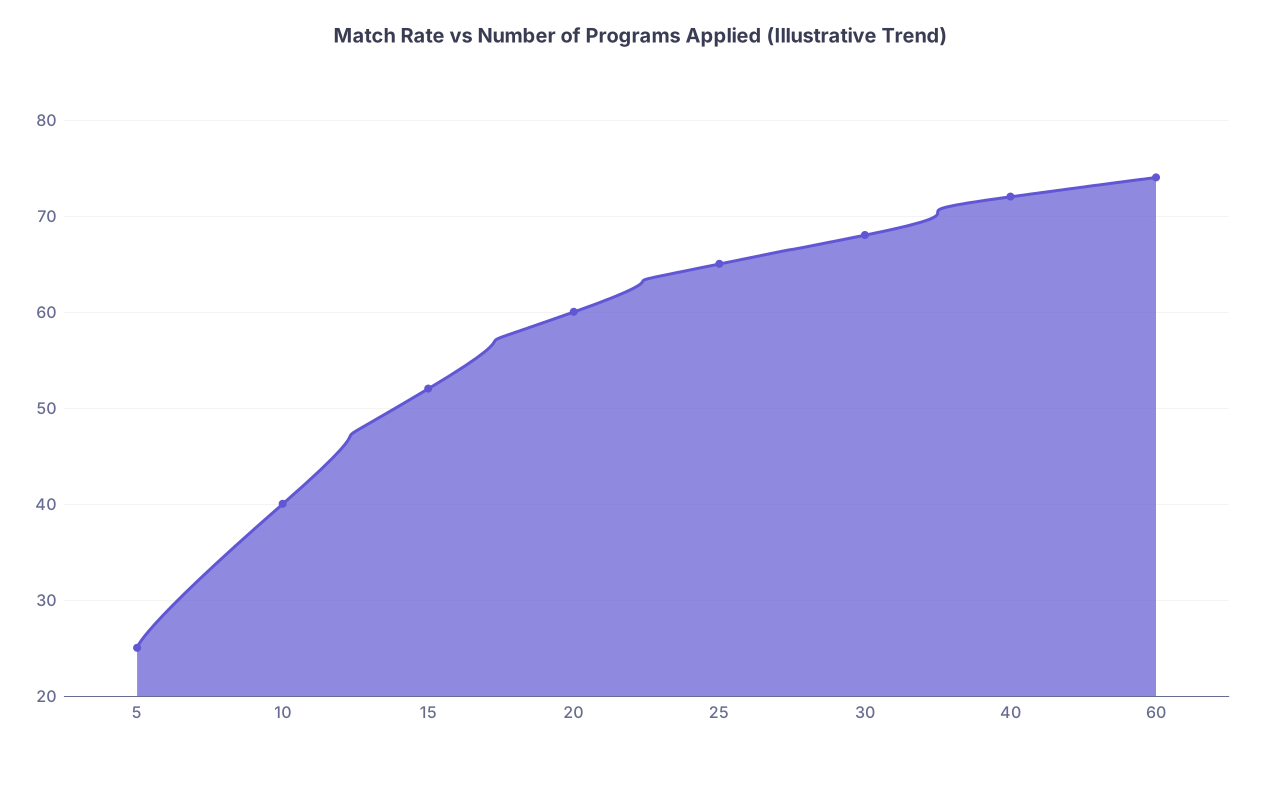
Understanding the Med-Peds Landscape as an IMG
Medicine-Pediatrics (Med-Peds) is a competitive but achievable specialty for international medical graduates. A strong program selection strategy is essential—not just to match, but to match into a program where you can thrive.
As an IMG, you face additional layers of complexity:
- Visa sponsorship requirements (J-1 vs H-1B)
- Variable acceptance of IMGs across programs
- Differences in ECFMG status, graduation year, and clinical experience
- Need to balance “how many programs to apply” with financial and time constraints
This IMG residency guide focuses specifically on building a smart, evidence-based program selection strategy for Med-Peds. You’ll learn how to research, categorize, and prioritize programs so your Medicine-Pediatrics match plan is realistic and strategic rather than random or purely “shotgun.”
By the end, you should be able to:
- Understand Med-Peds program types and competitiveness
- Decide how many programs to apply as an IMG
- Build a tiered list based on your profile
- Incorporate visa, geography, and career goals into decisions
- Avoid common application and selection mistakes
Step 1: Know Your Applicant Profile Honestly
Before you ask “how to choose residency programs,” you must first understand what you bring to the table. Your program selection strategy should be shaped by your strengths, weaknesses, and constraints.
Key Elements of an IMG Profile for Med-Peds
USMLE / Step Scores
- Step 1 (if numeric) and Step 2 CK are often used to screen applications.
- For Med-Peds, many programs still use score thresholds similar to categorical Internal Medicine and Pediatrics.
- For IMGs:
- Step 2 CK is often more important, especially if Step 1 is pass/fail.
- A strong Step 2 CK can partially offset other weaknesses.
Year of Graduation (YOG)
- Many programs have informal or explicit cutoffs (e.g., YOG within 5–7 years).
- Recent graduates usually have an advantage, but strong clinical experience can mitigate older YOG for some programs.
US Clinical Experience (USCE)
- Especially important for Med-Peds because it demonstrates:
- Familiarity with US clinical systems
- Ability to work across age ranges and settings
- Types of USCE:
- Sub-internships / acting internships in Medicine or Pediatrics
- Externships, observerships, research-based clinical exposure
- Aim for hands-on experiences when possible, with letters of recommendation from US faculty.
- Especially important for Med-Peds because it demonstrates:
ECFMG Status
- ECFMG certification (or clear path to having it before ranking) is critical.
- Many programs filter out applications without ECFMG certification status or clear documentation of eligibility.
Visa Needs
- Are you J-1 only, J-1 or H-1B eligible, or do you not need a visa?
- Visa sponsorship will dramatically influence the size and composition of your program list.
Red Flags
- Exam failures, professionalism issues, gaps in training, frequent transfers.
- These don’t automatically prevent a Medicine-Pediatrics match, but they require:
- Strong explanation in your personal statement
- Strategic program selection targeting IMG-friendly and holistic-review programs.
Self-Assessment Exercise
Write down:
- Step scores (or pass/fail status and CK score)
- YOG and any gaps
- Type and duration of USCE
- Visa requirement
- Any exam failures/red flags
- Career goal: academic vs community, subspecialty interest, underserved care, global health, etc.
This honest self-assessment forms the foundation for your program selection strategy.
Step 2: Understand the Med-Peds Program Landscape
What Makes Med-Peds Unique?
Medicine-Pediatrics is a combined residency, typically 4 years, leading to board eligibility in both Internal Medicine and Pediatrics. Programs vary widely in:
- Size (from 4 to >40 residents in total)
- Academic intensity
- Balance of Medicine vs Pediatrics experiences
- Emphasis on subspecialty vs primary care vs hospitalist training
- Research and global health opportunities
As an international medical graduate, you should understand how this diversity affects program selection.
Types of Med-Peds Programs (From an IMG Perspective)
Large Academic University Programs
- Usually affiliated with strong IM and Pediatrics departments.
- Pros:
- Robust teaching and research
- Strong fellowship pathways
- Good exposure to complex pathology
- Cons:
- Often more competitive
- Some are less IMG-friendly, especially if they rarely sponsor visas.
University-Affiliated Community Programs
- Community hospitals with academic ties.
- Pros:
- Often more open to IMGs
- Balanced clinical exposure
- Cons:
- Variable research opportunities
- May be less well-known for certain fellowships (but still strong training).
Community-Based Programs
- Most care delivered in community hospitals/clinics.
- Pros:
- Often IMG-friendly
- Strong emphasis on primary care, continuity, practical skills
- Cons:
- Less likely to have extensive research infrastructure
- Fewer subspecialty clinics on-site (varies by program).
Programs with Special Focus
- Global health, underserved care, health policy, advocacy, or combined tracks.
- As an IMG, these may be great if aligned with your background (e.g., prior global health work), but:
- They can be more competitive.
- They may have specific expectations for applicant backgrounds.
IMG-Friendliness in Med-Peds
“IMG-friendly” for Med-Peds usually means:
- A noticeable proportion of past or current residents are IMGs.
- The program explicitly accepts and sponsors visas.
- The program website (or residents’ bios) show international graduates.
- PDs or coordinators confirm openness to IMGs when contacted.
Searching current and past rosters (program websites, LinkedIn, Doximity) is a practical way to assess this.

Step 3: How Many Programs to Apply to as an IMG in Med-Peds
General Principles
There is no universal number, but as an IMG in a moderately competitive combined specialty, you should:
- Apply to enough programs to overcome:
- Lower interview rates for IMGs
- Automatic filters (scores, YOG, visa)
- Avoid applying to so many programs that:
- Your applications become generic and weak
- You waste money on clearly unrealistic choices
Practical Ranges for Med-Peds (IMG-Focused)
These ranges are not official NRMP numbers but practical heuristics based on competitiveness and anecdotal data from recent cycles:
Highly Competitive IMG Profile
- Step 2 CK: strong score (e.g., >250), recent YOG, robust USCE, no red flags, strong letters.
- Visa: none or flexible (or H-1B eligible with good scores).
- Suggested range:
- Med-Peds: ~20–35 programs
- Plus, consider adding some categorical IM and/or Pediatrics as backup if desired.
Average Competitive IMG Profile
- Step 2 CK: decent score (e.g., 235–250), some USCE, maybe slightly older YOG, no major red flags.
- Visa: J-1 or H-1B required.
- Suggested range:
- Med-Peds: ~35–60 programs
- Strongly consider applying to categorical IM or Pediatrics programs as a parallel plan.
More Challenging Profile (Multiple Risk Factors)
- Lower Step 2 CK, or exam failure
- Older YOG, limited USCE, or visa requirement plus other weaknesses.
- Suggested range:
- Med-Peds: ~50–80 programs (focusing heavily on IMG-friendly institutions)
- Very strongly consider:
- A larger number of categorical IM programs
- Realistic expectations about the Med-Peds match.
Your budget and emotional capacity to handle applications, emails, and interviews will also shape the upper limit.
Important: Quality vs Quantity
- Submitting 80–100 applications with a generic personal statement and poorly tailored program choices is less effective than 40–60 carefully selected programs where you:
- Meet basic criteria (scores, YOG, visa)
- Genuinely fit the program’s mission
- Can write a targeted “why this program” paragraph for interviews.
Use “how many programs to apply” as a range, not a target, and stay focused on quality.
Step 4: Building a Tiered Program List (High, Medium, Safety)
A strong program selection strategy begins with dividing your list into tiers based on competitiveness and fit.
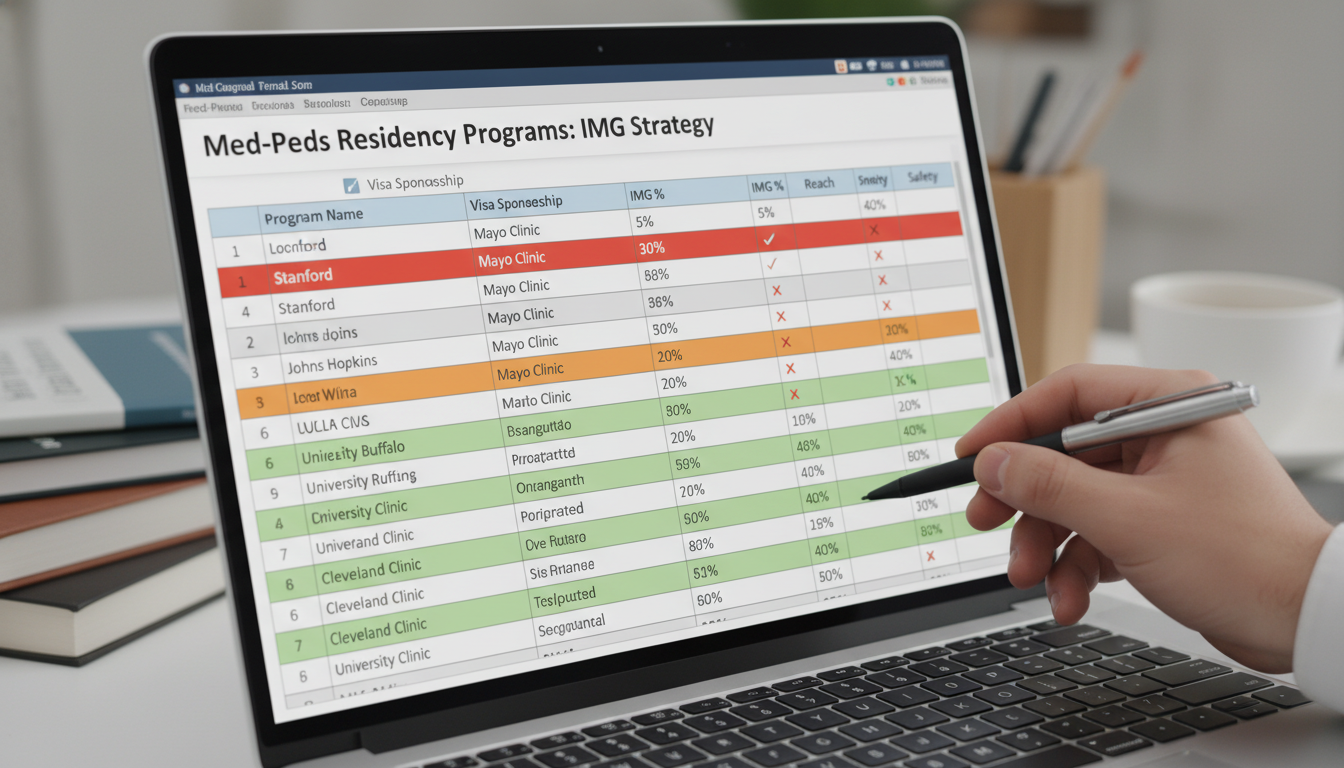
Step 4A: Gather Data on Programs
Use multiple sources:
- FREIDA (AMA Residency and Fellowship Database)
- Official program websites
- NRMP and AAMC data for Med-Peds
- Doximity, program social media, alumni networks
- Word of mouth from current or past Med-Peds residents
For each Med-Peds program, try to document:
- Visa sponsorship (J-1, H-1B, or none)
- Average board scores or minimum criteria (if listed)
- Number of positions per year
- Proportion of IMGs in recent classes
- Program type (university, community, hybrid)
- Location and cost of living
- Areas of emphasis (primary care, academic, global health, research)
Put this into a simple spreadsheet with color coding.
Step 4B: Define Your Tiers
As an IMG, tiers should be based on your profile relative to program patterns, not prestige alone.
High Reach Programs
- Historically lower IMG representation or highly academic.
- Program rarely sponsors visas or has strict score cutoffs near your score.
- You may be slightly below their typical academic profile but still within a reasonable range.
Realistic / Target Programs
- Programs where:
- You match or slightly exceed their common score/YOG patterns.
- They have some IMGs in recent years.
- They consistently sponsor your visa type.
- These should be the largest portion of your list.
- Programs where:
Safety / Backup Med-Peds Programs
- Smaller or less well-known programs.
- Clearly IMG-friendly with regular international graduates.
- Criteria that you comfortably exceed (scores, YOG, experience).
- Might be more community-based or in less popular geographic regions.
As a rough balance for a 40–60 program list:
- 20–30% High Reach
- 50–60% Realistic
- 20–30% Safety
Adjust these proportions depending on how strong or vulnerable your profile is.
Step 4C: Integrate Categorical IM and Pediatrics (If Needed)
Because Med-Peds has fewer total spots than categorical IM or Pediatrics, many IMGs pursuing the Medicine-Pediatrics match also apply to:
- Categorical Internal Medicine programs
- Categorical Pediatrics programs
If your absolute priority is to work in the US as a physician—even if not in Med-Peds—consider:
- 60–70% Med-Peds applications
- 30–40% categorical (IM and/or Peds) focusing on IMG-friendly and visa-sponsoring programs
This combined strategy improves your overall chance to match in the US system.
Step 5: Key Filters for IMGs in Med-Peds Program Selection
When you ask “how to choose residency programs” as an IMG, you must apply filters differently than a US graduate. Here are the most important:
1. Visa Sponsorship: Non-Negotiable Filter
- Check each program’s website or FREIDA entry for:
- J-1 sponsorship
- H-1B sponsorship (if applicable)
- If the program does not sponsor your needed visa type, remove it from your list.
- When unclear:
- Email the program coordinator early (before ERAS opens, if possible).
- Phrase it professionally and concisely.
Example email line:
“I am an international medical graduate requiring J-1 visa sponsorship. Could you kindly confirm whether your Medicine-Pediatrics residency program sponsors J-1 visas?”
Avoid wasting applications on programs that cannot legally train you.
2. IMG Presence and Culture
Look for evidence that the program genuinely integrates international graduates:
- Bios and photos of current or recent IMGs on the website
- Faculty who trained internationally
- Residents from a variety of medical schools globally
- Comments from alumni on reputable forums or professional platforms
Programs with no IMG in the last 5–10 years are unlikely to suddenly start with you (unless your profile is exceptionally strong).
3. Score and YOG Cutoffs
Pay attention to:
- Explicit minimum scores (e.g., “We generally interview applicants with Step 2 CK ≥ 230”)
- YOG preferences (e.g., “Graduation within the last 5 years preferred”)
- Automatic filters (sometimes shared in webinars or open houses)
If your scores or YOG are far below these stated thresholds, consider:
- Removing them from your main target list
- Keeping a few as “high reach” only if there is other strong fit
4. Geography and Lifestyle
As an IMG, you may feel tempted to ignore location just to maximize chances. This is risky.
Consider:
- Weather and climate (cold winters vs warm climates)
- Proximity to family or community support
- Visa options for certain states/employers later
- Cost of living and your likely salary as a resident
You don’t need your dream city, but you do need a place you can realistically handle for four years.
5. Alignment with Long-Term Goals
Med-Peds opens doors to:
- Hospital medicine (adult and pediatric)
- Primary care across the age spectrum
- Subspecialty fellowships in Medicine or Pediatrics
- Academic and global health roles
When choosing programs:
- If you want fellowship: prioritize strong academic and research programs with good fellowship match lists.
- If you want underserved care: seek programs with FQHC clinics, community rotations, or global health tracks.
- If you’re unsure: choose programs with breadth—diverse clinical environments and elective time.
Step 6: Practical Program Selection Workflow for an IMG
Here is a step-by-step actionable workflow to build your Med-Peds program list:
Step 1: Create a Master List
- Download or compile a list of all Med-Peds programs from FREIDA or other reliable sources.
- Include columns for:
- Program name and location
- Program type (university/community)
- Visa sponsorship
- IMG presence
- Step/YOG cutoffs
- Your tier (Reach / Target / Safety)
- Personal notes (interactions, webinars, impressions)
Step 2: Apply Non-Negotiable Filters
Immediately filter out:
- Programs that do not sponsor your required visa
- Programs with absolute cutoffs far above your metrics (e.g., Step 2 CK cutoff 245 when you have 220, unless you have a unique connection)
This first pass often shrinks the list substantially.
Step 3: Assess IMG-Friendliness
For remaining programs:
- Mark those with clear IMG representation as IMG-friendly
- Mark unknown/unclear programs separately
- Deprioritize programs that:
- Have zero IMGs in recent years
- State explicit preference for US graduates only
Step 4: Categorize by Tier
Using your self-assessment:
- High Reach: academically strong, low IMG presence, or minimal visa history but not impossible
- Target: scores/experience align with known profiles; IMG-friendly; visa-sponsored
- Safety: clearly IMG-friendly, moderate academic expectations, less geographically competitive regions
Aim for your final count to remain within the earlier discussed how many programs to apply range.
Step 5: Add Categorical Backup (If Appropriate)
If your risk tolerance is low or your Med-Peds chances are uncertain:
- Build a parallel list of Internal Medicine and/or Pediatrics programs:
- Apply similar filters: visa, IMG presence, scores
- Create tiers for these too
- Decide your total budget and how to split it between Med-Peds and categorical specialties.
Step 6: Revisit and Refine
Before ERAS submission:
- Remove programs you cannot see yourself attending at all (location, culture, or categorical backup misfit).
- Research each remaining Med-Peds program enough to:
- Write a specific reason you’d want to be there
- Mention something concrete during interviews or in communications
This final refinement gives you a polished and purposeful list.
Common Mistakes IMGs Make in Med-Peds Program Selection
Applying Blindly “Everywhere”
- Ignoring visa and IMG history wastes money and attention.
- A smaller, smarter list is often more effective.
Relying Only on Program Prestige
- Applying mostly to top-tier academic programs with little IMG history makes your Medicine-Pediatrics match odds worse.
- Balance ambition with realism.
Neglecting Categorical Backup
- Med-Peds has relatively limited positions nationwide.
- Without Internal Medicine or Pediatrics backup, you risk going unmatched entirely.
Underestimating Geography
- Choosing only major coastal cities or “popular” areas might severely reduce your options.
- Many IMG-friendly programs are in mid-sized or less glamorous locations.
Not Updating Strategy After Early Feedback
- If interview invitations are very low and it’s still early, proactively:
- Reach out to programs with updates
- Reassess whether categorical re-applications may be needed next year.
- If interview invitations are very low and it’s still early, proactively:
FAQs: IMG Program Selection Strategy for Med-Peds
1. As an IMG, is Med-Peds harder to match than categorical Internal Medicine?
Typically, yes. Med-Peds has:
- Fewer total positions nationwide
- A relatively competitive applicant pool (including strong US grads who love combined training)
However, it may not be as competitive as some top subspecialties or surgical fields. For an international medical graduate, it is often more challenging to match in Med-Peds than in categorical Internal Medicine, but many IMGs do succeed each cycle—especially with strong planning and backup strategies.
2. Should I apply only to Med-Peds, or also to categorical IM and Pediatrics?
It depends on your priorities and risk tolerance:
- If Med-Peds is your only acceptable outcome and you are comfortable potentially reapplying, you might focus mainly on Med-Peds.
- Many IMGs, however, apply to:
- Med-Peds as the primary goal
- Categorical Internal Medicine and/or Pediatrics as backup
- This combination improves your chances of matching into some residency while still targeting your preferred path.
3. How can I tell if a Med-Peds program is truly IMG-friendly?
Look for:
- Multiple current or recent residents who graduated from international medical schools
- Clear statements on the website about accepting IMGs and sponsoring J-1 or H-1B visas
- Positive reports from alumni, mentors, or online professional communities
- Quick and welcoming responses from program coordinators when you inquire about visa or IMG policies
Absence of any IMGs in the last several years is a caution sign, especially if you need visa sponsorship.
4. If my Step 2 CK score is below average, is Med-Peds still realistic?
It can be, but your strategy must adapt:
- Focus more heavily on:
- IMG-friendly, community-based, or university-affiliated community programs
- Programs that emphasize holistic review and service over pure test scores
- Strengthen other parts of your portfolio:
- US clinical experience with strong letters
- Clear Med-Peds-specific interests (e.g., transitional care, chronic disease across lifespan)
- Increase the total number of applications within your budget
- Be honest with yourself and strongly consider a categorical backup plan.
A thoughtful, data-informed program selection strategy is one of the most powerful tools an international medical graduate can use to navigate the Medicine-Pediatrics match. By understanding your profile, the Med-Peds landscape, and how many programs to apply in each tier, you transform a stressful, uncertain process into a structured plan with realistic and hopeful outcomes.