Understanding Transitional Year (TY) for IMGs
Transitional Year (TY) residency can be both a strategic opportunity and a potential trap for an international medical graduate. Used wisely, it offers:
- 1 year of broad-based clinical training
- US clinical experience in ACGME-accredited programs
- A bridge into advanced positions (e.g., Radiology, Anesthesiology, PM&R, Neurology, Dermatology, Radiation Oncology) or a chance to strengthen your profile
But TY is also:
- Highly competitive in some settings (especially cushy, lifestyle-friendly community programs)
- Often misunderstood by applicants
- Risky if you don’t have a clear path for what comes after
To design a smart program selection strategy as an IMG, you need to answer three questions first:
Why do you want a Transitional Year?
- Required prelim year for an advanced specialty
- Backup plan while reapplying to categorical programs
- US experience to improve your profile
What is your realistic competitiveness?
- Step scores, attempts, years since graduation, USCE, visa needs
What is your risk tolerance?
- Is your priority: any TY position, only specific regions, programs with strong support, or only “prestige” names?
Keep your answers visible while you build and refine your TY program list.
Core Principles of IMG Program Selection Strategy
1. Start With a Clear Target Path
Your strategy will differ depending on your primary goal:
A. You already have (or are applying to) an advanced position
Example: You are matched into Diagnostic Radiology or applying to it this cycle.
- TY is a required clinical base year.
- Priority: supportive clinical environment, good schedule, teaching, strong evaluations.
- Brand name matters somewhat, but stability and workload balance are more important.
B. You are using TY as a structured gap year to strengthen your profile
Common reasons for IMGs:
- Need US clinical experience and LORs
- Previous application cycle unsuccessful
- Need time to improve Step 3 or research portfolio
In this case:
- Choose TY programs with strong mentorship, IMG-friendly culture, and good exposure to core rotations (IM, EM, ICU).
- Emphasize programs that routinely place grads into categorical IM/FM, or into advanced specialties.
C. You are unsure of ultimate specialty or flexible
- Prioritize TY programs with:
- Exposure to multiple specialties
- Strong advising/mentoring infrastructure
- Good history of grads matching into varied specialties
2. Understand Transitional Year vs Prelim vs Categorical
To avoid confusion while searching programs:
Transitional Year (TY)
- 1 year, broad mix (IM, EM, electives)
- Often associated with advanced specialties
- Some are “cushier” than prelim years, others clinically intense
Preliminary Year (Medicine or Surgery)
- 1 year in IM or Surgery; heavier on that field
- Primarily designed as an intern year for advanced positions
- Can be less elective time, more ward-heavy
Categorical Programs
- Full 3–5+ year pathway to board certification (e.g., categorical IM)
As an IMG, be flexible and consider prelim IM or prelim surgery alongside TY if:
- Your Step scores or red flags limit TY options
- Your priority is to secure some ACGME PGY-1 position and US training year
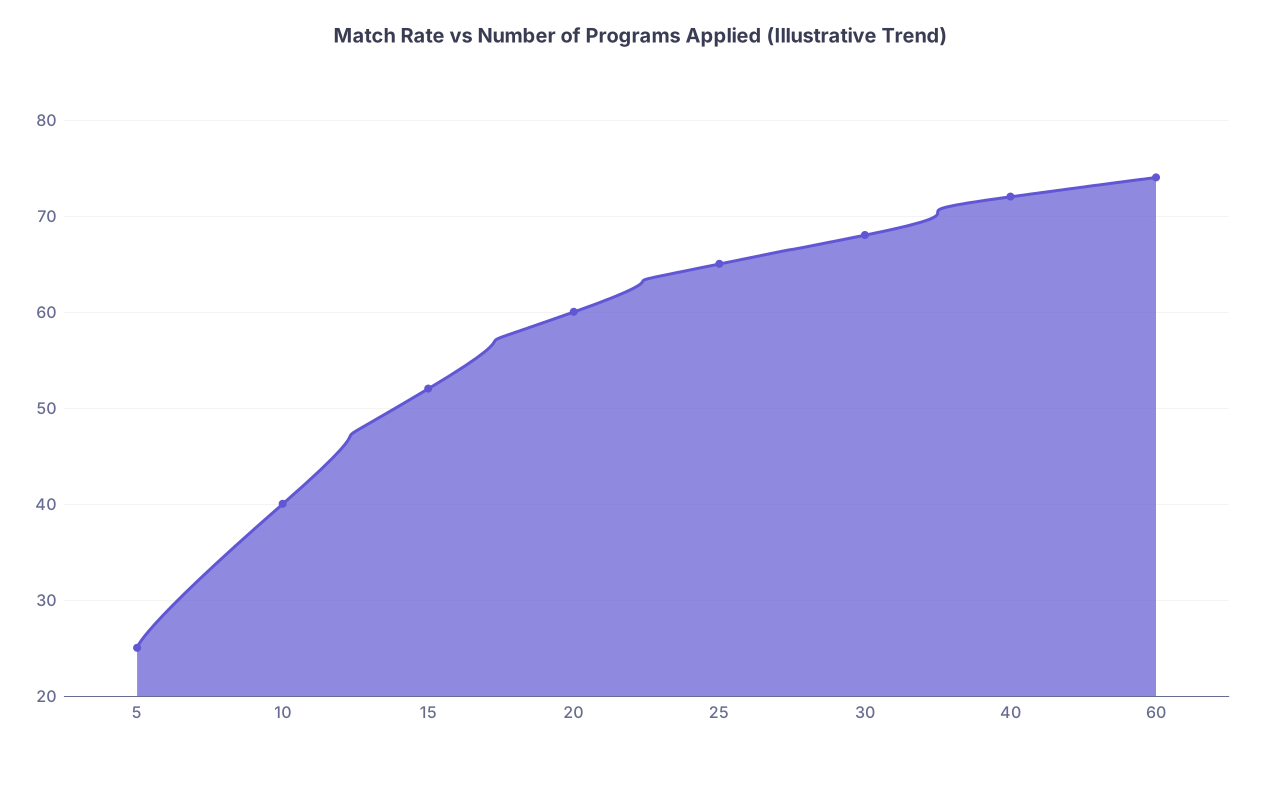
3. How Many Programs to Apply to as an IMG?
This is one of the most common IMG residency guide questions: how many programs to apply to for TY?
There is no single number, but for a typical IMG, you should assume higher volumes than US grads, especially if you need visa sponsorship.
A general starting framework (2025+ era, subject to change and individual variation):
Very strong IMG profile
- Step 1: Pass on first attempt
- Step 2 CK: ≥ 245–250+
- Recent graduate (≤ 2–3 years)
- 2–3 strong US clinical experiences with US LORs
- No visa or J-1 acceptable
- Reasonable target: 25–40 TY programs, plus prelim IM if needed
Moderately competitive IMG
- Step 2 CK: 230–245
- 3–6 years since graduation
- Some USCE, but limited
- Needs J-1 visa
- Reasonable target: 40–70 TY/prelim programs (mix of TY and prelim IM/Surgery)
Challenged profile (red flags)
- One Step failure, or low Step 2 CK (< 230)
6–7 years since graduation
- Needs H-1B
- Limited or no USCE
- Reasonable target: 70–120+ programs, with most being prelim IM/Surgery and only a subset TY
Key point: TY positions are limited nationwide compared to categorical IM or FM. As an IMG, you often can’t rely only on TY unless your profile is strong and/or you already have an advanced position.
Your program selection strategy must balance:
- Reach programs (ambitious)
- Solid targets (main focus)
- Safety options (including prelim years and IMG-friendly locations)

How to Build a Smart TY Program List as an IMG
Step 1: Clarify Your Constraints
Before looking at programs, write down:
- Visa requirement
- J-1 only / J-1 or H-1B / No visa needed
- Graduation year
- Many programs have cutoffs (e.g., ≤ 5 years since graduation)
- USMLE/COMLEX details
- Step 1 status (Pass/fails)
- Step 2 CK score
- Step 3 (completed or not)
- Any attempts or failures
- US clinical experience
- Type (observership, externship, sub-I, research)
- Duration
- Geographic limitations
- Family, finances, or licensure constraints
Treat these as filters when searching for TY programs.
Step 2: Use the Right Tools to Find TY Programs
Key sources:
- FREIDA (AMA)
- Filter by: Transitional Year, visa status, IMG percentage (if available), program size, location.
- ERAS Program Directory
- Check each program’s criteria: IMGs accepted, visa sponsorship, Step cutoffs.
- NRMP data / Charting Outcomes
- Review specialty- and program-type competitiveness trends for IMGs.
- Program Websites
- Confirm:
- Current residents’ profiles and backgrounds
- IMG presence
- Visa policies
- Rotations and elective distribution
- Links to affiliated advanced programs
- Confirm:
Aim to create an initial “long list” of TY programs that are at least theoretically open to IMGs with your visa and graduation year constraints.
Step 3: Categorize Programs: Reach, Target, Safety
Adopt a structured program selection strategy:
A. Reach Programs
- Prestigious academic centers
- Very competitive regions (e.g., NYC, Boston, California)
- Programs with limited prior IMG footprint
- You may still apply if:
- You have exceptional scores, research, or strong connections
- You need a few aspirational choices
B. Target Programs
- Programs where your profile closely aligns with their historical IMG intake:
- They accept and match IMGs regularly
- Visa support consistent with your needs
- Your scores are within or slightly above their typical range
- These should form 50–60% of your TY/prelim applications.
C. Safety Programs
- Smaller community or regional hospitals
- Less popular locations (Midwest, South, some rural areas)
- Programs with well-documented history of taking IMGs with mid-range scores
- May include more prelim IM or FM than pure TY
- These should form 30–40% of your total applications, especially if you have red flags.
Try to tag each program in your spreadsheet as R / T / S (Reach / Target / Safety) so you can see if the list is balanced.
Step 4: Evaluate IMG-Friendliness and Fit
For each potential program, investigate:
Current and past residents
- Do you see international medical graduates among them?
- From which countries and schools?
- Are they holding TY-only positions or integrated with categorical tracks?
Visa policies
- Explicit J-1 support?
- Any mention of H-1B for TY? (Rare, but possible for some prelim IM positions)
- If no clear statement, email the coordinator briefly and professionally.
USMLE language
- Do they list explicit score cutoffs? (e.g., Step 2 CK ≥ 230)
- Do they say “no minimum score but competitive”?
- Do they accept attempts or specify “no failures”?
Years since graduation
- Many programs restrict to ≤ 5 years; some allow longer if you’ve been clinically active.
Training environment
- Rotation mix: IM, EM, ICU, electives
- Call/night float structure
- Patient volume and acuity
- Affiliated advanced specialties
- Presence of categorical IM/FM/surgical programs you might transition into
This deeper review helps you distinguish:
- Paper-eligible programs vs
- Realistic, IMG-friendly, good-fit programs
Step 5: Prioritize Programs That Help Your Long-Term Goals
Your TY year should be a launchpad, not just a placeholder. Prioritize programs that:
- Are attached to or affiliated with the specialty you ultimately want (e.g., TY at a hospital with Radiology, Anesthesia, PM&R, or Neurology residencies).
- Have a demonstrated record of:
- Recommending TY residents for advanced positions
- Helping IMGs move into categorical IM or FM locally if reapplying
Look for clues on websites and resident bios:
- “After Transitional Year, Dr. X matched into Diagnostic Radiology at…”
- “Our TY graduates commonly match into Radiology, Anesthesiology, PM&R, Neurology, and Internal Medicine at a variety of institutions.”
This is much more valuable than a program that’s convenient or “nice” but offers little onward support.
Practical Scenarios and Example Strategies
Scenario 1: Strong IMG Aiming for Radiology With No Advanced Spot Yet
Profile:
- Step 2 CK 252, Step 1 pass, no attempts
- 2 years since graduation
- 3 months USCE (2 in IM, 1 in Radiology)
- Needs J-1 visa
Program selection strategy:
- Apply broadly to Diagnostic Radiology categorical/advanced and Transitional Year + prelim IM.
- For TY:
- ~30–40 programs total:
- 10 Reach TY (academic centers with strong Radiology departments)
- 20–25 Target TY (mixed academic-community with radiology presence)
- 5–10 Safety prelim IM programs in IMG-friendly regions
- ~30–40 programs total:
- Focus TY programs with:
- Radiology residency on-site
- Strong elective time and protected didactics
- Good history of placing grads into advanced specialties
Scenario 2: IMG Using TY/Prelim as Structured Gap Year After an Unmatched Cycle
Profile:
- Step 2 CK 235, Step 1 pass (first attempt)
- 4 years since graduation
- 1 month observership, no hands-on USCE
- Needs J-1 visa
- Applied once to categorical IM and had few interviews, no match
Program selection strategy:
- Goal: secure any ACGME PGY-1 that offers:
- US experience
- Strong LORs
- Time to improve application
- Apply to 60–80 programs:
- 10–15 TY (where IMGs are clearly present)
- 35–45 prelim IM
- 10–20 FM prelim/PGY-1 tracks if available
- Focus on:
- Community and regional hospitals
- Programs with explicit “IMG-friendly” language or track record
- Less competitive states (Midwest, South, non-coastal)
- De-prioritize:
- Extremely competitive metro areas (NYC/Boston/California) as core strategy—apply to a few, but don’t rely on them.
Scenario 3: Older IMG Graduate with Attempts, Seeking Any Foot in the Door
Profile:
- Step 2 CK 222 with one attempt
- 8 years since graduation
- No USCE yet
- Needs J-1 visa
Program selection strategy:
- A pure TY-only strategy is risky; you must maximize volume and flexibility.
- Apply to 90–120+ programs:
- Only a small number of TYs that are explicitly IMG-friendly and not academically hyper-competitive
- Majority in prelim IM, some prelim Surgery, possibly FM
- Emphasize:
- Lower-profile locations
- Programs that do not list rigid graduation year or Step cutoffs
- Strongly consider:
- Parallel plan: obtain USCE, prepare for Step 3, and network with hospitals that host IMGs frequently.

Common Pitfalls IMGs Should Avoid in TY Program Selection
1. Over-focusing on Name and Location
- Many strong IMGs waste most of their applications on:
- Major coastal cities
- Famous brands
- For TY, where spots are limited, this can be catastrophic.
- Solution: Always keep at least 30–40% of your list in smaller, less popular regions where IMGs actually match.
2. Ignoring Visa and Graduation-Year Filters
- Applying to programs that:
- “Do not sponsor visas”
- “Graduation cutoff within last 3 years” when you are 7 years out
- This wastes money and ERAS slots.
- Solution: Meticulously verify filters for each program before adding it to your list.
3. Assuming All TY Programs Are Cushy
- Some TYs are intense: heavy night float, ICU-heavy, limited elective time.
- Others truly are more balanced and education-focused.
- Solution: Read schedules and resident comments carefully. If this year is your only US experience before advanced training, you want a supportive but rigorous environment, not a pure vacation.
4. Not Considering Prelim IM/FM as Backup
- As an IMG, you may not match into a pure TY even with a decent profile simply due to numbers and competition.
- Solution: If your primary goal is to secure any PGY-1 slot in the US:
- Always include prelim IM plus TY in your application mix (unless you already have a signed advanced position).
5. Weak Spreadsheet and Organization
With dozens of programs, it’s easy to lose track. Build a detailed spreadsheet that tracks:
- Program name, city, state
- Type (TY, Prelim IM, Prelim Surgery)
- Visa policy
- IMG presence
- Score/attempts/graduation year policy
- Category (Reach/Target/Safety)
- Application status (applied, invited, interviewed, ranked)
This is essential to sharpen your program selection strategy in real time as you hear back from programs.
Crafting a Competitive Application for TY as an IMG
Your program selection strategy must be paired with an application that matches what TY programs actually seek.
1. Highlight Versatility and Adaptability
TY programs value residents who can function in multiple specialties and settings:
- Use your personal statement to:
- Emphasize broad clinical interests
- Show comfort switching between IM, EM, ICU, and electives
- Explain logically why a Transitional Year specifically fits your goals
2. Clarify Long-Term Plans Without Sounding Non-committal
- If you aim for Radiology, Anesthesia, PM&R, etc., be transparent:
- “My long-term goal is to enter Diagnostic Radiology. A Transitional Year will strengthen my clinical foundation, improve my communication skills across disciplines, and help me mature as a physician before advanced training.”
- If you are still deciding:
- Emphasize that TY will give you broad exposure to refine your interests—but show that you are committed to the TY year itself and patient care.
3. Maximize US-Focused LORs
Particularly valuable:
- Letters from:
- US IM, EM, or critical care attendings
- Department chairs or program leadership where you did rotations
- Ask letter writers to:
- Comment on your adaptability, reliability, teamwork, and communication
- Highlight your readiness to function in a busy US hospital
4. Address Red Flags Strategically
- Attempts or low scores:
- Briefly explain any context (health, personal circumstances) without making excuses.
- Show a pattern of improvement (e.g., stronger Step 2 CK than Step 1, or later strong clinical performance).
- Long gap since graduation:
- Demonstrate clinical continuity (home country practice, research, teaching).
- Emphasize new US experience or CME to show you are up to date.
Final Thoughts: Making TY Work for You as an IMG
As an international medical graduate, applying to Transitional Year programs is not just about “getting any internship.” It’s a deliberate move in your larger program selection strategy and long-term career planning.
To maximize your chances:
- Be honest and precise about your competitiveness.
- Answer the core “how many programs to apply” question based on your scores, gaps, and visa needs, then err slightly on the side of applying to more.
- Build a diverse list mixing TY and prelim IM (and possibly FM/Surgery), with Reach, Target, and Safety programs.
- Use data on IMG-friendliness and visa policies; never rely only on reputation or location.
- Ensure that the programs you prioritize will genuinely help you reach your advanced specialty or categorical goal.
If you treat this process as a structured, data-driven project rather than a random list of names, your Transitional Year can become one of the most strategic components of your IMG residency journey.
FAQ: Transitional Year Program Selection for IMGs
1. Is Transitional Year harder to match into than categorical Internal Medicine for IMGs?
Often yes. TY positions are fewer in number and many are linked to competitive advanced specialties. For IMGs, categorical IM generally has more total positions and more IMG-friendly programs. This is why many IMGs treat TY as one part of a broader strategy that also includes prelim IM and categorical IM applications.
2. As an IMG, should I apply to both Transitional Year and Prelim Medicine programs?
For most IMGs, yes. Unless you already hold a secured advanced position and are highly competitive, relying only on TY is risky. Combining TY with prelim IM (and possibly prelim FM or Surgery where appropriate) greatly increases your PGY-1 opportunities and keeps your pathway open.
3. How many Transitional Year programs should I apply to specifically?
For a relatively strong IMG (good scores, recent graduation, some USCE, J-1 acceptable), 25–40 TY applications is a reasonable range, supplemented with prelim IM. If your profile is more borderline (attempts, older graduation, limited USCE), you may apply to fewer TYs and many more prelim IM programs, aiming for a total of 70–120+ residency applications overall.
4. Does program prestige matter for TY if I’m going into an advanced specialty?
Prestige can help, but it is not the only factor. Advanced programs care about strong clinical performance, solid LORs, and evidence that you can function in a US environment. A less prestigious but supportive TY where you can excel, earn strong recommendations, and maintain wellness is often more beneficial than a big-name program where you struggle. Prioritize fit, support, and training quality alongside reputation.