Understanding the Urology Landscape for IMGs
Urology is one of the most competitive surgical subspecialties in the United States, and for an international medical graduate (IMG), the bar is even higher. A strong program selection strategy can make the difference between matching and going unmatched—even with similar board scores and credentials. This article is designed as a practical IMG residency guide specifically focused on urology, with step‑by‑step advice on how to choose residency programs, how many programs to apply to, and how to optimize your urology match outcomes.
Why Urology Is Especially Challenging for IMGs
Key realities you should know:
- Limited positions: Urology offers far fewer positions than core specialties like Internal Medicine or Pediatrics.
- Independent match: Urology participates in the AUA (American Urological Association) match, which has timelines and processes slightly different from the NRMP. You must plan earlier.
- High bar for interviews: Program directors screen heavily on objective criteria (USMLE, research, letters, U.S. clinical experience) because they have relatively few interview slots.
- Visa and funding issues: Some urology programs cannot or do not sponsor visas, immediately shrinking your realistic list as an IMG needing sponsorship.
Because of this, your program selection strategy must be focused, data-informed, and honest about your profile’s strengths and limitations.
Step 1: Clarify Your Applicant Profile
Before deciding how many programs to apply to or which ones, you need a realistic understanding of where you stand. Program selection is only as good as your self‑assessment.
A. Objective Metrics
Key metrics for urology programs:
- USMLE Step 1 (now Pass/Fail): While not scored, a first‑attempt pass is essentially mandatory. Multiple attempts are a major red flag.
- USMLE Step 2 CK: Now the main numerical screening tool. Competitive applicants often score in the 240s–260s; as an IMG, higher is better.
- Class rank / honors: Honors in surgery, strong class rank, or equivalent distinctions from your medical school add weight.
- ECFMG status: Being certified or on track to be certified before rank list submission is expected.
Action:
- Make a one‑page “snapshot” of your metrics: Step scores, attempts, graduation year, ranks/honors.
B. Subjective Strengths
For urology, the following are particularly influential:
- Urology-specific research: PubMed‑indexed publications, abstracts, posters, or presentations in urology or related fields (oncology, nephrology, transplant, pelvic surgery).
- Letters of Recommendation (LoRs): At least 2–3 letters from U.S.-based urologists strongly help, especially if they are known across the urology community.
- U.S. Clinical Experience (USCE): Ideally, at least 1–2 urology electives or observerships in U.S. academic centers.
- Communication and professionalism: Evaluations from rotations and letters that highlight teamwork, reliability, and patient care.
C. Risk Factors
Identify potential red flags:
- Multiple Step exam attempts or failures
- Long gap since graduation (e.g., >5–7 years)
- Limited or no U.S. clinical experience
- No urology research or publications
- No U.S. letters, especially no letters from urologists
You don’t need a perfect profile to match, but you must understand how these factors affect which programs to target and how broadly to apply.
Step 2: Decide How Many Programs to Apply To
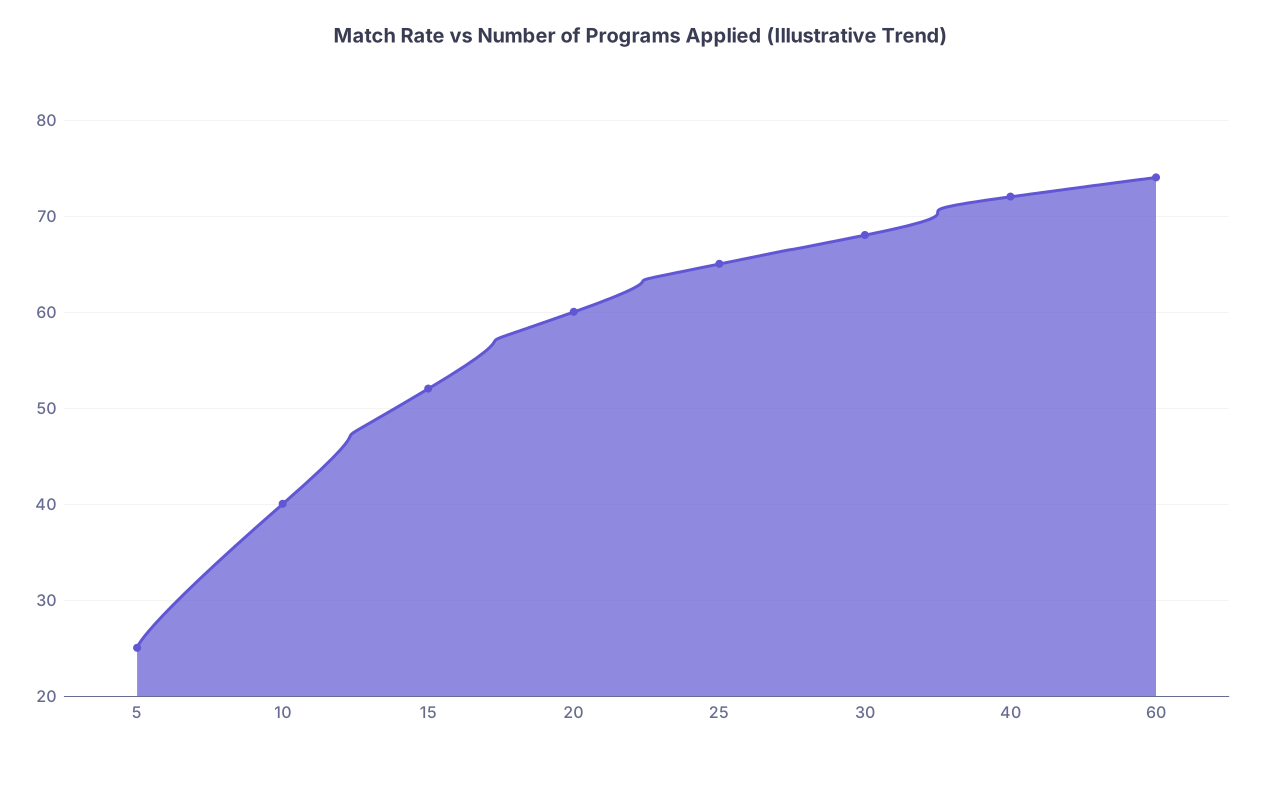
There is no single correct number, but for an IMG aiming for urology residency, under-applying is one of the most common reasons for going unmatched.
A. General Benchmarks for IMGs in Urology
While exact statistics vary by year, the following ranges are reasonable starting points:
Highly competitive IMG (excellent profile)
- Step 2 CK: ≥255
- Urology research, multiple U.S. rotations, 2–3 strong urology LoRs
- No exam failures, recent grad (≤3 years)
- Recommended: 30–40 urology programs (or close to all programs that accept IMGs/visas)
Moderately competitive IMG
- Step 2 CK: 240–255
- Some urology or surgical research, at least 1 urology USCE, 2 solid LoRs
- Possibly older graduate or one modest red flag
- Recommended: 40–60 programs (broad net, maximizing all IMG/visa-friendly programs)
At-risk or lower-competitiveness IMG
- Step 2 CK: <240
- Limited or no urology research; minimal U.S. clinical exposure
- Older graduation year, exam attempts, or other red flags
- Recommended: Apply to almost every possible IMG‑friendly urology program that does not explicitly exclude IMGs, and strongly consider a parallel plan (e.g., applying to a less competitive specialty or plan for research year).
Note: Urology has fewer total programs than big specialties, so “60 programs” may approach the entire set realistically open to IMGs.
B. Factors That Modify “How Many Programs to Apply” For You
Visa Needs
- If you require J-1 or H-1B sponsorship, your list is automatically smaller.
- You may need to apply to all visa‑sponsoring, IMG-friendly programs to keep realistic chances.
Financial Constraints
- Application and travel costs can be high.
- Strategies:
- Prioritize programs more likely to consider IMGs (see later sections).
- Use early interview data; if you receive multiple interviews early, you may not need to extend additional applications.
- Consider virtual rotations or networking to target certain programs instead of a blind mass-application.
Timeline and Parallel Planning
- If you are early in training and can invest another year in research or U.S. rotations, you might apply more selectively this cycle and plan to strengthen for a future cycle.
- If this is your last realistic attempt (e.g., aging out of eligibility), it may be rational to apply very broadly, while also pursuing a backup specialty.
The core principle: As an IMG in a competitive field like urology, it is usually safer to err on the side of more applications, not fewer, within financial reason.

Step 3: Build a Targeted Program List
Now that you know your approximate application volume, the next part of your program selection strategy is to choose which urology residency programs to apply to.
A. Gather the Right Data Sources
Use multiple sources to build and filter your list:
AUA Residency Program Directory
- Core reference for all ACGME‑accredited urology programs.
- Check for: program size, contact info, participation in the match.
Program Websites
- Look for:
- Stated visa policies (J-1 vs H-1B vs no sponsorship)
- Stated IMG or “international graduate” policies
- Number of positions per year
- Recent residents’ medical schools (do they include IMGs?)
- Look for:
FREIDA / ACGME / AMA databases
- Confirm accreditation, program size, and sometimes visa information.
Resident and Graduate Rosters
- Check current residents and recent graduates:
- Do you see any international medical graduates?
- Are there graduates from schools similar to yours (same country/region/prestige)?
- This is an excellent real-world sign of IMG-friendliness.
- Check current residents and recent graduates:
Networking and Word-of-Mouth
- Ask:
- Urology attendings or fellows you worked with in the U.S.
- Other IMGs who matched in urology or related fields
- Online communities (with caution; verify information via official sources).
- Ask:
B. Classify Programs by IMG Friendliness
Create a spreadsheet and group programs into tiers of IMG-accessibility:
Historically IMG-Friendly
- Programs that currently or recently have IMGs on their resident roster.
- Programs that clearly state: “We accept international medical graduates” or “We sponsor J-1/H-1B visas.”
Conditional or Unclear Policies
- Programs that do not explicitly exclude IMGs but have no visible IMGs on staff or roster.
- Programs that state “strong preference for U.S. grads” but no hard ban.
Likely Non-IMG-Friendly
- Programs that explicitly state:
- “We do not accept IMGs”
- “We only consider U.S. or Canadian medical graduates”
- Or never show any IMG in their residents or recent alumni.
- Programs that explicitly state:
For IMGs, especially those needing a visa, Tier 1 and some Tier 2 programs should form the backbone of your list. Tier 3 programs can be included sparingly if you are highly competitive, but they should not dominate your applications.
C. Assess Program Competitiveness and Fit
Beyond IMG policies, assess how competitive and how suitable each program is for your profile.
Key factors:
Academic vs Community Program
- Academic programs may place heavier emphasis on research and higher scores.
- Community or hybrid programs may be somewhat more open to strong, clinically oriented IMGs.
Research Focus
- If you have strong research credentials, target programs:
- With PhD-level faculty, multiple urology subspecialties, or NIH grants.
- That highlight clinical trials, translational research, or robust scholarly activity.
- If you have strong research credentials, target programs:
Program Size
- Larger programs (more residents per year) sometimes are more flexible in their selection.
- However, some very prestigious large programs may remain extremely competitive for IMGs.
Location
- Geographic preferences of programs matter.
- Programs in extremely desirable locations (major coastal cities) are typically more competitive.
- Programs in less popular regions or smaller cities might be more open to interviewing strong IMGs.
Action:
- Add columns to your spreadsheet: visa sponsorship, IMG history, research intensity, program size, location comfort (e.g., rural vs urban), your connections (if any), and subjective “fit score.”
Step 4: Design Your Program Selection Strategy
After building information, develop a deliberate program selection strategy instead of a random mass application.
A. Balanced Portfolio Approach
Think of your list like an investment portfolio, with different risk levels:
Reach Programs (10–25%)
- Highly prestigious, top academic centers, or IMG-skeptical programs where matching is unlikely but possible if you are exceptional.
- Keep these limited but present; they can reward outstanding profiles.
Target Programs (50–70%)
- Programs where your scores, research, and background align reasonably well.
- Typically IMG-tolerant, with residents or faculty having some international backgrounds.
Safety-leaning Programs (10–25%)
- Programs that are clearly IMG-friendly.
- Programs in less competitive locations or settings.
- Your chances of at least an interview are relatively higher here.
For example, if you will apply to 50 programs:
- Reach: 8–10
- Target: 30–35
- Safety-leaning: 8–12
Customize this ratio based on your competitiveness; more competitive IMGs can increase the reach category slightly, whereas at-risk applicants should focus heavily on IMG-friendly target/safety programs.
B. Align with Your Specific Profile
If you have strong research background (e.g., multiple publications, PhD, or 1–2 years of urology research in the U.S.):
- Target:
- Research-heavy academic centers that value publications and may be more open to research-rich IMGs.
- Programs known for strong academic outcomes (frequent conference presentations, etc.).
If your strengths are clinical and you have strong U.S. clinical experience but limited research:
- Prioritize:
- Community-based or hybrid programs with strong clinical volume.
- Programs where letters can speak strongly to your clinical performance and teamwork.
If you have significant red flags (older grad, Step attempt, visa issues):
- Emphasize:
- Programs with a documented history of supporting IMGs with similar backgrounds.
- Consider a two-year or “bridge” strategy (research, preliminary surgery, or another pathway) while applying more broadly.
C. Leverage Connections and Rotations
Your urology residency chances improve significantly where:
- You completed an in-person sub-internship or elective.
- You have strong letters from their faculty.
- You have research collaboration with that department.
Strategic advice:
- Treat every program where you rotated as a high-priority target.
- Add other programs in the same region (program directors often know each other and may informally share impressions).
- If your home institution (or research institution) has partnerships or alumni at certain programs, give those programs higher ranking on your application list.

Step 5: Practical Tactics to Optimize Your Application Strategy
Once you have a program list and a portfolio balance, you need to make sure your application communicates clearly and strategically to those programs.
A. Tailor Your Personal Statement and ERAS Content
While you can’t write 50 unique personal statements, you can create 2–3 tailored versions aligned with different subsets of programs:
Research-Focused Version
- Emphasize your academic productivity, curiosity, and long-term goal of becoming an academic urologist.
- Use for research-heavy universities and high-tier institutions.
Clinically-Focused Version
- Stress your surgical skills, clinical judgment, work ethic, and patient-centered care.
- Use for community and hybrid programs that emphasize surgical volume and hands-on experience.
IMG-Resilient / Perseverance-Focused Version
- If appropriate, highlight your journey, adaptation to new systems, and resilience.
- Use selectively where program culture values diverse backgrounds and nontraditional pathways.
Make sure each version is honest and not contradictory. Keep core narrative consistent, but adjust emphasis.
B. Use the Program Signaling Opportunity (If Available)
If the urology match (or ERAS changes) offers program signaling:
- Treat signals as a precious resource.
- Signal:
- Programs where you have rotated.
- Programs that are IMG-friendly and realistically match your profile.
- A small number of reach programs you genuinely would rank highly.
Avoid signaling programs that explicitly do not accept IMGs or where your chances are extremely low.
C. Monitor Interview Responses and Adjust in Real Time
Applications open and interviews are offered in waves. Use early responses as data:
If no interviews after the first 3–4 weeks:
- Re-evaluate your strategy.
- Ask mentors to review your personal statement and CV.
- Consider applying to additional programs that you may have initially overlooked.
If you receive multiple interviews early:
- You may choose not to expand applications further, limiting costs.
- Instead, focus energy on preparing for interviews and researching those programs deeply.
D. Have a Parallel Plan (Especially for At-Risk IMGs)
Given the competitiveness of the urology match, especially for international medical graduates, build a safety net:
- Consider:
- Applying to a backup specialty (e.g., General Surgery, Preliminary positions, or another field where you have genuine interest).
- Planning for a dedicated research year in urology or surgery at a U.S. institution if you do not match.
- Align your backup strategy with your long-term goals; don’t choose a backup solely out of desperation.
Step 6: Common Pitfalls in Program Selection for IMGs
Understanding frequent mistakes can help you avoid them.
Pitfall 1: Over-Focusing on Prestige
Some IMG applicants apply disproportionately to top-tier, highly prestigious academic programs and neglect more realistic options.
- Result: Fewer interviews and higher risk of going unmatched.
- Fix: Maintain a disciplined portfolio structure; let only 10–25% of your list be “reach” programs.
Pitfall 2: Ignoring Visa and IMG Policies
Applying heavily to programs that do not sponsor visas or never take IMGs wastes time and money.
- Fix:
- Always verify visa sponsorship and IMG policies before applying.
- Double-check: if multiple cycles show zero IMGs, treat that as a strong signal.
Pitfall 3: Underestimating the Number of Applications Needed
Some IMGs apply to 10–15 urology programs, similar to a very strong U.S. grad, and are surprised by the low interview yield.
- Fix:
- Accept that, as an IMG, you usually need to apply more broadly.
- Adjust application volume based on your competitiveness and red flags.
Pitfall 4: No Strategy for Follow-Up and Networking
Applying and then remaining passive can limit your exposure.
- Fix:
- Send polite updates to programs where you have genuine interest (after significant achievements like a new publication or award).
- Maintain professional connections with mentors who might advocate for you informally.
Frequently Asked Questions (FAQ)
1. As an IMG, how many urology residency programs should I apply to?
For most international medical graduates, a realistic answer falls between 30–60 programs, depending on your competitiveness:
- Strong IMG profile: around 30–40 programs, targeting many IMG-friendly and research-active places.
- Average or slightly below-average IMG profile: 40–60 programs, focusing heavily on IMG-friendly and mid-tier programs.
- At-risk profile (multiple red flags): apply to as many IMG- and visa-friendly urology programs as financially feasible, and strongly consider a backup or bridge strategy (research year, another specialty).
2. How do I know if a urology program is IMG-friendly?
Look for these signs:
- Current or recent residents include international medical graduates.
- The website explicitly states that IMGs are considered and/or visas are sponsored.
- Alumni lists include IMGs or graduates from schools like yours.
- Word-of-mouth from mentors, current residents, or alumni confirms they have accepted IMGs in the past.
If a program explicitly states they do not accept IMGs or only accept U.S./Canadian graduates, it is not worth applying as an IMG.
3. Should I apply to a backup specialty if I am committed to urology?
For many IMGs, yes—especially if your profile has risk factors (older graduation year, exam attempts, limited USCE, or need for visa sponsorship). You can:
- Apply primarily to urology, but also to a smaller number of programs in a related or acceptable backup specialty.
- Alternatively, plan for a research year in urology or surgery if you do not match, and reapply with a stronger application.
Your choice should reflect your genuine interests and long-term goals, not just short-term fear.
4. Is it worth applying to highly prestigious programs as an IMG?
It can be, but selectively and strategically:
- You should not fill your entire list with “dream” programs.
- Include a small number (10–25% of your list) if:
- Your profile is exceptional (very high Step 2 CK, strong research, high-level letters).
- You have a concrete connection to that program (rotation, research, mentor advocacy).
- Always balance them with a robust number of IMG-friendly, mid-tier programs to protect yourself from going unmatched.
A thoughtful, data-driven program selection strategy is one of the most powerful tools you have as an international medical graduate aiming for urology residency. By accurately assessing your profile, applying broadly but intelligently, and focusing on programs that truly consider IMGs, you maximize your chances of success in the urology match—and set the stage for a strong surgical career in the United States.