Understanding the Big Picture: Why Program Selection Matters So Much for IMGs
For an international medical graduate aiming for a pediatrics residency in the United States, nothing shapes your match outcome more than a thoughtful, data-driven program selection strategy. The question isn’t just how many programs to apply to—it’s which programs, why those programs, and how to build a list that realistically maximizes both your chances of matching and your long-term career satisfaction.
Pediatrics is often seen as more “IMG-friendly” than some highly competitive specialties, but that doesn’t mean the match is easy. As an IMG, you compete in a separate category, face visa barriers, and must overcome program biases and structural disadvantages (e.g., fewer US clinical experiences, networking limitations, or later graduation years). A generic approach—randomly selecting 100+ programs based on location alone—can waste money and opportunities.
This IMG residency guide will walk you step-by-step through a practical program selection strategy tailored specifically for international medical graduates seeking a pediatrics residency. You’ll learn:
- How to evaluate your own profile realistically
- How to categorize pediatrics programs by “IMG-friendliness” and competitiveness
- How many programs to apply to based on your specific risk factors
- How to use data tools like FREIDA, NRMP, and program websites strategically
- How to balance “dream,” “target,” and “safety” programs in your peds match plan
Step 1: Assess Your Starting Point as an IMG Applicant
Effective program selection starts with brutal honesty about your current competitiveness. Before asking how to choose residency programs, you must understand where you stand.
1. Core Metrics: Scores, Attempts, and Time Since Graduation
Key objective indicators in pediatrics residency selection include:
- USMLE Step 1 & Step 2 CK scores (or Step 2 CK only if Step 1 is Pass/Fail)
- Number of attempts on each step
- Year of medical school graduation (YOG)
- US clinical experience (USCE) in pediatrics (electives, sub-internships, hands-on observerships)
While specific score cutoffs vary, a rough guide for pediatrics (subject to change by year):
- Competitive IMG profile
- Step 2 CK: ≥ 245
- First attempt on all exams
- Graduation within the last 3–5 years
- Strong USCE in pediatrics (2–3 rotations or more)
- Average IMG profile
- Step 2 CK: 230–244
- First attempt or one retake on a step
- Graduation within the last 5–7 years
- Some USCE (1–2 rotations, possibly mixed specialties)
- At-risk IMG profile
- Step 2 CK: < 230, or multiple attempts
- Graduation > 7 years ago
- Limited or no USCE
- Major gaps or unaddressed red flags (e.g., unexplained career breaks)
Your category determines how aggressive your program selection strategy must be and how many programs to apply to.
2. Other Influential Factors for Pediatrics IMGs
Beyond scores, pediatrics program directors heavily weigh:
- Strong letters of recommendation in pediatrics (especially from US pediatricians)
- Demonstrated interest in child health (peds electives, research, volunteer work with children, child advocacy)
- Communication skills and empathy (crucial in pediatrics)
- Research in pediatrics or child health (helpful for academic or university programs)
- Visa status:
- Needing a visa (J-1 vs H-1B) narrows your options
- Green card or US citizenship opens many more doors
Create a one-page “profile summary” for yourself:
- Scores + attempts
- YOG
- USCE (type, length, specialty)
- Visa needs
- Research and publications
- Special interests within pediatrics (e.g., NICU, general peds, global health)
You will use this summary to quickly compare yourself against program requirements and typical resident backgrounds.

Step 2: Understand the Types of Pediatrics Programs and Their IMG Friendliness
Not all pediatrics residency programs are created equal in terms of how they view and support IMGs. To build an intelligent program selection strategy, you must classify programs along several dimensions.
1. Program Type: University, Community, and Community-University Affiliated
a. University-Based Programs
- Typically located at large academic medical centers
- Strong emphasis on research, subspecialties, and fellowships
- Often more competitive, especially in popular locations and big-name children’s hospitals
- Historically:
- Some are open to IMGs but often prefer US grads, especially for highly academic tracks
- Tend to prioritize higher scores, research, and strong academic CVs
Best for: Highly competitive IMGs with strong scores, recent graduation, meaningful research, and excellent USCE.
b. Community-Based Programs
- Focus more on primary care pediatrics and community child health
- Patient volume is often high; residents gain strong clinical exposure
- Many such programs are relatively IMG-friendly, especially in less popular geographic regions
- Often more flexible with scores and YOG, if other strengths are present (experience, maturity, strong LORs)
Best for: Average or at-risk IMGs who want a clinically strong, service-heavy pediatrics training and are more flexible on location.
c. Community/University Affiliated Programs
- Hybrid structure: community hospital with academic affiliation (often a nearby university)
- Good balance of clinical exposure and some academic opportunities
- Many accept and support IMGs while still offering pathways to fellowships
Best for: Broad range of IMGs; these are often ideal “target” programs.
2. IMG-Friendliness: Proven Track Record vs. Unknown
This is crucial for an IMG residency guide and your program selection strategy.
Look for:
- Programs with current or recent residents who are IMGs (check websites, social media, or reach out to residents)
- NRMP or FREIDA data showing a substantial percentage of IMGs in the program’s resident pool
- Explicit statements on the program website like “We welcome applications from international medical graduates”
Red flags or low IMG-friendliness may include:
- No IMGs in current or recent classes
- Vague or non-committal statements about IMGs
- Strict cutoffs that most IMGs find hard to meet (e.g., YOG < 3 years, only US grads, no visa sponsorship)
Focus your list heavily on programs with a documented history of accepting IMGs—this is often the single most powerful filter to increase your odds of matching.
Step 3: Research Tools and Data Sources for Smart Program Selection
To answer how to choose residency programs and how many programs to apply intelligently, use structured data rather than guesswork.
1. FREIDA, Program Websites, and Official Sources
Use these systematically:
AMA FREIDA Online
- Filter by: Pediatrics, state, minimum number of positions, program type
- Review:
- Whether they sponsor visas (J-1, H-1B, both, or none)
- Program size (larger programs = usually more interview spots, more IMGs)
- Contact information and basic program structure
Program Websites
- Check:
- Resident roster: % of IMGs, diversity of schools
- USMLE minimum score requirements
- YOG cutoffs (if listed)
- Visa policy (J-1 only vs H-1B; “we do not sponsor” is common)
- Curriculum, clinical sites, call structure
- Check:
NRMP and ERAS Resources
- NRMP’s “Charting Outcomes in the Match” and other specialty data reports for pediatrics
- Historic match rates for IMGs and average number of applications/interviews
2. Unofficial but Valuable Resources
- Program social media (Instagram, Twitter/X, LinkedIn):
- Gives insight into culture, diversity, and resident happiness
- Residency forums and communities (Reddit, Student Doctor Network, specialty/IMG Telegram or WhatsApp groups):
- Current-season impressions (e.g., “this program was IMG-friendly; I was invited with XYZ score”)
- Always cross-check such information; use trends, not single anecdotes.
- Networking:
- Reach out to alumni from your medical school who matched in pediatrics
- Ask about their experience, interview list, and which programs were receptive to IMGs
As you research, maintain a spreadsheet listing each program and key attributes (we’ll discuss structure in the next section).

Step 4: Building and Categorizing Your Pediatrics Program List
A professional program selection strategy transforms raw data into a structured, prioritized list.
1. Design a Program Spreadsheet (Your Central Tool)
Create a spreadsheet with columns such as:
- Program name
- State / city
- Program type (University, Community, Affiliated)
- Total positions per year
- Visa policy (J-1, H-1B, both, none)
- Minimum USMLE score / stated cutoffs
- YOG limit (if any)
- % IMG or number of IMGs in current class
- Your personal “fit” rating (1–5)
- Location preference rating (1–5)
- Notes (e.g., strong NICU, underserved population, research focus)
This becomes your master database to guide both how to choose programs and to later track interview invites.
2. Classify Programs by Difficulty: Dream, Target, and Safety
Your pediatric residency program list should include a mix of:
Dream Programs (Reach)
- Above your profile level (e.g., top-tier university children’s hospitals, highly academic programs, highly desirable locations)
- You meet minimum requirements but are below their typical resident average or they seem very competitive
Target Programs (Realistic)
- Your profile matches or slightly exceeds their likely average
- They have a history of taking IMGs with similar or lower scores / YOG
- You would be genuinely happy training there
Safety Programs (Conservative)
- Clearly IMG-friendly with many IMGs historically
- Scores/YOG/public profile suggest you are above their usual threshold
- Often community or community-affiliated programs in less popular locations
A sustainable ratio for many IMGs in pediatrics might be:
- 15–25% Dream
- 40–60% Target
- 20–30% Safety
Adjust this based on your competitiveness:
- Stronger IMGs can afford more dreams.
- At-risk IMGs should lean heavily toward safety and realistic targets.
3. Factor in Geographic and Personal Preferences—But Carefully
Many IMGs understandably prefer specific regions (e.g., near family or large urban centers). However, location can drastically affect your peds match chances.
More competitive regions often include:
- California
- New York City and some parts of the Northeast
- Large urban centers with famous children’s hospitals
Less competitive or more open regions often include:
- Midwest
- Some Southern states
- Smaller cities, rural or semi-rural programs
If you are an at-risk or average IMG, narrowing your applications to only major coastal cities will severely reduce your chances. A good compromise:
- Anchor with some programs in preferred areas
- Generously include programs in geographically less popular regions that are IMG-friendly and have good training
Step 5: How Many Programs to Apply to in Pediatrics as an IMG?
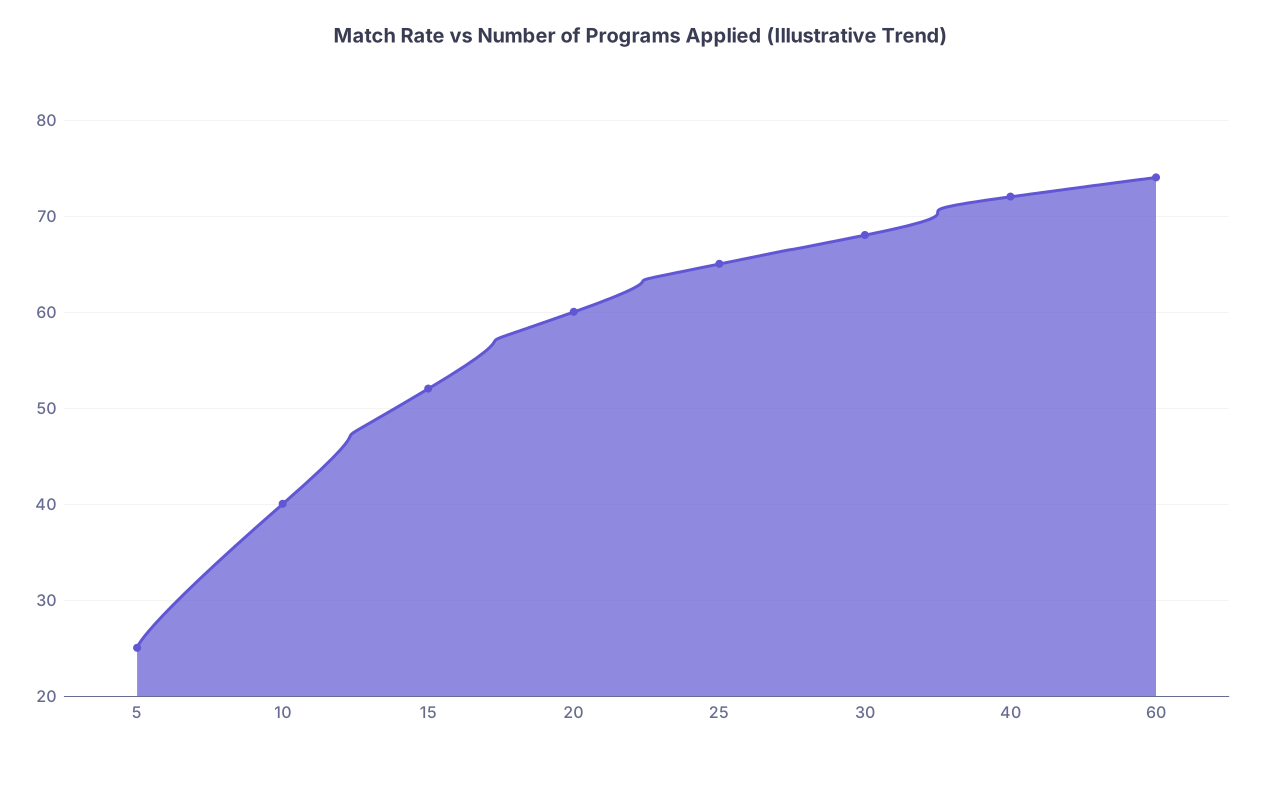
The question “how many programs to apply” doesn’t have a single answer—it depends on your profile, risk tolerance, and finances.
1. General Ranges for Pediatrics IMGs
Based on recent patterns and NRMP data trends (which may evolve over time), typical application ranges for IMGs in pediatrics:
- Highly competitive IMG (strong scores, recent YOG, strong USCE, no red flags)
- ~30–45 programs
- Average IMG (mid-range scores, 1 minor attempt or YOG 5–7 years ago, adequate USCE)
- ~60–80 programs
- At-risk IMG (low scores, multiple attempts, older YOG, limited USCE, visa-dependent)
- ~90–120+ programs
These ranges are not strict rules but reflect a program selection strategy balancing cost and opportunity. Pediatrics is more forgiving than some specialties, but IMGs still face competition and structural limitations.
2. Balancing Cost and Benefit
ERAS application fees increase as you cross certain thresholds (e.g., 20+, 30+, etc.). Applying to 100+ programs is expensive.
To avoid waste:
- Don’t apply to programs that:
- Explicitly say they don’t sponsor your needed visa
- State a YOG cutoff that excludes you
- Have no history of IMGs and list extremely high score cutoffs you clearly don’t meet
For example, if you need an H-1B visa and a program only offers J-1 or “no visas,” there is no benefit to applying. Similarly, a top-5 children’s hospital with near-zero IMGs, average Step 2 CK > 250, and a strong US grad preference is a poor use of funds unless you are truly exceptional.
3. Matching Application Volume to Your Profile
Linking to the earlier profile categories:
Stronger profile:
- Focus on high-quality fit over volume
- Use data and networking to strategically pick programs where you add clear value
Middle profile:
- Moderate to high volume, balanced across dream/target/safety
- Emphasize proven IMG-friendly programs
At-risk profile:
- Higher application volume is often necessary
- Maximize safety and realistic targets, especially where your unique strengths (e.g., extensive home-country pediatrics experience) may be valued
Remember: More applications don’t guarantee more interviews if you’re not strategically targeting programs that actually accept and sponsor IMGs like you. Quality plus quantity is key.
Step 6: Advanced Filters: Fit, Training Quality, and Long-Term Goals
Beyond simply “IMG-friendly” and “visa-sponsoring,” refine your list using qualitative factors.
1. Training Focus: General Pediatrics vs. Academic & Subspecialty-Oriented
Ask yourself:
- Do you see yourself as a general pediatrician in the community?
- Or are you aiming for fellowship (e.g., NICU, pediatric cardiology, pediatric hematology-oncology)?
If fellowship is a strong goal:
- Lean more toward university or affiliated programs with active subspecialty services and research
- Look for programs with successful fellowship matches in your areas of interest
- Research faculty and ongoing projects where you could participate
If your primary goal is strong hands-on clinical training:
- Community programs with high patient volume can be ideal
- Look for robust continuity clinic experiences, diverse pathology, and strong supervision
2. Program Culture and Support for IMGs
Not all IMG-friendly programs are equally supportive. Look for signs of a healthy learning environment:
- Testimonials from current residents (especially IMGs)
- Mention of mentorship, wellness initiatives, and career advising
- Reasonable duty hours and schedules
- Opportunities for leadership, QI projects, advocacy, and teaching
You can often sense culture from:
- How responsive the program coordinator is to inquiries
- The tone and content of the website and social media posts
- Interviews or online videos featuring residents and faculty
3. Lifestyle, Family, and Personal Considerations
International graduates often juggle family obligations, financial constraints, and cultural adaptation. Include practical filters:
- Cost of living in the city
- Public transportation vs. need for a car
- Access to communities/language groups that might offer social support
- Proximity to family, if that’s a major factor for your mental health and support system
These are secondary to your core goal of matching, but ignoring them completely can affect your long-term satisfaction and resilience.
Step 7: Examples of Program Selection Strategies for Different IMG Profiles
Concrete scenarios can help translate theory into action.
Scenario 1: Strong IMG, Fellowship-Oriented
- Step 2 CK: 248, first attempt
- YOG: 2 years ago
- 3 months USCE in pediatrics (including one sub-I)
- Several pediatric research projects, one publication
- Needs only J-1 visa
Strategy:
- Total applications: ~35–45
- ~12–15 dream university programs (including some in competitive cities)
- ~15–20 target university-affiliated and strong community programs with fellowships
- ~5–10 safety but still academically active programs
- Heavy use of networking and faculty emails to highlight research interests and fit
Scenario 2: Average IMG, Primary Care Oriented
- Step 2 CK: 236, first attempt
- YOG: 5 years ago
- 1–2 months USCE in mixed internal medicine/pediatrics
- Limited research, but strong volunteer work with children in home country
- Requires J-1 visa
Strategy:
- Total applications: ~60–80
- ~10–12 dream programs (selective but realistic—IMG-friendly universities)
- ~30–40 target community or affiliated programs with established IMG residents
- ~15–20 safety community programs, especially in Midwest and South
- Emphasize clinical experience, maturity, commitment to underserved populations in personal statement and program-specific communications
Scenario 3: At-Risk IMG, Older Graduate
- Step 2 CK: 224, one retake
- YOG: 9 years ago
- Home-country pediatrics experience: 3–4 years
- Limited or no USCE
- Requires H-1B visa
Strategy:
- Total applications: ~90–120+
- Focus heavily on community and community-affiliated pediatrics programs that:
- Sponsor H-1B (or at least J-1 if you can be flexible)
- Have multiple IMGs and historically accept older graduates
- Only a minimal number of dream programs (if any)
- Maximize safety and realistic targets, including less popular geographic locations
- Consider improving profile with USCE or observerships if possible before applying, or being open to prelim/transitional paths as a last resort
Step 8: Final Checklist Before Submitting Your ERAS Application
Before you click “submit,” run through this checklist to confirm your program selection strategy is sound:
Visa filter applied rigorously?
- No programs on your list that can’t support your visa status.
YOG and score filters respected?
- Very few or no programs that explicitly reject your graduation year or score band.
Documented IMG-friendliness?
- Majority of programs show a history of taking IMGs.
Balanced list?
- Clear mix of dream, target, and safety programs.
Geographic flexibility?
- At least some programs in less competitive regions.
Application volume appropriate to your profile?
- Not too few (risking not enough interviews), not wildly excessive without strategy.
Personal statement and CV tailored to pediatrics?
- Consistent narrative of long-term interest in child health, continuity of care, and relevant experience.
Spreadsheet ready for tracking?
- You’re prepared to track interview invites, responses, and eventual ranking decisions.
With this structured approach, your pediatrics residency program selection strategy becomes targeted, realistic, and aligned with your career goals—not just a random list of hospitals.
FAQs: Program Selection Strategy for IMG Pediatrics Applicants
1. As an international medical graduate, how many pediatrics programs should I apply to?
It depends on your competitiveness. Rough guidelines:
- Strong IMG: ~30–45 programs
- Average IMG: ~60–80 programs
- At-risk IMG: ~90–120+ programs
Adjust based on your scores, YOG, visa needs, and available financial resources. Prioritize programs that are both pediatrics-focused and historically IMG-friendly, rather than applying blindly to the maximum number possible.
2. How can I quickly tell if a pediatrics program is IMG-friendly?
Look for:
- Current or recent residents who are IMGs on the program website
- Clear statements that they welcome international medical graduates
- Visa sponsorship explicitly offered (J-1 and/or H-1B)
- Historical match data or informal reports from IMGs showing that similar profiles have matched there
If a program has no IMGs, doesn’t sponsor visas, and sets very strict cutoffs, it is likely not a good use of an IMG’s application.
3. Should I prioritize location or match chances when choosing pediatrics programs?
For most IMGs, especially those with average or at-risk profiles, maximizing the chance of matching should come first. You can and should include some programs in preferred locations, but if you restrict yourself only to very popular cities, you may drastically reduce your odds.
A balanced strategy:
- Include a minority of programs in your top choice regions.
- Include many more programs in less saturated regions that still offer solid pediatrics training.
4. Are university programs always better than community pediatrics programs for IMGs?
Not necessarily. University programs may be better for applicants strongly targeting research-heavy careers or competitive fellowships, but:
- Many community and affiliated programs provide excellent clinical training
- Some community programs also send graduates to fellowships
- For many IMGs, well-chosen community or community-affiliated programs offer the best combination of IMG-friendliness, strong clinical exposure, and realistic match chances
Your goal is not to chase names, but to match into a pediatrics residency where you can thrive, grow, and build the career you want. A thoughtful, data-driven program selection strategy will bring you much closer to that goal.