Selecting the right internal medicine residency programs as a non-US citizen IMG can feel overwhelming—but it’s also one of the few parts of the IM match process that you completely control. A smart program selection strategy can compensate for some weaknesses, amplify your strengths, and significantly increase your odds of matching.
Below is a structured, practical guide tailored specifically for the non-US citizen IMG and foreign national medical graduate aiming for an internal medicine residency in the United States.
Understanding Your Starting Point as a Non‑US Citizen IMG
Before you think about how to choose residency programs, you need a clear, honest profile of yourself as an applicant. This is especially important for a non-US citizen IMG because visa needs, graduation year, and training background dramatically affect which programs are realistic.
1. Clarify Your Applicant Category
As a non-US citizen IMG or foreign national medical graduate, your status is different from:
- US citizen/permanent resident IMGs
- US MD/DO seniors
Programs will immediately consider:
- Do they sponsor visas (J-1, H-1B)?
- Do they have a history of training foreign national medical graduates?
- Are your exam scores and timeline compatible with their filters?
You are not just competing on academic metrics—you’re competing for sponsorable positions.
2. Build a Realistic Applicant Profile
Make a one-page “snapshot” of your profile including:
- USMLE scores
- Step 2 CK (and Step 3 if taken)
- Note any failed attempts
- Year of graduation (YOG)
- Clinical experience in the US
- Observerships, externships, research, or hands-on electives
- Visa requirement
- J-1 acceptable?
- H-1B required or preferred?
- Research & publications
- LORs
- Any US-based IM letters? From academic or community attendings?
- Red flags
- Attempts, gaps in training, professionalism issues, extended time to graduate
This “snapshot” is what you will use to decide which internal medicine residency programs are realistic for you.
3. Know the Typical IM Program Filters for IMGs
Many internal medicine residency programs use filters to reduce application volume. For non-US citizen IMGs, typical filters include:
- Minimum Step 2 CK score (often 220–230+, higher for university programs)
- Maximum number of exam attempts (often no failures)
- Maximum YOG gap (commonly 3–5 years)
- Visa sponsorship limitation (J-1 only, J-1 + H-1B, or no visas)
- Minimum US clinical experience (often “some US experience preferred”)
Your program selection strategy must work with these filters, not against them.
Step-by-Step Framework for Program Selection Strategy
Think of program selection as a structured, multi-step process rather than random guesswork.

Step 1: Define Your Constraints Clearly
Your constraints answer: Which programs are even worth opening?
Key constraints for a non-US citizen IMG:
- Visa Type
- Are you open to J-1?
- If yes: most IMG-friendly programs become available.
- Do you require H-1B?
- Your pool shrinks significantly; you must be more strategic and often more competitive.
- Are you open to J-1?
- YOG Limit
- If you graduated >5–7 years ago, aggressively target programs that explicitly mention:
- “No YOG cut-off” or
- “Consider older graduates with recent clinical experience”
- If you graduated >5–7 years ago, aggressively target programs that explicitly mention:
- Exam Attempts
- If you have any USMLE failures:
- Focus on programs explicitly stating they “consider” applicants with attempts
- Community programs and some university-affiliated community programs may be more flexible.
- If you have any USMLE failures:
At this stage, you are not deciding where to apply. You are eliminating programs that are effectively impossible.
Step 2: Construct a Broad “Long List”
Use these sources to generate a long list of internal medicine residency programs:
- FREIDA (AMA Residency & Fellowship Database)
- Program websites
- NRMP’s Charting Outcomes & Program Director Survey (for strategy, not for a list)
- Alumni networks from your medical school
- IMGs’ online communities and forums (use cautiously; verify information)
For each program, collect:
- Visa sponsorship type
- Presence of IMGs in current residents
- Average or minimum Step 2 scores if available
- YOG preference or cut-off
- Mention of US clinical experience requirement
- University vs community setting
- Geographic location
Enter this into a spreadsheet—your central tool for program selection strategy.
Step 3: Label Programs by Competitiveness Tier
To refine how to choose residency programs, you should categorize them into three tiers relative to your profile:
- Reach Programs (“Dream”)
- Your metrics are below or on the low end of their typical range.
- Often big-name university programs, top academic institutions, or highly desirable locations.
- Target Programs (“Realistic”)
- Your scores, YOG, and experiences are roughly aligned with what they usually accept.
- You see multiple current non-US citizen IMGs in their resident roster.
- Safety Programs (“Backup”)
- You are stronger than their typical accepted IMG profile.
- Your Step 2 is higher than their stated minimum or their historical average.
- They have many IMGs and clear visa support.
Your goal is not to guess exact cutoffs, but to create relative categories based on patterns you see.
Step 4: Decide How Many Programs to Apply To
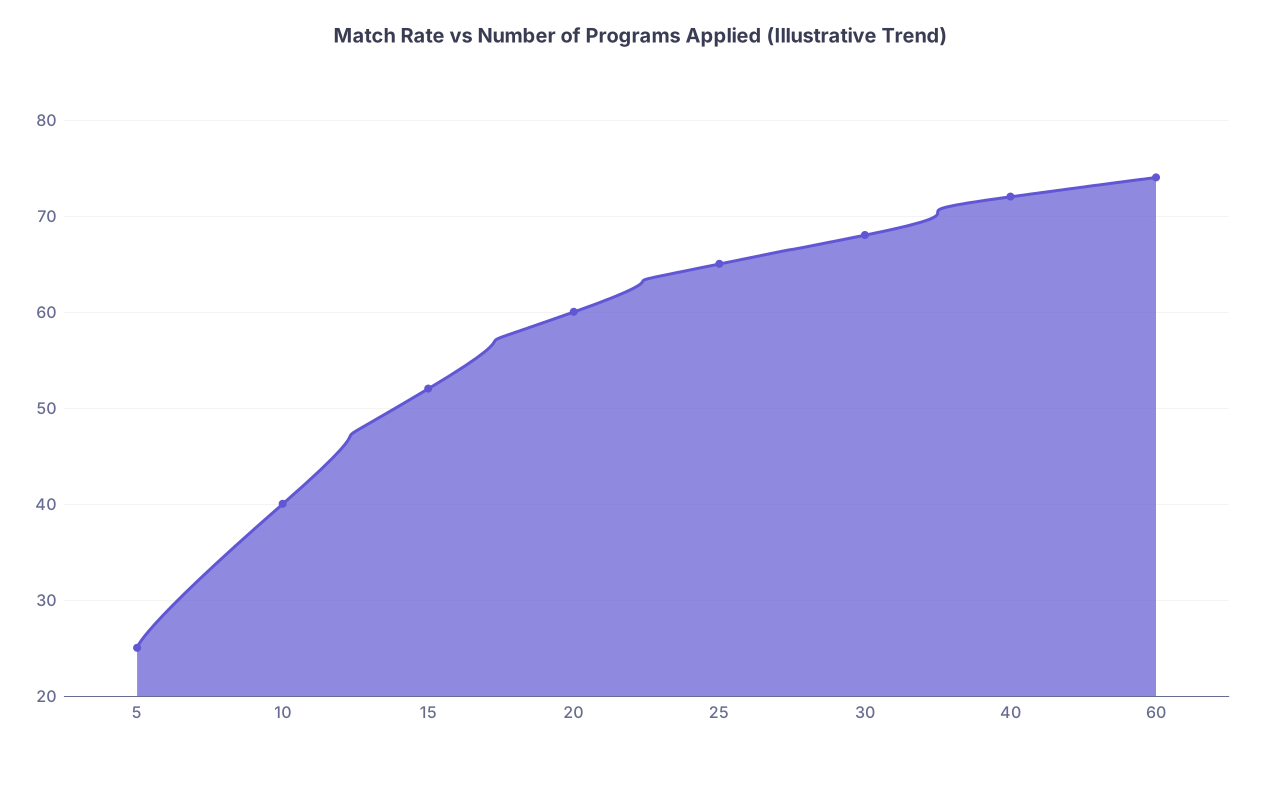
The question “how many programs to apply” is critical, especially for non-US citizen IMGs in internal medicine.
While exact numbers vary by profile, you can use the following general benchmarks:
Strong Non-US Citizen IMG Profile
- Step 2 CK: ≥ 245–250
- Graduation within last 3 years
- Some US clinical experience
- No exam failures
- US-based LORs in internal medicine
Suggested number of applications in IM:
- 40–60 programs, with:
- 10–15 reach
- 20–30 realistic
- 10–15 safety
Moderate Non-US Citizen IMG Profile
- Step 2 CK: 230–245
- Graduation within last 5–7 years
- Limited but at least some US clinical experience
- No or one exam attempt
- Good quality IM-based LORs
Suggested number of applications:
- 70–120 programs, with:
- 10–20 reach
- 30–50 realistic
- 30–50 safety
Weaker or High-Risk Profile
- Step 2 CK: <230 OR
- Multiple attempts OR
- Older YOG (>7–10 years) OR
- Minimal/no US clinical experience
Suggested number of applications:
- 120–180+ programs, weighted heavily toward safety:
- 10–20 reach
- 30–60 realistic
- 80–100+ safety
This is not about “buying” a match through volume. It’s about compensating for filters and bias that disproportionately affect foreign national medical graduates.
Step 5: Adjust for Financial and Time Constraints
Application fees grow quickly:
- The first 10 programs are comparatively affordable.
- Each additional group of programs becomes more expensive, especially after 30–40 applications.
Consider:
- Your total budget for ERAS applications + travel (if in-person interviews).
- Whether you will be able to:
- Write meaningful program-specific communication (if you choose to do so)
- Attend interviews if clustered in specific regions
Sometimes, it is smarter to apply to fewer but better-chosen programs than blindly applying to 200+ without data-driven targeting.
Key Filters for Internal Medicine Programs (Specific to Non‑US Citizen IMGs)
To optimize your program selection strategy, consider these dimensions systematically when asking yourself how to choose residency programs.

1. Visa Sponsorship Type and Consistency
For each program, check:
- Do they sponsor J-1 visas?
- Most IMG-friendly IM programs do.
- Do they sponsor H-1B visas?
- Fewer programs do; often require:
- Step 3 passed early
- Stronger academic profile
- Fewer programs do; often require:
- Do their current residents include non-US citizen IMGs on visas?
- This is more important than generic website statements.
Practical tip:
If a program claims “we sponsor H-1B” but no current resident has an H-1B, treat that information cautiously.
2. IMG Friendliness
Look at:
- Percentage of current residents who are IMGs
- Diversity of countries represented
- Whether Chief Residents include former IMGs
- Program bios featuring IMGs
Programs that regularly train IMGs are more likely to:
- Understand visa timelines
- Value international experiences
- Be flexible with non-traditional backgrounds
3. Academic vs Community Settings
University programs tend to be more competitive:
- Higher Step 2 expectations (often ≥240)
- More research-heavy environment
- Sometimes less flexible on attempts or older YOG
Community or community-affiliated IM programs may be more IMG-friendly, especially if:
- They have a long history of foreign national medical graduates
- They are in less competitive locations (Midwest, South, some Northeast)
Your mix should usually be:
- Some university (especially if you have strong scores/research)
- Mostly community or university-affiliated community programs for match security
4. Geographic Strategy
Location strongly influences competitiveness.
- Highly competitive regions:
- New York City, Boston, California, major coastal metro areas
- Moderately competitive:
- Larger cities in Midwest, Texas (depending on visa policies), Southeast
- Less competitive:
- Smaller cities, more rural areas, some community programs in the Midwest and South
As a non-US citizen IMG, you will usually need to:
- Apply broadly across regions
- Include many programs in less competitive states/regions
- Be cautious about applying only to major coastal cities
5. USMLE Score & Attempts Policy
Many IM programs list:
- Minimum Step 2 CK score (e.g., 220 or 230)
- Policy on failures or multiple attempts
Use this policy to:
- Remove programs that clearly exclude you
- Prioritize ones that explicitly “consider” applicants with attempts, especially if:
- You have strong recent performance
- You have strong US clinical experience
Building Your Personal Program List: A Practical Example
Below is a worked example to show how a foreign national medical graduate might translate theory into a real program selection strategy.
Example Applicant Profile
- Non-US citizen IMG, needs J-1 (open to H-1B but not required)
- YOG: 2021
- Step 2 CK: 236 (first attempt)
- Step 3: not taken
- 12 weeks US observerships in internal medicine
- 2 US IM LORs + 1 home country IM LOR
- No research publications
- No gaps, no professionalism issues
Strategy Based on This Profile
Competitiveness:
Moderate—solid but not outstanding scores, decent recency of graduation, some USCE, no major red flags.
How many programs to apply (IM only):
Aim for 80–110 programs.
Breakdown:
- 10–15 Reach
- Some university-affiliated IM programs in moderately competitive cities
- Occasional university IM programs with visible IMG presence
- 40–60 Realistic
- Community or community-based university programs with:
- Multiple IMGs in each class
- Clear J-1 sponsorship
- Community or community-based university programs with:
- 30–40 Safety
- Lesser-known community programs in smaller cities or non-coastal states
- Programs where your Step 2 is above their average or minimum
Shortlisting Process
For each program on the long list:
- Check visa:
- Exclude programs that say “no visa sponsorship” or “US citizens/GC only.”
- Review current residents:
- Prefer programs where IMGs form a significant part of the class.
- Look at YOG and USMLE statements:
- Exclude programs clearly stating:
- “Graduation within past 3 years only” if you are outside that window.
- “Minimum Step 2 CK 240” (you have 236) unless you have compensating strengths.
- Exclude programs clearly stating:
- Prioritize:
- Programs in less saturated markets
- Programs where multiple non-US citizen IMGs are current residents.
This method ensures that each program in your final list is there for a specific reason, not just because it exists.
Refining Your Program Selection Strategy Over Time
A strong strategy is not frozen; you will adjust it as you get more information.
1. Use Historical Match Data
Study:
- NRMP’s Charting Outcomes in the Match (IMG edition if available)
- NRMP Program Director Survey (for IM)
- Outcomes from seniors or alumni from your school with similar profiles
Ask:
- With similar scores and background, how many interviews did they get?
- Which types of programs responded more?
2. Listen to Early Signals (Carefully)
If you:
- Apply on Day 1
- Have a well-prepared ERAS application
- Yet receive very few interview invitations by November
Then:
- Consider adding more safety and IMG-heavy programs if ERAS still allows (some cycles this is limited).
- Review whether red flags (e.g., failed attempts) need to be better contextualized in your application.
3. Reassess for Future Cycles if Needed
Not every non-US citizen IMG matches on the first try. If you must reapply:
- Study which tiers responded better to your application.
- Consider:
- Taking Step 3 (especially if aiming for H-1B)
- Gaining additional US clinical experience or research
- Narrowing your cycle to internal medicine (if you previously applied to many specialties)
Your second-cycle program selection strategy should be data-driven, not emotional.
Common Mistakes Non‑US Citizen IMGs Make in Program Selection
Avoiding typical errors can save money, time, and frustration.
1. Over-focusing on “Famous Name” Programs
Applying to many top-tier university IM programs when your profile is not competitive leads to:
- Wasted application fees
- Fewer interview offers
- False hope
Include a few aspirational programs—but anchor your list in realistic options.
2. Ignoring Geography and Competition Level
Limiting yourself to:
- New York City
- California
- Major East Coast cities
is a common cause of no-match outcomes in foreign national medical graduates.
You do not have to avoid these regions entirely, but:
- They cannot be most of your list.
- Balance them with programs in the Midwest, South, and less saturated locations.
3. Not Checking Visa and IMG History Carefully
Some applicants:
- Apply to dozens of programs that do not sponsor visas
- Or that historically accept almost no IMGs
Always verify:
- Visa type actually used by current residents
- Side-by-side photos of current classes (percentage of IMGs)
4. Underestimating the Number of Programs Needed
Many non-US citizen IMGs with moderate profiles mistakenly apply to only 30–40 IM programs and receive very few interviews. Unless you are exceptionally strong, this is a high-risk approach.
For most foreign national medical graduates in internal medicine, realistic totals are 70–150+, depending on profile strength.
FAQs: Program Selection Strategy for Non‑US Citizen IMGs in Internal Medicine
1. As a non-US citizen IMG, how many internal medicine programs should I apply to?
It depends on your profile:
- Strong applicants (Step 2 ≥245, recent grad, good USCE, no attempts):
40–60 programs may be sufficient. - Moderate applicants (Step 2 230–245, some USCE, recent to mid-range YOG):
70–120 programs is a safer range. - Weaker/high-risk applicants (low scores, attempts, older YOG, minimal USCE):
120–180+ programs, heavily skewed toward IMG-friendly community programs.
Your answer to “how many programs to apply” should be based on competitiveness, visa needs, and budget.
2. Should I apply to both university and community internal medicine programs?
Yes—a mix is usually optimal. For non-US citizen IMGs:
- Community and community-affiliated programs often provide:
- More IMG-friendly environments
- More flexibility on YOG and attempts
- University programs can:
- Offer stronger academic exposure
- Be significantly more competitive
A balanced list might include:
- 15–30% university/university-affiliated
- 70–85% community or community-based university programs
3. How important is visa sponsorship when choosing programs?
For a foreign national medical graduate, visa sponsorship is non-negotiable:
- If you need J-1, most IMG-friendly programs will be open, but you must confirm they sponsor it.
- If you aim for or require H-1B, your program pool is smaller and you are expected to be more competitive (often including Step 3).
Never apply blindly to programs that:
- Do not explicitly sponsor visas
- Have no current residents on visas in their roster
4. Can strong US clinical experience compensate for lower scores?
US clinical experience (USCE)—especially in internal medicine—can partially offset:
- Slightly lower scores
- Older YOG (if recent USCE)
- Lack of research
However, it rarely compensates for multiple exam failures or very low Step 2 scores in highly competitive programs. For your program selection strategy, strong USCE should:
- Encourage you to include some reach programs
- But not lead you to ignore realistic and safety options
A deliberate, data-driven program selection strategy is one of the most powerful tools a non-US citizen IMG has in the internal medicine residency match. By understanding your own profile, defining how many programs to apply to based on realistic expectations, and systematically evaluating visa, IMG-friendliness, location, and competitiveness, you can transform a chaotic process into a targeted path toward matching in internal medicine in the United States.