Dermatology is one of the most competitive specialties in the allopathic medical school match, and a smart program selection strategy is often what separates successful applicants from disappointed ones. As an MD graduate interested in dermatology residency, you can’t afford to “wing it” when deciding where to apply. You need a deliberate, data‑driven approach that fits your profile, goals, and risk tolerance.
This guide walks through a step‑by‑step framework: how to choose residency programs, how many programs to apply to, and how to build a balanced list that maximizes your chance of a derm match while still being true to your priorities.
Understanding the Dermatology Residency Landscape as an MD Graduate
Dermatology consistently ranks among the most competitive specialties in the NRMP match. As an MD graduate (US allopathic), you start with several advantages—but also face stiff competition from equally strong peers.
Why Dermatology Is So Competitive
Key drivers of competitiveness include:
- Limited number of positions compared with interest
- High lifestyle satisfaction (predictable hours, fewer emergencies)
- Strong compensation and procedural opportunities (cosmetic, surgical)
- Appeal across personality types (outpatient care, pathology, surgery, research, aesthetics)
In this environment, program selection is not just about “where you’d be happy,” but also about where you can realistically match given your profile.
MD Graduate Advantages and Realities
As a US allopathic MD graduate, programs generally see you as:
- Familiar with the US clinical training system
- Often with more predictable clinical evaluations and letters
- Less likely to encounter visa sponsorship issues
However:
- Many of your peers will have strong USMLE scores, research, and home‑institution support.
- Some top programs are heavily research‑oriented and may favor applicants with major publications or research fellowships.
- Others may favor applicants with a strong “fit” and institutional ties over raw metrics.
To use your status as an MD graduate effectively, you need a focused program selection strategy that aligns your strengths with the right tier and type of programs.
Step 1: Conduct an Honest Self‑Assessment
Before you decide how many programs to apply to or which ones, you need a clear sense of where you stand.
Consider the following dimensions:
1. Academic Metrics
Key components:
- USMLE Step 2 CK (and Step 1 performance, even if pass/fail)
- Clerkship grades, particularly in medicine, surgery, and dermatology electives
- AOA membership or other academic honors if applicable
Ask yourself:
- Are your scores well above, around, or below typical dermatology applicant averages?
- Do you have any red flags (failed exams, repeated courses, professionalism notes)?
- Are your clinical evaluations strong and consistent?
This will help you determine whether you are a realistic candidate at very research‑intense or “prestige” programs, or better suited to solid mid‑tier or community‑focused programs.
2. Dermatology‑Specific Exposure
Programs like to see clear, sustained interest:
- Dermatology rotations (home and away)
- Subspecialty exposure (peds derm, dermpath, procedural/cosmetic)
- Participation in dermatology interest group, local or national societies
- Attendance at AAD or other dermatology conferences
More robust exposure is particularly important if your research profile is lighter; it demonstrates commitment and helps you obtain strong derm‑specific letters.
3. Research and Scholarly Activity
Dermatology is research‑heavy relative to many other fields. Assess:
- Number and quality of publications
- Peer‑reviewed articles
- First‑ or second‑author papers
- PubMed‑indexed vs non‑indexed journals
- Abstracts, posters, and presentations
- Regional, national, or international meetings
- Dedicated research time or fellowship in dermatology or related fields
If you lack derm‑specific research, but have research in internal medicine, oncology, immunology, or rheumatology, emphasize its relevance to dermatology (e.g., inflammatory skin disease, cutaneous oncology, immunobullous diseases).
4. Letters of Recommendation
High‑impact letters for a dermatology residency typically come from:
- Well‑known dermatology faculty (ideally at your institution or from away rotations)
- Faculty who can comment on:
- Your clinical reasoning
- Work ethic and professionalism
- Teamwork and communication
- Potential for an academic or leadership role
Ask yourself:
- Do I have 2–3 strong derm letters plus a strong medicine or surgery letter?
- Are any letter writers known to faculty at programs where I want to apply?
5. Personal and Geographic Factors
These can significantly shape your program selection strategy:
- Family obligations or partner’s job/location
- Financial constraints (cost of travel for interviews)
- Preference for urban vs suburban vs rural settings
- Preference for academic vs community‑based training
- Interest in specific patient populations (e.g., skin of color, HIV derm, complex medical derm)
A realistic self‑assessment is your foundation. It will guide how broad your list needs to be and which program types make strategic sense for you.
Step 2: Understand Types and Tiers of Dermatology Programs
Dermatology residencies vary widely in size, mission, and emphasis. When thinking about how to choose residency programs, classify them along at least three axes: academic focus, clinical volume, and research intensity.
1. Highly Academic, Research‑Intense Programs
Characteristics:
- Strong emphasis on basic science and translational research
- High volume of complex tertiary‑care dermatology
- Many fellows and subspecialty clinics
- Often associated with a large, renowned academic medical center
Best suited for MD graduates who:
- Have strong USMLE scores and academic records
- Possess substantial research experience (ideally derm‑focused)
- Are considering careers in academic dermatology, research, or subspecialization
Examples of what to look for on program websites:
- NIH or foundation funding to faculty
- Required research blocks for residents
- Resident publications and conference presentations
2. Balanced Academic‑Clinical Programs
Characteristics:
- Mix of complex cases at an academic center plus community exposure
- Strong clinical training with some research opportunity
- Moderate emphasis on scholarship (e.g., required QI projects, case reports)
Best suited for MD graduates who:
- Want a broad yet solid training foundation
- Are open to academic or private practice careers
- Have some research, but not necessarily a research‑fellowship‑level portfolio
3. Community‑Focused or Clinically Heavy Programs
Characteristics:
- High patient volume, strong emphasis on bread‑and‑butter dermatology
- Often smaller programs with fewer formal research requirements
- May be in non‑major metropolitan areas or affiliated with community hospitals
Best suited for MD graduates who:
- Want to focus on clinical excellence and high patient volume
- Prioritize lifestyle, procedural experience, or specific geographic regions
- May have a less research‑heavy application but strong clinical performance
In practice, most dermatology programs fall along a spectrum rather than into strict categories. Your goal is to identify which profiles align with your strengths and goals, then distribute your applications accordingly.

Step 3: How Many Dermatology Programs Should You Apply To?
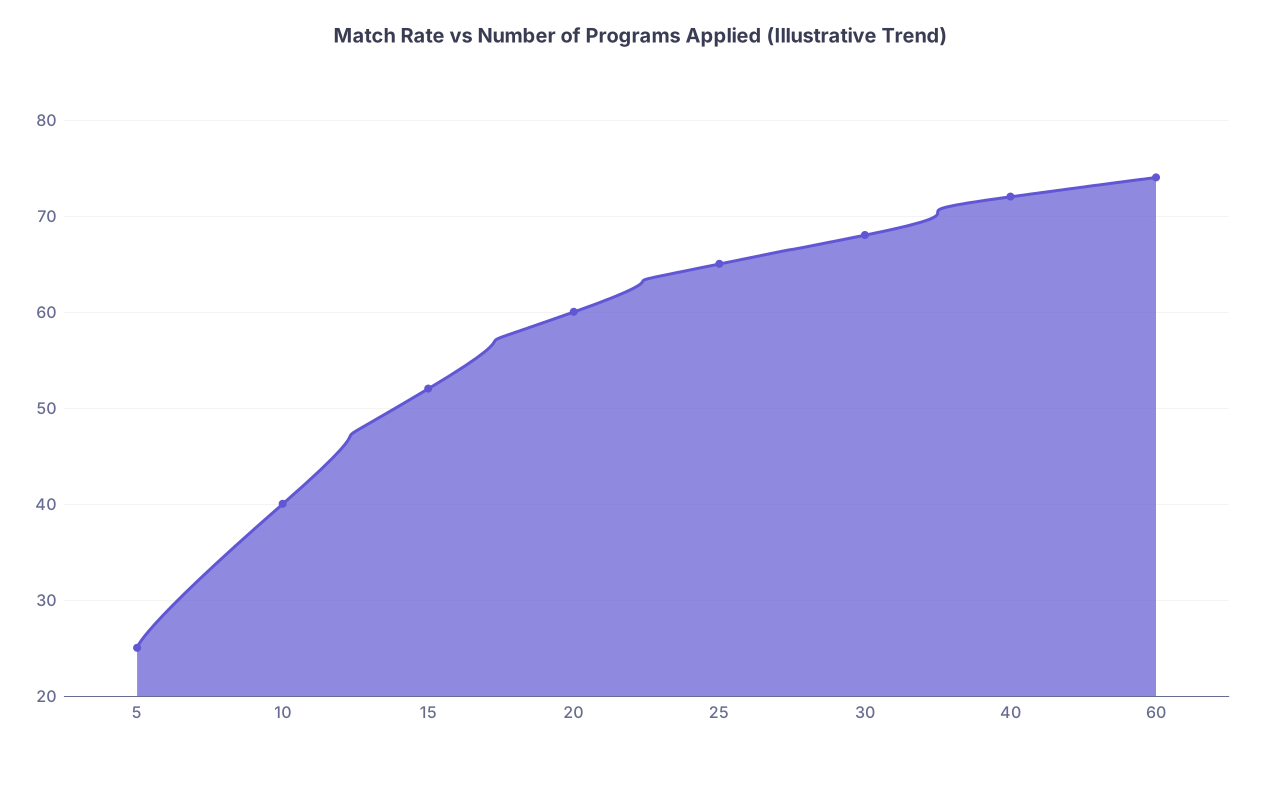
Because dermatology is so competitive, the question of how many programs to apply to is critical. While there is no universal number, you can make a reasoned decision based on your competitiveness and constraints.
General Ranges for MD Graduates
The following ballpark figures apply to many US MD graduates, though individual situations may vary:
Very strong applicants
- High Step 2 CK, AOA or strong academic honors
- Robust derm research and strong derm letters
- May be competitive at top‑tier programs
- Typical range: 35–55 programs
Solid but not top‑of‑the‑heap applicants (most MD grads)
- Good scores, some research, strong clinical performance
- No major red flags
- Typical range: 45–70 programs
Applicants with one or more relative weaknesses
- Lower scores, minimal derm research, or limited letters
- May still be strong clinically but less “sparkling” on paper
- Typical range: 60–80+ programs
These numbers may seem high, but remember:
- Dermatology programs are small, and many receive hundreds of applications per spot.
- A larger application pool spreads risk across different tiers and regions, especially if you aim for a derm match in a single application cycle.
Factors That May Push Your Number Up or Down
Apply more broadly (toward the higher end or beyond) if:
- You lack a home dermatology program.
- Your school has limited derm research infrastructure.
- You’re geographically flexible and open to lesser‑known programs.
- You have any red flags on your application.
You may cautiously apply to fewer if:
- You are a truly exceptional candidate with strong national recognition, publications, and home‑program advocacy.
- You have significant constraints (financial or time limits) for interviews and are targeting a narrow geography.
Even for strong MD graduates, erring slightly on the side of more applications is usually safer in dermatology than being too conservative.
Step 4: Building a Balanced Program List
Once you have a target number, the next question is how to structure the list across competitiveness tiers and geographic regions.
A Practical Tiering System
Create an organized spreadsheet and assign programs to tiers based on:
- Your academic and research profile vs their published resident profiles
- Known program reputation and selectivity
- Word‑of‑mouth insights from residents, alumni, and mentors
A simple 3‑tier system works well:
Reach Programs (“Dream”)
- Highly prestigious or research‑intense institutions
- Very selective, high average metrics
- You may be borderline or slightly below their typical profile
Target Programs (“Realistic”)
- Your credentials align well with typical resident profiles
- Solid academic or balanced training environment
- You could reasonably expect interview offers here
Safety‑Lean Programs (“Moderate Reach but More Attainable”)
- Less nationally known; may be in smaller cities or regions
- Emphasis on clinical training and service
- You may be above average for their usual applicant pool
Example Distribution for a Typical MD Applicant
Suppose you decide to apply to 60 programs. A reasonable distribution might be:
- 20% Reach (12 programs)
- 50–55% Target (30–33 programs)
- 25–30% Safety‑Lean (15–18 programs)
If your profile is stronger, you might shift a bit more toward reach and target. If you’re more borderline for dermatology overall, shift more heavily toward the “safety‑lean” category and include a larger number of programs outside major metro hubs.
Geographic and Lifestyle Considerations
When planning how to choose residency programs, do not ignore your real‑life circumstances. Clarify:
- Non‑negotiables
- Must be within X hours of family
- Must be in a particular region (e.g., West Coast, Northeast)
- Preferences (but not deal‑breakers)
- City size, climate, cultural offerings
- Access to outdoor activities or specific communities
- Proximity to a partner’s job or training program
Then:
- Give priority to programs in your preferred regions within target and safety‑lean tiers.
- Consider strategically including a few programs in less sought‑after locations (Midwest, smaller cities) where competition may be slightly less intense, especially if you are open to relocating for strong training.
Dual‑Application Strategies
Some MD graduates also apply in a backup specialty (e.g., internal medicine) in parallel with a dermatology residency application. If you are considering this:
- Discuss with mentors early; this affects how many dermatology programs to apply to and how you present your narrative.
- Recognize that dual‑applying may limit how many derm programs you can interview with, due to scheduling and cost.
- If derm is your clear first choice and your profile is reasonably strong, you may choose to focus solely on dermatology and apply broadly.

Step 5: Researching and Prioritizing Individual Programs
After selecting your rough list and tier distribution, you need to deep‑dive into program details so your choices—and eventual ranking—are thoughtful and informed.
Where to Find Reliable Information
Use multiple sources:
- Program websites
- Resident bios and career outcomes
- Rotations, call schedule, clinical sites
- Research opportunities and faculty interests
- FREIDA and NRMP Program Director Survey data
- Program size and structure
- How they weigh research, letters, and scores
- Conversations with mentors and recent alumni
- First‑hand impressions of culture and training quality
- Dermatology interest group networks and national organizations
- Insight into lesser‑known but high‑quality programs
Key Features to Compare
When evaluating programs, consider:
Clinical Breadth and Volume
- Variety of cases (medical derm, surgery, complex inpatient consults)
- Dedicated clinics (peds derm, skin of color, hair disorders, psoriasis, derm‑rheum)
- Surgical training (MOHS exposure, excisions, cosmetic procedures)
Research Infrastructure
- Availability of mentors in your areas of interest
- Protected research time during residency
- Track record of resident publications and fellowships
Program Culture
- Resident satisfaction and morale (ask during interviews)
- Faculty approachability and teaching style
- Diversity, equity, and inclusion efforts
Lifestyle and Wellness
- Call schedule intensity
- Flexibility for family or personal life
- Location cost of living and commute
Career Outcomes
- Graduates entering fellowships vs private practice
- Academic placements and leadership roles
- Connections to networks you’re interested in (e.g., cosmetic derm, dermpath)
As you evaluate programs, update your spreadsheet and possibly re‑tier some programs based on new information and your evolving priorities.
Step 6: Practical Strategy Tips for a Successful Derm Match
Beyond the raw question of how many programs to apply to, there are strategic moves that can enhance your overall dermatology residency candidacy and make your program selection strategy more effective.
Use Your Home Institution Strategically
If your allopathic medical school has a dermatology department:
- Seek guidance from derm faculty and residents early.
- Ask for feedback on your competitiveness and which programs to target.
- Try to secure at least one strong derm letter from your home institution.
Programs often prefer candidates with strong endorsements from colleagues they know or respect, especially if they are in the same regional network.
Plan Away Rotations Thoughtfully
Away rotations (audition rotations) can:
- Help you demonstrate interest in a specific program or region.
- Allow faculty there to assess your work ethic and fit.
- Lead to valuable letters and advocates.
Choose away sites that:
- Align reasonably with your competitiveness.
- Are in regions you’re seriously willing to rank highly.
- Offer robust exposure to the kind of dermatology you want to practice.
Tailor Your ERAS Application and Personal Statement
Use your ERAS application to clearly communicate:
- Why dermatology (specific, patient‑centered reasons, not just lifestyle).
- How your experiences prepared you for derm training.
- What you bring to a residency class (skills, perspectives, diversity, leadership).
- Your genuine interests: e.g., inflammatory diseases, skin of color, derm surgery, health equity, global derm.
Avoid generic statements that could apply to any program; instead, subtly reflect themes that will resonate with the types of programs you’re targeting.
Be Strategic With Interviews
When interview invitations arrive:
- Respond promptly; derm spots fill quickly.
- Keep a calendar and be realistic about travel (or videoconference fatigue, if virtual).
- If you’re over‑invited relative to what you can handle, prioritize:
- Programs in your target and safety‑lean tiers
- Programs in your most desired geographic regions
Remember that interview performance and perceived fit significantly influence whether you’ll be ranked highly, even at programs where you are academically competitive.
FAQs: Dermatology Program Selection Strategy for MD Graduates
1. As an MD graduate, do I still need to apply very broadly to dermatology programs?
Yes. Even as a US allopathic MD graduate, dermatology remains highly competitive. For most MD graduates, applying to 45–70 programs is reasonable, with adjustments based on your metrics, research portfolio, and geographic flexibility. A broad list gives you a better chance of securing enough interviews to match while allowing you to include a mix of reach, target, and safety‑lean programs.
2. How should I decide between research‑intense and clinically heavy programs?
Align this decision with your career goals and application strengths:
- If you have strong research and aim for academic dermatology or subspecialty fellowships, prioritize research‑intense or balanced academic programs.
- If you are passionate about high‑volume patient care and private practice, or your research background is limited, consider emphasizing clinically heavy or community‑focused programs with strong procedural exposure.
Most applicants benefit from a mix of both types to keep options open.
3. What if I have below‑average USMLE scores but strong clinical skills—should I still apply to dermatology?
Yes, but with a realistic and strategic approach:
- Apply broadly and include many programs in the safety‑lean category, particularly in less competitive geographic areas.
- Strengthen other parts of your application—derm exposure, letters, and possibly short‑term research projects.
- Be ready to explain any score issues in a concise, mature way if asked.
- Discuss with mentors whether to pursue a backup specialty while still aiming for a derm match.
4. Is it worth applying to top‑tier programs if I’m not a “superstar” applicant?
Usually yes—in moderation. Having some reach programs on your list is appropriate, especially if they align well with your interests or geography. Just ensure that:
- Reach programs comprise no more than about 20–25% of your list.
- The bulk of your applications go to target and safety‑lean programs where you have a realistic chance at interviews.
A well‑designed program selection strategy for dermatology balances aspiration with pragmatism—maximizing your chances of matching while still giving you opportunities to train in environments where you can thrive and build the career you want.