Understanding the Landscape: PM&R Residency for the MD Graduate
Physical Medicine & Rehabilitation (PM&R) is one of the most varied and rapidly evolving specialties—bridging neurology, orthopedics, internal medicine, and sports medicine. As an MD graduate planning a PM&R residency, your program selection strategy will have a major impact on your training experience, career opportunities, and day‑to‑day happiness.
Unlike some surgical fields, the physiatry match is moderately competitive but highly heterogeneous: programs differ widely in clinical focus, patient populations, and culture. A smart approach goes far beyond asking “how many programs to apply” and instead asks:
- Where will I get the best training for my career goals?
- What type of clinical environment and culture will help me thrive?
- How do I balance match safety with aspiration?
This article will walk you through a structured, evidence‑informed program selection strategy for an MD graduate residency applicant in PM&R, with practical, concrete steps you can apply immediately.
Step 1: Clarify Your PM&R Career Vision
Before you create a list or worry about numbers, you need a clear sense of what you want out of a PM&R residency. The sharper your self‑assessment, the smarter your program choices.
1.1 Reflect on Your Clinical Interests
PM&R is extremely broad. As an MD graduate, you may have exposure from clerkships, electives, or sub‑internships; now is the time to translate that into priorities:
Common PM&R “tracks” or focus areas:
- Neurorehabilitation
- Stroke, spinal cord injury (SCI), traumatic brain injury (TBI), neuromuscular disease
- Often centered in academic medical centers and large rehab hospitals
- Musculoskeletal & Sports Medicine
- Spine, joint, tendon, non‑operative orthopedics, ultrasound‑guided procedures
- Strong ambulatory exposure; often linked closely to orthopedics and sports teams
- Pain Medicine
- Interventional procedures, multidisciplinary pain clinics
- May involve a separate fellowship; some PM&R programs are strong feeders
- Pediatrics Rehabilitation
- Cerebral palsy, spina bifida, childhood injuries, developmental disorders
- Often concentrated in children’s hospitals or specialized centers
- Cancer & Integrated Rehabilitation
- Oncologic rehab, cardiac/pulmonary rehab, general inpatient rehab services
You do not need to be fully decided, but you should be able to say:
- “I lean more toward neuro vs musculoskeletal”
- “I’m very likely to pursue fellowship X”
- “I know I want mostly outpatient vs I really enjoy inpatient rehab units”
This clarity will help you prioritize programs with matching strengths.
1.2 Consider Your Preferred Practice Setting
Ask yourself where you likely see yourself post‑residency:
- Academic medical center: involved in teaching, research, possibly subspecialty care
- Large group or hospital‑employed practice: mixed inpatient/outpatient, some teaching
- Private practice / community‑based: predominantly clinical, high volume, procedures
- Niche settings: sports team coverage, VA system, multidisciplinary rehab centers
If you strongly lean academic, programs with:
- Robust research infrastructure
- T32 grants or funded labs
- High rate of graduates entering fellowships or academic positions
will rise to the top of your list.
If you envision a more community‑focused, high‑volume clinical practice, prioritize:
- Heavy outpatient experience
- Diverse pathology, strong procedural training
- Graduates placed in community and private practices
Step 2: Understanding Competitiveness & “How Many Programs to Apply”
Program selection strategy requires balancing risk and opportunity. For the allopathic medical school match in PM&R, competitiveness is moderate and varies by applicant profile.
2.1 Where PM&R Falls in the Match Landscape
For an MD graduate residency applicant:
- PM&R is less competitive than dermatology, ortho, plastics, but
- More competitive than many primary care specialties in desirable locations.
- Applicants increasingly have:
- Strong Step/Level scores (or equivalent),
- Research or publications, and
- Dedicated PM&R experiences and letters.
Your competitiveness is shaped by:
- Board scores (or pass/fail equivalent plus clerkship grades)
- Class rank / AOA (if applicable)
- Strength of letters (especially from physiatrists)
- Quality and quantity of PM&R exposure
- Research (especially in PM&R or adjacent fields)
- Red flags (remediation, professionalism issues, gaps)
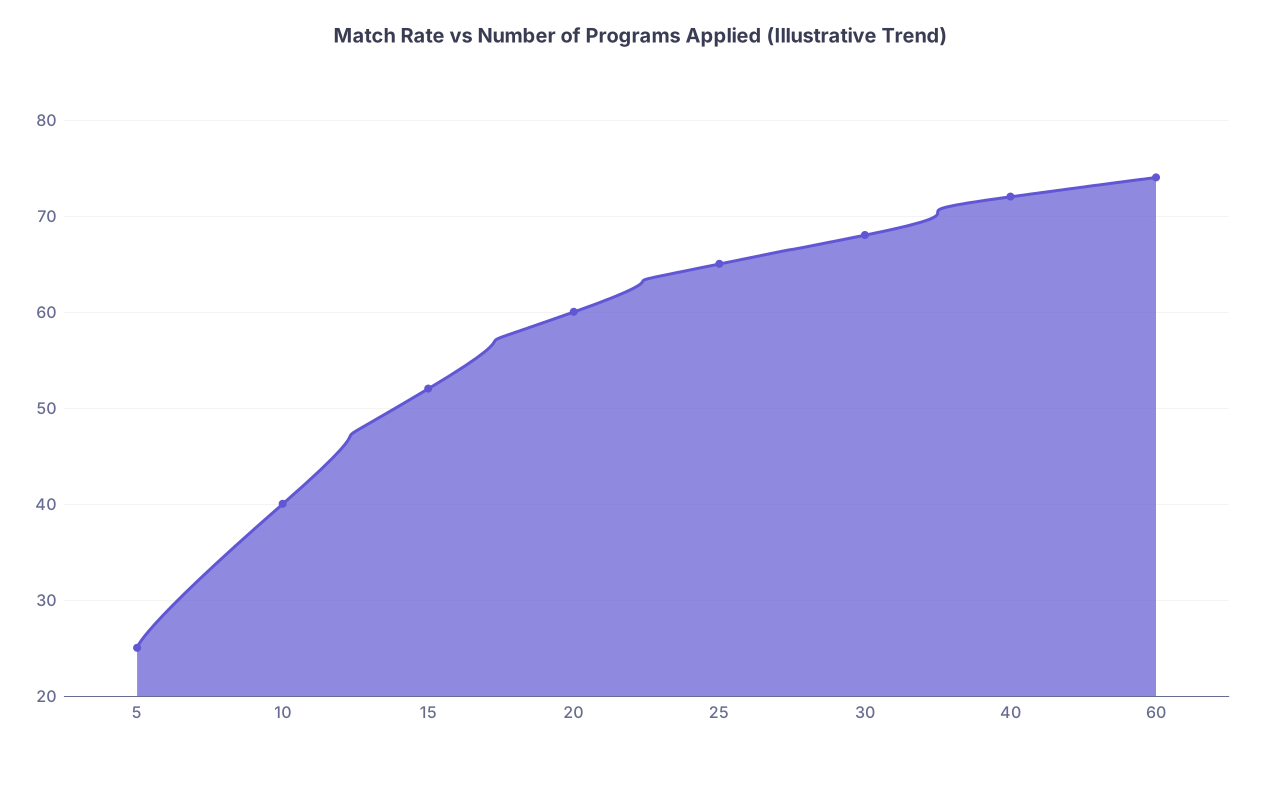
2.2 General Guidance: How Many Programs to Apply (MD PM&R Applicant)
While numbers can fluctuate, for an average MD graduate applying to PM&R:
- Highly competitive applicant (strong scores, AOA, strong PM&R letters, some research, no red flags):
- Typically: 15–25 applications
- Solid applicant (no red flags, decent scores, strong clinical evaluations, good letters):
- Typically: 25–40 applications
- At‑risk applicant (marginal scores, limited PM&R exposure, career change, gaps, or red flags):
- Typically: 40–60+ applications
These numbers are not rigid rules, but they offer a starting framework.
Key point: Casting a very wide net (e.g., 70–80 programs) without strategy is often less effective than a targeted, thoughtful list aligned with your profile and goals. Your program selection strategy should be about fit and probability, not just volume.
Step 3: Building a Rational, Tiered Program List
With your self‑assessment and approximate application volume in mind, you can now construct a tiered program list that balances dream, target, and safety options.
3.1 Define Your Personal “Tiers”
Instead of focusing on prestige alone, define tiers based on:
- Competitiveness match (your profile vs program’s historical intake)
- Fit with your interests (neuro vs MSK, inpatient vs outpatient)
- Geographic constraints (family, visas, specific cities/regions)
- Program resources (research, electives, mentorship)
A common approach:
- Reach programs (15–25% of your list)
- Highly selective, top academic centers, extremely desirable locations, or very strong niche focus
- You might be competitive but not guaranteed serious consideration
- Target programs (50–60% of your list)
- Well‑aligned with your profile and interests
- You generally meet or exceed their typical applicant metrics
- Safety programs (20–30% of your list)
- Historically take a wider range of applicants
- Strong clinical training, maybe less name recognition / in less competitive locations
For example, if you plan to apply to 30 programs:
- 6–8 reach, 15–18 target, 6–8 safety.
3.2 Key Filters for the Initial Long List
Start from:
- FREIDA
- NRMP data
- Program websites
- Advice from your home PM&R faculty
Filter based on:
Geography
- Where can you realistically live for 3–4 years?
- Are you open to all US regions or restricted due to family/partner?
- Do you prefer urban academic centers vs smaller cities?
Program Size & Structure
- Small (3–4 residents/year) vs large (8–12 residents/year)
- Single main hospital vs multi‑site training (VA, rehab hospital, children’s hospital)
- Advanced vs categorical program (do you need to secure a separate prelim year?)
Clinical Focus
- Strong inpatient rehab with SCI/TBI focus vs more outpatient MSK/sports
- Dedicated pain or sports tracks or strong affiliated fellowships
- Pediatric rehab or cancer rehab exposure
Program Culture & Lifestyle
- Call schedule & workload (night float vs traditional call)
- Resident satisfaction (from word of mouth, social media, alumni)
- Wellness culture, mentorship, support systems
Board Pass Rates & Outcomes
- ABPMR board pass rates (if published or available from residents)
- Fellowship placements (sports, pain, SCI, TBI, peds, EMG)
- First job placement (academic vs community, geographic spread)
At this stage, err on the side of including rather than excluding.
3.3 Converting a Long List into a Strategic Short List
Once you have a long list (often 40–60+ programs), begin trimming by:
- Eliminating locations you realistically would not rank highly.
- Removing programs that clearly do not support your primary interest (e.g., very limited MSK exposure if you are certain about sports).
- Prioritizing programs with:
- Accessible faculty (names you can identify, publications in your areas of interest)
- Clear curriculum and call schedule outlined online
- Evidence of resident advocacy and wellness
Create a spreadsheet including, for each program:
- City/State, Program size, Hospital types
- Major strengths (neuro, MSK, pediatrics, pain, research, etc.)
- Board pass/fellowship/job outcomes (if available)
- Your tier (Reach/Target/Safety)
- Personal notes (“Close to family”; “Strong sports coverage”; “High cost of living”)
Sort and re‑sort by different fields to see which programs repeatedly float to the top.
Step 4: Evaluating Individual PM&R Programs in Depth
After your initial screening, the next level is deep assessment of training quality and fit. As an MD graduate, you likely know how to evaluate internal medicine or surgery programs; PM&R has some distinct nuances.
4.1 Inpatient vs Outpatient Balance
PM&R residencies differ widely in inpatient and outpatient exposure:
Inpatient‑heavy programs:
- Often based at large rehab hospitals or VA centers
- Excellent for neurorehab, SCI, TBI, medically complex rehab
- May require you to seek elective time elsewhere for high‑volume MSK procedures
Outpatient‑heavy programs:
- Strong MSK, sports, ultrasound, interventional procedures
- May have fewer months on high‑acuity inpatient units
- Could be ideal for those headed to sports or pain fellowship
Look closely at:
- Number of months on core inpatient rotations (SCI, TBI, general rehab)
- Number of months in outpatient MSK/sports, EMG, pain clinics
- Availability of elective time to tailor experiences
You want enough breadth to be an excellent general physiatrist, plus depth in areas aligned with your goals.
4.2 Procedural & Diagnostic Training
For many MD graduate residency applicants interested in sports, pain, or MSK, procedural training is a major differentiator:
Ask or look for information about:
- Number and type of injections per resident (joint, bursal, spine, etc.)
- Ultrasound‑guided procedures: quantity, formal curriculum, faculty expertise
- EMG/NCS volumes and who supervises (neurology vs PM&R faculty)
- Interventional spine procedures (e.g., epidurals, medial branch blocks, RFAs) – often more fellowship‑level, but early exposure is helpful
If you’re more inclined toward neurorehab or pediatrics, emphasize:
- Tone management (botulinum toxin injections, intrathecal baclofen pump management)
- Spasticity clinics, neuro‑ultrasound use
- Exposure to assistive technology, wheelchairs/orthotics clinics
4.3 Academic vs Clinically Focused Programs
For the allopathic medical school match, some applicants prioritize name recognition and academic prestige; others care more about day‑to‑day clinical teaching and lifestyle.
Features of more academic‑oriented PM&R programs:
- Large faculty with substantial research output
- Funded research time during residency
- Requirements for publications or conference presentations
- Multiple fellowship programs in‑house (sports, pain, SCI, TBI, peds)
- Highly subspecialized inpatient and outpatient rotations
Features of more clinically oriented programs:
- High clinical volume, robust hands‑on training
- Emphasis on efficiency, real‑world practice patterns
- Less formal research expectation, but still supportive if you’re proactive
There is no single “right” type—choose based on your personal career vision.
4.4 Culture, Mentorship, and Resident Support
Some of the most important factors are hard to quantify:
- Program leadership: Is the PD approachable, invested in education, open to feedback?
- Mentorship culture: Do residents have access to advisors and research mentors in their areas of interest?
- Resident community: Does the group appear cohesive and supportive or fragmented and burned out?
- Educational structure:
- Protected didactic time
- Board review sessions
- Journal clubs and case conferences
Pay attention to:
- Resident turnover: Are there many transfers or sudden departures?
- How residents talk about their program (candidly, if you can speak 1:1)
- Whether the program seems adaptive (e.g., changed call schedules or improved curricula in response to feedback)
Step 5: Geographic Strategy and Life Considerations
No program exists in a vacuum; your life outside the hospital matters.
5.1 Regional Clustering Strategy
For most MD graduates, it is wise to cluster applications in several regions:
- Example: Northeast cluster, Midwest cluster, West Coast cluster
- This can:
- Reduce travel time/cost if in‑person interviews or second looks are offered
- Keep long‑term networks regionally coherent (useful for job hunting)
If you have a strong geographic preference (partners’ career, family, visas), you may choose to:
- Apply more heavily in one region (e.g., 60–70% of your list)
- Still include a few programs in other regions as a buffer in case that region is highly competitive
5.2 Cost of Living and Lifestyle
Consider:
- Cost of living vs resident salary
- Commuting times and housing options
- Climate and outdoor activities that matter to you
- Access to family, support networks, child care (if applicable)
A smaller name‑brand program in a city where you and your family will thrive may be a far better choice than a big‑name institution in a location you’ll resent for four years.

Step 6: Application Tactics and Refining Your Strategy
Once you have a preliminary list and understand “how many programs to apply,” refine your program selection strategy with tactics that increase your odds of success.
6.1 Leverage PM&R‑Specific Networking
PM&R is a relatively small field. Thoughtful networking can help you:
- Identify programs where your interests are a particularly good fit
- Get honest, nuanced feedback about program culture
- Sometimes secure stronger letters or advocacy
Approaches:
- Work closely with your home PM&R department (if available): seek mentors, ask about their match outcomes, request introductions.
- Attend national meetings (AAP, AAPM&R) if timing permits: poster presentations, networking with residents/faculty.
- Use away rotations or virtual electives strategically:
- Prioritize one or two programs that are realistic matches and aligned with your goals.
- Understand that an away is more about fit demonstration and relationship building than “guaranteeing” an interview.
6.2 Tailoring Your Application to Programs
For PM&R, generalized personal statements and undifferentiated CVs are common; that’s a missed opportunity.
To strengthen your strategy:
- Write a core personal statement that clearly communicates:
- Why PM&R,
- Your current clinical interests within physiatry,
- What you bring to a residency program, and
- The type of environment where you will thrive.
- Develop minor tweaks for select programs or regions:
- Mention specific program strengths or faculty interests that intersect with your goals.
- For example: referencing their strong SCI program if you’re SCI‑focused, or their sports coverage arrangements if you’re sports‑oriented.
This shows that your interest is informed and intentional, not random.
6.3 Monitoring and Adjusting as the Cycle Progresses
Even the best strategy benefits from iteration:
- Track:
- Which programs acknowledge your application,
- Timing and pattern of interview offers,
- Your own impressions from social media, resident Q&As, and open houses.
- If you receive fewer interview invitations than expected (especially in the early wave):
- Consider sending courteous, concise interest emails to certain programs, especially where you have geographic or clinical alignment.
- Ask mentors whether expanding your list slightly is advisable, if the calendar allows and ERAS is still open.
Remember: your application and program list are not static. Remain flexible, data‑driven, and honest with yourself and your mentors.
Example: Applying the Strategy – Two Hypothetical MD Applicants
Applicant A: Academic Neurorehab Focus
- MD graduate from an allopathic medical school with:
- Strong clinical grades, decent but not stellar board scores
- Two PM&R research projects (SCI‑related)
- Excellent letters from PM&R faculty
- Career goal: Academic neurorehabilitation, first‑choice regions: Northeast/Mid‑Atlantic
Strategy:
- Apply to 30 programs:
- 7–8 reach (major academic centers with large SCI/TBI units)
- 15–16 target (solid academic/programs in desired regions)
- 6–7 safety (well‑regarded clinical programs with robust inpatient experience, perhaps in less competitive cities)
- Emphasize research and neurorehab passion in personal statement.
- Choose away elective at a strong but realistic academic program in the Northeast to demonstrate fit.
- Prioritize programs with:
- SCI/TBI fellowships,
- Active clinical trials in neurorehab,
- ABPMR board pass rates consistently high.
Applicant B: Community‑Oriented MSK/Sports Focus
- MD graduate with:
- Average board performance, strong clinical evals
- High‑level athletic background, some sports medicine shadowing
- Limited PM&R research, but strong narrative of interest in MSK and sports
- Career goal: High‑volume MSK/sports practice, potentially a sports fellowship, open to many regions.
Strategy:
- Apply to 35–40 programs:
- 6–7 reach (prestigious sports‑heavy academic centers)
- 20–24 target (mixed inpatient/outpatient with strong MSK clinics, ultrasound opportunities)
- 8–10 safety (community and mid‑tier academic programs with strong outpatient exposure)
- Seek elective at a community‑based or hybrid program with robust sports coverage.
- Look for:
- Strong ultrasound curriculum,
- High injection numbers per resident,
- Graduates matching into sports fellowships.
- Mention in personal statement:
- Long‑term interest in community practice,
- Need for broad MSK training, not only elite academic exposure.
These cases show how program selection strategy changes with goals and profiles; neither applicant simply mass‑applied without direction.
Putting It All Together: A Practical Checklist
When you’re finalizing your PM&R residency application as an MD graduate, use this checklist:
Self‑Assessment
- I’ve defined my preliminary clinical interests (e.g., neuro, MSK, pain, peds).
- I’ve clarified whether I’m leaning academic, community, or unsure.
Competitiveness & Numbers
- I’ve honestly evaluated my application strengths and weaknesses.
- I’ve selected a total number of programs to apply to (e.g., 25–40) appropriate to my profile.
- I’ve roughly distributed programs into reach/target/safety tiers.
Building & Refining the List
- I created a spreadsheet with key program features and notes.
- I filtered programs by geography, clinical focus, and size.
- I trimmed programs I would not realistically rank or that clearly don’t fit my interests.
Deep Program Evaluation
- I understand each program’s inpatient vs outpatient balance.
- I have a sense of procedural exposure and research opportunities.
- I’ve probed (via websites, residents, mentors) for culture and resident support.
Life & Geography
- I considered cost of living and lifestyle factors for each region.
- I targeted clusters of programs to maintain geographic coherence.
Application Tactics
- My personal statement clearly articulates my path to physiatry and goals.
- I’ve identified a subset of programs for mild customization in my statement or emails.
- I have PM&R mentors who have reviewed my list and offered feedback.
By approaching the physiatry match with this structured strategy, you move from anxiety and guesswork toward intentional, informed decision‑making. This is not only about “how many programs to apply”; it’s about choosing environments where you will become the kind of physiatrist you want to be.
FAQ: Program Selection Strategy for MD Graduates in PM&R
1. As an MD graduate, is it risky to apply only to highly academic PM&R programs?
Yes, if your list is too top‑heavy, you may limit your chances unnecessarily. Even strong applicants should balance their lists: include a mix of highly academic centers, solid regional programs, and a few less competitive programs, especially if you have geographic constraints. Academic success can come from many types of programs, particularly if you are proactive.
2. How important is it to have PM&R research for a competitive physiatry match?
PM&R‑specific research is helpful but not strictly mandatory. For research‑heavy academic programs, it’s more important. Many clinically focused programs care more about your clinical performance, letters, and genuine commitment to the field. Non‑PM&R research still shows scholarly ability; pair it with strong PM&R experiences (electives, shadowing, letters) to demonstrate specialty commitment.
3. I don’t have a home PM&R department. How should this affect my program selection strategy?
Without a home program, you should:
- Apply to slightly more programs to hedge uncertainty.
- Make deliberate use of away rotations or virtual electives to gain letters and exposure.
- Network through national organizations (AAPM&R, AAP) and seek external mentors. Programs are accustomed to applicants without home PM&R departments; explain your path clearly in your personal statement.
4. Should I prioritize programs where I could see myself staying for fellowship or a first job?
It’s helpful, but not mandatory. Many PM&R residents pursue fellowship or jobs at different institutions. However, training at a program with in‑house fellowships or strong affiliations can open doors and streamline the process. When ranking, factor in whether you’d be happy to stay, but don’t reject otherwise excellent training solely because they lack an in‑house fellowship—especially if their graduates match well elsewhere.
By combining honest self‑assessment, a balanced list, and a thoughtful understanding of program differences, you can approach the PM&R residency match as an MD graduate with a clear, confident strategy.