Understanding the Big Picture: Pathways into Addiction Medicine
Addiction medicine is a rapidly growing field, and as an MD graduate planning your residency and eventual addiction medicine fellowship, your program selection strategy will significantly shape your career.
Before you decide how many programs to apply to or develop a program selection strategy, you need to understand your training pathway options:
1. Traditional Route: Residency → Addiction Medicine Fellowship
Most MD graduates who aim for a career in addiction medicine complete:
- An ACGME-accredited primary residency (commonly):
- Internal Medicine
- Family Medicine
- Psychiatry
- Emergency Medicine
- Pediatrics (less common but possible, especially for adolescent addiction)
- Then a 1-year Addiction Medicine Fellowship (ACGME-accredited).
This route is typical for an allopathic medical school match candidate pursuing addiction medicine.
2. Psychiatry vs Non-Psychiatry Pathways
A core strategic decision is whether you want to enter addiction medicine via:
- Psychiatry residency → Addiction Psychiatry or Addiction Medicine
- Non-psychiatry residency (IM, FM, EM, etc.) → Addiction Medicine Fellowship
Each has advantages:
Psychiatry-based pathway:
- Deep training in co-occurring mental health disorders
- Strong psychotherapy and psychopharmacology foundation
- Often more aligned with academic addiction psychiatry departments
Medicine-based pathway (e.g., IM or FM):
- Strong background in chronic disease management
- Easier integration into primary care, hospital medicine, and public health roles
- Excellent preparation for systems-based addiction care (e.g., bridge clinics, consult services)
Your program selection strategy should be informed by:
- Your desired patient population (inpatient vs outpatient, general medical vs psychiatric)
- Whether you envision your future practice as:
- Consultation-liaison addiction work in hospitals
- Outpatient MAT clinics (buprenorphine, methadone, naltrexone)
- Academic research and teaching
- Public health and policy-focused roles
3. Fellowship Position Trends
Addiction medicine is still expanding. Many areas:
- Lack sufficient addiction specialists
- Actively recruit fellowship-trained physicians
- Offer flexibility in academic, community, and hybrid roles
Strategically, this means:
- You don’t necessarily need a single “perfect” residency for addiction medicine.
- You do need a residency that will prepare you clinically, give you exposure to substance abuse training, and position you competitively for an addiction medicine fellowship.
Your approach to how to choose residency programs should therefore focus on:
- Clinical foundation
- Access to substance use disorder (SUD) experiences
- Mentorship and research opportunities
- Geographic and lifestyle considerations that support long-term sustainability
Clarify Your Goals: What Do You Want from Your Training?
Before building your list or deciding how many programs to apply to, you must define what you actually want from residency and subsequent addiction medicine fellowship.
1. Clinical Focus: What Kind of Addiction Medicine Physician Do You Want to Be?
Ask yourself:
Do you want to manage:
- Primarily opioid use disorder and MAT?
- Polysubstance and co-occurring psychiatric disorders?
- Addiction in special populations (pregnant patients, adolescents, those with severe mental illness, or incarcerated individuals)?
Do you see yourself:
- Running an outpatient addiction clinic?
- Working on an inpatient consult service?
- Leading detox/rehab programs?
- Working in community-based harm reduction settings?
Your answers guide whether you lean toward:
- Internal Medicine or Family Medicine residency (for broad medical + addiction focus)
- Psychiatry residency (for heavy comorbidity of mental illness and addiction)
2. Academic vs Community vs Hybrid Careers
Clarify how much research and teaching you want:
Research/Academic focus:
- You’ll want programs with:
- NIH-funded faculty
- Ongoing addiction-related trials or implementation projects
- Structured research time
- Consider large academic centers with established addiction medicine fellowship programs.
- You’ll want programs with:
Clinically focused career:
- You still benefit from exposure to SUD training, but:
- Emphasize strong clinical volume
- Robust continuity clinics with MAT
- Community partnerships (e.g., methadone clinics, syringe services programs)
- You still benefit from exposure to SUD training, but:
Hybrid clinician-educator:
- Look for residencies where:
- Residents regularly teach students
- There are addiction medicine electives you could help develop or improve
- Medical education faculty are accessible
- Look for residencies where:
3. Geography, Personal Life, and Burnout Risk
Addiction medicine work is emotionally demanding. Your success depends on:
- Geographic fit (family, support systems, cost of living)
- Access to mental health support and wellness resources
- Your tolerance for high-intensity patient populations
When thinking about how to choose residency programs, honestly assess:
- Urban vs suburban vs rural settings
- Regions with high burden of opioid and polysubstance use (more learning opportunities, but potentially heavier workload)
- Proximity to mentors, friends, or family for support

Building the Right List: How Many Programs to Apply to and Why
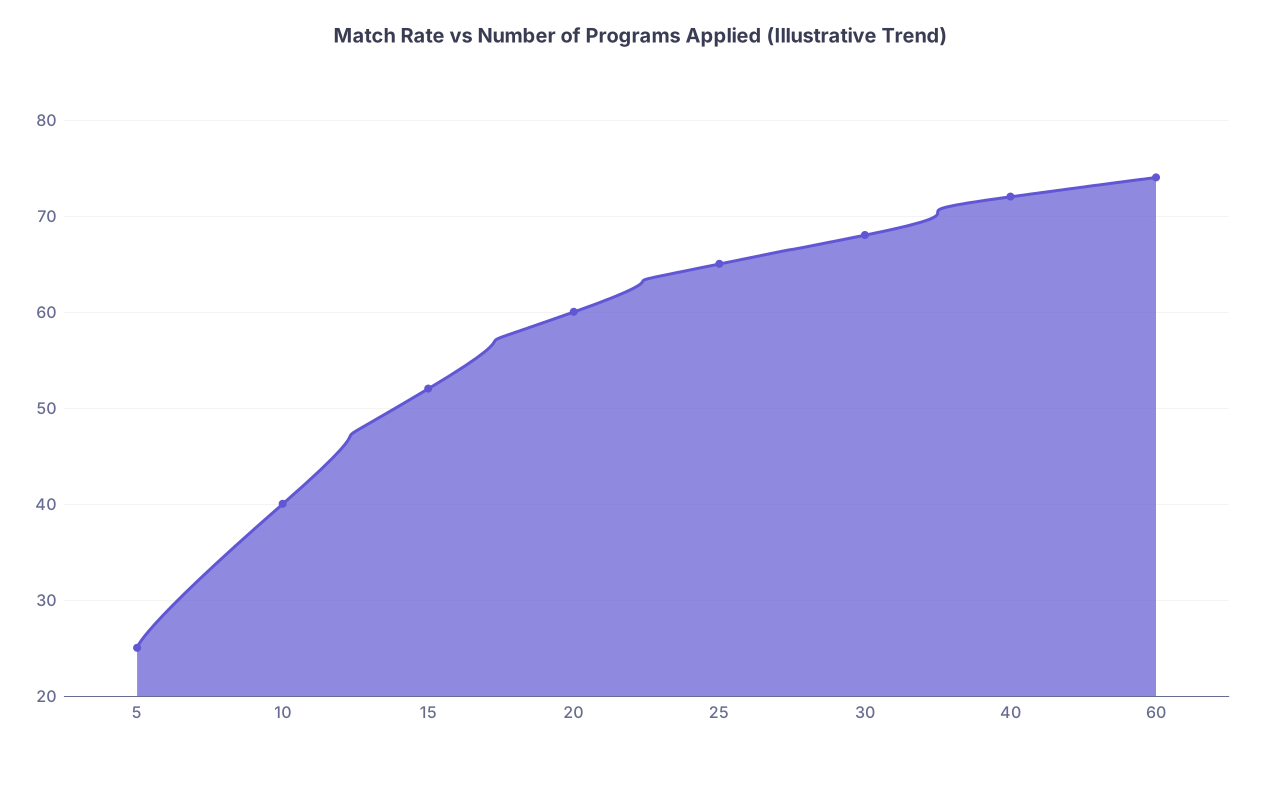
The number of programs you apply to should reflect:
- Your competitiveness as an applicant
- Specialty competitiveness (e.g., psychiatry vs internal medicine)
- Your geographic flexibility
- The presence of multiple programs that support substance abuse training
Below is a structured approach to determine how many programs to apply to and how to tier them.
1. Assess Your Competitiveness Realistically
Consider:
- USMLE/COMLEX scores (or pass/fail context and transcript detail)
- Clinical grades and honors
- Letters of recommendation (especially from addiction specialists or related fields)
- Research, QI, or advocacy in SUD, mental health, or public health
- Red flags: gaps, failed exams, professionalism concerns
As an MD graduate residency applicant from an allopathic medical school, you often have an advantage compared to IMGs, but intra-MD competition is still real—especially in psychiatry.
Rough guide (for U.S. MD graduates, adjust based on specialty competitiveness and personal profile):
Strong applicant:
- Above-average scores, strong letters, some SUD-related activity
- Internal Medicine/Family Medicine: ~15–20 programs
- Psychiatry: ~20–25 programs
Average applicant:
- Solid but not stellar, limited research, steady but not standout SUD exposure
- Internal Medicine/Family Medicine: ~20–25 programs
- Psychiatry: ~25–30 programs
Below-average/risk factors:
- Lower scores, failed exam attempt, limited clinical honors, IMG status, or major geographic restriction
- Internal Medicine/Family Medicine: ~25–30+ programs
- Psychiatry: ~30–40+ programs
These ranges are not rules, but planning benchmarks. They help ensure you’re not underapplying.
2. Tiering Your List Strategically
Use a three-tier system:
Reach Programs (20–30%)
- Highly ranked or very popular locations
- Strong addiction medicine or psychiatry/addiction faculty
- More research-heavy than your current track record supports
Target Programs (40–60%)
- Programs where your metrics match or slightly exceed typical residents
- Offer good SUD exposure and supportive environment
- Reasonable fit for geography and lifestyle
Safety Programs (20–30%)
- Less competitive locations or mid-sized community programs
- Still offer at least some substance use training, or are in regions with high SUD prevalence where you can create experiences
This mix improves your match probability while giving you multiple pathways into addiction medicine, even if not all programs are addiction-powerhouses.
3. Balancing Quantity vs. Quality
More applications are not always better if they dilute the thoughtfulness of your personal statements and program-specific communication.
A practical rule:
- Apply to enough programs to protect your match, but:
- Make sure each program is somewhere you could realistically see yourself training for several years.
For a typical MD graduate residency applicant pursuing an addiction medicine career:
- Psychiatry-bound: ~25–30 well-chosen applications is often sufficient.
- Internal Medicine/Family Medicine: ~20–25 is often enough, unless you have significant red flags or tight geographic limits.
If you:
- Have a restrictive couples match situation
- Are geographically limited to a single region
- Are an older graduate or have failed exams
…lean toward the higher end of these ranges.
Key Features to Look For: How to Choose Residency Programs with Addiction Medicine in Mind
Not every residency has a robust addiction training infrastructure, but many have enough exposure to prepare you for an addiction medicine fellowship. Use this checklist to evaluate programs.
1. Curriculum and Clinical Exposure to Substance Use Disorders
Look for evidence of:
- Dedicated rotations in:
- Addiction consult services (hospital-based)
- Outpatient addiction clinics
- Methadone/buprenorphine clinics
- Residential or intensive outpatient programs
- Formal SUD curriculum:
- Pharmacology of SUDs
- Motivational interviewing
- Harm reduction principles
- Legal and ethical issues (e.g., involuntary holds, confidentiality)
- Longitudinal exposure:
- Continuity clinics with substantial SUD patient volumes
- Integrated behavioral health or collaborative care models
Red flag: Addiction appears only as a half-day lecture with no hands-on experience.
2. Faculty Expertise and Mentorship
When evaluating program selection strategy, mentorship is critical. Ask:
Are there faculty with:
- Addiction Medicine or Addiction Psychiatry board certification?
- Ongoing SUD or harm reduction research?
- Leadership in hospital or community-based addiction programs?
Do they:
- Supervise residents directly?
- Mentor resident projects (case series, QI, advocacy)?
- Assist with fellowship applications and career planning?
Use program websites, conference presenter lists, and PubMed searches to identify key faculty.
3. Addiction Medicine Fellowships and Institutional Ecosystems
Programs are particularly valuable if:
- The institution already has an addiction medicine fellowship (or addiction psychiatry fellowship)
- There are:
- Waivered faculty prescribing buprenorphine
- Hospital-based addiction consult teams
- Dedicated SUD clinics or bridge clinics
- Partnerships with community treatment centers
You might complete residency at an institution where:
- You can later stay for fellowship, or
- Your faculty are well networked with fellowship directors nationally
This can streamline your transition into specialized addiction medicine training.
4. Research, Quality Improvement, and Advocacy Opportunities
If you are interested in policy, advocacy, or academic addiction work, scan for:
- Existing SUD-focused research:
- Clinical trials of pharmacotherapies
- Implementation projects (e.g., ED-initiated buprenorphine)
- Population health interventions
- Resident QI or scholarly projects related to:
- Improving MAT access
- Reducing stigma in clinical documentation
- Enhancing screening and brief intervention workflows
- Advocacy pathways:
- Involvement in state or national societies
- Harm reduction initiatives
- Overdose prevention projects
Mentioning these interests in your personal statement and at interviews signals a thoughtful program selection strategy linked to addiction medicine.
5. Culture, Stigma, and Institutional Attitude Toward Addiction
Addiction medicine demands a culture that:
- Views SUD as a chronic medical condition, not a moral failing
- Supports harm reduction strategies
- Encourages person-first language
Gather intel:
Ask residents:
- “How are patients with substance use disorder talked about on rounds?”
- “Do you feel supported when caring for complex addiction patients?”
Pay attention during interviews:
- Are addiction patients described empathically, or with frustration and stigma?
- Are faculty proud of their addiction services?
You cannot thrive in addiction medicine if your training environment is actively stigmatizing.

Putting It All Together: A Step-by-Step Program Selection Strategy
Below is a concrete, actionable roadmap tailored to an MD graduate interested in addiction medicine.
Step 1: Decide on Primary Specialty (Psych vs Medicine/Family)
Ask:
- Do I want:
- Heavy emphasis on mental health and psychotherapy → Psychiatry
- Broad medical management and integration in primary care/hospital medicine → Internal Medicine or Family Medicine
- High acute care and ED-initiated treatment work → Emergency Medicine (less traditional but increasingly relevant to addiction)
Choose the specialty first; your allopathic medical school match strategy depends heavily on this decision.
Step 2: Define Your Constraints and Priorities
Make two lists:
Non-negotiables:
- Geographic limits (family, visas, etc.)
- Minimum program type (must be ACGME-accredited, no preliminary-only, etc.)
- Strong SUD exposure vs willing to build your own path
Preferences:
- Urban vs rural
- Academic vs community or hybrid
- Available addiction medicine fellowship at the same institution
This prevents you from over-applying to programs you would never actually rank highly.
Step 3: Create an Initial Program List
Use:
- ERAS and FREIDA databases
- Program websites
- Fellowship program lists (to backtrack which residencies they affiliate with)
- Word of mouth from:
- Faculty in addiction medicine or psychiatry
- Recent graduates in your network
Tag each program with:
- Presence of addiction-focused faculty
- Existence of addiction medicine or psychiatry fellowships
- SUD clinical rotations
Aim for an initial list 1.5–2x larger than your final target (e.g., identify 40 psychiatry programs if you plan to apply to 25–30).
Step 4: Triage and Tier Programs
Narrow down by:
- Eliminating:
- Places that don’t meet your non-negotiables
- Programs with almost no visible SUD exposure or interest
- Tiering remaining programs into:
- Reach / Target / Safety, based on your own competitiveness and program selectivity
Ensure that each tier still supports your addiction goals (e.g., even your safety programs should have potential SUD experiences, high-prevalence populations, or faculty open to helping you develop addiction-focused projects).
Step 5: Customize Application Materials Around Addiction Medicine
Your program selection strategy should be reflected in your application:
Personal statement:
- Clearly articulate your interest in addiction medicine
- Include concrete experiences (e.g., inpatient detox rotation, street medicine, needle exchange volunteering)
- Show understanding of SUD as a complex, chronic disease
ERAS experiences section:
- Highlight:
- SUD-related projects
- Advocacy
- Research
- Teaching or curriculum development on substance use topics
- Highlight:
Letters of recommendation:
- At least one from:
- Psychiatry, addiction medicine, or a faculty heavily involved in SUD care
- Someone who can speak to your empathy, resilience, and commitment to underserved populations
- At least one from:
This alignment signals to programs that your interest is serious and deeply considered.
Step 6: Use Interviews to Probe Addiction-Relevant Features
Prepare targeted questions such as:
- “What formal substance abuse training is incorporated into residency?”
- “Are there opportunities to work with addiction consult teams or outpatient SUD clinics?”
- “Do any residents go on to addiction medicine fellowships, and how are they supported?”
- “What is the institutional culture around patients with substance use disorders?”
Evaluate responses:
- Generic, vague answers may indicate limited structure.
- Concrete details about rotations, mentors, and fellowships indicate a more supportive environment.
Step 7: Ranking with the Future Fellowship in Mind
When building your rank list, think downstream:
For each program, ask:
- Will this residency:
- Prepare me clinically for advanced addiction work?
- Connect me to mentors and networks in addiction medicine?
- Support my well-being and career development?
You do not need to match at a “top 10” name to have an outstanding career in addiction medicine. You do need:
- Solid training
- Genuine mentorship
- Real-world experience with people living with SUD
Programs that check these boxes—even if less famous—can position you extremely well for an addiction medicine fellowship and a fulfilling career.
FAQs: Program Selection Strategy for MD Graduates in Addiction Medicine
1. Do I need to match into psychiatry to become an addiction medicine specialist?
No. While psychiatry is a common route, addiction medicine is a multidisciplinary subspecialty. Many addiction medicine fellows come from:
- Internal Medicine
- Family Medicine
- Emergency Medicine
- Pediatrics (less common, but possible)
Your choice of specialty should reflect the type of patients and clinical contexts you enjoy most. All of these pathways can lead to a career centered on addiction.
2. How important is it to train at a program that already has an addiction medicine fellowship?
It’s very helpful but not strictly required. Benefits include:
- Easier access to addiction faculty and mentors
- Structured SUD rotations
- Clear pipeline into fellowship
However, you can still match to an addiction medicine fellowship from a program without an in-house fellowship, especially if you:
- Seek out SUD experiences during residency
- Pursue relevant research or QI projects
- Obtain strong addiction-focused letters of recommendation
3. If I’m from an allopathic medical school, can I apply to fewer programs than IMGs?
Often, yes—but not always. As an allopathic medical school match candidate, you typically have:
- Higher overall match rates
- More flexible options, especially in IM and FM
However, factors such as specialty choice, exam performance, geography restrictions, and red flags may still require a broader application strategy. Use the ranges in this guide as a starting point, then adjust based on your specific situation and advisor feedback.
4. What if my residency doesn’t have strong addiction training—can I still get an addiction medicine fellowship?
Yes, but you’ll need to be intentional:
- Seek electives in:
- Addiction consult services
- Community SUD programs
- Outpatient MAT clinics
- Connect with:
- Regional addiction specialists or faculty at nearby institutions
- National organizations (e.g., ASAM)
- Build a track record:
- Case reports, QI projects, or research related to SUD
- Advocacy or educational initiatives in your residency program
Fellowship directors look for sustained interest, initiative, and commitment to caring for people with substance use disorders—traits you can demonstrate from almost any residency if you are deliberate.
A thoughtful program selection strategy centered on your long-term addiction medicine goals will help you match into a residency that supports your growth, prepares you for an addiction medicine fellowship, and positions you to make a real impact in the care of people with substance use disorders.