Understanding the Unique Landscape of Med-Peds Residency
Medicine-Pediatrics (Med-Peds) is a relatively small but highly competitive combined residency, and program selection strategy for an MD graduate is more nuanced than for many categorical specialties. As an allopathic medical school graduate targeting the medicine pediatrics match, you have strengths that can be leveraged, but you also face a limited number of programs and positions nationwide.
Before you decide how many programs to apply to or exactly which ones, you need to understand several structural realities:
Smaller program universe
- Roughly 80–90 accredited Med-Peds residency programs in the U.S.
- Typically 2–6 categorical Med-Peds positions per program each year.
- Compared with categorical internal medicine or pediatrics, there are fewer total slots.
Applicant pool
- Mix of MD graduates from U.S. allopathic medical schools, DOs, and some IMGs.
- Many applicants are highly focused, with strong longitudinal interests in primary care, complex chronic disease, transitional care, or hospitalist careers.
Dual identity of the specialty
- You must fit with two departments (internal medicine and pediatrics) and a Med-Peds “home” within the institution.
- Programs vary in how integrated Med-Peds is within each department and how much identity/support the combined residents have.
Because of this structure, your program selection strategy needs to be intentional and data-driven. A generic “apply everywhere” strategy is neither necessary nor efficient for most MD graduate residency applicants in Med-Peds, yet over-selectivity can seriously jeopardize your allopathic medical school match outcome.
In this article, we’ll map out a practical, stepwise approach to:
- Identify what you personally need from a Med-Peds program
- Build a balanced list of programs
- Decide how many programs to apply to
- Use data to refine your program selection strategy
- Avoid common pitfalls specific to the medicine pediatrics match
Throughout, we’ll emphasize the perspective of an MD graduate from an allopathic medical school aiming for a Med-Peds residency.
Step 1: Clarify Your Personal and Professional Priorities
Effective program selection starts with clarity about who you are as an applicant and what you want from training. Without this, you’re likely to over- or under-apply, or target programs that don’t actually serve your goals.
1. Academic and Career Goals
Ask yourself:
- Do you see yourself in academic medicine, community practice, hospitalist work, global health, or subspecialty training?
- Do you want your Med-Peds training to lead to fellowship (e.g., cardiology, heme/onc, ID, hospital medicine, combined adult/peds subspecialties, etc.)?
- Are you passionate about primary care and continuity or more drawn to acute, inpatient medicine?
How this affects program choice:
If you’re fellowship-minded or academically oriented, you may prioritize:
- University-based programs with strong research infrastructure
- Large tertiary or quaternary care centers
- Institutions with both medicine and pediatrics fellowships in your fields of interest
- Robust scholarly activity expectations and mentorship structures
If you see yourself in community practice or hospitalist roles, you might target:
- Community-based or hybrid programs
- Programs with strong Med-Peds presence in local primary care, hospital medicine, or transitional care clinics
- Training sites that mirror your ideal future practice setting
2. Geographic and Lifestyle Needs
Location is often the strongest driver of applicant satisfaction—and a key component of program selection strategy.
Consider:
Regional preference
- Are there regions of the country you strongly prefer or must avoid for family, partner, or personal reasons?
- Are you open to relocating anywhere, or do you need to cluster your applications?
Urban vs. suburban vs. rural
- Large academic centers in urban areas vs. community-based programs in smaller cities or towns.
- Your comfort with cost of living, commuting, and lifestyle trade-offs.
Support system
- Proximity to family, friends, or a partner can be protective against burnout.
- For couples match, you’ll likely need a broader geographic net but more targeted city-level clustering.
3. Clinical Exposure and Patient Population
Med-Peds residents care for a wide spectrum of patients, but the emphasis varies by program.
Ask:
- Do I want extensive exposure to underserved populations, global health, or refugee/immigrant health?
- Am I drawn to complex chronic disease, transitional care, cystic fibrosis, sickle cell, congenital heart disease, or similar niche populations?
- How important is rural health exposure?
Align program choice with what will keep you engaged for four demanding years. Training is more sustainable when your day-to-day work feels meaningful.

Step 2: Understand Key Med-Peds Program Differences
Med-Peds programs share a core ACGME framework, but the training experience can vary widely. A smart program selection strategy requires you to understand and compare these dimensions.
1. Program Size and Structure
- Class size
- Small: 2–3 Med-Peds residents per year
- Medium: 4–5 per year
- Large: 6+ per year
Implications:
Smaller programs
- Pros: Tight-knit group; more individual attention from faculty; strong identity.
- Cons: Fewer peers to share call; possibly less schedule flexibility; heavy reliance on each individual.
Larger programs
- Pros: More peer support; greater scheduling flexibility; often more alumni network reach.
- Cons: Risk of feeling less individualized attention or getting “lost in the crowd.”
Curriculum structure
- Typical 4-year Med-Peds curriculum alternates between medicine and pediatrics blocks.
- Some programs prefer longer contiguous blocks (3–6 months), others switch more frequently (1–2 months).
- Consider your learning style: Do you prefer immersion or frequent switching?
2. Integration of Med-Peds within Departments
Key questions:
- How visible and valued is Med-Peds within internal medicine and pediatrics?
- Do Med-Peds residents have leadership roles—chiefs, clinic leads, QI champions?
- Is there a clearly defined Med-Peds “home base” (e.g., a Med-Peds office, dedicated clinics, a program director who is present and accessible)?
Signals of strong integration:
- Med-Peds residents frequently selected for prime teaching roles and chief positions.
- Med-Peds faculty holding leadership roles in departments or hospital committees.
- Dedicated Med-Peds conferences, journals clubs, and social events.
3. Inpatient vs. Outpatient Balance
All Med-Peds programs must meet ACGME requirements, but the “feel” can tilt more inpatient or outpatient:
Inpatient-heavy programs
- Strong tertiary/quaternary referral centers
- Busy ICU and step-down experiences
- Great if you anticipate a hospitalist or critical care career
Balanced or clinic-strong programs
- Robust continuity clinics for both adult and pediatric patients
- Dedicated Med-Peds or transitional care clinics
- Excellent for future primary care, Med-Peds outpatient practice, or population health focus
Ask specifically:
- How many half-days of continuity clinic per week, and how are they distributed between medicine and pediatrics?
- Is there a Med-Peds continuity clinic, and what is the patient mix (ages, conditions, payer mix)?
4. Fellowship and Career Outcomes
Your program selection strategy should account for what alumni actually do:
- What proportion of graduates pursue fellowship vs primary care vs hospitalist roles?
- In which specialties do graduates commonly match (adult cardiology, peds heme/onc, ID, hospital medicine, etc.)?
- Are there recent graduates in less common pathways (e.g., combined fellowships, global health leadership, public health)?
Programs with a strong track record of placing graduates into your desired career path are promising fits.
5. Culture, Wellness, and Support
Culture is harder to quantify, but you can look for:
- Resident testimonials (official and off-the-record) about supportiveness, respect, and workload realism
- Evidence of burnout prevention and wellness initiatives that residents actually use
- Approach to feedback, remediation, and how they support residents when life happens (illness, family needs, pregnancy, etc.)
During interview season, expect to ask pointed questions about:
- How residents are supported after adverse events, medical errors, or personal crises
- Schedule flexibility for life events
- Efforts to promote diversity, equity, and inclusion, especially for underrepresented groups in medicine
Step 3: Building a Targeted and Balanced Program List
Once you understand your priorities and the range of program types, it’s time to build your list. This is where the central question—how many programs to apply and which ones—becomes critical.
1. Know Your Competitiveness as an MD Graduate
As an allopathic MD graduate applying to the medicine pediatrics match, you generally start from a strong position. Programs are often very receptive to MD graduate residency applicants, particularly when the rest of the application aligns with Med-Peds values.
Key factors affecting competitiveness:
- USMLE Step scores (especially Step 2 CK in the post-Step 1–P/F era)
- Clinical grades and honors, particularly in Internal Medicine and Pediatrics
- Quality and Med-Peds relevance of your letters of recommendation
- Evidence of longitudinal commitment to Med-Peds style populations (e.g., complex chronic disease, underserved care, transitional care)
- Research or QI work (not mandatory, but can strengthen academic applications)
- Red flags (course failures, professionalism issues, large exam score gaps)
Be honest and realistic. Talk to your home advisors or Med-Peds faculty who know your file and can help you stratify programs into “reach,” “target,” and “safer” options.
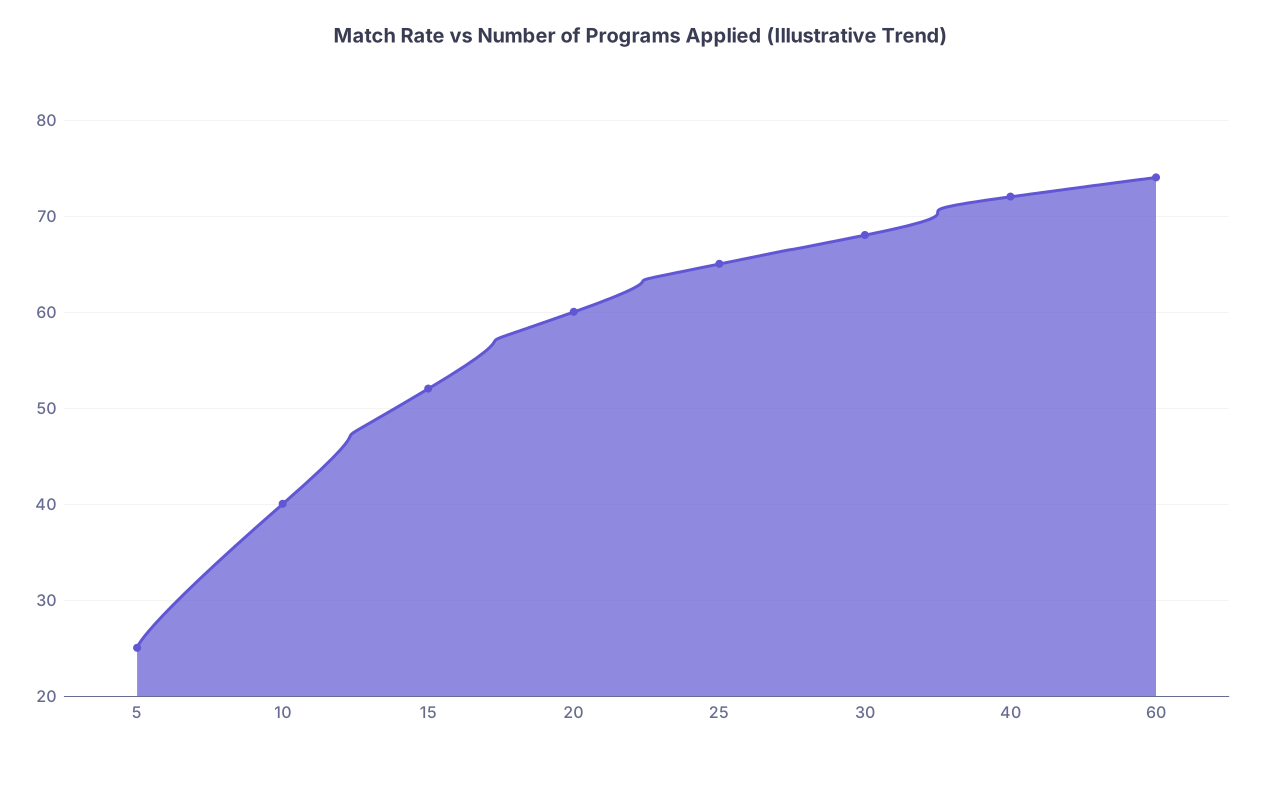
2. General Guidance: How Many Programs to Apply to in Med-Peds
The number of programs you should apply to depends on your profile and constraints. Because the total number of Med-Peds programs is relatively small, the numbers tend to be lower than highly competitive categorical specialties.
Rough ranges (for MD graduates from allopathic schools):
Highly competitive MD applicant, no major red flags, broad geographic flexibility
- Approximately 15–20 Med-Peds programs is often sufficient.
- May add a small number of categorical IM or peds programs as backup if desired.
Solid but not stellar MD applicant, typical profile, some geographic preferences
- Aim for 20–25 Med-Peds programs.
- Consider adding a thoughtful set of backup categorical programs in IM and/or peds, particularly in regions you care about.
Applicant with significant geographic constraints or mild academic concerns
- Consider 25–30 Med-Peds programs, if available in your acceptable locations.
- More deliberate use of categorical IM and/or peds backups is recommended.
Applicant with significant academic or professionalism concerns
- You may still apply to Med-Peds if your advisors encourage it, but:
- Apply to a wide array of categorical IM and pediatrics programs as primary targets.
- Med-Peds may function as a “stretch” option rather than your only plan.
Remember: these are approximate ranges, not firm rules. Your specific “how many programs to apply” decision should follow a personalized conversation with advisors, taking into account:
- Whether you are couples matching
- Whether you already have categorical interviews at your home institution
- Your willingness to reapply if you don’t match Med-Peds on the first try
3. Creating a Tiered List: Reach, Target, and Backup
A balanced program selection strategy often uses tiers:
Reach Programs (20–30%)
- Highly competitive academic centers
- Historically lower match rates or more selective applicant pools
- May be in ultra-desirable locations (major coastal cities, high-demand metro areas)
Target Programs (50–60%)
- Programs where your stats and experiences align well with typical matched residents
- Mix of strong academic and community-based programs
- Preferably in locations you’d be happy living in for four years
Safer or Backup Options (10–30%)
- Solid, possibly less competitive Med-Peds programs where your profile is above average
- Categorical internal medicine and/or pediatrics programs that you’d genuinely consider attending
This tiering helps insure against over-concentrating your applications in ultra-competitive locations while ensuring you still have a chance at your dream programs.

Step 4: Using Data and Tools to Refine Your List
Strong program selection strategy isn’t guesswork. Use all available data sources to build and refine your Med-Peds list.
1. Official Data Sources
NRMP Program Director Survey & Charting Outcomes in the Match
- Help you understand typical metrics of matched Med-Peds applicants
- Clarify how PDs weigh factors such as USMLE scores, clerkship grades, and letters
FRIEDA (AMA Residency & Fellowship Database)
- Provides program size, benefits, call schedules, and often a snapshot of clinical opportunities
- Look for program-specific details: number of Med-Peds residents, major training sites, and whether the program sponsors visas (if relevant)
Individual program websites
- Curriculum breakdowns between medicine and pediatrics
- Resident bios — these are revealing: see where residents came from, their interests, and where they go after graduation
- Descriptions of Med-Peds clinics, global health tracks, advocacy or QI pathways
2. Informal but Valuable Sources
Current residents and recent alumni
- Reach out via your school’s alumni network, Med-Peds interest groups, or social media (e.g., #medpeds on Twitter/X).
- Ask targeted questions:
- “What surprised you most once you started?”
- “What kind of resident tends to thrive here?”
- “If you could change one thing about the program, what would it be?”
Advisors at your home institution
- Particularly Med-Peds trained faculty who understand the inside dynamics of many programs.
- Ask where recent graduates with similar profiles matched and how they perceived those programs.
Virtual open houses and interest group events
- Many Med-Peds programs host webinars or Q&A sessions.
- Notice how program leadership interacts with applicants and whether residents feel free to speak candidly.
3. Iterative Refinement
Program selection should be dynamic:
- Start with a broad initial list (maybe 1.5–2× your target number).
- Apply your personal filters: geographic, academic focus, size, culture.
- Narrow down to your final application list, ensuring tier balance.
- Remain flexible: if you get a cluster of interviews from one region or tier, you can later fine-tune your rank list accordingly.
Step 5: Strategic Considerations Specific to the Medicine Pediatrics Match
Med-Peds has nuances that distinguish it from categorical matches. Being aware of these can strengthen your application and your program selection strategy.
1. Thinking Carefully About Backup Plans
Med-Peds applicants often wrestle with whether (and how) to apply to categorical internal medicine or pediatrics.
Options:
Med-Peds only
- Reasonable if:
- You’re a strong MD graduate,
- Have no geographic constraints,
- And are willing to reapply or SOAP into categorical if needed.
- Higher risk if you have constraints or academic concerns.
- Reasonable if:
Med-Peds plus categorical in one specialty (IM or Peds)
- Good if you could see yourself being satisfied in either single specialty.
- Helps ensure you match into a core field you truly enjoy.
Med-Peds plus both categorical IM and Peds
- Maximizes safety but can dilute your narrative if not carefully framed.
- Use your personal statement and letters to keep your core story coherent (e.g., commitment to complex chronic disease care through any of these paths).
If you pursue backups, be honest with yourself about whether you’d genuinely attend those programs. Do not treat categorical programs as purely theoretical—you may match there.
2. Crafting a Consistent Application Narrative
Your med peds residency program selection strategy is tightly linked to your narrative:
- Show a clear through-line:
- Past experiences → Med-Peds interest → Future career aspirations.
- Avoid looking “undecided between IM and peds” — Med-Peds is a deliberate choice, not a compromise.
- Ensure your program list is consistent with your stated interests:
- If you emphasize global health, at least some of your programs should have established global health initiatives.
- If you describe a passion for transitional care, target programs with robust adolescent/adult congenital or complex pediatric-to-adult transition clinics.
Programs notice when your story and choices align.
3. Couples Match Within Med-Peds or Across Specialties
If you’re in the Couples Match, your program selection strategy becomes more complex:
- Create city-based clusters where both partners have reasonable options.
- You may need to expand both:
- The number of cities you target, and
- The number of programs per city.
For example:
You (Med-Peds) + partner (Internal Medicine):
- Apply to med peds residency and IM programs in the same institutions/cities.
- Consider cities with multiple academic centers to increase pairings.
You (Med-Peds) + partner (non-IM/peds specialty):
- Carefully identify institutions where both specialties are strong enough to be realistic options.
- Expect to apply to more total programs than a typical Med-Peds applicant.
4. Reducing Overwhelm and Burnout During Application Season
Finally, remember that program selection, applications, and interviews are emotionally and logistically taxing.
Protect yourself by:
Setting clear limits:
- Decide a firm upper bound on interviews you can realistically attend (travel or virtual fatigue is real).
- Decline extra interviews once you have enough from programs you’d truly rank.
Keeping a live spreadsheet:
- Track program features, interview impressions, mentor comments, and gut feelings.
- After each interview, jot quick pros/cons while the experience is fresh.
De-briefing with mentors:
- Periodically review whether your evolving impressions should shift your rank list strategy (e.g., elevating certain “target” programs you loved over famous “reach” programs that felt like poor culture fits).
FAQs: Program Selection Strategy for MD Graduates in Medicine-Pediatrics
1. As an MD graduate, can I safely apply only to Med-Peds programs?
You can, but it depends heavily on your individual risk tolerance and situation. A strong MD graduate from an allopathic medical school with solid evaluations, no red flags, and broad geographic flexibility might choose to apply solely to Med-Peds, especially if they are willing to consider SOAP or reapplication if needed. However, most advisors recommend including categorical internal medicine and/or pediatrics programs—at least a modest number—so you’re not entirely dependent on a smaller match pool. If you have geographic limits or any academic concerns, relying exclusively on Med-Peds is risky.
2. How many Med-Peds programs should I apply to if I want to maximize my chances?
For a typical MD graduate in the medicine pediatrics match, 20–25 Med-Peds programs is a common target range, assuming you have some geographic flexibility. Very strong applicants might apply to 15–20, while applicants with constraints or concerns might consider 25–30 where available. Remember that more is not always better—beyond a certain number, applications add cost and complexity without significantly improving your odds. Focus on a balanced mix of reach, target, and safer programs that genuinely fit your goals.
3. How should I decide between university-based and community-based Med-Peds programs?
Base this decision on your career goals and learning preferences:
- Choose a university-based program if you anticipate academic careers, subspecialty fellowship, complex tertiary/quaternary care, or broad research opportunities. You’ll typically see more rare pathologies and have more formal scholarly expectations.
- Choose a community-based or hybrid program if you’re drawn to primary care, hospitalist work in community settings, or close-knit teams with continuity in a defined community. Many community-based Med-Peds programs still offer strong fellowship placement, but the day-to-day environment may be more reflective of typical future practice.
Most applicants select a mix of both and refine their rank list based on interview impressions of fit and culture.
4. What if my interest in Med-Peds is strong, but my Med-Peds-specific experiences are limited?
You can still be a competitive applicant—especially as an MD graduate—if your core training and performance are solid. Focus your application on:
- Highlighting experiences that show comfort with both adults and children, even if not labeled “Med-Peds” (e.g., hospitalist shadowing, student-run free clinics spanning ages, transition-of-care projects).
- Securing strong letters from internal medicine and pediatrics faculty who can speak to your performance, maturity, and potential to thrive in a combined program.
- Crafting a personal statement that clearly explains your reasoning for Med-Peds: your understanding of the specialty, your long-term goals, and how Med-Peds uniquely fits your aspirations.
Then, use your program selection strategy to favor programs that value holistic review, education, and mentorship—settings where your potential, not just your pedigree, will be recognized.
Designing a thoughtful program selection strategy as an MD graduate targeting a med peds residency is both an art and a science. Ground your choices in data, honest self-assessment, and clear priorities. If you align your program list with who you are, how you want to train, and where you hope to practice, you’ll not only increase your chances of a successful allopathic medical school match—you’ll set yourself up for a satisfying and sustainable career in Medicine-Pediatrics.