Residency application season can feel like a full-time job—especially for those pursuing a med peds residency. Medicine-Pediatrics (Med-Peds) is a small but highly competitive specialty, and building a smart program selection strategy is one of the most important steps for a successful medicine pediatrics match.
This guide walks you through how to choose residency programs in Med-Peds, how many programs to apply to, and how to create a realistic, personalized program list that maximizes your chances while protecting your wellbeing and budget.
Understanding the Med-Peds Landscape
Before diving into how to choose residency programs, it helps to understand the structure and realities of Med-Peds as a specialty.
What is Med-Peds, and why the strategy matters?
Internal Medicine–Pediatrics (Med-Peds) is a four-year combined residency that fully trains you in both Internal Medicine and Pediatrics. Graduates are board-eligible in both specialties and can pursue a wide range of career paths: primary care, hospital medicine, subspecialty fellowships, academic medicine, global health, and more.
Key features of Med-Peds that impact program selection strategy:
- Relatively small specialty: There are fewer Med-Peds positions than categorical Internal Medicine or Pediatrics positions.
- Program variation: Med-Peds programs differ widely in size, institutional type (university, community, hybrid), and emphasis (primary care, subspecialty, global health, research).
- Match dynamics: Many applicants are strong and highly motivated; some also dual-apply to categorical Medicine or Pediatrics, which shapes competitiveness and strategy.
Because of this, you cannot simply “apply broadly and hope for the best.” A thoughtful, data-driven program selection strategy is crucial.
How many Med-Peds programs exist?
Numbers change slightly year to year, but typically there are:
- Roughly 80–90 Med-Peds programs in the U.S.
- Around 450–500 PGY-1 Med-Peds positions total
Compared with hundreds of categorical Internal Medicine and Pediatrics programs, the Med-Peds universe is relatively small. That makes each choice on your list more consequential.
Step 1: Clarify Your Personal and Professional Priorities
Any strong program selection strategy starts with you—not with program rankings or prestige. Before you decide how many programs to apply to or which ones to target, clarify what you actually want out of training.
Core career questions to answer
Spend some time reflecting (and ideally writing) about the following:
Long-term career goals
- Do you see yourself in primary care, hospital medicine, or a subspecialty?
- Are you interested in academic medicine, medical education, research, or administration?
- Do you want to practice in urban, suburban, or rural settings?
- Do you envision caring for both adults and children long-term, or do you anticipate focusing on one population after training?
Lifestyle and location
- Geographic deal-breakers (family ties, visas, partner’s career, cost of living).
- Preferences for region (Northeast, South, Midwest, West), urban vs small city, climate.
- Desired call schedule intensity and work-life balance tolerance.
Training environment
- Large university vs community-based vs hybrid programs.
- Exposure to quaternary care vs community pathology.
- Interest in global health, underserved populations, or public health.
Learning style and support needs
- Do you thrive in large cohorts or small, tight-knit teams?
- How important is formal mentorship, scholarly support, and structured curricula?
- Are you seeking a particularly diverse patient population or robust advocacy training?
Once you’re clear on your priorities, every aspect of how to choose residency programs becomes easier: each program either moves you toward these goals, or it doesn’t.
Step 2: Build a Thoughtful “Universe” of Programs
After clarifying your goals, the next step in your program selection strategy is to create a broad “universe” of programs you might consider—then strategically narrow.
Starting sources for Med-Peds programs
Use multiple tools to build your initial list:
- NRMP and ERAS program lists: Official directories of accredited Med-Peds programs.
- American Academy of Pediatrics (AAP) / American College of Physicians (ACP) Med-Peds resources and program directories.
- Program websites: Often provide detailed information about curriculum, hospitals, resident life, and alumni.
- Current residents and alumni: Especially those from your school who matched into Med-Peds.
- Faculty advisors and Med-Peds mentors: They often know intangible factors—culture, mentorship, stability—that don’t show up on websites.
Creating an initial long list
Aim for an initial long list of 30–40+ programs that are at least potentially aligned with your interests and constraints. Don’t worry yet about how many programs to apply to—this is about exploration.
For each program, track:
- Location (city, region, climate)
- Program size (number of residents per year)
- Institution type (university, community, safety-net, children’s hospital affiliation)
- Notable features:
- Global health / underserved focus
- Med-Peds continuity clinics (adult and pediatric)
- Combined clinics (transition care, complex care)
- Research infrastructure
- Hospital medicine vs primary care emphasis
- Your initial impression from the website and resident bios
Use a spreadsheet to keep this organized; you’ll refine it as you go.

Step 3: How Many Programs to Apply to in Med-Peds?
One of the most common and anxiety-provoking questions is: how many programs to apply to for a Med-Peds residency?
There is no one-size-fits-all answer, but we can outline reasonable ranges and how to personalize them.
General numerical guidance
For most U.S. MD or DO applicants targeting Med-Peds as their primary specialty:
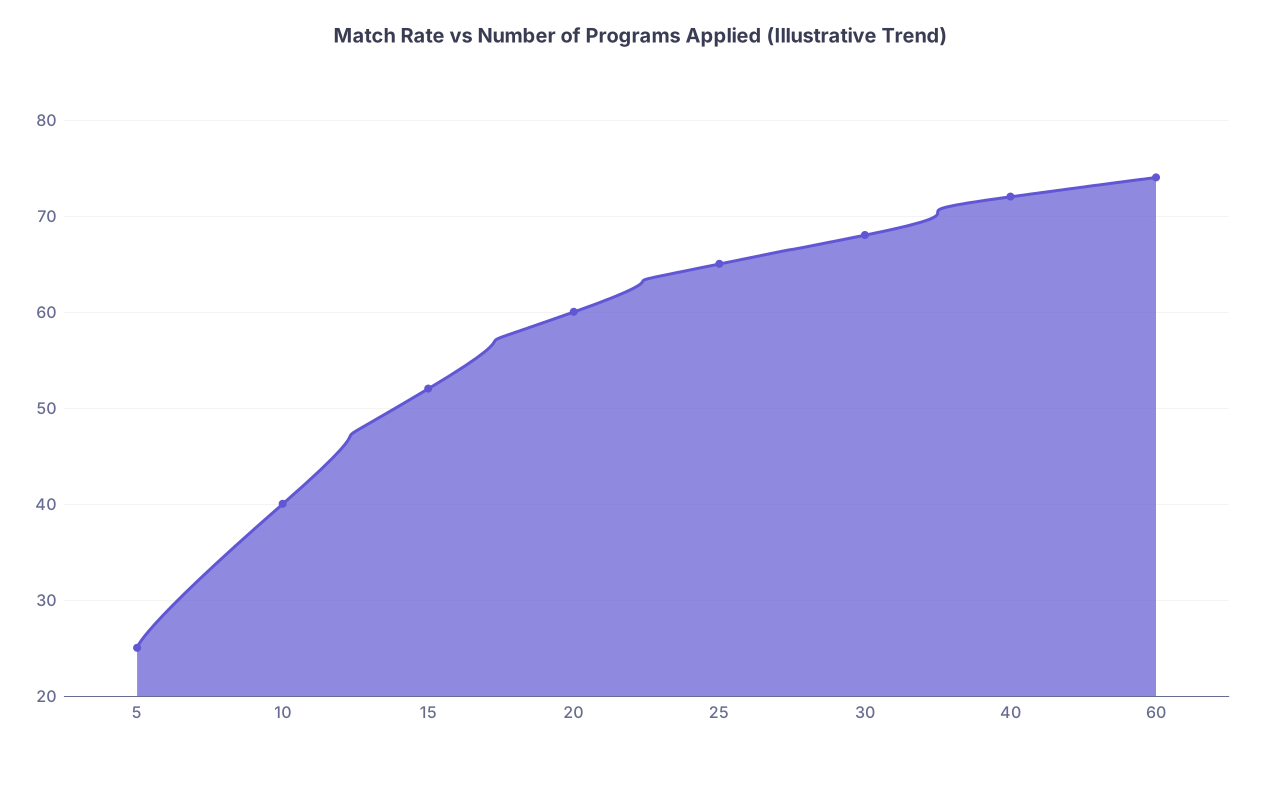
- Typical range: 15–25 Med-Peds programs
- Higher end (20–30):
- If you have application concerns (lower Step scores, remediation, limited clinical honors, late specialty switch, visa needs).
- If you are geographically restricted to competitive regions (e.g., only interested in a few major cities).
- Lower end (10–15):
- If your application is very strong (strong scores, strong grades, Med-Peds specific letters, home Med-Peds program, significant scholarly work).
- And you are flexible geographically and in program style.
If you are dual-applying (e.g., Med-Peds + categorical Internal Medicine or Pediatrics), your total number of programs may be higher, but your Med-Peds list can still be around 10–20 programs, depending on your risk tolerance and competitiveness.
Match statistics and safety
The NRMP data (positions vs applicants) vary each year, but Med-Peds:
- Typically has a high fill rate.
- Matches the majority of U.S. MD seniors who rank enough programs.
- Can be more challenging for IMGs or applicants with significant red flags.
A helpful rule of thumb:
- Try to obtain 10–12 interviews in Med-Peds if it’s your primary specialty.
- Historically, ranking 8–10 programs gives a high probability of matching if they are a mix of reach, target, and safer programs.
Because you cannot fully control interview invitations, applying to a sufficient number of programs up front is your best protection.
Balancing cost, burnout, and safety
More is not always better. Apply too broadly and you may face:
- Excessive interview travel/time (even with virtual interviews, time commitments are substantial).
- Application costs that rapidly increase beyond about 20–25 programs.
- Decision fatigue and less time for genuinely preparing for each interview.
Program selection strategy in Med-Peds should balance:
- A statistically safe number of applications,
- Realistic financial costs,
- Your capacity to handle interviews and follow-up communications well.
Step 4: Tiers and Filters – Narrowing Down Your List
Once you’ve built a long list and a target range for how many programs to apply to, the next step is intelligent narrowing—deciding which programs best fit your goals and how to categorize them.
Use “must-have,” “nice-to-have,” and “deal-breaker” criteria
Define three levels of filters:
Must-have criteria
- Geographic constraints (e.g., within 3 hours of family, specific states).
- Visa sponsorship needs (for IMGs).
- Required Med-Peds features (e.g., dedicated Med-Peds clinic, strong Med-Peds identity).
- Adequate exposure to your intended career path (e.g., access to adult and pediatric subspecialties you’re interested in).
Nice-to-have factors
- Formal Med-Peds tracks (global health, advocacy, hospital medicine).
- Scholarly infrastructure: residents regularly presenting at national conferences, QI projects, research.
- Strong mentorship and alumni network in your area of interest.
- Schedule design (block vs longitudinal Med-Peds experiences, night float, 4+1 systems).
Deal-breakers
- Locations you truly could not live for four years.
- Programs misaligned with your fundamental career goals (e.g., overwhelmingly primary care–focused if you want research-intensive subspecialty training, or vice versa).
- Recurrent serious concerns about culture, mistreatment, or instability (from multiple, reliable sources).
Apply these filters systematically to your long list and narrow it down to your target number of applications.
Categorize programs into “reach,” “target,” and “safer”
A sophisticated program selection strategy uses tiers—not all programs on your list should be of the same competitiveness relative to your application.
Using your school’s Med-Peds advisor or national Med-Peds mentors, classify:
Reach programs
- Highly competitive institutions or locations.
- Programs where your metrics are below or at the lower end of their typical matched cohort.
- You’re still a plausible candidate, especially with strong narratives, but less predictable.
Target programs
- Your metrics and experiences closely match their current or recent residents.
- Programs where your probability of interview and match is solid.
Safer programs
- Programs where your academic metrics and experiences are above their typical range.
- Usually less in-demand geographic areas or mid-size programs.
- These are crucial for match security.
Aim for a mix like:
- 20–30% reach
- 40–60% target
- 20–30% safer
Example for an applicant aiming to apply to 20 Med-Peds programs:
- 5–6 reach programs
- 9–11 target programs
- 4–5 safer programs
This tiered approach alleviates the anxiety of “is my entire list too competitive?” and ensures you’re not overloading on only dream programs.
Step 5: Evaluating Programs in Depth
After you have a manageable list and tiers, refine your program selection strategy by evaluating each program more deeply.
Key Med-Peds–specific factors to review
Program identity and integration
- Is there a clear Med-Peds identity (e.g., leadership in institutional roles, Med-Peds–specific conferences, combined didactics)?
- How integrated are Med-Peds residents within categorical Internal Medicine and Pediatrics?
Curriculum structure
- Rotational pattern: 3+3 months, 4+4, 6+6, or other?
- Continuity clinics: separate adult and pediatric clinics vs combined Med-Peds clinics.
- Exposure to transitional care (adolescents with chronic pediatric-onset conditions entering adulthood).
Resident cohort and culture
- Number of Med-Peds residents per year (1–2 vs 6–8+).
- Do residents appear collaborative and happy in photos and resident bios?
- Diversity of trainees: background, interests, demographics.
Clinical training sites
- Quality and reputation of adult and children’s hospitals.
- Range of pathology: tertiary/quaternary referral vs community-based.
- Opportunities in community settings, rural rotations, or subspecialty electives.
Career outcomes
- Where graduates go: fellowships (which specialties and where), hospitalist jobs, primary care positions, leadership roles.
- Evidence of support for fellowships if that’s your plan (letters, research connections, mentors).
Scholarly and leadership opportunities
- Track record of resident publications, QI projects, and conference presentations.
- Mentorship for academic careers, educational leadership, or health policy.
Practical evaluation strategies
- Program websites + Instagram/X: See how they present their residents, recent achievements, and DEI and wellness initiatives.
- Ask upperclassmen and alumni: Especially those with similar goals or backgrounds to yours.
- Pre-interview communication: Some programs host informal info sessions or second-look webinars where you can ask targeted questions.
- Talk with Med-Peds faculty mentors: Present your short list and ask for honest impressions.
Throughout, keep returning to your original priorities: Does this program realistically support the type of physician you want to become?

Step 6: Integrating Strategy with the Interview and Match Phases
Program selection doesn’t end after submitting ERAS. The interview phase gives you crucial new information that should refine your program ranking strategy.
Before interviews: Prepare targeted questions
For each program you interview at, prepare a short list of program-specific questions aligned with your goals. Examples:
For someone interested in hospital medicine:
- “How are Med-Peds residents integrated into hospitalist teams on both adult and pediatric sides?”
- “What proportion of recent graduates go into hospitalist positions, and how does the program support them?”
For someone focused on underserved populations:
- “What opportunities exist for longitudinal work with underserved communities?”
- “Are there formal advocacy or community outreach tracks for Med-Peds residents?”
This helps you genuinely compare programs for fit, rather than relying solely on prestige or vague “feel.”
During interviews: Observe culture and values
While virtual interviews change the environment, you can still assess:
- How residents talk about:
- Workload and backup.
- Relationships between Med-Peds and categorical residents.
- How leadership responds to feedback.
- Whether program leadership knows and can articulate:
- Med-Peds residents’ unique role.
- How they protect Med-Peds residents from getting pulled disproportionately to one department.
- How transparent they are about:
- Program challenges.
- Ongoing improvement efforts.
Take structured notes right after each interview: list three pros, three cons, and one “intangible vibe” impression. This will be invaluable for the rank list stage.
After interviews: Reassess your strategy
As you receive interview invitations, you may need to adjust:
- If you have fewer Med-Peds interviews than hoped:
- Consider adding more categorical Internal Medicine or Pediatrics interviews (if you dual-applied or are open to it).
- Revisit “safer” programs in nearby specialties if necessary.
- If you have many Med-Peds interviews (e.g., 15+):
- You might strategically decline a few interviews that are clearly poor fits (geography, career misalignment).
- Use your time to deepen engagement with top-choice programs (attend optional sessions, meet residents again).
Remember, your goal is not just to match, but to match into a program where you will thrive.
Putting It All Together: A Sample Program Selection Plan
To illustrate a complete program selection strategy in Med-Peds, consider this example:
Applicant profile
- U.S. MD, solid academics (middle–upper quartile, passes Step 1, above-average Step 2 CK).
- Strong clinical grades in Medicine and Pediatrics.
- One Med-Peds sub-I, two Med-Peds letters.
- Career interest: hospital medicine with some teaching.
- Geographic preference: Midwest or Northeast, but flexible.
- No significant red flags.
Strategy
Clarify priorities
- Needs robust Med-Peds identity.
- Wants hospital medicine mentors on both adult and pediatric sides.
- Prefers medium-to-large resident cohorts and university-affiliated programs.
Build long list
- Identifies ~35 Med-Peds programs in Midwest and Northeast, plus a few in other regions with strong Med-Peds reputations.
Decide how many programs to apply to
- Target: 20–22 Med-Peds programs.
- No dual application planned; Med-Peds is primary.
Filter and tier
- Remove 10 programs due to location deal-breakers or clearly misaligned focus.
- Remaining 25 programs:
- 6 reach (prestigious urban academic centers).
- 11 target (university or hybrid programs in mid-size cities).
- 8 safer (smaller programs in less competitive locations).
- Further narrow to 21 total (6 reach, 9 target, 6 safer) based on mentorship opportunities.
Interview season response
- Receives 13 interviews: 3 reach, 7 target, 3 safer.
- Cancels no interviews; attends all.
- After interviews, ranks all 13 based on fit, not prestige alone.
This structured approach combines data-driven planning with nuanced self-knowledge, leading to a strong chance of a satisfying match.
Frequently Asked Questions (FAQ)
1. Is Med-Peds more competitive than categorical Internal Medicine or Pediatrics?
Med-Peds generally has fewer positions and a high fill rate, which can make it feel more competitive, especially at certain well-known programs. However, many applicants who pursue a med peds residency are very focused on the combined pathway, so the overall applicant pool is self-selected. If you have solid clinical evaluations, thoughtful letters (especially from Med-Peds faculty), and a clear narrative for why Med-Peds, your chances are good—particularly if your program selection strategy includes a balanced mix of reach, target, and safer programs.
2. If I dual-apply (e.g., Med-Peds + Pediatrics), how many programs should I apply to in each?
Dual-application strategy is highly individual, but typical patterns include:
- Primary focus on Med-Peds:
- 12–20 Med-Peds programs + 8–15 categorical (Medicine or Pediatrics) programs.
- Truly undecided between Med-Peds and a categorical specialty:
- More balanced numbers (e.g., 10–15 Med-Peds, 15–20 categorical).
Key points:
- Clearly communicate your genuine interest in each specialty where you apply.
- Make sure your total number of applications/interviews does not become unmanageable.
- Work closely with a trusted advisor to tailor your plan.
3. How do I know if a program is a good “fit” for me?
Fit combines objective and subjective elements:
Objective:
- Program structure aligns with your career goals (fellowship vs primary care vs hospital medicine).
- Geographic and lifestyle factors are workable for you and your support system.
- Adequate Med-Peds identity, mentorship, and alumni outcomes.
Subjective:
- You feel comfortable and respected in interactions with residents and faculty.
- The culture seems supportive, not punitive.
- Residents you meet seem like people you would trust and enjoy working with at 3 a.m.
Use both logic and gut instinct—but always ensure basic objective needs are met before relying on “vibes.”
4. Should I apply to every Med-Peds program just to be safe?
In almost all cases, no. Applying to every program:
- Greatly increases cost and administrative burden.
- Makes it harder to research and present yourself authentically to each program.
- May still leave you with a poorly fitting match if you don’t think critically about fit.
A targeted list of 15–25 well-chosen programs—built using a deliberate program selection strategy—is usually more effective than blanket applications. Focus on quality of fit and a smart mix of reach, target, and safer options, rather than sheer quantity.
By approaching your medicine pediatrics match with a clear, structured program selection strategy—clarifying your goals, understanding how many programs to apply to, filtering based on realistic criteria, and actively assessing fit—you position yourself not only to match, but to thrive in a Med-Peds residency that aligns with the physician you aspire to become.