Understanding the Unique Landscape of Medicine-Psychiatry Residency
For an MD graduate residency applicant, choosing a Medicine-Psychiatry combined program is both exciting and strategically complex. Medicine-psychiatry residencies are small, relatively few in number, and highly individualized. That makes your program selection strategy especially important—far more so than in many larger, more standardized specialties.
This article will walk you step-by-step through:
- How to think about your goals as a future med-psych physician
- How to evaluate programs beyond just reputation and location
- How to choose residency programs that fit your background and competitiveness
- How many programs to apply to in Medicine-Psychiatry
- Concrete examples, checklists, and practical tips tailored to MD graduates from allopathic medical schools
Throughout, we’ll keep the emphasis on actionable strategy, not just generic advice about the allopathic medical school match.
Clarify Your Career Goals Before You Build a Program List
Before asking how to choose residency programs, start with what you want your career to look like. Medicine-psychiatry combined training is inherently flexible—but programs differ significantly in how they support different career paths.
Step 1: Define Your Long-Term Direction
Spend time articulating your top 1–3 long-term goals. For example:
Academic/Research-Focused Med-Psych Physician
- Interests: Health services research, integrated care models, serious mental illness and comorbid medical disease, addiction.
- You might value: Strong research infrastructure, MPH or PhD opportunities, NIH-funded faculty, protected research time.
Integrated Outpatient or Primary Care Mental Health Clinician
- Interests: Collaborative care in primary care settings, community mental health, outpatient psychopharmacology, chronic disease + mental illness.
- You might value: Federally Qualified Health Center (FQHC) rotations, VA integrated care models, continuity clinics in integrated settings.
Hospital-Based Med-Psych Consultant
- Interests: C-L psychiatry, inpatient medicine, ICU consultation, delirium, complex medical-psychiatric inpatients.
- You might value: Strong consultation-liaison psychiatry services, robust inpatient medicine, med-psych inpatient units.
Rural or Underserved Community Clinician
- Interests: Broad-scope practice, limited access settings, telepsychiatry, global health, substance use in rural environments.
- You might value: Rural or community rotations, global health tracks, strong addiction services, broad procedural exposure in medicine.
Write your version in one sentence:
“I want to be a med-psych physician who primarily does ______ in a setting like ______, with a focus on ______.”
This will become your anchor when comparing programs.
Step 2: Identify “Non-Negotiables” vs. “Preferences”
List your non-negotiables—elements you truly must have:
- Must be in a specific geographic region (e.g., family, visa, partner’s career)
- Must have strong addiction training
- Must have established integrated primary care clinics
- Must offer serious mental illness focus or med-psych inpatient units
Then list preferences that would be great but not essential:
- Urban vs suburban vs rural location
- Program size and culture
- Formal combined med-psych conferences
- Opportunity for chief resident roles
- Specific research mentor interests
When you later review programs, you’ll label each item as:
- Meets most non-negotiables
- Meets some non-negotiables
- Meets few non-negotiables
This prevents you from being swayed solely by name recognition or city appeal.

Understanding the Medicine-Psychiatry Combined Training Structure
A well-thought-out program selection strategy requires understanding how medicine-psychiatry residencies are structured and how they differ.
Core Features of Medicine-Psychiatry Combined Programs
Most medicine-psychiatry residencies:
- Are 5-year combined programs that confer eligibility for both:
- American Board of Internal Medicine (ABIM)
- American Board of Psychiatry and Neurology (ABPN)
- Are small, often taking 2–4 residents per year
- Have a limited national footprint compared with categorical internal medicine or psychiatry
- Can be structured as:
- Fully integrated (switching between med and psych at regular intervals)
- “Front-loaded” or “back-loaded” (heavier on medicine or psychiatry in early years)
- Block model vs. longitudinal continuity exposures
Key Dimensions That Differ Between Programs
As an MD graduate residency applicant, pay attention to these differentiating factors:
Balance Between Medicine and Psychiatry
- How evenly are months distributed?
- Are there extended continuous blocks in one specialty (e.g., 6–12 months of medicine early on)?
- Is there explicit integrated med-psych teaching or largely separate training tracks?
Presence of Dedicated Med-Psych Units or Services
- Combined inpatient med-psych units
- Dedicated C-L teams led by med-psych faculty
- Integrated addiction services with strong medical management
Culture and Identity of the Med-Psych Track
- Is med-psych fully integrated and valued within the institution?
- Are med-psych residents isolated or well supported by categorical peers?
- Are there med-psych faculty mentors and graduates in influential roles?
Dual Board Preparation
- Pass rates for ABIM and ABPN
- Formal board review resources
- Track record of graduates successfully sitting for both boards on schedule
Pathways After Graduation
- Fellowship matches (e.g., C-L psychiatry, addiction, cardiology, palliative care)
- Graduates in academic roles vs community practice
- Leadership positions in integrated care or system-level innovation
When you compare programs, look beyond “they have a combined program” and ask: “How do they specifically integrate medicine and psychiatry training?”
Building a Targeted Program List: Competitiveness, Fit, and Strategy
Now we turn to the heart of your program selection strategy: how to build a realistic yet ambitious list of medicine-psychiatry combined programs.
Step 1: Honestly Assess Your Application Strength
As a graduate of an allopathic medical school, you already meet a core expectation many programs have. Then look at:
- USMLE/COMLEX Scores
- Above-average vs average vs below-average for IM and Psychiatry
- Clinical Performance
- Medicine and psychiatry clerkship grades
- Sub-internships (especially in IM, psych, or med-psych if available)
- Med-Psych Commitment Signals
- Electives in C-L psychiatry, addiction, psychosomatic medicine, integrated care
- Scholarly projects linking medical and psychiatric care
- Longitudinal clinics or community psychiatry work
- Letters of Recommendation
- Do you have at least one strong letter from:
- Internal medicine faculty
- Psychiatry faculty
- Ideally a med-psych or C-L psychiatrist?
- Do you have at least one strong letter from:
- Red Flags
- Any USMLE failures?
- Remediation or professionalism issues?
- Significant time off? (which can be explainable but needs framing)
Rough self-categorization (just for planning):
- Highly Competitive
- Above-average scores, strong clinical grades, clear med-psych involvement, strong letters.
- Moderately Competitive
- Solid but not exceptional metrics, good clinical performance, some med-psych evidence.
- Potentially Challenged
- Score issues, limited med-psych exposure, or other red flags that require careful explanation.
This informs both how many programs to apply to and which tiers you realistically target.
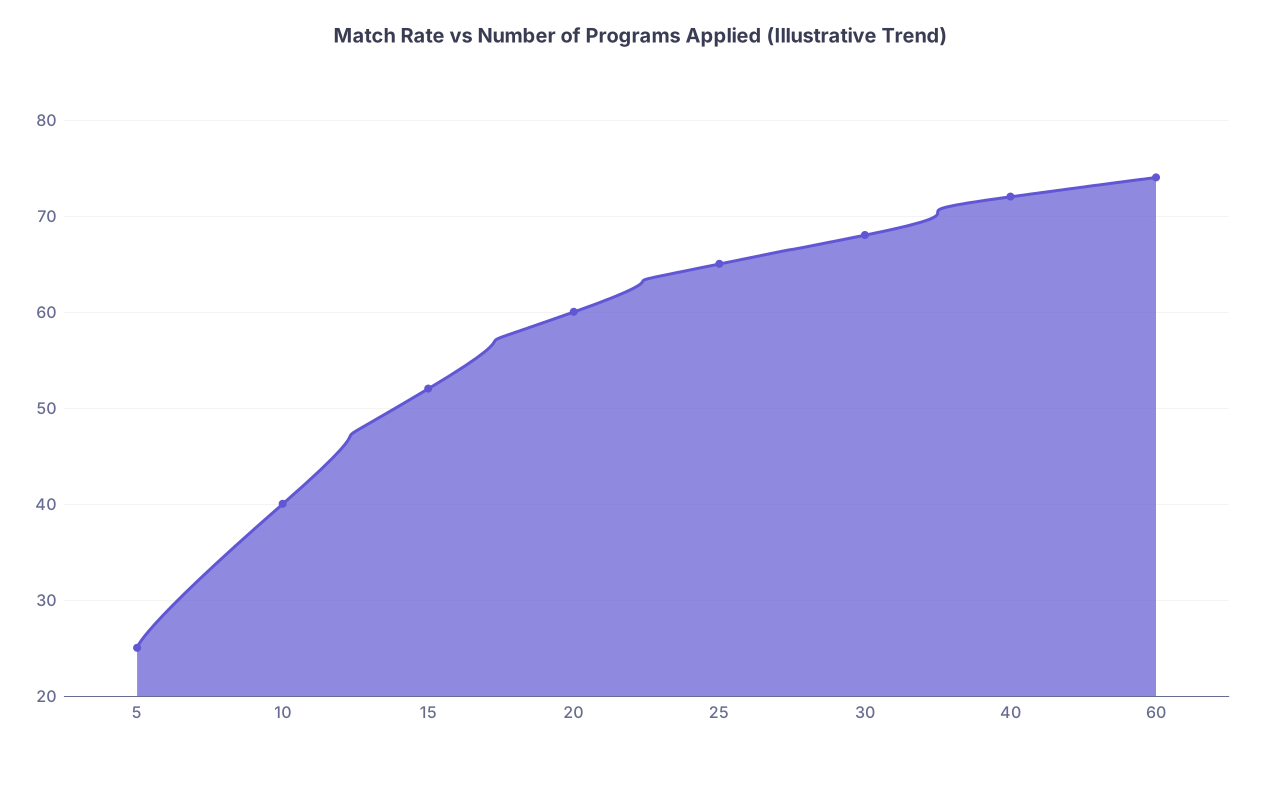
Step 2: Decide How Many Programs to Apply to in Med-Psych
Medicine-psychiatry is niche, but that doesn’t mean you should only apply to one or two programs. At the same time, there are far fewer programs than in categorical IM or psych, so you physically cannot apply to 50 med-psych residencies.
As of recent match cycles, there are roughly 15–20 medicine-psychiatry combined programs (numbers can vary slightly year to year). Many applicants also dual-apply to:
- Categorical Internal Medicine
- Categorical Psychiatry
- Occasionally Family Medicine or other integrated tracks
For med-psych programs specifically, a common rule of thumb for an MD graduate:
Highly Competitive Applicant
- Apply to 70–90% of available med-psych programs (e.g., 12–16 programs if 18 exist that year)
- Likely no need to apply to every single program unless geography is flexible and you want maximum security.
Moderately Competitive Applicant
- Apply to essentially all med-psych programs you’d consider attending, usually 14–18.
- Strongly consider dual-applying to categorical IM and/or psychiatry in regions you’d accept.
Potentially Challenged Applicant
- Apply to all med-psych programs (unless there are absolute geographic barriers)
- Strategically apply to a substantial number of categorical IM and/or psychiatry programs, sometimes 20–40+ total across those specialties, depending on your profile.
Remember:
- Interview caps and financial constraints matter.
- More applications ≠ better if you are indiscriminate.
- Your goal is a balanced list where you would genuinely be willing to rank each program.
Step 3: Build a Tiered List (Reach, Target, Safety)
Similar to other specialties, structure your med-psych list:
Reach Programs
- Programs at very prestigious institutions
- Very small programs (1–2 residents/year)
- Historically very competitive, or with unique high-demand features (e.g., famous med-psych units)
Target Programs
- Programs where your metrics and experiences are near or slightly below their typical matched applicant profile
- Reasonable geographic and mission fit
Safety Programs (relative term in a niche field)
- Programs with more spots or historically broader applicant pools
- Programs outside major “hotspot” cities
- Places where your metrics are clearly above their typical matched profile (based on past match lists or anecdotal data)
Within med-psych, “safety” is always relative because overall numbers are small, which increases inherent uncertainty. That’s where dual-applying to categorical specialties becomes part of a robust program selection strategy for the allopathic medical school match.

What to Look for When Evaluating Individual Med-Psych Programs
Once you’ve decided how many programs to apply to and built a preliminary list, the next step is a structured evaluation of each program.
1. Curriculum Design and Integration
Questions to ask:
- How are the 5 years distributed between medicine and psychiatry?
- 30 months medicine / 30 months psychiatry?
- Concentrated early medicine then more psychiatry?
- Are there integrated med-psych rotations beyond the standard ABIM/ABPN requirements?
- Dedicated med-psych inpatient units
- Consult services focused on medically complex psychiatric patients
- Addiction medicine with strong medical-management component
- Is there a med-psych continuity clinic or are medicine and psychiatry clinics separate?
- Are wellness and burnout prevention addressed, given the intensity of dual training?
Example:
Program A alternates 3-month blocks of medicine and psychiatry for 4 years, then a flexible 5th year with med-psych electives, research, and advanced consult rotations. This may be ideal if you like variety but can be challenging if you prefer longer immersion in one specialty at a time.
2. Faculty and Mentorship
Look closely at:
- How many faculty are dual-trained in medicine-psychiatry?
- Are there recognized leaders in:
- C-L psychiatry
- Integrated care
- Addiction medicine
- Serious mental illness with medical comorbidities
- Do current residents speak positively about:
- Accessibility of mentors
- Responsiveness of program leadership
- Support for individualized career paths (e.g., extra research time, MPH, global health)
Example:
Program B has 5 dual-trained faculty, a med-psych program director, and an established weekly med-psych conference. This suggests strong identity and mentorship potential.
3. Resident Culture and Support
Even an excellent curriculum can feel unsustainable if the culture is unhealthy.
Consider:
- How do med-psych residents describe:
- Workload and call schedules on medicine vs psychiatry
- How they are treated by categorical IM and psych residents
- Their identity—do they feel “in between” or fully integrated?
- Are there tangible wellness resources (e.g., mental health support, guaranteed days off after call, programmed wellness time)?
- Do residents appear:
- Burned out and cynical, or
- Engaged, honest about challenges, but overall satisfied?
Tip: During interviews, always ask:
“What are one or two things you would change about this med-psych program if you could?”
The specificity and tone of the answer tell you a lot.
4. Outcomes and Career Paths
Look at where graduates go:
- Fellowship:
- C-L psychiatry, addiction, geriatrics, cardiology, pulmonary/critical care, palliative care, etc.
- Job types:
- Academic faculty in med-psych
- Medical directors of integrated clinics
- Community roles in safety-net hospitals
- Geographic spread of alumni:
- Stay local vs dispersed nationally
- This may matter if you’re targeting a future region.
Ask for a list of recent graduates and their current positions. Programs proud of their outcomes usually share this readily.
5. Personal and Practical Considerations
Finally, practical issues matter:
- Location and Cost of Living
- Will you (and your family if applicable) be comfortable there for 5 years?
- Partner/Family Needs
- Employment opportunities for partners
- Schools or childcare if you have or plan to have children
- Visa and Employment
- For non-citizens: J-1 vs H-1B sponsorship policies
- Institutional support for immigration processes
Don’t underestimate the impact of geography and cost of living on your quality of life over 5 years of intense dual training.
Putting It All Together: A Practical Step-by-Step Strategy
To make this concrete, here is a structured workflow you can follow as an MD graduate crafting a program selection strategy for medicine-psychiatry combined training.
Step 1: Initial Research (2–3 Weeks)
- Generate a master list of all medicine-psychiatry combined programs from:
- ACGME listings
- Program websites
- NRMP directory
- Create a spreadsheet with columns such as:
- Program name
- City/State
- Program size (med-psych residents/year)
- Curriculum structure (integrated vs block)
- Med-psych units/services (Y/N)
- Dual-trained faculty count (approximate)
- Research opportunities
- Non-negotiables met (Y/Partial/N)
- Subjective interest level (1–5)
Step 2: Narrow to Serious Consideration List
- Exclude programs that clearly violate your non-negotiables (e.g., wrong region, no visa, curriculum highly misaligned).
- Highlight:
- High-interest programs (your dream tier)
- Moderate-interest programs (good fit)
- Backup programs (you’d attend, but they’re not your top choice)
Aim for a serious consideration list of:
- Most or all med-psych programs that you could realistically see yourself attending.
Step 3: Decide on Dual-Application Strategy
Based on your competitiveness and risk tolerance:
- If highly competitive:
- Primary focus on med-psych, with a modest number of categorical IM or psychiatry programs as a safety net.
- If moderately competitive:
- Full med-psych applications + a solid set of categorical IM and/or psychiatry programs in your desired region.
- If potentially challenged:
- All med-psych programs + larger number of categorical IM and/or psych to maximize match chances.
Document clearly:
- Total programs you will apply to
- How many are:
- Med-psych combined
- Categorical internal medicine
- Categorical psychiatry
Step 4: Deep Dive on Shortlisted Programs
Use websites, resident manuals (if available), virtual open houses, and networking (e.g., mentors, alumni) to answer detailed questions:
- How do med-psych residents describe their identity and support?
- What unique integrated care experiences exist?
- What is call structure for med-psych residents vs categorical residents?
- Are there dedicated med-psych didactics?
Update your spreadsheet with:
- Notes from open houses
- Comments from current residents
- Fit scores for:
- Curriculum
- Culture
- Career alignment
Step 5: Finalize Your Application List
Using all the above:
- Remove programs that:
- Consistently feel like poor fit
- Would be untenable for personal reasons (cost, location, culture)
- Ensure:
- You have the number of applications appropriate for your competitiveness
- Your list includes a mix of reach, target, and relatively safer programs
Step 6: Recalibrate After Interview Invitations
Once interviews start coming in:
- If you have fewer med-psych interviews than expected:
- Increase focus on preparing strongly for categorical interviews
- Explore adding late-application categorical programs if feasible
- If you have multiple med-psych interviews:
- Prioritize preparation for those
- Continue evaluating fit carefully; do not assume all med-psych programs are interchangeable
Frequently Asked Questions (FAQ)
1. How many medicine-psychiatry programs should I apply to as an MD graduate?
For an MD graduate from an allopathic medical school:
- If you are reasonably competitive (solid scores, good clinical performance, some med-psych exposure), aim to apply to the majority of med-psych programs you’d genuinely consider, often 12–18 programs depending on how many exist that year.
- If you have application concerns (exam failures, limited med-psych experience), strongly consider applying to all med-psych programs and supplement with a substantial number of categorical IM and/or psychiatry programs.
- Highly competitive applicants may not need every program but commonly still apply to at least 70–90% of available med-psych options, given the small national pool.
2. Should I dual-apply to Internal Medicine or Psychiatry if I’m committed to med-psych?
In many cases, yes. Because med-psych is small and inherently more variable, a parallel application to categorical internal medicine and/or psychiatry is a rational risk management strategy. You can:
- Target categorical programs that share:
- Strong C-L psychiatry
- Integrated care initiatives
- Interest in medically complex psychiatric populations
This keeps you aligned with your interests even if you train in a categorical program and later pursue fellowships or integrated-care roles.
3. What signals to programs that I’m genuinely interested in medicine-psychiatry combined training?
Programs look for:
- Evidence of sustained interest in both medicine and psychiatry:
- Strong clerkship/sub-I performance in both
- Electives bridging the fields (C-L, addiction, med-psych units)
- Scholarly or quality improvement work at the intersection of medicine and mental health
- Letters of recommendation that:
- Highlight your aptitude for complex, integrated care
- Emphasize adaptability, curiosity, and strong communication skills
- Personal statement that:
- Clearly articulates why med-psych (not just “I like both”)
- Shows you understand what the training entails
4. How much does program “prestige” matter in med-psych residency?
Reputation can influence fellowship opportunities and networking, but in medicine-psychiatry combined training, fit and alignment with your career goals usually matter more than pure prestige. A smaller or less famous program with:
- Dedicated dual-trained faculty
- Robust integrated care environments
- Strong mentorship and supportive culture
may prepare you better for your desired career than a brand-name institution with a weaker med-psych identity. Prioritize programs where you could realistically thrive for five demanding years and graduate ready to do the kind of medicine psychiatry combined practice you envision.
Thoughtful program selection is a key part of a successful allopathic medical school match into medicine-psychiatry. By clarifying your goals, understanding the structure of med-psych training, realistically assessing your competitiveness, and strategically deciding how many programs to apply to, you give yourself the best chance of landing in a program where you can grow into the kind of integrated clinician you aim to be.