Understanding the Unique Landscape of Med-Psych Residency
Choosing a program in medicine psychiatry combined training is very different from selecting a categorical internal medicine or psychiatry residency. The relatively small number of med psych residency programs, the unique dual-board pathway, and the culture of these hybrid departments mean your program selection strategy must be deliberate and informed.
You are not just choosing “where you’ll train.” You are choosing:
- Two departments and two cultures (medicine and psychiatry)
- A specific model of integrated training
- The type of patients and systems you’ll work in for five years
- Your future niche: inpatient vs outpatient, academic vs community, primary care vs consult-liaison vs serious mental illness care, etc.
This guide walks you through a step-by-step program selection strategy tailored specifically to medicine-psychiatry, including how to choose residency programs, how many programs to apply to, and what to prioritize as you build a realistic yet ambitious rank list.
Step 1: Clarify Your Career Vision Before Looking at Programs
Before you open a single spreadsheet or ERAS filter, you need clarity about why you’re choosing medicine-psychiatry and what you want to do with it. The smaller and more specialized the field, the more important this step is.
Key Questions to Ask Yourself
Reflect honestly on the following:
What types of patients do I want to care for long-term?
- People with severe mental illness and complex medical comorbidities?
- Patients with substance use disorders in primary care settings?
- Medically complex patients with neuropsychiatric syndromes?
- Underserved populations (homeless, incarcerated, rural, immigrant)?
Where do I see myself practicing?
- Academic medical center with teaching and research
- VA system
- Community hospital or safety-net system
- Integrated primary care/behavioral health clinics
- Consult-liaison psychiatry services
- Correctional or forensic settings
How do I want to balance medicine and psychiatry in my future career?
- Roughly 50/50 internal medicine and psychiatry?
- Mostly psychiatry with comfort managing medical complexity?
- Mostly internal medicine with deep psychiatric expertise?
- Systems leadership and collaborative care design?
What matters most to me personally?
- Geographic ties (family, partner, children)
- Cost of living and call schedule
- Research or fellowship aspirations
- Lifestyle vs academic intensity
- Diversity, equity, and inclusion environment
Write brief answers to these questions. This becomes the lens through which you evaluate each med psych residency. Programs differ substantially in culture, flexibility, and emphasis—even though they share a similar combined curriculum structure.
Step 2: Understand the Structure and Variability of Med-Psych Programs
All ACGME-accredited internal medicine-psychiatry programs meet basic requirements: 5 years of training, dual board eligibility (ABIM and ABPN), and exposure to a range of inpatient and outpatient experiences in both fields. However, how they achieve that is highly variable.
Common Training Models
Block Model
- Alternating multi-month blocks of internal medicine and psychiatry (e.g., 4 months IM, then 4 months psych).
- Pros: clear identity in each department; easier for scheduling.
- Cons: frequent switching; integration depends heavily on the resident, not the structure.
Integrated/Longitudinal Model
- Shorter alternating blocks or concurrent clinics (e.g., continuity clinics in both IM and psych during the same year).
- Pros: more consistent integration, continuous exposure to both disciplines.
- Cons: potentially more complex scheduling; cognitive switching between specialty mindsets.
Hybrid Model
- Larger blocks early in training, more longitudinal and integrated experiences later.
- Often used to front-load core inpatient requirements, then allow more integrated electives and clinics.
When crafting your program selection strategy, look beyond the label “med-psych” and ask: How will I experience integration on a week-to-week basis? This deeply affects your satisfaction and learning.
Key Program Elements to Compare
As you research each med psych residency, systematically note:
- Number of residents per year and total program size
- Whether there is a dedicated Med-Psych division or leadership
- How much time you spend:
- On medicine wards, ICU, clinics
- On psychiatry inpatient, consults, outpatient
- In explicitly integrated med-psych rotations (e.g., behavioral health primary care, complex care clinics)
- Nature of continuity clinics:
- Do you have a true “integrated” med-psych panel?
- Or separate medicine and psychiatry clinics?
- Presence of:
- Med-psych inpatient units
- CL-psychiatry with strong medical complexity exposure
- Integrated addiction medicine or consult services
- Opportunities for:
- Research and quality improvement
- Global health or community psychiatry
- Leadership in integrated care
This structural understanding will help you differentiate programs beyond name recognition or geography.
Step 3: Building Your List – How Many Programs to Apply To?
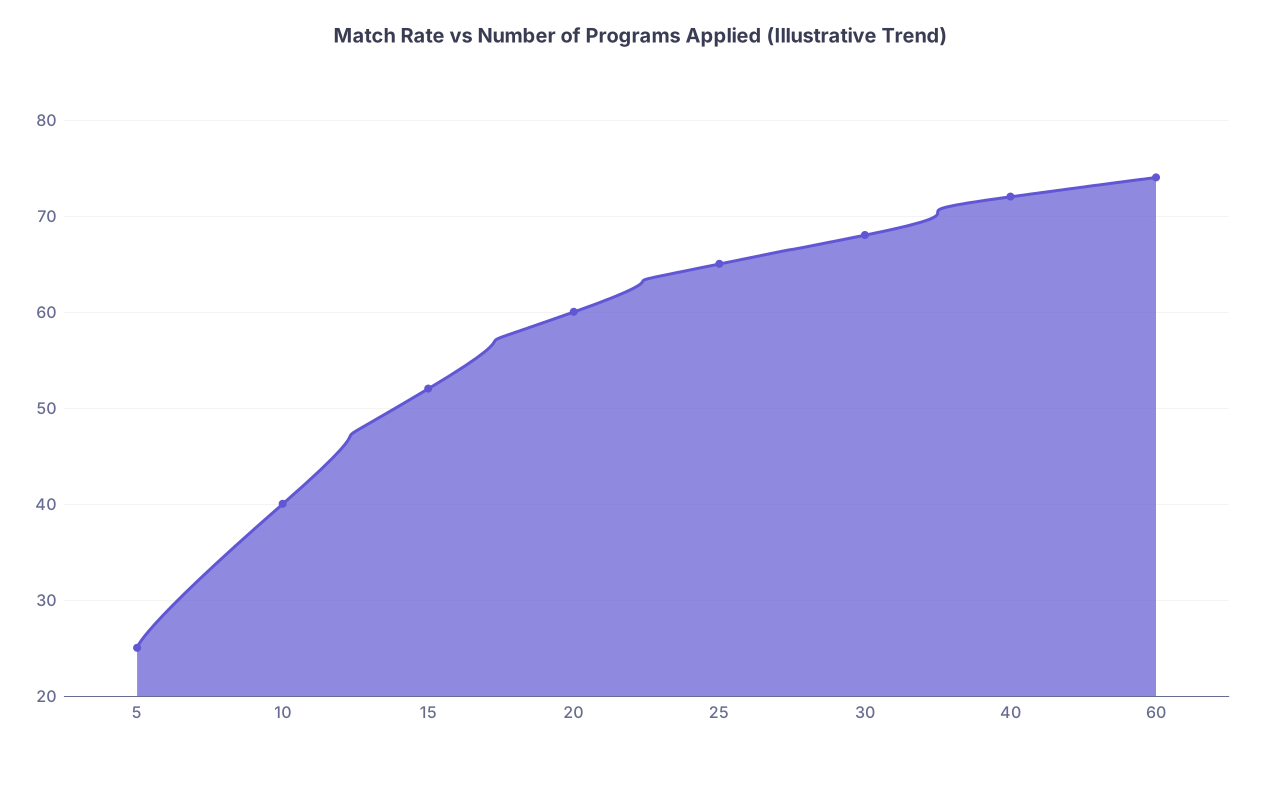
Because the number of medicine psychiatry combined programs is limited and class sizes are small (often 2–4 residents per year), your question is not just how many programs to apply to, but how to balance risk, geography, and dual interests.
General Benchmarks
These numbers are not official rules, but reasonable starting points for a typical US MD/DO applicant with no major application red flags:
Strong applicant (solid scores, strong IM and psych grades, research or leadership in integrated care, good letters):
- Med-Psych programs: 8–12 applications (which may be nearly all programs)
- Plus: a backup strategy (see below)
Average applicant (passes Step/COMLEX on first attempt, at least high passes/honors mixed, some related experience but not extensive):
- Med-Psych programs: 10–15 applications (effectively, as many as are acceptable to you geographically)
- Strongly consider parallel application to:
- Categorical psychiatry and/or
- Categorical internal medicine
Applicant with significant concerns (exam failures, professionalism issues, limited clinical performance):
- Med-Psych programs: apply broadly to all programs you would genuinely attend
- Parallel applications:
- Broad psychiatry and/or internal medicine application
- Possibly community or prelim years if advised by mentors
Because the absolute number of med psych residency spots is low, many serious applicants choose to dual-apply. A common strategy:
Apply broadly in Med-Psych, and in addition apply to a more standard number of categorical psychiatry and/or internal medicine programs.
Factors That Modify How Many Programs You Should Apply To
Your program selection strategy should adjust based on:
Geographic Flexibility
- If you must stay in one region (partner, children, visa constraints), your realistic list will be shorter. In that case, dual-apply more robustly to categorical programs in that region.
- If you are geographically flexible, you can cast a wider net across med-psych programs.
Competitiveness of Your Application
- Strong academic record, integrated-care research, compelling narrative → slightly fewer applications may be reasonable.
- Borderline metrics or unexplained gaps → increase the number of applications, seek more interviews, and emphasize fit and growth.
Parallel Application Strategy
- If you plan to dual-apply in psychiatry and/or internal medicine:
- Plan your ERAS documents carefully (see below).
- Decide your true priority: if Med-Psych is not your clear #1 choice, that affects how you message your interests.
- If you plan to dual-apply in psychiatry and/or internal medicine:
Practical Example: Application Volume
Case 1: Strong, flexible applicant
- 11 med-psych programs
- 8 psychiatry categorical
- 4 internal medicine categorical
- Most energy on Med-Psych; psych and IM as contingency
Case 2: Region-limited applicant
- 6 med-psych programs (within 1–2 flights of home)
- 18 psychiatry categorical in target region
- 10 internal medicine categorical in target region
In both examples, the applicant is using a layered program selection strategy to balance passion for med-psych with risk management across related specialties.
Step 4: Researching and Comparing Programs Systematically
Treat program research as a structured project, not casual browsing. This is where you operationalize how to choose residency programs in a rational way.
Create a Comparison Spreadsheet
Set up a simple table (spreadsheet, Notion, or similar) with columns such as:
- Program name and location
- Size (med-psych class + categorical class sizes)
- Academic vs community vs VA emphasis
- Presence of:
- Med-psych clinic
- Dedicated med-psych inpatient or consult service
- Addiction medicine focus
- Primary care integrated teams
- Rotation structure (block vs integrated)
- Research/academic opportunities
- Call schedule, night float, ICU exposure
- Psych subspecialty strengths (CL, addiction, forensics, geri, child)
- Medicine subspecialty strengths (cardiology, ID, rheum, etc.)
- Culture notes (from residents, virtual Q&A)
- Your subjective “fit” rating (e.g., 1–5)
Information Sources
To build this table:
- Program websites
- Look for rotation schedules, sample yearly schedules, med-psych–specific clinics, and faculty bios.
- Virtual open houses
- Ask specifically about integrated experiences, clinical autonomy, and med-psych identity.
- Current residents and alumni
- Many med psych residency programs list their residents; reach out professionally by email or LinkedIn/X.
- Ask what they would change about the program, if anything.
- Your school’s alumni network
- See where prior graduates with integrated interests have matched.
- Faculty mentors
- Especially those in CL psychiatry, primary care, or integrated behavioral health.
Questions to Ask When Evaluating Programs
To refine your program selection strategy, consistently ask:
Integration and Identity
- Are med-psych residents known and valued in both departments?
- Are there faculty role models who actively practice integrated care?
- Do residents feel like “true” members of each department, not visitors?
Clinical Experiences
- How much time do med-psych residents actually spend in integrated settings (e.g., combined clinics, complex care programs)?
- Are there unique rotations that only med-psych residents do?
- How is autonomy fostered by PGY3–5?
Culture and Support
- How do residents describe wellness and burnout?
- Are program leadership and coordinators accessible and responsive?
- How are schedule conflicts between medicine and psychiatry resolved?
Career Outcomes
- Where do graduates go? (Academics, primary care, CL, inpatient psychiatry, VA systems)
- What fellowships do they match into (addiction, CL, geriatrics, health services research, etc.)?
- Are there recent graduates with a career trajectory you admire?
Document these answers; they will be invaluable when you build your rank list later.
Step 5: Geographic, Personal, and Lifestyle Considerations
Even the best curriculum will not compensate for a location where you are unhappy or unsupported. For a 5-year med psych residency, geographic and lifestyle fit are critical.
Geographic Priorities
Ask yourself:
- Do I have non-negotiable geographic needs (family caregiving, partner’s job, immigration/visa constraints)?
- Do I strongly prefer:
- Urban vs suburban vs rural?
- Relative proximity to airports for travel?
- Specific regions due to cost of living or climate?
Use these answers as filters, not afterthoughts. For example:
- If you know you cannot tolerate harsh winters or very high cost of living, think twice before including a program where those factors are extreme—this is five years, not one.
Lifestyle and Well-Being
Look beyond duty hour compliance and ask:
- Are there support systems for residents with families (childcare, parental leave)?
- How is night coverage handled? Is there night float?
- Are med-psych residents ever pulled disproportionately for coverage given their dual affiliation?
- What is the culture around:
- Using vacation time
- Mental health support
- Flexibility for personal emergencies
A strong program selection strategy explicitly weighs these factors alongside academic and clinical fit.

Step 6: Crafting a Coherent Parallel Application Strategy
Many applicants wonder whether they should dual-apply to categorical medicine and/or psychiatry. For medicine psychiatry combined, this is a central strategic decision.
When to Dual-Apply
You should strongly consider dual-applying if:
- You would be genuinely happy in categorical psychiatry or internal medicine.
- You have geographic constraints that limit accessible med-psych options.
- You have any concern about the competitiveness of your application.
- Your school or mentors specifically recommend having a broader safety net.
Messaging Your Interest Without Undermining Yourself
The biggest concern is: will med-psych programs think I’m not truly committed if I also apply to categorical programs?
In practice:
- Many med-psych residents did dual-apply.
- Program directors understand that the field is small and applicants must consider risk.
- What matters is that your story is coherent.
Tips:
Personal Statement Strategy
- Consider writing:
- One statement specifically for Med-Psych explaining your passion for integrated care and dual identity.
- A psychiatry-specific and/or IM-specific statement that still reflects your interest in comorbidities and integrated practice.
- Don’t hide your Med-Psych interest from categorical programs; it often reads as a sincere subspecialty passion.
- Consider writing:
Letters of Recommendation
- Aim for a mix:
- At least one strong internal medicine letter.
- At least one strong psychiatry letter.
- A third letter from someone who understands your integrated interests (e.g., CL psych, primary care preceptor, research mentor).
- Aim for a mix:
Interview Conversations
- Be honest but strategic:
- With Med-Psych programs: clearly state that combined training is your top choice and articulate why.
- With categorical programs: frame your Med-Psych interest as a passion for complex, comorbid patients—not as a signal that you’ll leave the field.
- Be honest but strategic:
Example Narrative
“I’ve always been drawn to patients whose medical and psychiatric needs are tightly intertwined. Combined medicine-psychiatry programs are my ideal training path because they allow me to develop a dual identity from the start. At the same time, I’m excited about categorical psychiatry programs that prioritize complex medical comorbidity, collaborative care, and consultation, where I can bring my internal medicine foundation to the psychiatric setting.”
This kind of framing supports both med-psych and categorical applications without contradiction.
Step 7: From Interviews to Rank List – Refining Your Strategy
Once interviews arrive, your program selection strategy shifts from how many programs to apply to how to choose residency programs from those that have invited you.
After Each Interview
Immediately after each interview (before impressions blur):
- Write down:
- Your gut feeling about resident happiness.
- How candid faculty were about program limitations.
- Whether the structure matches your learning style (block vs integrated).
- How you were treated as a med-psych applicant by both departments.
- Note:
- Any “red flags” (e.g., dismissive comments about med-psych residents, lack of clarity about schedule).
- Any “green flags” (e.g., recent med-psych graduates in roles you admire, strong leadership support).
Ranking Priorities
When building your rank list, explicitly weigh:
Training Quality and Integration
- Does the program truly train integrated physicians, or just sequence two categorical experiences?
- Will you be competent and confident in both board exams?
Career Alignment
- Do graduates do what you want to do (e.g., CL psychiatry, integrated primary care, leadership in behavioral health)?
Culture and Support
- Did residents seem supported, not just surviving?
- Did leadership speak passionately and specifically about the value of med-psych?
Personal and Geographic Fit
- Can you imagine living there for five years?
- Will your support system be sustainable?
Backup Options
- For dual applicants: decide honestly where combined vs categorical programs line up in your true preferences. Your rank list must reflect your real priorities, because the algorithm will honor your ranking.
Use your spreadsheet plus your post-interview notes to create an ordered list based on these criteria. Your final program selection strategy culminates in this ranked list.
Common Pitfalls in Med-Psych Program Selection
Be aware of a few patterns that can undermine your strategy:
Over-emphasizing prestige
- Some top-name institutions have strong reputations but may not prioritize med-psych integration.
- A “less famous” program with deeply integrated med-psych clinics, committed faculty, and happy residents can be a far better fit.
Underestimating the importance of culture
- Toxic or indifferent cultures can burn out even the most passionate med-psych resident.
- Listen carefully to how residents talk about each other and their leadership.
Neglecting categorical backups until it’s too late
- If you choose to dual-apply, plan from the beginning—don’t add categorical programs at the last minute without tailored materials.
Ignoring your own learning style
- If you thrive on continuity and dislike constant transitions, an ultra-blocked structure may frustrate you.
- If you like deep immersion, too much parallel clinic may feel scattered.
Confusing interest with commitment
- It’s fine if you’re not 100% sure which exact job you want in 10 years.
- Programs mainly want to see a sincere, thoughtful interest in integrated care and a realistic self-understanding of why med-psych fits you.
Putting It All Together: A Sample Program Selection Strategy
Imagine you are a US MD student with average-to-strong academic metrics, significant interest in severe mental illness and chronic disease management, and moderate geographic flexibility.
Your strategy might look like this:
Clarify Vision
- Long-term goal: academic career in CL psychiatry with strong primary care collaboration.
- Comfortable living anywhere with a major airport; mild preference for East Coast or Midwest.
Research Programs
- Build a list of all med psych residency programs.
- Screen out only those in regions you absolutely cannot live in.
- Attend at least 4–6 virtual open houses.
Application Volume
- 12 Med-Psych programs.
- 10 Categorical psychiatry programs with strong CL and integrated care.
- 6 Internal medicine programs with established collaborative care models.
Materials
- One Med-Psych personal statement.
- One psychiatry statement emphasizing interest in medically complex populations.
- One IM statement emphasizing behavioral health and complex chronic disease.
Interview Season
- After each interview, document fit, culture, and integrated experiences.
- Prioritize where you feel you could “be yourself” and grow.
Rank List
- Rank all Med-Psych programs in honest order of preference.
- Interleave categorical psychiatry programs where you’d prefer them over some med-psych options (if any).
- Rank internal medicine programs below those if psych is clearly more important to you, or vice versa.
This systematic, reflective process transforms what can feel like a chaotic scramble into a deliberate, values-driven program selection strategy.
FAQs: Med-Psych Program Selection Strategy
1. Is Med-Psych more competitive than categorical psychiatry or internal medicine?
Med psych residency is numerically more competitive in the sense that there are far fewer total positions, and each program often has only 2–4 spots per year. However, the applicant pool is also smaller and very self-selected. Compared to categorical internal medicine, the absolute number of positions is much lower; compared to psychiatry, some years the match rate may be similar.
Practically, you should treat med-psych as a small, niche specialty with limited capacity and plan your application volume accordingly, often with a parallel application to categorical programs.
2. How do I explain why I want combined medicine-psychiatry instead of just psychiatry?
Focus on patient stories and clinical patterns, not abstract enthusiasm. For example:
- Discuss a patient whose medical and psychiatric issues were inseparable, where siloed care clearly failed.
- Highlight how you enjoyed both IM and psychiatry rotations and felt frustrated by artificial boundaries.
- Emphasize your desire for dual competence and systems-level impact, not indecision.
Programs want to see that you understand the added demands of dual training and still find it compelling.
3. If I dual-apply, will Med-Psych programs hold that against me?
In most cases, no. Many successful med-psych residents dual-applied. Programs are aware that the limited number of positions necessitates a backup plan for many applicants. The important points:
- Be transparent and consistent in your narrative.
- Make it clear—especially during Med-Psych interviews—that combined training is your top choice and why.
- Ensure your letters and statements are aligned and don’t send mixed messages (e.g., expressing disinterest in combined training anywhere).
4. How many Med-Psych programs should I apply to if I’m a very strong applicant?
Even as a strong applicant, the small number of total spots introduces randomness (geographic preferences of programs, limited interview days, etc.). If there are, for example, 12–14 med psych residency programs that are realistically acceptable to you geographically, a very strong candidate might apply to most or all of them.
You might reduce slightly (e.g., to 8–10) if:
- You have significant geographic constraints and know several locations are impossible.
- You have an excellent parallel application and would be genuinely happy with a categorical path.
However, applying “only two or three” programs is generally risky—even for an outstanding applicant—unless your situation is very unusual and you have strong internal alignment with specific institutions.
By approaching medicine psychiatry combined training with a structured program selection strategy—grounded in your career goals, learning style, and life circumstances—you significantly increase your chances of matching into a program where you can thrive for five years and beyond.