Understanding the Big Picture: Why Program Selection Matters So Much
Program selection is one of the most critical—and most underestimated—parts of your neurology residency application strategy. Many applicants spend months polishing personal statements and perfecting ERAS entries, but only a few hours deciding where to apply. That’s backwards.
Your program selection strategy directly affects:
- Your chances of matching at all
- The likelihood of matching at a program that truly fits your goals and personality
- How many interviews you receive (and whether you can attend them)
- Your stress, finances, and time management during interview season
For neurology specifically, you’re navigating:
- A specialty that has become more competitive over the last decade
- A mix of categorical and advanced programs (sometimes with a separate preliminary year)
- Wide variation in subspecialty strengths (stroke, epilepsy, neurocritical care, movement disorders, etc.)
- Geographic clustering of strong programs in academic hubs
A thoughtful strategy doesn’t mean just asking “how many programs to apply.” It means systematically aligning your neuro match plans with your academic profile, priorities, and long-term career goals.
This guide will walk you through:
- How to estimate a realistic target range for how many programs to apply
- How to choose residency programs intelligently (beyond just brand names)
- How to categorize programs into “reach/target/safety” tiers
- How to balance geographic, academic, and lifestyle factors
- Practical workflows and timelines for building and refining your program list
Step 1: Know Your Applicant Profile in Neurology
Before you can build a program list, you need a clear-eyed understanding of your own competitiveness for neurology residency.
Key Factors That Influence Your Competitiveness
USMLE/COMLEX performance
- Step 1 is now pass/fail, so it mainly serves as a screen.
- Step 2 CK (or COMLEX Level 2) is a major differentiator.
- Very low or borderline scores don’t automatically disqualify you, but they affect how broad your program selection must be.
Neurology-specific experience
- Neurology rotations (home and away)
- Letters of recommendation from neurologists (especially known faculty or subspecialists)
- Neurology-related research, QI projects, case reports, or presentations
- Demonstrated interest (neuro electives, student interest group leadership, etc.)
Type of applicant
- US MD, US DO, or international medical graduate (IMG)
- Visa requirement (for IMGs or some DOs)
- Gap years, career-changers, or major red flags (failures, professionalism issues)
Academic record and narrative
- Honors in neurology or medicine clerkships
- A well-structured personal statement with a coherent neurology story
- Consistency across your application (interests, experiences, goals)
Rough Competitiveness Categories (for Strategy Purposes)
These are planning tools, not value judgments.
Highly competitive
- Strong Step 2 CK (>240–245), no failures
- Honors in neurology and medicine
- Multiple solid neurology letters, often including from academic faculty
- Some research or meaningful scholarly work
- No major red flags
Moderately competitive
- Step 2 in the mid-range (e.g., ~220–240) or COMLEX in a similar percentile
- Solid but not standout clinical evaluations
- 2–3 neurology letters, maybe limited research
- Possibly minor concerns (slightly low score, late exam, etc.)
Less competitive / higher-risk profile
- Below-average Step 2 score or exam failure(s)
- Limited neurology exposure or letters
- Older graduation date, gaps, or significant red flags
- International graduate needing a visa
Your first step in a program selection strategy is being honest about which category you fit into; that will determine both the number and type of programs you should target.
Step 2: How Many Neurology Programs Should You Apply To?
The question “how many programs to apply” doesn’t have a single number, but we can outline sensible ranges.
General Ranges for Neurology Residency
These ranges assume you’re applying broadly in neurology, not dual-applying in a second specialty:
Highly competitive applicants
- Typical range: 20–35 neurology programs
- Rationale: You have a high chance of interviews at a good number of programs; you can target academic and geographic preferences more aggressively.
Moderately competitive applicants
- Typical range: 35–60 programs
- Rationale: You still have a strong chance to match, but individual programs may be more variable in their response. Slightly broader net improves odds of interviews and flexibility.
Less competitive / higher-risk applicants
- Typical range: 60–80+ programs
- Rationale: You need to offset risk factors with volume, especially adding more community-based and less competitive academic programs, and possibly more geographic flexibility.
These are not rigid cutoffs, but they reflect common patterns seen in the neuro match.
Factors That Might Push You Toward More Applications
- You are an IMG (especially if older grad date or needing a visa)
- You have limited or no home neurology program
- You have a Step 2 score substantially below the median
- You are geographically inflexible (e.g., only one region for family reasons)
- You have limited neurology letters or no strong academic letter
- You’re dual-applying but not fully committed to the backup specialty
Factors That Might Let You Apply to Fewer Programs
- You have strong metrics and well-known neurology mentors
- You have a strong home program likely to interview and rank you
- You’re geographically flexible
- You’ve done neurology research at high-visibility institutions
- You have multiple high-impact away rotations with excellent feedback
A Practical Financial Reality Check
Residency applications are expensive. When defining your program selection strategy, consider:
- ERAS fees escalate as you go higher in number of programs.
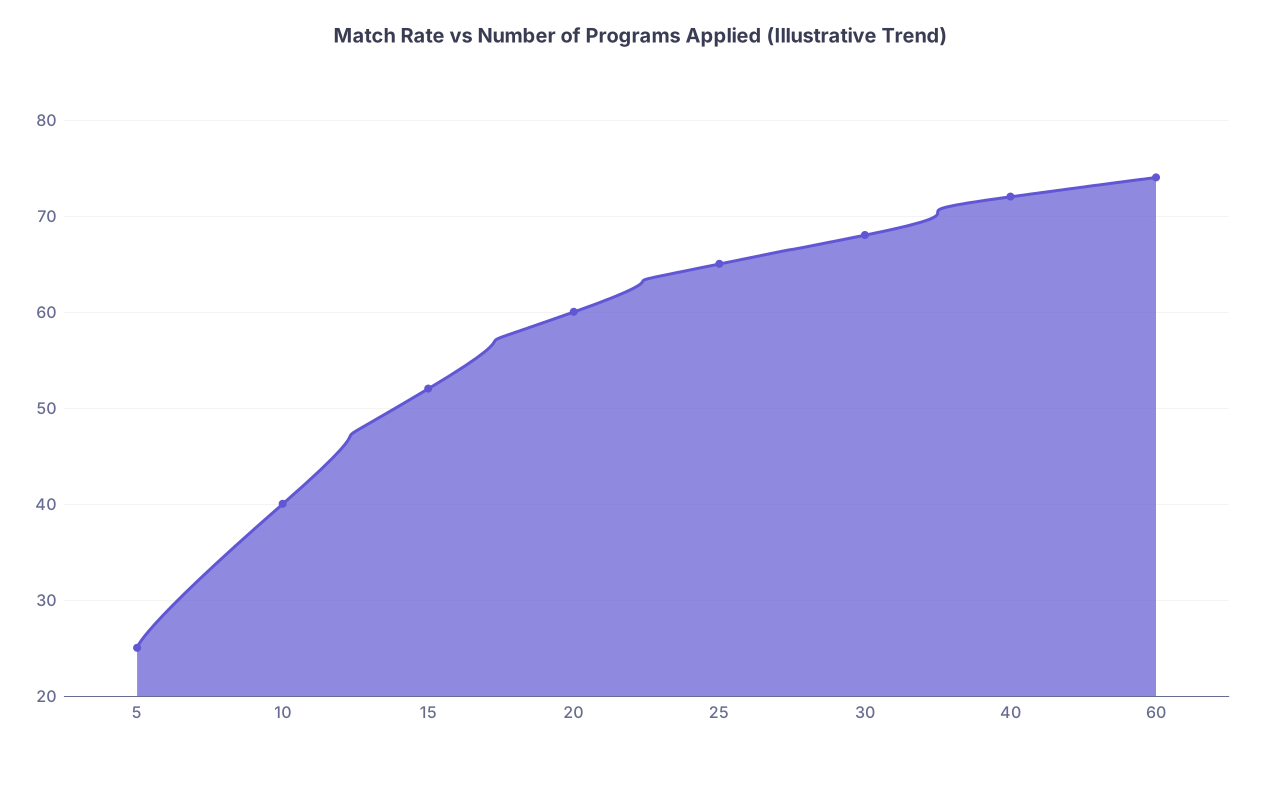
- Beyond a certain point (often 60–80), additional applications yield diminishing returns.
- Travel is less of a factor with virtual interviews, but time and scheduling still matter.
If budget is tight, a carefully curated list of well-researched, strategically chosen programs can be more powerful than a random blast of 100.
Step 3: Building Your Initial List – Systematic Program Selection
Once you have a target range for how many programs to apply, your next step is how to choose residency programs within that range.
Key Data Sources
- FREIDA / AAMC program directory
- NRMP “Charting Outcomes in the Match” (for neurology)
- Individual program websites (rotations, call structure, fellowships)
- Current or recent residents (via mentors, social media, alumni networks)
- Your dean’s office or advising program
Core Filters to Use Early
Program type
- Categorical neurology (PGY-1 to PGY-4 combined) vs. advanced (PGY-2+)
- University-based academic vs. community-based vs. hybrid
- Presence of strong affiliated prelim medicine year (if advanced)
Location and geography
- Major regions you are open to (Northeast, Midwest, South, West, etc.)
- Urban vs. suburban vs. smaller city
- Proximity to family or partner
Visa and IMG friendliness (if relevant)
- J-1 vs. H-1B sponsorship
- Historical percentage of IMGs in the program
Program size
- Larger programs: often more fellowships and subspecialty diversity, more residents, sometimes more anonymity
- Smaller programs: closer-knit communities, more direct faculty contact, but fewer in-house fellowships
Start by generating a broad list that passes these basic filters. For many applicants, this first pass generates 60–100+ possible programs.

Example: Early Filtering in Practice
Imagine you’re a US MD student with:
- Step 2 CK: 233
- One neurology rotation at home, one away rotation
- Two neurology letters (home + away), one from internal medicine
- No major red flags; moderate research
Your initial criteria:
- Categorical programs preferred
- Open to Midwest, South, and East Coast; less interested in West Coast
- University-affiliated or large community with strong academic ties
- Mid-sized or large programs (≥4 residents/year)
From 180–220 neurology programs nationwide, this might quickly narrow to, say, 80–90 programs. You’ll refine this further in the next step.
Step 4: Refining Your List – Reach, Target, and Safety Programs
A smart program selection strategy uses tiers—just like applying to college.
Define Your Tiers
Reach programs
- Programs where your profile is somewhat below their usual metrics or prestige level
- Often highly ranked academic centers or very location-competitive programs
- You might get interviews, especially with strong letters or unique experiences
Target programs
- Programs where your metrics and experiences align closely with their typical residents
- Reasonable expectation of multiple interviews
- Combination of mid-tier academic centers and strong community programs
Safety programs
- Programs that routinely take residents with metrics similar to or below yours
- Often smaller or more community-focused, or in less competitive regions or cities
- Still capable of strong training and neurology fellowship placement
How to Categorize Programs
Use:
- NRMP Charting Outcomes (look at ranges of Step 2 scores and research for matched applicants)
- Program’s current resident profiles (graduating schools, US vs. IMG proportion)
- Program website or social media: see where residents come from and what they do after graduation
- Advice from mentors who know neurology residency landscapes
Recommended Distribution by Applicant Type
For a moderately competitive neurology applicant applying to ~50 programs:
- ~10–15 reach programs
- ~20–25 target programs
- ~10–15 safety programs
For a less competitive applicant applying to ~70 programs:
- ~10–15 reach programs
- ~25–30 target programs
- ~25–30 safety programs (prioritizing IMG-friendly or lower-volume regions if applicable)
For a highly competitive applicant applying to ~25–30 programs:
- ~10–12 reach programs (top academic / elite geographic locations)
- ~10–15 target programs
- ~3–5 safety programs (for security)
Example: Turning an 80-Program Longlist into a 50-Program Strategic List
Suppose your initial filter produced 80 possible programs.
You might:
Remove:
- Programs with clear misalignment (e.g., no support for your visa, or location truly unacceptable)
- Programs with very negative word-of-mouth from trusted sources
- Programs whose case mix or structure doesn’t match your goals (e.g., predominantly outpatient when you want heavy inpatient exposure or vice versa)
Classify the remaining into R/T/S tiers.
Adjust counts:
- If you have too many “reach” and few “safety” programs, rebalance.
- If all are clustered in one region, add programs from other regions to improve match chances.
By the end, your list might look like:
- 15 reach
- 25 target
- 10 safety
Total: 50 neurology programs that make sense for you.
Step 5: Deeper Fit Considerations – Beyond Numbers and Prestige
Once you’ve done the quantitative work, it’s time to think about qualitative fit. This is where “how to choose residency programs” becomes very personal.
Clinical Training and Case Mix
Look for:
- Breadth and depth of inpatient neurology (stroke, general, neuro ICU)
- Exposure to subspecialties (epilepsy, movement disorders, neuromuscular, MS, behavioral, neuroimmunology, neuro-oncology)
- Structure of continuity clinic and outpatient rotations
- Call schedule and night float systems
Ask yourself:
- Do I want a program with a strong neurocritical care focus? Epilepsy? Movement?
- Is it important that I see large volumes of complex tertiary/quaternary referrals?
Academic and Fellowship Opportunities
If you’re academically inclined:
- Check what fellowships are offered in-house (stroke, epilepsy, movement, neuromuscular, neurocritical care, etc.).
- Look at where recent graduates have matched for fellowship.
- Explore opportunities for:
- Clinical or basic science research
- QI projects
- Resident-as-teacher programs
- Leadership roles (chief residency, committees)
If you’re more clinically focused:
- Look for heavy hands-on training, graduated autonomy, and strong mentorship into general neurology practice.
Culture, Wellness, and Support
Neurology is intellectually demanding; program culture makes a big difference.
Signals of a supportive environment:
- Reasonable duty hours and call structure
- Formal mentorship programs
- Wellness initiatives that aren’t just buzzwords (e.g., scheduled wellness half-days, protected time)
- Resident feedback mechanisms (e.g., regular town halls or meetings with leadership)
- Diversity, equity, and inclusion efforts
Talk to current or recent residents (even informally via alumni networks) about:
- How approachable the faculty are
- How the program responded to challenges (COVID surges, schedule crises, etc.)
- How residents feel about work-life balance

Geographic and Personal Life Factors
You can’t ignore your life outside of residency:
- Proximity to family or partner’s job
- Cost of living and salary relative to local expenses
- Public transportation or driving needs
- Climate and lifestyle (urban vs. suburban, recreation, culture)
Prioritize non-negotiables honestly. If you know you will be miserable in a remote setting far from family, do not build a list that depends heavily on those locations, even if they’re “easy matches.” Instead, broaden your list in other ways (more programs, more variety of institutions) in regions that realistically work for you.
Step 6: Organizing, Tracking, and Adapting Your Strategy
A program selection strategy isn’t “set it and forget it.” You will likely need to adjust based on new information (e.g., late Step 2 score, new letter, advisor input).
Create a Master Spreadsheet
Include columns for:
- Program name and location
- Program type (categorical/advanced; university/community)
- Tier (reach/target/safety)
- Visa policy / IMG friendliness (if applicable)
- Key pros (fellowships, subspecialty strengths, location)
- Key cons (call structure, limited research, etc.)
- Personal ranking of interest (e.g., 1–5)
- Applied? (Y/N)
- Interview offer? (Y/N)
- Final rank list position (later in the season)
This helps you stay systematic and avoid emotional over-reaction to individual rejections or rumors.
Adjusting After Application Submission
After you submit ERAS:
- Track which programs offer interviews and how quickly.
- If your first 3–4 weeks generate very few interviews:
- Consult an advisor urgently.
- Consider adding more “safety” tier programs if application deadlines are still open.
- If you receive significantly more interviews than you can reasonably attend:
- Prioritize programs that best match your long-term goals and geographic preferences.
- Politely decline lowest-interest interviews early to free up slots for others.
Balancing Interview Volume and Quality
Most neurology applicants who rank around 10–12 programs have a high probability of matching, but the exact number varies by year and profile.
As a rough target:
- Aim to attend at least 10–14 interviews if possible.
- If you’re less competitive, try for 12–15.
- More competitive applicants may feel comfortable with 8–12 if the program mix is favorable.
Your initial decision about how many programs to apply should be designed to create the opportunity for that number of interviews.
Putting It All Together: A Sample Neurology Program Selection Strategy
Imagine three different applicants and how they might approach the neuro match:
Applicant A: Strong Academic US MD
- Step 2 CK: 252
- Two high-profile neurology research projects, national conference presentations
- Honors in neurology and medicine; strong letters from academic neurologists
- Flexible geographically
Strategy:
- Apply to 25–30 programs
- Tiers:
- 10–12 reach (top 10–20 academic centers, very competitive cities)
- 10–12 target (mid- to upper-tier academic centers)
- 3–6 safety (solid university-affiliated programs in less competitive areas)
- Focus on:
- In-house fellowships and research infrastructure
- Resident scholarly support and mentorship
- Expectation:
- 12–18 interview offers; attend 10–14
Applicant B: Moderately Competitive US DO
- COMLEX and Step 2 in mid-range (e.g., 225–230 equivalent)
- Good clinical grades, two neurology letters, one from IM
- Limited research; wants to stay in Midwest or South for family
Strategy:
- Apply to 45–60 programs
- Tiers:
- 10–15 reach (university neurology programs in preferred regions)
- 20–30 target (mix of university-affiliated and strong community programs with DO-friendly history)
- 10–15 safety (community-heavy, smaller academic programs, slightly broader region)
- Focus on:
- DO-friendly and IMG/visa-neutral programs
- Balanced list within and slightly beyond desired regions
- Expectation:
- 8–15 interviews; aim to attend ≥10–12
Applicant C: IMG with Visa Needs and Lower Score
- Step 2: 215 with a Step 1 attempt
- Strong neurology experience in home country, a few publications
- Requires J-1 visa
Strategy:
- Apply to 70–90 neurology programs
- Tiers:
- 10–15 reach (IMG-friendly university programs with strong visa support)
- 25–35 target (programs with consistent history of accepting J-1 IMGs)
- 25–40 safety (community programs and less competitive geographic regions known to consider IMGs)
- Focus on:
- Confirmed visa sponsorship
- High IMG percentage among current residents
- Expectation:
- 5–12 interviews; aim to attend as many as possible (ideally ≥10)
FAQs: Neurology Program Selection Strategy
1. Is it better to apply to as many neurology programs as possible?
Not necessarily. There is a point where additional applications add cost but little benefit. For most neurology applicants:
- Below ~30 applications is often too few unless you are very strong and flexible.
- Between 40–70 is the “sweet spot” for many typical applicants.
- Above ~80 can be helpful mainly for high-risk profiles (IMGs with major constraints), but only if you have researched programs enough that they’re realistic options.
Quality and strategic targeting matter more than raw quantity.
2. Should I avoid programs where my score is below their average?
No—but you should recalibrate expectations and categorize them as reach programs. A few lower-score applicants match at such programs every year based on:
- Exceptional letters
- Strong research
- Unique backgrounds or personal fit
It’s reasonable to include a handful of these, but your core list should be made up of programs where your profile aligns with their typical residents.
3. How important is having a home neurology program for my strategy?
A home neurology program is a major advantage:
- You are more likely to get an interview and a strong letter.
- The program already knows you; this increases your match probability there.
If you don’t have a home program:
- Consider away rotations at one or two programs you might realistically match at.
- Broaden your application list slightly to compensate.
- Use neurology interest group faculty, external mentors, and alumni to advocate and advise.
4. If I’m dual-applying (e.g., neurology and internal medicine), how does that affect how many neurology programs I should apply to?
Dual-applying complicates program selection. Some general principles:
- Be honest with yourself about your first choice. If neurology is primary:
- Apply broadly enough in neurology to give yourself a realistic chance (often 40–60 programs or more, depending on your profile).
- Apply to a more modest number of internal medicine programs targeted as “safety” options.
- If your metrics are strong but you’re anxious:
- Seek advisor input before dramatically inflating application numbers in both specialties.
- Remember that interview season logistics get harder when you’re juggling two specialties.
A deliberate, data-informed program selection strategy in neurology is one of the highest-yield steps you can take for a successful neuro match. By combining realistic self-assessment, smart decisions about how many programs to apply, and thoughtful choices about how to choose residency programs that truly fit your goals, you position yourself not just to match—but to thrive in the neurology residency that’s right for you.