Understanding the Neurology Landscape as a Caribbean IMG
For a Caribbean medical school graduate interested in neurology, choosing the right residency programs is both strategic and personal. The combination of being an IMG, often from schools like SGU, AUC, or Ross, and applying to a moderately competitive specialty like neurology means you must be thoughtful about your program selection strategy, especially around how many programs to apply and which ones.
Neurology is not as competitive as dermatology or plastic surgery, but it is far from easy—particularly for IMGs. Many US neurology programs welcome international graduates, including Caribbean IMGs, yet others simply do not consider them. That reality makes targeted, data-driven program selection essential.
Key things you must keep in mind as a Caribbean IMG:
- You are competing in the Neurology Match against:
- US MD seniors
- US DO seniors
- US-IMGs (including Caribbean graduates)
- Non-US IMGs
- Programs vary widely in:
- How many IMGs they take
- Their minimum score thresholds
- Their perception of Caribbean schools
- Their emphasis on research vs. clinical performance
Your Caribbean medical school residency outcome in neurology will be heavily influenced by how effectively you build your program list—more so than for many US MD applicants. The SGU residency match outcomes in neurology are a helpful benchmark: they show that consistent matching is possible, but they also reveal that SGU and other Caribbean schools’ successful graduates usually apply smartly and broadly.
This article focuses on:
- How to evaluate your competitiveness as a neurology applicant
- How many neurology programs to apply to as a Caribbean IMG
- How to choose residency programs strategically
- Practical steps to build and refine a target list
- Special considerations for neurology (e.g., research, Step scores, visas)
The goal is to help you move from “I’ll just apply everywhere” to a deliberate program selection strategy that maximizes your chance to neuro match without wasting time and money.
Step 1: Honestly Assess Your Neurology Competitiveness
Before you can decide how many programs to apply to or where to focus, you must understand where you stand. As a Caribbean IMG in neurology, three pillars matter most:
- USMLE performance
- Clinical performance and letters
- Neurology-relevant exposure and research
1. USMLE Scores and Attempts
Even with Step 1 now pass/fail, programs still heavily scrutinize:
- Step 2 CK score
- Number of attempts
- Timing of exams
For Caribbean IMGs targeting neurology:
- A strong Step 2 CK (e.g., 240+ range) will open more doors, including some university programs.
- A mid-range score (e.g., 225–239) can still be competitive, especially at community programs and IMG-friendly academic centers.
- Scores below ~220 or any failures will limit options; you’ll need to be more strategic and apply more broadly.
Neurology PDs often see Step 2 CK as a surrogate for:
- Your ability to pass the neurology board exam
- Your reliability under pressure
- Your grasp of internal medicine, which underpins neurology
2. Clinical Performance, Clerkships, and LORs
Programs care about how you perform in real clinical settings:
- Neurology rotations (home or away)
- Internal Medicine clerkship (since neurology is very medicine-heavy)
- Sub-internships / acting internships in neurology or medicine
For Caribbean IMGs, strong US-based clinical experiences are crucial:
- Ideally one or more neurology electives in the US
- Strong performance in medicine sub-I or sub-internship
- Evaluations/letters that state you are at or above the level of US grads
Letters of Recommendation (LORs) carry significant weight:
- Aim for at least one, preferably two neurology letters from US neurologists
- One solid Internal Medicine letter
- Letters should speak directly to:
- Clinical reasoning and exam skills
- Professionalism and reliability
- Communication with patients and team
3. Neurology Exposure and Research
While not mandatory for all programs, neurology-specific engagement strengthens your profile:
- Experiences:
- Stroke clinic, epilepsy monitoring unit, neuro-ICU observerships
- Neurology interest group leadership
- Presenting neurology topics in student conferences
- Research:
- Case reports (e.g., interesting stroke or epilepsy cases)
- Posters or abstracts at AAN or local neurology conferences
- Quality improvement projects in neurology wards
These help demonstrate to programs that you are genuinely pursuing neurology, not just defaulting to it.

Step 2: Decide How Many Programs to Apply to (Neurology + Prelim/TY)
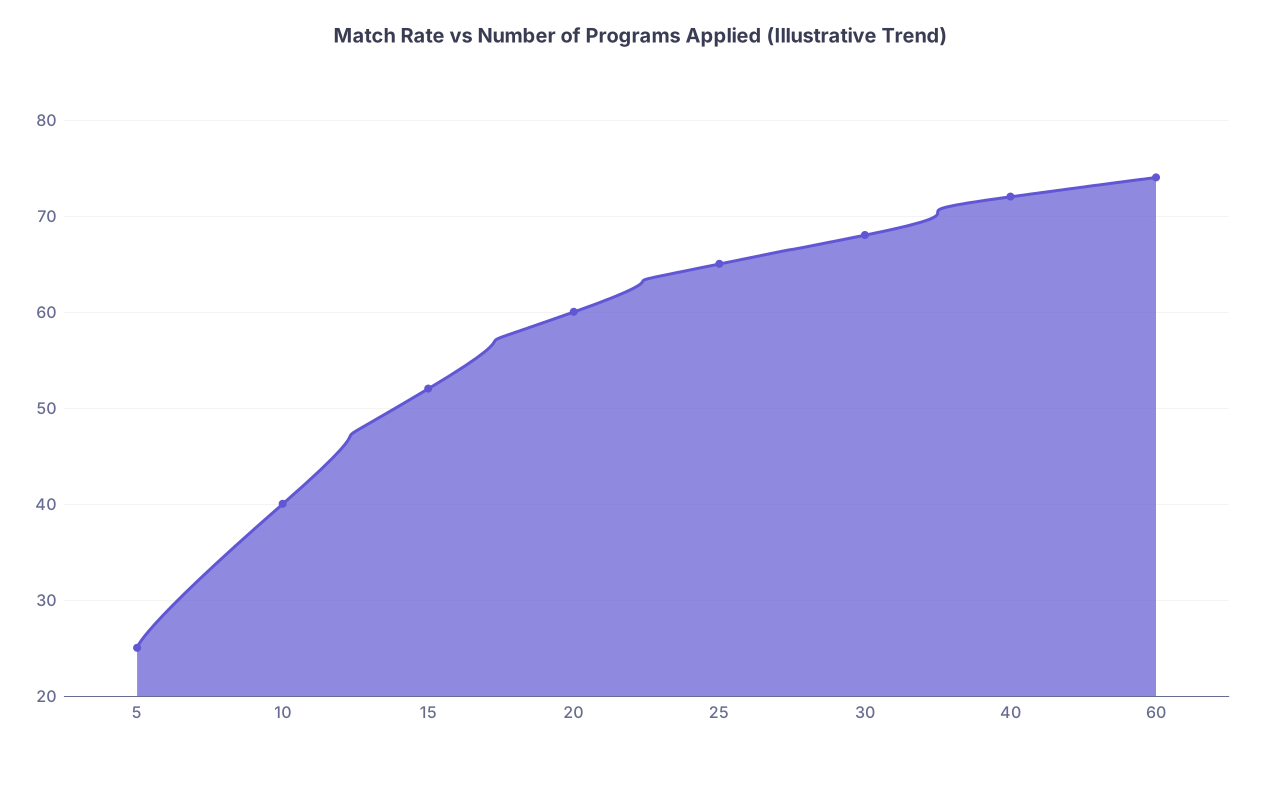
The question “how many programs should you apply to?” is central to any program selection strategy, especially in neurology for Caribbean IMGs.
General Numbers for Caribbean IMGs in Neurology
Exact numbers vary by applicant strength, but for a typical Caribbean IMG in neurology:
- Competitive Caribbean IMG (strong Step 2, solid LORs, some neurology exposure, no fails):
- 40–60 Neurology categorical programs
- 10–20 Prelim/TY Medicine programs (if you apply to advanced neurology programs)
- Average Caribbean IMG (mid-range Step 2, maybe minor red flags, limited research):
- 60–80 Neurology categorical programs
- 20–30 Prelim/TY Medicine programs
- Caribbean IMG with significant red flags (low Step 2, attempts, late graduation, or lack of US experience):
- 80–100+ Neurology categorical programs (essentially every IMG-friendly program)
- 30–40 Prelim/TY Medicine programs
Remember that neurology consists of:
- Categorical programs (include PGY-1 + neurology years)
- Advanced programs (PGY-2+ neurology only; require separate prelim/TY PGY-1)
Many Caribbean IMGs target primarily categorical neurology programs to simplify the process, adding some advanced programs plus prelim/TY applications as needed.
Factors That Influence Your Application Volume
You may increase or decrease your target number of programs based on:
- Step 2 CK score and failures
- Year of graduation (YOG > 5 years may be a concern for some programs)
- Visa requirement (needing H-1B or J-1 narrows the field)
- Research strength (more research may open doors at academic centers)
- Budget (ERAS fees increase with number of programs)
Most Caribbean IMGs who successfully match neurology—particularly those referenced in annual SGU residency match outcome lists—tend to apply broadly. Underapplying is a common reason for failing to match, even among reasonably competitive applicants.
Step 3: Building Your Initial Neurology Program List
Once you know roughly how many programs to apply to, you need a methodology for how to choose residency programs and convert that number into a concrete, prioritized list.
1. Start with Official and Data-Driven Sources
Use a combination of:
- FREIDA (AMA Residency & Fellowship Database):
- Filter by specialty: Neurology
- Note:
- Program type (categorical vs. advanced)
- IMG percentage
- Visa sponsorship
- Program websites:
- Look for:
- Statements about IMGs
- Current residents (how many IMGs, any Caribbean grads?)
- Minimum USMLE requirements (Step 2 CK cutoff)
- Visa policies
- Look for:
- NRMP and Charting Outcomes data:
- Check neurology match data for IMGs
- See how many programs typical matched IMGs apply to
- Alumni match lists from Caribbean schools (e.g., SGU, AUC, Ross):
- Identify historically IMG-friendly neurology programs
- Confirm if your school’s graduates have matched there recently
2. Identify IMG-Friendly Neurology Programs
Focus your early list-building on programs that:
- Have current or recent IMGs among residents (ideally Caribbean grads)
- Publicly state that they welcome international graduates
- Sponsor J-1 visas (minimum) and ideally H-1B if you seek that route
Look for clues on program websites and social media:
- Resident bios mentioning:
- SGU, AUC, Ross, Saba, MUA, etc.
- Other well-known international schools
- PD or coordinator statements like:
- “We consider applications from international medical graduates”
- “Several of our residents are IMGs”
3. Consider Geographic and Personal Constraints
Your program selection strategy must also reflect your life realities:
- Family or partner location
- Preference for:
- Urban vs. suburban vs. rural
- East Coast vs. Midwest vs. South vs. West
- Climate, cost of living, support networks
As a Caribbean IMG, you might be tempted to apply only where you “want” to live. That can be dangerous if it significantly shrinks your list. A balanced approach:
- Have a core set of preferred regions
- Still include programs across the country that:
- Are known to be IMG-friendly
- Fit your academic and visa needs
4. Understand Program Types: Categorical vs. Advanced
In neurology:
- Categorical Neurology:
- You match into a program that covers PGY-1 (intern year) + PGY-2–PGY-4 neurology
- Simpler logistically; only one program to secure
- Advanced Neurology (PGY-2 start):
- You must secure a separate preliminary (prelim) or transitional year (TY) for PGY-1
- More complex, but can sometimes open additional high-quality neurology options
Many Caribbean IMGs favor categorical neurology programs because they reduce uncertainty. However, including a modest number of advanced programs—especially IMG-friendly academic centers—can diversify your chances.
Step 4: Tiering Programs and Refining Your List
Once you have a broad list, it’s time to refine and tier. This is where your program selection strategy becomes truly targeted.
1. Create Tiers Based on Competitiveness and Fit
Divide your neurology programs into three tiers:
- Reach programs:
- Historically favor US grads
- Strong academic or university-based with limited IMGs
- Your profile is slightly below their typical matched resident profile
- Target programs:
- Take a moderate number of IMGs, sometimes Caribbean
- Your scores and experiences are within or near their usual range
- Safety programs:
- High percentage of IMGs, often community-based
- Clear record of Caribbean and other IMGs matching there
- Your metrics exceed their usual minimums
A good distribution for a Caribbean IMG might be:
- 15–25% Reach
- 50–60% Target
- 20–30% Safety
Your task is not to eliminate reach programs, but to avoid a list that is all reach with no realistic options.
2. Key Filters to Apply
When deciding how to choose residency programs within each tier, consider:
- IMG track record:
- Do they list Caribbean IMGs as residents?
- Do multiple years show consistent IMGs?
- USMLE expectations:
- Explicit cutoffs listed on website (e.g., Step 2 CK ≥ 230)
- “No more than 5 years since graduation”
- Visa policy:
- J-1 only, or H-1B possible?
- If you need H-1B, your list must be tailored accordingly.
- Curriculum and training environment:
- Exposure to stroke, epilepsy, neurocritical care, EMG, etc.
- Research opportunities if you are interested in academic neurology
- Program culture and support:
- Feedback from residents, alumni, or upperclassmen
- Presence of mentorship and IMG support systems
3. Common Mistakes Caribbean IMGs Make in Program Selection
Avoid these pitfalls:
- Applying too narrowly:
- Only applying to a few “top” names or certain cities
- Ignoring community programs that are IMG-friendly and well-regarded clinically
- Ignoring IMG history:
- Wasting applications on programs that clearly do not take IMGs
- Not double-checking visa policy:
- Applying widely to non-sponsoring programs when you require a visa
- Underestimating prelim/TY needs:
- For advanced programs, failing to apply to enough prelim/TY spots
Remember: the neurology residency match is a numbers game combined with fit. A strong program selection strategy treats both seriously.

Step 5: Tactical Considerations for Caribbean IMGs in the Neuro Match
Beyond basic list-building, there are nuanced issues specific to neurology and to Caribbean IMGs.
1. Categorical vs. Advanced: Strategy for PGY-1
For Caribbean IMGs, a typical approach to the neurology residency match is:
- Apply predominantly to categorical neurology programs
- Add a set of advanced neurology programs that:
- Are known to be IMG-friendly
- Offer strong academic training or subspecialty exposure
- Simultaneously apply to:
- Prelim Internal Medicine programs
- Transitional Year (TY) programs (if any in your preferred regions)
Practical strategy:
- If you have:
- Solid scores
- Good neurology exposure
- Strong letters
You can target a mix of categorical and advanced.
- If you have:
- Lower scores
- Fewer neurology connections
Focus more heavily on IMG-friendly categorical programs, and be realistic about the competitiveness of advanced university programs.
2. Aligning with Your Long-Term Neurology Goals
Your program selection strategy should align with your future plans:
- If you want fellowship training (stroke, epilepsy, neurocritical care, MS, movement disorders, etc.):
- Prioritize programs with:
- Active subspecialty services
- Existing fellowships or nearby tertiary centers
- Published research and conference participation
- Prioritize programs with:
- If you prefer community neurology practice:
- Consider:
- Community-based neurology programs with strong general neuro exposure
- Programs with strong outpatient and EMG/EEG training
- Consider:
- If you are considering academic neurology:
- Lean more towards:
- University or academic hybrid programs
- Programs with research infrastructure and mentorship
- Lean more towards:
You don’t need to know your exact subspecialty, but clarity helps you systematically filter programs.
3. Financial and Logistical Considerations
Applying to many programs has clear costs:
- ERAS fees rise steeply with each additional group of programs
- Interview travel (if in-person) or time commitment (even for virtual)
- Time spent preparing for each program (research, thank-you letters, etc.)
To cope:
- Decide your maximum budget for ERAS upfront
- Prioritize programs that:
- You’d genuinely consider ranking
- Are realistic based on your profile and IMG history
- Consider grouping programs by region to manage potential in-person interviews (if applicable)
4. Using Mentors and Networks
As a Caribbean IMG, you may feel more distant from US academic networks—but you do have resources:
- Neurology faculty from your clinical sites:
- Ask which programs are IMG-friendly
- Request honest feedback on your competitiveness
- Upperclassmen and alumni:
- SGU, AUC, Ross, etc., often have alumni networks
- Find Caribbean grads who matched into neurology and ask:
- Where they applied
- Which programs seemed IMG-receptive
- Professional societies:
- American Academy of Neurology (AAN) resident/student sessions
- Local neurology societies and meetings
Sometimes a single mentor’s email to a PD can increase your chance of getting an interview at a program where your metrics might not otherwise stand out.
Step 6: Final Checklist Before Submitting Your Application List
Before finalizing your list for the neurology residency match, run through a structured checklist.
Content Checklist
- Do you have:
- A realistic understanding of your overall competitiveness?
- An appropriate total number of programs (typically 60–100+ neurology programs for most Caribbean IMGs, depending on strength)?
- A solid mix of categorical and advanced + prelim/TY applications, if applicable?
Program List Checklist
- For each neurology program:
- Does it consider IMGs and/or have a track record of Caribbean grads?
- Does it offer the visa you require?
- Are the USMLE expectations consistent with your scores and attempts?
- Have you checked the current resident list and/or alumni where available?
- For advanced neurology programs:
- Have you applied to a sufficient number of prelim/TY medicine programs?
- Are the prelim/TY programs realistic and not all at ultra-competitive academic centers?
Strategic Balance Checklist
Your program list should:
- Include a spread of competitiveness (reach, target, safety)
- Reflect geographic flexibility, especially if your profile is average or weaker
- Align with your:
- Visa needs
- Long-term neurology interests
- Reasonable living and support preferences
Once this is in place, your primary task shifts to application quality (personal statement, experiences, LORs) and then interview performance—but all of that is built on the foundation of a smart program selection strategy.
FAQs: Program Selection Strategy for Caribbean IMG in Neurology
1. As a Caribbean IMG, how many neurology programs should I apply to?
Most Caribbean IMGs should plan to apply broadly:
- Strong applicants: 40–60 neurology programs (plus 10–20 prelim/TY if needed)
- Average applicants: 60–80 neurology programs (plus 20–30 prelim/TY)
- Applicants with red flags: 80–100+ neurology programs (plus 30–40 prelim/TY)
Your exact number depends on Step 2 CK, attempts, graduation year, research, and visa status. When in doubt, err on the side of more neurology programs that are realistically IMG-friendly rather than fewer.
2. How do I identify neurology programs that are friendly to Caribbean IMGs?
Focus on:
- Current resident rosters showing Caribbean graduates (e.g., SGU, AUC, Ross)
- Program websites mentioning:
- Acceptance of international medical graduates
- Visa sponsorship (J-1 and/or H-1B)
- Past match lists from your school (e.g., SGU residency match lists)
- FREIDA filters for IMG percentages and visa information
If a program has no IMGs over several years, explicitly discourages non-US grads, or does not sponsor visas you need, it should be low priority or removed from your list.
3. Should I focus only on categorical neurology programs as a Caribbean IMG?
Not necessarily, but many Caribbean IMGs choose to prioritize categorical for simplicity. A balanced approach:
- Make categorical neurology your core foundation, especially at IMG-friendly programs.
- Add a selection of advanced neurology programs (usually academic centers) that:
- Are open to IMGs
- Fit your academic interests
- Ensure you apply to enough prelim/TY medicine programs if you apply to advanced positions.
The key is not to overconcentrate only on advanced programs without sufficient categorical or prelim/TY backup.
4. Can I be competitive for academic neurology programs as a Caribbean IMG?
Yes, but it requires:
- Strong Step 2 CK (ideally in the higher range)
- Solid neurology-focused LORs from US neurologists
- Evidence of academic engagement:
- Case reports
- Posters
- Small research or QI projects
- A thoughtfully crafted application expressing clear interest in academic neurology
While some top-tier academic programs rarely take IMGs, many mid-tier academic or hybrid programs have a solid history of accepting Caribbean IMGs. Strategic targeting based on IMG history and your profile is crucial.
By combining an honest self-assessment with a data-informed, tiered program selection strategy, Caribbean IMGs can successfully navigate the neurology residency match. The goal is not just to match anywhere, but to build a list that maximizes your odds while aligning with your long-term neurology career aspirations.