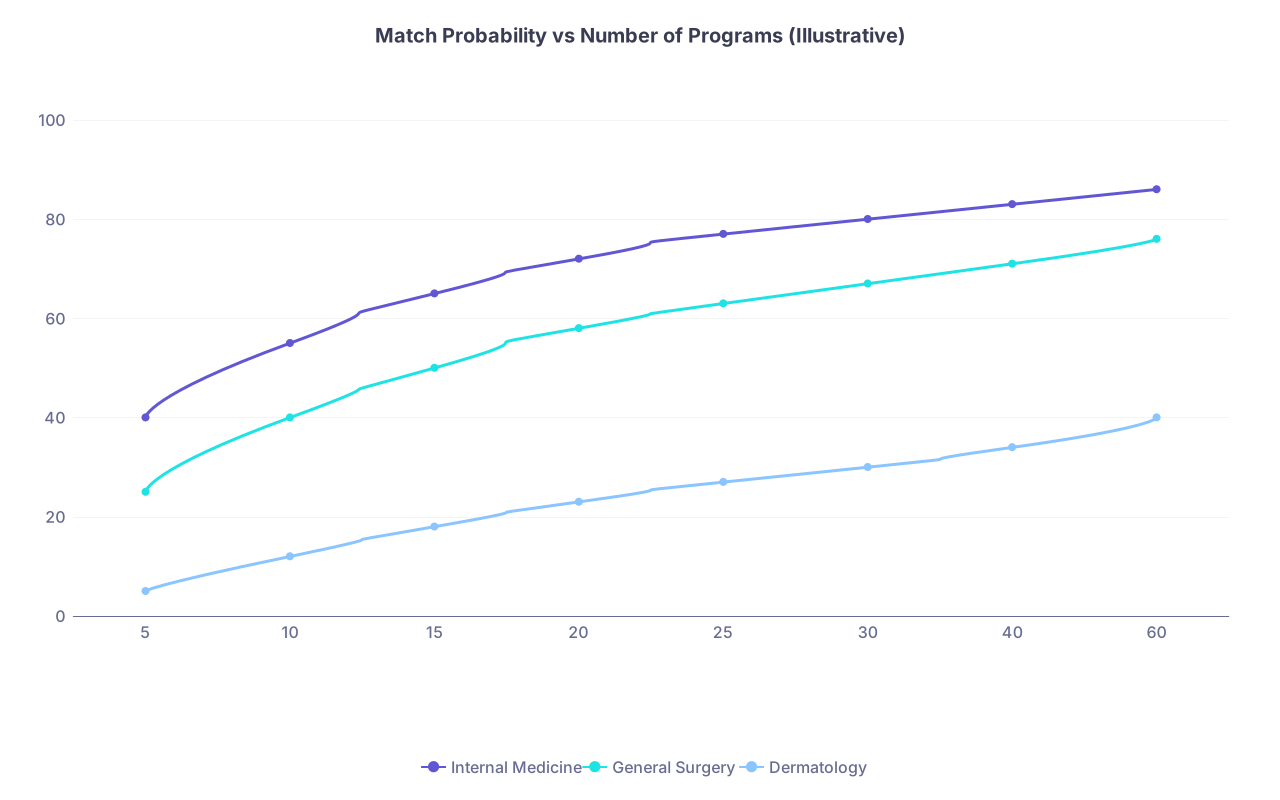
Choosing where to apply for emergency medicine residency as a non-US citizen IMG can feel overwhelming. You’re not just asking “Is this a good program?” — you’re also asking “Will they sponsor a visa?”, “Do they take foreign national medical graduates?”, and “Do I realistically have a shot here?”
This article walks through a structured, realistic program selection strategy tailored specifically for non-US citizen IMGs targeting Emergency Medicine (EM). You’ll learn how to build a smart list, understand how many programs to apply to, and increase your odds of a successful EM match without wasting time or money.
Understanding the Unique Position of a Non-US Citizen IMG in EM
Before building your list, you need a clear picture of where you stand and how EM programs see applicants like you.
1. The EM Landscape for IMGs
Emergency Medicine in the US is moderately competitive, with a significant preference for:
- US MD seniors
- Then US DO seniors
- Then IMGs (both US-IMGs and non-US citizen IMGs)
As a foreign national medical graduate, your hurdles are usually:
- Visa sponsorship
- Limited EM-specific US clinical experience
- Less familiarity with US letters of recommendation (SLOEs)
- Perception bias (programs preferring US grads when possible)
But you also bring strengths:
- Often strong clinical resourcefulness and adaptability
- Exposure to high-acuity medicine in resource-limited settings
- Multilingual skills and cross-cultural communication
Your program selection strategy must maximize where those strengths matter and where your barriers (especially visa) are explicitly acknowledged and supported.
2. Visa Status: The First Filter
For a non-US citizen IMG, visa is a non-negotiable screening factor. Programs vary widely in what they offer:
- J-1 visa only (via ECFMG): Most IMG-friendly and common
- J-1 + H-1B visa: More flexible but fewer programs
- No visa sponsorship: Automatically off your list
Your first step in program selection:
Do not waste time on programs that do not sponsor a visa you can realistically obtain.
Action steps:
- Decide early: Are you pursuing J-1, H-1B, or are you flexible?
- If you don’t have Step 3 at application time, H-1B is generally unrealistic.
- For most non-US citizen IMGs, J-1 is the primary/realistic path.
Step 1: Clarify Your Applicant Profile (Honest Self-Assessment)
Before asking “how to choose residency programs”, you need to know what you bring to the table. This determines how many programs to apply to and what tier of programs to target.
1. Academic Metrics
Key components:
- USMLE Step 2 CK (most important now that Step 1 is pass/fail)
- Any prior Step 1 score if numerical (still considered at some programs)
- Number of attempts on any exam
Typical benchmarks for a competitive EM applicant:
- Step 2 CK: often ≥ 240 for US grads at many university programs
For a non-US citizen IMG: - Stronger scores help compensate for other disadvantages.
- A score < 230 doesn’t eliminate you but pushes you toward a heavily IMG-friendly / community-based EM list.
Be honest:
- Were there failures or attempts on Step exams?
- Any gaps in training or extended graduation time?
2. Clinical Experience and SLOEs
In EM, Standardized Letters of Evaluation (SLOEs) from US EM rotations are critical.
Ask yourself:
- Do you have at least 1–2 SLOEs from US EM rotations?
- Are they from ACGME-accredited EM programs?
- Do they explicitly recommend you for EM and compare you favorably to peers?
If you have:
- 2 strong SLOEs + solid Step 2 CK: You’re competitive for a broader range of programs.
- 0–1 SLOE or only non-EM letters: You must prioritize IMG-friendly + lower-competition programs and increase the number of applications.
3. Year of Graduation (YOG) and Gaps
Programs vary in YOG preferences:
- Many prefer within 5 years of graduation
- Some strict; some flexible if there is meaningful clinical activity
If:
- YOG ≤ 5 years and continuous clinical work → standard consideration
- YOG > 5–7 years or significant non-clinical gaps → more selective list, more programs, more IMG-friendly emphasis
4. Other Strengths to Factor In
- Prior residency or specialty training abroad (especially in EM or critical care)
- Research experience (particularly US-based)
- English proficiency (especially if exam scores like OET/IELTS/TOEFL show high-level communication)
- Leadership, teaching, or public health experience
These won’t fully overcome visa/score barriers, but they can tip the scale when programs are choosing between IMGs.
Step 2: Building Your Long List – A Structured Research Method
Now that you understand your profile, let’s talk about how to choose residency programs in a systematic way for EM.
1. Use Multiple Data Sources
Don’t rely on a single website. Combine:
- FREIDA (AMA): Filter by:
- Specialty: Emergency Medicine
- Visa sponsorship (J-1 / H-1B)
- IMG percentage (if available)
- Program Websites:
- Confirm visa policies (J-1 vs H-1B, recent changes)
- Look for explicit mentions of “International Medical Graduates” or “foreign national medical graduates”
- NRMP/Charting Outcomes in the Match:
- Look at EM data for IMGs
- Online forums / applicant spreadsheets / EMRA resources:
- Alumni or applicant reports on IMG-friendliness
- Info about who matched where, especially non-US citizen IMG success stories
2. First-Level Filters for a Non-US Citizen IMG
Start with all ACGME-accredited EM programs and apply these filters:
Visa filter (mandatory)
Remove:- Programs that do not sponsor any visa
- Programs that clearly state “US citizenship or permanent residency required”
EM structure filter
- Prioritize 3- or 4-year categorical EM programs (not fellowships or fellow-only sites).
- Avoid EM tracks with unusual requirements (e.g., military commitments).
IMG policy filter
- Keep programs that:
- Explicitly mention IMGs or have current/past IMGs on residents’ page
- List non-US medical schools among their residents
- Flag programs that say:
- “We do not sponsor visas”
- “We consider only US MD/DO applicants”
- Keep programs that:
At this stage, do not overthink geographic preference. Your first pass should build a broad “long list” of all possible EM programs that can even consider a foreign national medical graduate.

Step 3: Tiers and Priorities – Ranking Programs by Fit and Realistic Odds
Once you have your long list, categorize programs into tiers based on competitiveness and your profile. This is where program selection strategy becomes critical.
1. Create a Tiered System
A useful 3-tier framework:
Tier 1: Stretch Programs
- University or university-affiliated EM programs
- Limited IMGs but occasional success stories
- Prefer higher Step 2 CK (e.g., > 240+) and strong SLOEs
- Often in desirable locations (big cities, coastal areas)
- May take IMGs mostly if they are US citizens or green card holders
Tier 2: Target Programs
- Community/university-affiliated EM programs with:
- Clear history of accepting IMGs
- Regular J-1 sponsorship
- Moderate competitiveness
- Known to value clinical performance and SLOEs over just metrics
Tier 3: Safety/High-IMG Programs
- Community programs with:
- High percentage of IMGs
- Long history of visa sponsorship
- Sometimes in less popular locations (rural, mid-size cities)
- More forgiving on:
- Slightly lower scores
- Older YOG (especially with continuous clinical work)
Your goal is to populate each tier with a realistic number of programs and match that to how many programs to apply to overall.
2. Factors to Use When Tiering Programs
For each program on your list, look at:
- Visa support:
- J-1 only vs J-1 + H-1B (H-1B often implies stricter Step score expectations, especially Step 3)
- IMG representation:
- Are current residents IMGs?
- Do you recognize non-US medical schools in their resident lists?
- Score requirements:
- Explicit minimums (e.g., “Step 2 ≥ 230”, “No attempts”)
- Implied competitiveness (top-ranked academic centers usually higher)
- SLOE expectations:
- Some state “at least 2 EM SLOEs required”
- YOG and attempts:
- Programs that specify “within 5 years” or “no failures” may be less friendly if you don’t meet these.
Example for a non-US citizen IMG with Step 2 = 238, YOG 3 years ago, 2 SLOEs:
- Tier 1: 20–25 more competitive academic or popular-location community programs
- Tier 2: 40–50 IMG-neutral or moderately IMG-friendly community/university programs
- Tier 3: 30–40 highly IMG-friendly programs, often in less competitive locations
The exact distribution depends heavily on your profile and budget.
Step 4: How Many EM Programs Should a Non-US Citizen IMG Apply To?
This is the most practical question: how many programs to apply to in EM as a foreign national medical graduate?
1. General Benchmarks (For Non-US Citizen IMGs)
For Emergency Medicine, non-US citizen IMGs usually benefit from broad application strategies:
- Highly competitive IMG (Step 2 ≥ 245, strong SLOEs, recent YOG, no attempts)
- Target range: 40–60 EM programs
- Moderately competitive IMG (Step 2 ~230–244, 1–2 SLOEs, recent YOG)
- Target range: 60–90 EM programs
- High-risk profile (Step 2 < 230, older YOG, gaps, limited SLOEs, exam attempts)
- Target range: 80–120+ EM programs, often combined with a parallel backup specialty (e.g., FM, IM) if EM is still your first choice
These numbers are higher than for US grads because:
- Fewer EM programs sponsor visas.
- Some programs filter IMGs automatically, even if they say they “consider” them.
- Interview numbers for non-US citizen IMGs are often lower on average.
2. Balancing Cost vs Benefit
ERAS can be expensive, especially when you cross 40–60 programs. To make this affordable while still improving your EM match chances:
- Prioritize:
- All programs that sponsor your visa type + have evidence of IMGs in their residency.
- Deprioritize:
- Ultra-competitive “prestige” centers with no IMG history unless you are truly exceptional.
- Use a spreadsheet to monitor:
- Application count by tier
- A reasonable budget ceiling
If you have to cut your list:
- Cut Tier 1 “dream” programs that barely take IMGs.
- Preserve or increase Tier 2 and Tier 3 programs where your chances are realistic.
3. Considering a Dual-Application Strategy
If your profile is weaker, you may consider:
- Applying to EM as primary + another specialty (IM or FM) as a safety net.
In this case, adjust:
- EM applications: maybe 40–60
- Backup specialty: 40–80 depending on risk level
This strategy is especially important for:
- Older YOG (≥ 5–7 years)
- Lower scores/exam attempts
- No SLOEs or no US clinical experience

Step 5: Refine by Fit – Beyond Numbers and Visa
Once you have a numerically appropriate and visa-feasible list, refine it based on fit—where you will both learn best and be most valued.
1. Educational Environment
Consider:
- 3-year vs 4-year EM programs:
- 3-year: Faster to independent practice, less time on visa clock
- 4-year: Often more leadership/research opportunities, but one more year of J-1/H-1 constraints
- Volume and acuity:
- Level I trauma centers vs community EDs
- Exposure:
- Procedures (intubations, central lines, US-guided procedures)
- Pediatric EM exposure
- Ultrasound curriculum, simulation training
Choose based on:
- Your future goals (academic vs community vs international EM)
- Need for procedural confidence vs research focus
2. IMG-Friendly Culture
Subtle but important:
- Look at resident bios:
- How many are IMGs?
- Are there non-US citizen IMGs (you can often infer from medical school list)?
- Check program values:
- Do they talk about diversity, global health, or international partnerships?
- Are there faculty with international training backgrounds?
Programs that celebrate diversity and global experience tend to be more open to foreign national medical graduates.
3. Geographic and Personal Considerations
As a non-US citizen IMG, location should not be your primary filter, but it does matter:
- Visa and immigration:
- Some states or institutions are more experienced with J-1/H-1B processes.
- Cost of living:
- Think about your ability to manage finances during training, especially without family support.
- Support network:
- If you have relatives or friends in specific regions, that can ease the adaptation process.
Use location as a secondary filter after you have ensured:
- Visa sponsorship
- Reasonable competitiveness
- Evidence of IMG inclusion
Step 6: Making the Final List: A Practical Workflow
To pull everything together, here’s a step-by-step, actionable workflow you can follow.
Step-by-Step Program Selection Strategy
Define your non-negotiables
- Visa: J-1 only vs J-1 + H-1B requirement
- Maximum budget for ERAS applications
Self-assess
- Step 2 CK score and attempts
- YOG and any gaps
- Number and strength of EM SLOEs
- US clinical experience
Build a master spreadsheet
- Columns: Program Name, City/State, Visa (J-1/H-1B), IMG presence, Score cutoffs, SLOE requirements, YOG limits, Tier (1–3), Notes
- Fill in data from FREIDA, websites, and forums
Apply first-level filters
- Delete:
- Programs with no visa sponsorship
- Programs explicitly excluding IMGs
- Flag highly competitive sites as potential Tier 1
- Delete:
Assign tiers
- Tier 1: Dream/highly competitive
- Tier 2: Matches your metrics; some IMGs; stable visa support
- Tier 3: Multiple IMGs, known J-1 support, less selective locations
Set target numbers
- Based on your risk profile:
- ~40–60 programs for strongest profiles
- ~60–90+ programs for typical non-US citizen IMG profiles
- 80–120+ if multiple risk factors or if EM-only and low scores
- Based on your risk profile:
Trim and balance
- Reduce Tier 1 if overrepresented
- Maintain a strong base of Tier 2 and Tier 3 programs
- Ensure each program is realistically reachable for you
Re-check program policies near ERAS
- Visa rules and IMG policies can change annually
- Finalize your list a few weeks before submission
Track interviews
- Once invites start:
- Reassess if you need to add more applications (if any late-cycle programs are open and accept IMGs)
- Strategically schedule and prioritize interviews at programs where your chance of ranking highly is best
- Once invites start:
Practical Examples: Different Applicant Scenarios
To illustrate how this works, here are three brief profiles and suggested strategies.
Scenario 1: Strong Non-US Citizen IMG
- Step 2 CK: 248
- YOG: 1 year ago
- 2 strong EM SLOEs from US rotations
- No attempts/failures
- Applying J-1 only
Strategy:
- Apply to 50–60 EM programs
- Tiers:
- Tier 1: 15–20 university/university-affiliated programs (some academically strong, IMG-neutral)
- Tier 2: 20–25 solid community/university-affiliated IMG-friendly programs
- Tier 3: 10–15 high-IMG programs as safety
- No backup specialty necessary unless personal risk tolerance is low.
Scenario 2: Average Profile Non-US Citizen IMG
- Step 2 CK: 234
- YOG: 3 years ago
- 1 SLOE, 1 US internal medicine letter
- No exam failures
- J-1 visa needed
Strategy:
- Apply to 70–90 EM programs
- Tiers:
- Tier 1: 10–15 carefully chosen university/community-university with some IMG presence
- Tier 2: 30–40 IMG-neutral or moderately IMG-friendly programs
- Tier 3: 30–35 community programs with clear history of IMGs
- Consider a small backup in IM or FM (20–30 programs) if anxious about match security.
Scenario 3: Higher-Risk Non-US Citizen IMG
- Step 2 CK: 222
- YOG: 6 years ago
- 0 EM SLOEs, 2 non-EM US letters
- One Step 1 attempt
- J-1 visa
Strategy:
- EM-only match is risky; consider dual-application.
- EM:
- Apply to 60–80 EM programs, almost all Tier 2–3 high-IMG programs
- Backup specialty (IM/FW):
- Add 60–90 programs in a more IMG-friendly specialty
- Focus on:
- Clearly IMG-friendly programs
- Regions where IMGs are highly represented
- Strong personal statement and explanation of gaps/attempts
FAQs: Program Selection Strategy for Non-US Citizen IMGs in EM
1. As a non-US citizen IMG, is Emergency Medicine realistic for me?
Yes, but it’s more challenging than for US grads. Success depends on:
- Competitive Step 2 CK score (ideally ≥ 230–235+)
- At least 1–2 solid EM SLOEs from US rotations
- Thoughtful, broad program selection strategy focusing on IMG-friendly, visa-sponsoring programs
Many foreign national medical graduates have matched EM by targeting the right programs and applying widely.
2. Should I only apply to programs that have current IMG residents?
Not necessarily, but:
- Programs with current or recent IMGs, especially non-US citizen IMGs, are higher-yield for you.
- You can still apply to a limited number of programs without visible IMGs (especially if they’re strong academic fits), but those should be your Tier 1 “stretch” choices, not the core of your list.
3. How important is location in my program selection strategy?
For a non-US citizen IMG in Emergency Medicine:
- Location should be secondary to:
- Visa sponsorship
- IMG-friendliness
- Reasonable competitiveness relative to your profile
- Once you have a solid base of realistic programs, you can refine with:
- Cost of living
- Support networks (family/friends)
- Lifestyle preferences
Avoid over-limiting yourself geographically in a specialty where your opportunities are already narrowed by visa and IMG status.
4. If I don’t get many EM interviews, can I add more programs late in the season?
Sometimes yes, but:
- Many EM programs fill their interview spots early.
- Late-cycle applications can help a little, especially to community or newer programs that are slower to fill.
- The best strategy is to apply broadly from the start with a realistic number of programs and a well-designed tier structure.
If early interview response is very low, strongly consider: - Expanding to additional EM programs (if any remain that fit criteria)
- Strengthening your backup plan in another specialty in future cycles if needed.
By understanding your unique profile as a non-US citizen IMG, systematically researching programs, and building a tiered, visa-conscious list, you transform a confusing process into a deliberate program selection strategy. This maximizes your chances in the EM match while using your time, money, and effort wisely—and brings you closer to your goal of becoming an Emergency Medicine physician in the US.