Understanding the Unique Challenge: Med-Peds as a Non‑US Citizen IMG
Medicine-Pediatrics (Med-Peds) is a small but highly competitive specialty, and the stakes are even higher when you are a non-US citizen IMG or foreign national medical graduate. You’re not only competing for a limited number of positions; you’re also navigating:
- Visa sponsorship requirements
- Limited interview spots
- Possible institutional or state restrictions on hiring foreign nationals
- Program directors’ variable comfort with IMGs
A strong program selection strategy can be the difference between matching and going unmatched—even with good scores and clinical performance. This article will walk you through a practical, step-by-step framework for choosing where to apply, how many programs to apply to, and how to prioritize programs as a non-US citizen IMG targeting Med-Peds.
We will focus on:
- Understanding the Med-Peds landscape
- Building a realistic program list
- Prioritizing visa-friendly programs
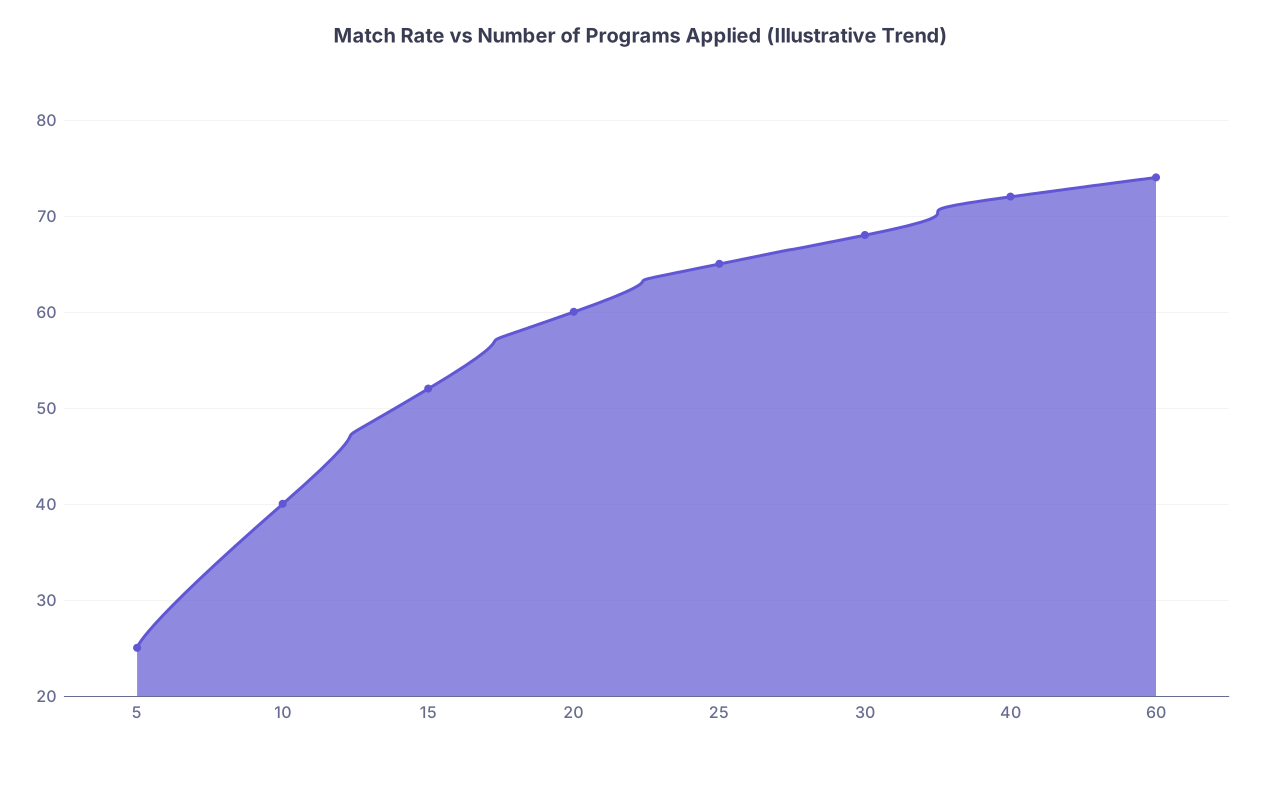
- Using data and self-assessment to decide how many programs to apply to
- Putting it all together in a concrete program selection strategy
Throughout, “non-US citizen IMG” and “foreign national medical graduate” will be used to emphasize the specific challenges and solutions relevant to your situation.
The Med-Peds Landscape: What You’re Up Against
Why Med-Peds Is Different
Medicine-Pediatrics programs are fundamentally different from categorical Internal Medicine or Pediatrics in several ways:
- Smaller total number of programs and positions
- Historically strong interest from US MD graduates
- Many programs are in academic centers with particular institutional policies on visas
- Programs often value broad clinical exposure and strong communication skills because graduates are expected to function across both adult and pediatric systems
While Internal Medicine and Pediatrics each have hundreds of programs, Med-Peds has a fraction of that number. This means that even “less competitive” Med-Peds programs are not as numerous as their categorical counterparts.
How IMGs Fit into Med-Peds
Compared with Internal Medicine:
- Fewer Med-Peds programs routinely take IMGs
- Some Med-Peds programs have never matched an IMG, or only very occasionally
- Programs that do sponsor visas and accept IMGs often have a clear track record, which you can identify with some research
For a non-US citizen IMG, the medicine pediatrics match is not only about your application strength; it’s about matching yourself to programs that are structurally able and historically willing to sponsor and train foreign national medical graduates.
Implications for Your Strategy
Because of this:
- Your program selection strategy must be more focused and data-driven than that of a US graduate
- You cannot assume that “I’ll just apply broadly” will work unless you understand visa and IMG dynamics
- Your list must balance ambitious and realistic choices while always respecting visa constraints
Your goal is not just to match into Med-Peds; it is to maximize your chances within the subset of programs that realistically consider non-US citizen IMGs.
Step 1: Honest Self-Assessment Before Choosing Programs
Before you can decide how to choose residency programs or how many programs to apply to, you must understand your own profile. This determines what tier of programs you should target.
Core Components of Your Profile
USMLE/COMLEX Scores (if applicable)
- Competitive Med-Peds candidates—especially US grads—often have strong scores.
- As a non-US citizen IMG, you typically need equal or stronger scores than US applicants to receive the same number of interview invitations.
- Step 2 CK is particularly important now that Step 1 is pass/fail.
Year of Graduation (YOG)
- Many Med-Peds programs prefer applicants within 5 years of graduation, sometimes stricter.
- If your YOG is older, you will need to be more selective about which programs you target and favor those explicitly open to older graduates.
US Clinical Experience (USCE)
- Strongly preferred by most Med-Peds programs.
- Rotations in Internal Medicine, Pediatrics, or Med-Peds—especially in academic centers—are valuable.
- LoRs from US faculty in both Medicine and Pediatrics are very helpful.
Research, Publications, and Leadership
- Med-Peds programs in academic centers value involvement in research, especially in chronic disease, health disparities, transitions of care, or primary care.
- Leadership experiences (student groups, community outreach, teaching) demonstrate potential for Med-Peds’ broad roles.
Red Flags
- Step failures, significant gaps, professionalism concerns.
- Not automatically disqualifying, but they narrow the set of programs that may consider you.
Rough Tiering of Applicant Profiles (for Non-US Citizen IMGs)
This is a practical framework, not an official classification:
Tier A (Highly Competitive IMG)
- Step 2 CK: very strong (e.g., ~250+ or equivalent percentile)
- Recent YOG (≤ 3 years)
- Multiple US rotations including Internal Medicine or Pediatrics
- Strong US letters of recommendation, possibly from academic centers
- Some research or leadership
Tier B (Solid IMG Applicant)
- Step 2 CK: solid (e.g., ~235–249)
- YOG within ~5–7 years
- Some USCE (at least 1–2 rotations)
- Good LoRs (may include home country + US)
- Possible minor gaps or one less strong area
Tier C (At-Risk Applicant)
- Step 2 CK: lower (e.g., <235) or an exam failure
- YOG > 7–8 years
- Limited or no USCE
- Limited research or leadership
- Red flags present
Your tier influences:
- Whether you should apply exclusively Med-Peds or add categorical Internal Medicine and/or Pediatrics
- How many Med-Peds programs you should include
- How much weight you place on “IMG-friendliness” vs other desirable features

Step 2: Building a Targeted Med-Peds Program List
Once you understand your profile, you can begin to design your program selection strategy. This is where you move from “I’ll apply everywhere” to a thoughtful, data-based list.
Key Filters for a Non-US Citizen IMG
When researching Med-Peds programs, prioritize information on:
Visa Sponsorship (Absolutely Critical)
- Does the program or its sponsoring institution sponsor J-1 and/or H-1B visas?
- Has the program sponsored visas recently (last 2–3 match cycles), not just historically?
- Some hospitals sponsor only J-1, some offer both, and a few do not sponsor any visas.
IMG Acceptance and Track Record
- Does the program list current or recent IMG residents on their website?
- Are any of them non-US citizen IMGs (not just US citizens who went to offshore schools)?
- A visible IMG presence strongly suggests the program is comfortable training foreign national medical graduates.
USMLE Cut-Offs and YOG Limits
- Many Med-Peds programs publish minimum score requirements or YOG preferences.
- If your profile doesn’t meet the stated criteria, you should consider such programs high-reach or exclude them.
Program Size and Location
- Larger programs may have slightly more flexibility in their selection.
- Programs in very desirable locations often fill with US graduates; be cautious if you are a Tier B or C applicant.
Institutional Type (University vs Community)
- University-affiliated programs may have stronger research and subspecialty opportunities, but sometimes more competition and stricter requirements.
- Community-based Med-Peds programs may be more flexible in terms of scores and background, though not always.
Where to Find Reliable Information
- Program websites – for visa policies, resident biographies, curriculum, and requirements
- NRMP and FREIDA – for basic program characteristics, although visa info may be incomplete
- Program social media (Twitter/X, Instagram) – to gauge culture and current residents’ backgrounds
- Reputable IMG forums and mentorship groups – cautiously used, to supplement but not replace official information
Categorizing Programs on Your List
As you research, categorize each program into:
Green (Realistic)
- Sponsors your visa type
- Has at least some non-US citizen IMG presence or clearly states openness to IMGs
- Your scores and YOG meet or exceed posted criteria
- Location and size are compatible with your overall goals
Yellow (Reach but Possible)
- Visa sponsorship present, but limited or unclear IMG track record
- Higher average scores or prestigious reputation
- Very desirable location (big city, famous academic center)
Red (Unlikely or Not Viable)
- No visa sponsorship or only for US citizens/GC holders
- Explicit “No IMGs” or “No visa sponsorship” policies
- Strict cutoffs you do not meet, without compelling compensating strengths
You should not waste applications on Red programs. Every application costs money; that money is better spent on more realistic options or additional Internal Medicine/Pediatrics programs if needed.
Step 3: How Many Med-Peds Programs Should You Apply To?
“How many programs to apply” is one of the most frequent and anxiety-inducing questions for any applicant, especially a foreign national medical graduate aiming at Med-Peds.
Because Med-Peds has fewer programs, you cannot apply to hundreds like in categorical Internal Medicine. Instead, you should focus on a strategic but sufficiently broad approach, tailored to your tier and visa needs.
General Ranges for Non-US Citizen IMGs (Med-Peds Only)
These are approximate ranges and assume you are applying only to Med-Peds (not necessarily recommended for all tiers):
Tier A (Highly Competitive IMG)
- Med-Peds: ~35–45 programs
- You can include more “Yellow/Reach” programs because your baseline competitiveness is strong.
- Still prioritize visa-friendly and IMG-accepting institutions.
Tier B (Solid IMG Applicant)
- Med-Peds: ~45–60 programs
- Heavier emphasis on “Green” programs that clearly sponsor visas and accept IMGs.
- You may also consider adding a significant number of Internal Medicine or Pediatrics programs as backup.
Tier C (At-Risk Applicant)
- Med-Peds: ~25–40 very targeted programs (only those that are clearly visa-friendly and IMG-accepting)
- Add a large number of categorical Internal Medicine and/or Pediatrics programs to secure interviews.
- Your Med-Peds list should be realistic, not aspirational only.
Med-Peds Alone vs Combined Strategy
Because Med-Peds is small, many non-US citizen IMGs benefit from a dual-application strategy:
Med-Peds + Internal Medicine
- Most common combination.
- Use Med-Peds to target your true passion; use Internal Medicine to protect against going unmatched.
- Internal Medicine often has more IMG-friendly and visa-sponsoring opportunities.
Med-Peds + Pediatrics
- Less common but attractive if your interests are pediatric-heavy.
- Some programs may perceive you as very pediatrics-oriented; explain your reasoning clearly in interviews.
Med-Peds + Both IM and Peds
- Used by risk-averse Tier B/C candidates.
- Requires careful management of your personal statement themes and explanation of your goals.
When you combine specialties, your total number of applications (Med-Peds + others) often ranges:
- Tier A: ~60–80 total programs
- Tier B: ~80–120 total programs
- Tier C: ~120–150+ total programs
These numbers vary with your budget and comfort level, but the principle is: do not rely solely on Med-Peds unless your profile is very strong and you can accept the risk.

Step 4: Prioritizing and Refining Your Program List
Once you have a preliminary sense of how many programs to apply to and which programs sponsor visas, refine your list using a structured approach.
Core Priorities (Non-Negotiables)
Visa Sponsorship
- J-1 is the most common; H-1B is less common and usually requires Step 3.
- If you require a specific visa (for example, you cannot accept J-1 due to home residency requirements), your search is more constrained, and you must be even more targeted.
Openness to Non-US Citizen IMGs
- At least one current or recent non-US citizen IMG resident is an excellent sign.
- If all residents are US MD/DO, the program might be a long shot unless your profile is exceptional.
Compatibility with Your Profile
- If your Step scores and YOG barely meet cutoffs, treat the program as “Yellow” rather than “Green”.
- Prioritize programs where you clearly exceed minimum expectations.
Secondary Priorities (Personal Fit and Career Goals)
After meeting the non-negotiables, consider:
Career goals
- Interested in academic medicine, combined fellowships, med-peds hospitalist careers, or primary care?
- Some Med-Peds programs are very fellowship-oriented; others emphasize primary care and underserved communities.
Location and Support Systems
- Large urban vs mid-sized city vs rural.
- Presence of cultural communities, religious centers, or support networks relevant to you.
Program Culture and Structure
- Balance between Internal Medicine and Pediatrics rotations.
- Opportunities for global health, advocacy, community work—areas often attractive to Med-Peds residents.
Practical Example of List Refinement
Imagine you are a Tier B non-US citizen IMG with:
- Step 2 CK: 240
- YOG: 3 years ago
- 3 months of USCE (IM + Peds)
- J-1 visa required
You initially identify 55 Med-Peds programs that sponsor J-1 visas. Now you refine:
Review each program’s website to confirm:
- J-1 sponsorship
- IMG acceptance (current/recent non-US citizen IMG residents)
- No strict Step 2 cutoffs above your score
Result after refinement:
- 25 programs: Green (visa + clear IMG presence + score-compatible)
- 20 programs: Yellow (visa + unclear IMG history or slightly higher competitiveness)
- 10 programs: Red (no recent IMGs or explicit score/YOG limits you do not meet)
Final Med-Peds list:
- Apply to all Green (25) and most of the Yellow (say 15) = 40 Med-Peds programs
- Drop the clearly non-viable Red (10) programs
- Add 40–60 Internal Medicine programs that are J-1-friendly and IMG-accepting
Total: ~80–100 applications across Med-Peds and Internal Medicine, balanced and realistic.
Step 5: Advanced Tactics to Strengthen Your Program Selection Strategy
Once you have your preliminary list, there are a few more tactics that can help you fine-tune your targeting and improve your chances.
Aligning Your Application Materials with Your Program List
Your personal statement, letters, and ERAS entries should reflect:
- A genuine interest in Med-Peds—include experiences that show you enjoy working with both adult and pediatric patients.
- Clear explanation of why Med-Peds (not just “I like both”; focus on transitions of care, chronic disease continuity, or underserved populations across ages).
- If you are also applying to Internal Medicine or Pediatrics, create separate personal statements with coherent—but not contradictory—narratives.
Programs do notice when your story aligns with their strengths. If you apply heavily to community-focused Med-Peds programs, emphasize:
- Community outreach
- Longitudinal relationships with families
- Primary care experiences
If your list is dominated by academic centers, emphasize:
- Research
- Teaching
- Interest in fellowships or academic careers
Communicating with Programs (Selective and Professional)
Emailing programs will not magically convert a “No IMGs” program into an IMG-friendly one, but in some situations, reaching out can clarify:
- Whether a program will sponsor a visa this year
- If there are changes in policies not yet reflected on websites
- If they will consider your older YOG with strong updates (extra research, recent USCE, etc.)
When emailing:
- Be brief, polite, and focused on concrete questions (e.g., “Does your program sponsor J-1/H-1B visas for residents?”).
- Do not send mass-generic emails to every program; target only those with unclear information.
Tracking and Adjusting During the Season
Create a simple spreadsheet including:
- Program name
- City/State
- Visa type(s) sponsored
- IMG presence (Yes/No/Unclear)
- Category: Green/Yellow/Red
- Application submitted (Yes/No)
- Interview offer status
This allows you to:
- See patterns in which types of programs respond favorably
- Learn and adjust if a particular profile (e.g., smaller community J-1 programs) offers more interviews
- Be prepared for SOAP if needed, with a clear list of programs that are more likely to consider a foreign national medical graduate
Frequently Asked Questions (FAQ)
1. Should I apply only to Med-Peds if it is my true passion?
If you are a non-US citizen IMG, applying only to Med-Peds is usually advisable only if:
- You are a Tier A applicant (excellent scores, strong USCE, no major red flags), and
- You can emotionally and practically accept the higher risk of going unmatched if things go poorly.
For most Tier B and C applicants, applying to a combination of Med-Peds + Internal Medicine and/or Pediatrics is a safer and more rational program selection strategy.
2. How can I tell if a Med-Peds program really accepts non-US citizen IMGs?
Look for:
- Current resident lists that explicitly mention international backgrounds and non-US citizenship
- Program websites referencing “we welcome IMGs” or listing visa details
- Historical match data (sometimes available through alumni pages or match announcements)
If you see only US MD/DOs year after year, it does not automatically mean they never consider foreign national medical graduates, but it makes them more of a reach.
3. Is it worth applying to very competitive academic Med-Peds programs as a non-US citizen IMG?
Yes, but strategically and sparingly. Include a few such programs if:
- Your scores and experiences are strong compared to other IMGs
- They clearly sponsor visas
- They have at least occasional non-US citizen IMGs in their program history
However, most of your applications should go to programs where your chances are realistic, not just aspirational.
4. What if my Step 2 CK is below average—should I still apply to Med-Peds?
You can still apply, but:
- Focus on programs that do not list strict high cutoffs and have a history of working with IMGs.
- Strengthen other aspects: recent USCE, strong letters, clear Med-Peds interest.
- Combine Med-Peds applications with a larger number of Internal Medicine and/or Pediatrics programs to improve your overall match chances.
By combining honest self-assessment, careful research on visa and IMG acceptance, and a realistic understanding of how many programs to apply to, you can create a powerful program selection strategy as a non-US citizen IMG in Medicine-Pediatrics. The medicine pediatrics match is challenging, but a data-driven approach and thoughtful planning give you a genuine opportunity to succeed.