Understanding the Med-Psych Landscape as a Non-US Citizen IMG
Medicine-Psychiatry combined residencies are small, competitive, and very different from categorical Internal Medicine or Psychiatry. As a non-US citizen IMG (foreign national medical graduate), you face two simultaneous challenges:
- Competing in a niche specialty with limited spots
- Navigating visa, licensing, and screening filters that disproportionately affect non–US citizens
A strong program selection strategy is therefore just as important as your CV, scores, or personal statement. Many excellent candidates fail to match not because they are weak, but because they:
- Applied to the wrong mix of programs
- Underestimated how many programs to apply to
- Ignored visa or screening realities
- Didn’t differentiate between “reach,” “target,” and “safety” programs
This article will walk you step-by-step through how to choose residency programs, specifically for combined Medicine-Psychiatry (Med-Psych), with a focus on non-US citizen IMGs. You’ll leave with a practical framework to answer:
- How many programs to apply to in Med-Psych as a non-US citizen IMG
- Which factors matter most for your profile
- How to build a realistic, data-driven program list and ranking strategy
Step 1: Know the Structure of Medicine-Psychiatry Combined Programs
Before building your program selection strategy, you need a clear understanding of what you are applying for.
What Is Medicine-Psychiatry Combined Training?
Medicine-Psychiatry combined residencies are 5-year programs that lead to board eligibility in both Internal Medicine and Psychiatry. You rotate between both fields under a coordinated curriculum, rather than completing a sequential residency.
Key characteristics:
- Duration: 5 years
- Outcome: Board-eligible in Internal Medicine and Psychiatry
- Typical program size: 2–4 residents per year (sometimes fewer)
- Total number of programs: Very limited (usually under 20 in the US; exact number changes slightly year to year)
For a foreign national medical graduate, this has pros and cons:
Advantages
- Unique niche: Fewer applicants overall than categorical specialties
- Strong interest from academic centers focusing on integrated care, CL psychiatry, addiction, primary care mental health
- You emerge with dual skills that can be attractive for hospitals and academia worldwide
Challenges
- Small numbers: Some programs take only 2 residents per year; a few may have only 1
- Many are at academic centers with strong domestic applicant pools
- Institutional comfort with visa sponsorship varies widely
Understanding the Program Ecosystem
Med-Psych programs are often housed within large academic health systems. Pay attention to:
- Primary department home: Some are more medicine-driven; others more psychiatry-driven
- Institution size: Large university hospitals vs community-based university affiliates
- Regional differences: Coasts and large cities vs Midwest/South vs smaller markets
This ecosystem matters because it affects:
- Your visa chances
- Your fit as a non-US citizen IMG
- The program’s past track record with IMGs and foreign nationals
Step 2: Clarify Your Personal Profile and Constraints
Your program selection strategy must be rooted in a realistic assessment of your strengths and limitations, especially as a non-US citizen IMG.
1. Visa Status and Eligibility
This is the single most important filter for many non-US citizen IMGs.
Common scenarios:
- You are ECFMG certified and require a J-1 visa
- You are eligible for or require H-1B visa sponsorship
- You are on another status (e.g., F-1 with OPT, dependent visa) and might need to transition
Key actions:
- Decide whether you are open to J-1 only or must have H-1B
- Understand that H-1B sponsorship is more restrictive:
- Requires certain USMLE attempts and Step 3 completion (in most cases)
- Fewer programs are willing/able to support it
- Realize that insisting on H-1B dramatically reduces your list of potential Med-Psych programs
For most non-US citizen IMGs in Med-Psych, a practical strategy is:
- Be open to J-1 at minimum
- Consider H-1B a bonus rather than a requirement
- Fact-check visa policies on each program’s website
2. Academic Metrics and Red Flags
Assess honestly:
- USMLE Step 1 (pass/fail), Step 2 CK score, and any attempts
- If applicable, Step 3 score
- Any gaps between graduation and application
- Any failures, leaves of absence, or professionalism issues
For Med-Psych specifically:
- Programs appreciate consistent academic performance and strong clinical reasoning
- Step 2 CK tends to be more heavily weighted since Step 1 became pass/fail
- Long gaps or multiple failures may make some academic centers less likely to consider you, though not impossible if you have strong clinical/psychiatric experience
3. Clinical Experience and Specialty-Relevant Exposure
For a medicine psychiatry combined residency, programs look for evidence that you genuinely understand and are committed to this integrated path.
Strengthening factors:
- US clinical experience (USCE), ideally in both Internal Medicine and Psychiatry
- Rotations or electives in:
- Consultation-Liaison Psychiatry
- Addiction Medicine/Psychiatry
- Primary care with mental health integration
- Research or quality improvement projects at the interface of medicine and psychiatry
- Longitudinal volunteer work with populations with serious mental illness, substance use disorders, or chronic medical conditions
As a non-US citizen IMG, this exposure is especially important to overcome implicit biases programs may have toward IMGs’ familiarity with US healthcare and mental health systems.
4. Personal Constraints and Priorities
Your program selection strategy must account for:
- Geographic limitations (family, spouse, visa issues)
- Willingness to train in smaller cities or less popular states
- Openness to different patient populations and hospital systems
Being flexible geographically is one of the most powerful advantages you can leverage as a non-US citizen IMG. Many IMGs match into excellent programs in locations less popular with US graduates.

Step 3: How to Choose Residency Programs – A Structured, Data-Driven Approach
Most applicants approach program selection emotionally (“I like this city,” “This is a famous university”), but as a non-US citizen IMG targeting a small specialty, you must be very systematic.
A. Core Filters for Non-US Citizen IMGs in Med-Psych
Create a spreadsheet and capture, at minimum, the following for each Medicine-Psychiatry program:
Visa policy
- J-1: Yes/No
- H-1B: Yes/No; any requirements noted
- Historical trends if available
IMG-friendliness
- Do they explicitly state they welcome IMGs?
- Have they matched IMGs or non-US citizen IMGs recently?
- Can you identify current/past residents from foreign medical schools?
USMLE and academic thresholds
- Any posted minimum score cutoffs?
- Requirement for Step 3 if H-1B is possible
- Policy on attempts
Program size and structure
- Number of Med-Psych residents per year
- Whether they share recruitment/interview days with categorical IM or Psych
- Associated categorical program strength (Harvard-level vs solid regional academic center)
Location and institutional profile
- Region and city size
- University vs community-based academic center
- Cost of living and support systems (important if relocating alone)
B. Evaluating “Fit” for Medicine Psychiatry Combined
Beyond logistics, look at how each program defines Med-Psych identity:
Key questions to research on program websites and during Q&As:
- Do they have established Consultation-Liaison and integrated care services?
- What Med-Psych–specific rotations exist (e.g., inpatient Med-Psych unit, primary care mental health, collaborative clinics)?
- Are there faculty whose clinical or academic work clearly bridges both fields?
- Are graduates going into academic Med-Psych roles, CL psychiatry, integrated primary care, addiction, or hospital medicine with strong psych skills?
As a foreign national medical graduate, showing in your personal statement and interviews that you have specifically researched these features greatly strengthens your perceived fit.
C. Using Tiers: Reach, Target, and Safety Programs
For a realistic program selection strategy, categorize each program into:
Reach programs
- Highly competitive universities, very small class sizes, or places with limited IMG history
- You still have a plausible case (good scores, strong USCE, relevant research), but odds are lower
Target programs
- Programs where your profile is close to their typical accepted resident
- They sponsor visas and have a history of taking IMGs or non-US citizens
Safety programs (as much as possible in Med-Psych)
- Programs that are explicitly IMG-friendly
- Located in less competitive regions
- Known to have a strong need for applicants and stable visa sponsorship
For Med-Psych, truly “safe” programs are rare because the overall number is small, but some will be relatively more accessible for non-US citizen IMGs based on history and location.
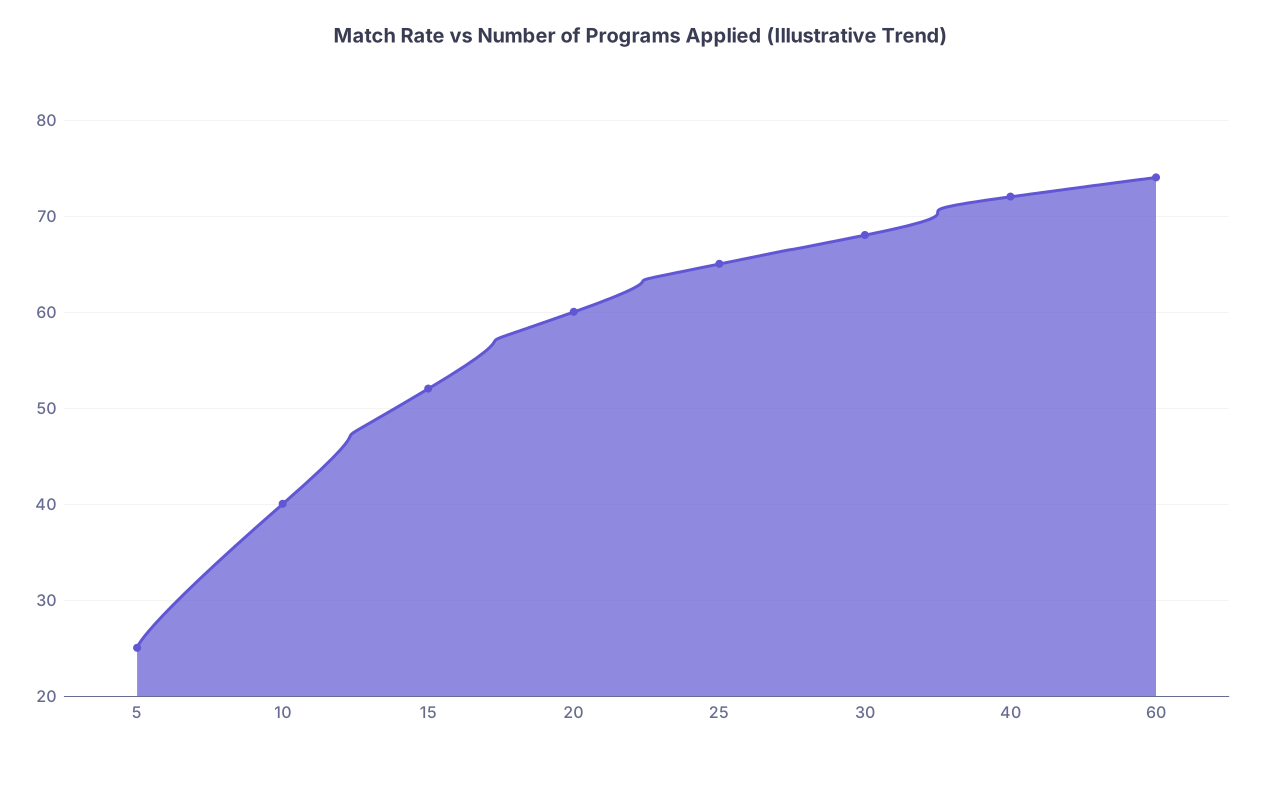
Step 4: How Many Programs to Apply to in Medicine-Psychiatry
Given the HOW_MANY_PROGRAMS_SHOULD_YOU_APPLY_TO category, we need to be concrete and realistic.
A. Unique Application Math for Med-Psych
Unlike large specialties, Medicine-Psychiatry combined has:
- Limited number of programs (often <20)
- Small class sizes (1–4 residents/year)
- Overlap in applicant pool with highly motivated US MD/DOs, triple-board–curious students, and strong IMGs
For non-US citizen IMGs, the competition is not just for spots—it’s for interviews at visa-sponsoring, IMG-accepting programs.
B. Recommended Application Numbers
Exact numbers depend on your profile, but as a non-US citizen IMG:
- Apply to every Med-Psych program where you meet basic criteria, unless:
- They explicitly state “no visa sponsorship”
- They clearly do not consider IMGs at all
For most applicants, this means:
- Med-Psych applications:
- Aim to apply to all eligible Med-Psych programs, often in the range of 12–18 (or however many exist in the current cycle that meet your visa/eligibility constraints)
- Supplement with categorical applications
- Because Med-Psych positions are few, it is risky to apply only to combined programs
- Strongly consider applying to both:
- Categorical Internal Medicine (university-affiliated community programs, IMG-friendly academic centers)
- Categorical Psychiatry (especially IMG-friendly, visa-sponsoring programs)
A common balanced portfolio for a non-US citizen IMG might look like:
- 15 Med-Psych programs (if that many meet your constraints)
- 25–40 categorical Psychiatry programs, depending on your competitiveness
- 20–35 categorical Internal Medicine programs, focusing on IMG-friendly, visa-sponsoring institutions
Total: often 60–90 programs across specialties, sometimes more for applicants with weaker metrics or multiple red flags.
C. Adjusting the Number Based on Your Profile
Stronger profile (high Step 2 CK, strong USCE, no gaps, US research, solid LORs)
- Can lean slightly more on Med-Psych and fewer categorical back-ups
- Example: 15 Med-Psych, 25 Psych, 20 IM
Average profile (moderate scores, limited USCE, no major red flags)
- Balanced approach with robust categorical cushion
- Example: 15 Med-Psych, 35 Psych, 30 IM
Weaker profile (borderline scores, gaps, attempts, minimal USCE)
- Still apply to all reasonable Med-Psych programs (because you are passionate about the combined path), but broaden categorical applications substantially
- Example: 15 Med-Psych, 45+ Psych, 40+ IM
Remember: the point is not just how many programs to apply to, but how intelligently those programs are chosen according to visa, IMG-friendliness, and personal fit.

Step 5: Building and Refining Your Program List
Now that you know your constraints and approximate numbers, it’s time to operationalize your program selection strategy.
A. Start with Official and Specialty-Specific Resources
Use:
- NRMP/ERAS program listings for Medicine-Psychiatry
- Society websites (e.g., AADPRT, AAIM-related resources)
- Individual program websites for details on structure, curriculum, and current residents
For each medicine psychiatry combined program:
- Confirm it still exists and is recruiting in your application year
- Record:
- Number of Med-Psych positions
- Visa policy (J-1 vs H-1B vs none)
- Stated IMG policy if any
- Links to resident profiles
B. Investigate Visa Policies and IMG History
As a non-US citizen IMG, prioritize programs where:
- Visa sponsorship is explicitly stated (at minimum J-1)
- At least one of the following is true:
- Current or recent residents include graduates from foreign medical schools
- Program statements or FAQs affirm they consider IMGs
- Affiliated categorical IM or Psych programs regularly match IMGs
If a program is silent on visa sponsorship:
- Email the coordinator politely and briefly:
- Ask if they sponsor J-1 and/or H-1B for Med-Psych residents
- Do this before finalizing your list, not the night before ERAS opens
C. Evaluate Academic and Clinical Fit
For each program, ask:
- Does the curriculum emphasize what you care about? (e.g., CL, addiction, integrated primary care, serious mental illness with complex medical comorbidity)
- Are there mentors with dual interests? (e.g., Med-Psych faculty publishing on delirium, SMI and chronic disease management, psychopharmacology in medical illness)
- Is there flexibility for research, electives, or global mental health? This can be attractive if you eventually want to bring integrated care skills back to your home country.
Rank programs internally not just by name or location, but by how well they align with your long-term Med-Psych identity.
D. Balancing Geography with Match Probability
Many non-US citizen IMGs naturally prefer large coastal cities. However:
- Some of the best Med-Psych programs and most IMG-friendly categorical programs are in the Midwest, South, or smaller cities
- Willingness to consider these locations can significantly increase your interview yield
Use this principle:
- For every “highly desirable” city or famous name program you include, balance it with several solid, less competitive locations that are proven IMG-friendly.
Step 6: Strategy for Interviews, Ranking, and Backup Plans
Application is only step one. Your program selection strategy continues through interviews and ranking.
A. Aligning Your Story with Medicine-Psychiatry
In every Med-Psych interview, articulate:
- Why a combined program (and not “I’ll do IM, then a Psych fellowship later”)
- How your experiences in your home country and in the US showed you the need for integrated care
- Specific examples: patients with severe mental illness and uncontrolled diabetes; medically complex patients with delirium and mood disorder; addiction in medical wards
This helps programs see you as someone who understands the unique nature of Med-Psych, not just someone randomly applying.
B. Ranking Med-Psych Versus Categorical Programs
When rank list time comes:
- Rank all Med-Psych programs in your genuine order of preference
- Then rank categorical Psychiatry and Internal Medicine programs according to:
- Visa feasibility
- IMG-friendliness
- Geography and lifestyle preferences
- Potential to later work in integrated care or pursue relevant fellowships (e.g., CL psychiatry, addiction, hospital medicine)
Do not underestimate categorical Psychiatry as a path toward an “integrated” career. Many psychiatrists build extremely Med-Psych–like careers via:
- CL fellowships
- Work at academic medical centers seeing medically complex patients
- Collaborative care roles
Internal Medicine plus strong psych exposure also lets you practice Med-Psych–like medicine, especially in hospitalist or primary care roles.
C. Avoiding Common Mistakes in Program Selection
Non-US citizen IMGs commonly make these errors:
- Over-relying on prestige: Overloading their list with big-name universities that rarely match IMGs in Med-Psych
- Underapplying: Sending applications to 5–8 Med-Psych programs and 15–20 categoricals, which is often insufficient
- Ignoring visa realities: Applying heavily to programs that don’t sponsor visas or favor green-card holders/US citizens
- Not diversifying geography: Applying only to major coastal cities
A smart program selection strategy deliberately avoids these pitfalls by combining:
- Breadth (enough programs)
- Depth (researching each program thoroughly)
- Realism (honest match between your profile and program patterns)
FAQs: Medicine-Psychiatry Program Selection for Non-US Citizen IMGs
1. As a non-US citizen IMG, is Med-Psych an unrealistic goal?
Not inherently, but it is highly competitive due to small numbers. Your chances depend on:
- USMLE Step 2 CK performance and clinical evaluations
- Strength and relevance of your clinical and research experience
- How well you communicate a clear, authentic interest in Medicine-Psychiatry combined training
- Whether you strategically also apply to categorical IM and Psychiatry programs
It is not unrealistic, but it must be approached with a solid backup strategy and awareness that Med-Psych alone cannot be your only match plan.
2. How many Med-Psych programs should I apply to specifically?
In most cycles, you should apply to all Medicine-Psychiatry programs where:
- They sponsor your required visa (at least J-1)
- You meet posted eligibility criteria
- They are not explicitly closed to IMGs
For many non-US citizen IMGs, this means around 12–18 Med-Psych applications (depending on that year’s program offerings). Do not limit yourself to a small subset unless visa constraints force you to.
3. Should I prioritize Psychiatry or Internal Medicine as my backup?
For most non-US citizen IMGs drawn to Med-Psych:
- Psychiatry is often the more natural backup because:
- Many Med-Psych applicants are primarily Psych-oriented
- Psych residencies may have slightly more openness to IMGs and J-1 visas in some regions
- You can still build a career that strongly resembles Med-Psych via CL psychiatry, addiction, and integrated care roles
However, if your background and interests are more Medicine-heavy (e.g., strong IM research, hospitalist aspirations), you might give equal or slightly greater weight to Internal Medicine as a backup.
4. Does insisting on H-1B sponsorship significantly reduce my chances?
Yes. In a small specialty like Med-Psych, insisting on H-1B only can severely restrict the number of programs you can apply to. Many excellent programs offer only J-1 visas. Unless you have compelling immigration reasons:
- Consider being open to J-1
- Treat H-1B–sponsoring programs as high-value additions, not your entire list
Flexibility on visa type is often critical for a non-US citizen IMG trying to match into Medicine-Psychiatry combined training.
By methodically assessing your profile, understanding the Med-Psych ecosystem, and building a broad, diversified, and data-driven program list, you significantly improve your odds of matching—whether into Med-Psych itself or into a categorical path that still lets you build a richly integrated career at the interface of medicine and psychiatry.