
Understanding Your Unique Position as a Non‑US Citizen IMG
If you are a non‑US citizen IMG (international medical graduate) targeting neurology residency, your program selection strategy is just as important as your scores, CV, or personal statement. You are not only navigating the neuro match but also the additional layers of visa sponsorship, state licensure rules, and IMG‑friendliness.
Before you decide how many programs to apply to or how to choose residency programs, you need to understand three things about your profile:
Your Immigration Status
- Non‑US citizen IMG without any US visa or green card
- Non‑US citizen on a different visa (e.g., F‑1, H‑4) requiring sponsorship later
- Canadian citizen (unique category; often counted as IMGs but with some advantages)
Why it matters: Programs vary widely in whether they:
- Sponsor J‑1 visas only
- Sponsor H‑1B visas
- Sponsor both J‑1 and H‑1B
- Do not sponsor any visas (often off‑limits for you)
Your Academic Profile
- USMLE/COMLEX scores (or equivalent)
- Attempts and gaps
- Year of graduation
- Clinical/research experience (especially in the US)
- Neurology‑specific exposure: electives, observerships, publications
Neurology is moderately competitive, with a large proportion of IMGs, but non‑US citizen status is still a challenge at many academic centers.
Your Career Goals
- Academic neurology vs community practice
- Subspecialty interests (e.g., stroke, epilepsy, neurocritical care, movement disorders)
- Desire for research, fellowships, or physician‑scientist pathway
- Preference for certain regions (e.g., East Coast, Midwest, West Coast)
Your program selection strategy should integrate all three: immigration reality, academic strength, and long‑term goals.
Step 1: Clarify Your Priorities Before Building a List
Before opening ERAS or FREIDA, define what truly matters to you. This avoids an unfocused, overly costly application strategy.
A. Must‑Have vs Nice‑to‑Have Criteria
Create two columns in a spreadsheet:
Must‑Have (Non‑negotiable)
- Visa sponsorship type(s) acceptable (J‑1 only, or must have H‑1B)
- Accepts non‑US citizen IMGs
- Minimum score/attempts requirements that you meet
- State license rules compatible with your graduation date and attempts
- Accepts or at least regularly interviews foreign national medical graduates
Nice‑to‑Have (Preferences)
- Preferred US region or city type (urban vs suburban vs rural)
- Program size (small vs medium vs large)
- Strength in your target subspecialty
- Research opportunities level
- Work‑life balance, call structure, wellness culture
- On‑site fellowships (stroke, epilepsy, EMG, neurocritical care, etc.)
Being honest about your minimum requirements will keep you from wasting applications on programs that will not rank you because of visa or policy barriers.
B. Understand Common Non‑US Citizen IMG Constraints
For a non‑US citizen IMG aiming for neurology residency:
Visa Sponsorship is King
- Many neurology programs sponsor J‑1 but not H‑1B.
- Some high‑tier academic centers do not sponsor any visas.
- H‑1B often requires passing USMLE Step 3 before visa processing.
Year of Graduation (YOG)
- Programs often prefer graduates within 3–5 years of application.
- Older graduates can still match but must compensate with strong:
- Recent clinical experience
- US experience or strong research
- Clear explanation for gaps
US Clinical Experience (USCE)
- Neurology electives or observerships are a strong positive.
- Letters from US neurologists carry major weight.
Your program selection strategy must explicitly account for these factors before you decide how many programs to apply to.
Step 2: Research Programs Systematically (Not Randomly)
A strong program selection strategy is methodical. Avoid relying only on hearsay or one forum list. Instead, build a structured program research workflow.
A. Core Tools You Should Use
FREIDA (AMA Residency & Fellowship Database)
- Filter by specialty: Neurology
- Filter by:
- Visa sponsorship
- IMG percentage (if available)
- Program size and setting
- Review program descriptions, requirements, and contact details.
NRMP & Charting Outcomes (When Available)
- Look for:
- % IMGs in neurology
- Match outcomes by score/YOG
- Helps you understand how competitive neurology is for foreign national medical graduates with profiles similar to yours.
- Look for:
Program Websites
- Check for:
- Explicit statements on visa sponsorship (J‑1, H‑1B)
- “We welcome IMGs” or recent IMG graduates
- Resident roster and current residents’ medical schools
- Research and subspecialty strengths
- Check for:
Doximity & Other Reputation Tools
- Useful for relative reputation, alumni network, and fellowship placement.
- Do not overvalue rankings; instead, use them to categorize programs into tiers for your personal neuro match strategy.
State Medical Board Websites
- Some states have:
- Requirements for number of USMLE attempts
- Restrictions on IMGs or YOG
- A program may want you, but state rules could block your license.
- Some states have:
B. Identify IMG‑Friendly Neurology Programs
For a non‑US citizen IMG, “IMG‑friendly” does not simply mean they have matched IMGs; it means:
- They routinely interview and rank non‑US citizen IMGs
- They sponsor visas (at least J‑1; H‑1B if you plan for that)
- Their current or recent residents include graduates from outside the US/Canada
Steps:
- Visit the “Current Residents” or “Our Residents” page.
- Note how many are IMGs and from which regions.
- Look for any explicit mention like:
- “We welcome applications from international medical graduates.”
- “We sponsor J‑1/H‑1B visas.”
If you notice multiple non‑US citizen IMGs from diverse schools, that program is very likely open to foreign national medical graduates.
Step 3: Building the Right Mix of Programs (Tiers & Risk Levels)
An effective neurology residency program selection strategy requires categorizing programs by tier and probability of interview/match. This avoids an unbalanced list (all “dream” programs or all “safety” programs).
A. Defining Tiers for Neurology Programs (For Your Strategy)
These tiers are for your personal planning, not official labels:
Reach Programs
- Highly academic, often top‑ranked university hospitals.
- Heavy research and subspecialty focus.
- Historically competitive (strong USMsLE/COMLEX averages).
- May favor US grads or permanent residents.
- Some may be less generous with visas.
Target (Realistic) Programs
- Solid university‑affiliated or large community‑based academic centers.
- Regularly match IMGs, including non‑US citizens.
- Balanced clinical training and research.
- Requirements align with your scores and YOG.
Safety Programs
- Community‑based or smaller university‑affiliated programs.
- Historically IMG‑heavy, often in less popular locations.
- More flexible with scores, YOG, and profiles as long as you demonstrate interest and reliability.
Your goal is to build a portfolio with all three tiers.
B. How Many Programs Should You Apply To in Neurology?
There is no single number that fits every non‑US citizen IMG, but we can outline ranges and how to adjust them.
Factors influencing how many programs to apply to:
- USMLE Step 1/2 CK scores and attempts
- YOG and gaps
- Presence/absence of USCE in neurology
- Strength of letters and research
- Visa status
General neurology guidance for non‑US citizen IMGs:
Very strong profile
- High scores (e.g., > 240 Step 2 CK), no failures, recent grad, solid USCE, research.
- Typical range: 50–80 programs
- Balance: ~30% reach, 50% target, 20% safety.
Average but solid profile
- Moderate scores (e.g., 220–240), maybe one minor gap, some USCE.
- Typical range: 80–120 programs
- Balance: ~20% reach, 50–60% target, 20–30% safety.
Red flags or weaker profile
- Older YOG, multiple attempts, limited USCE.
- Typical range: 120–150+ programs
- Balance: ~10–15% reach, 40–50% target, 40–50% safety.
- Consider adding preliminary medicine applications if you’re open to a more complex path.
These numbers recognize that foreign national medical graduates often receive fewer interview invites per application compared to US graduates. You’re applying not just to neurology, but to neurology with visa and IMG filters also in play.
C. Example Scenarios
Scenario 1: Strong Profile Non‑US Citizen IMG
- Step 2 CK: 252, recent grad (YOG last year)
- 2 US neurology electives, 1 US neuro research project
- J‑1 acceptable, prefers H‑1B but flexible
Application strategy:
- Apply to ~70 programs
- 20 reach (top academic centers, NIH‑level research)
- 35 targets (university and university‑affiliated with known IMGs)
- 15 safety (community and hybrid programs, IMG‑heavy)
- Prioritize any programs that sponsor both J‑1 and H‑1B.
Scenario 2: Average Profile Non‑US Citizen IMG
- Step 2 CK: 228, YOG 4 years ago
- 1 observership in neurology, no strong research
- Requires visa sponsorship (J‑1 is fine)
Application strategy:
- Apply to ~100 programs
- 15–20 reach
- 50–60 target
- 25–30 safety
- Choose programs with consistent history of non‑US citizen IMGs.
Scenario 3: Challenging Profile Non‑US Citizen IMG
- Step 2 CK: 214 (first attempt), failed Step 1 once
- YOG 7 years ago, limited recent clinical work
- No USCE yet, but planning observership
Application strategy:
- Apply to 130–160 programs if financially possible
- 10–15 reach
- 50–60 target
- 60–80 safety (strongly IMG‑friendly, less popular locations)
- Be flexible on geography and focus on programs that:
- Explicitly state they welcome IMGs
- Clearly sponsor J‑1 visas.
Step 4: Advanced Filters for Choosing Neurology Programs
Beyond the basic “IMG‑friendly” and “visa‑sponsoring” filters, you should refine your list with deeper factors that matter for your training and future career.
A. Clinical Exposure and Case Mix
For neurology, consider:
- Stroke center level (Primary vs Comprehensive)
- Presence of:
- Epilepsy monitoring unit
- Neurocritical care unit
- EMG/NCV labs
- Movement disorders clinic
- Multiple sclerosis, neuromuscular, cognitive/behavioral, and neuroimmunology services
If you have subspecialty interests (e.g., epilepsy), favor programs with strong exposure in that area. This will influence your fellowship prospects and satisfaction with training.
B. Research and Academic Orientation
If you aim for fellowships at major academic centers:
- Look for:
- Ongoing clinical trials
- NIH funding
- Dedicated research time in PGY‑3/4
- Number of annual publications by residents
If you prefer community practice:
- Focus less on research and more on:
- Breadth of hands‑on clinical experience
- Outpatient vs inpatient volume
- Autonomy in managing cases
C. Fellowship Placement
Review the program’s recent graduates:
- Do they match into fellowships you might want?
- Are there in‑house fellowships (stroke, epilepsy, neurocritical care, EMG)?
- Are graduates entering jobs or fellowships in locations you like?
A strong internal fellowship pipeline can be a big advantage, especially for a foreign national medical graduate who might face additional barriers in securing fellowships later.
D. Location, Cost of Living, and Support Systems
For a non‑US citizen IMG, settling in a new country is stressful:
Location Factors
- Proximity to major airports (if family abroad)
- Availability of cultural/religious communities
- Climate tolerance (e.g., harsh winters vs mild climates)
Cost of Living
- Salary vs local rent and living expenses
- Some “less famous” cities may offer better quality of life on resident salary.
Support
- Programs with multiple IMGs may better understand visa and adaptation issues.
- Ask about mentorship, orientation programs, and IMG support.

Step 5: Practical Workflow to Build and Refine Your Program List
Turn this into a structured, step‑by‑step project. Here is a suggested workflow for your neurology residency neuro match strategy:
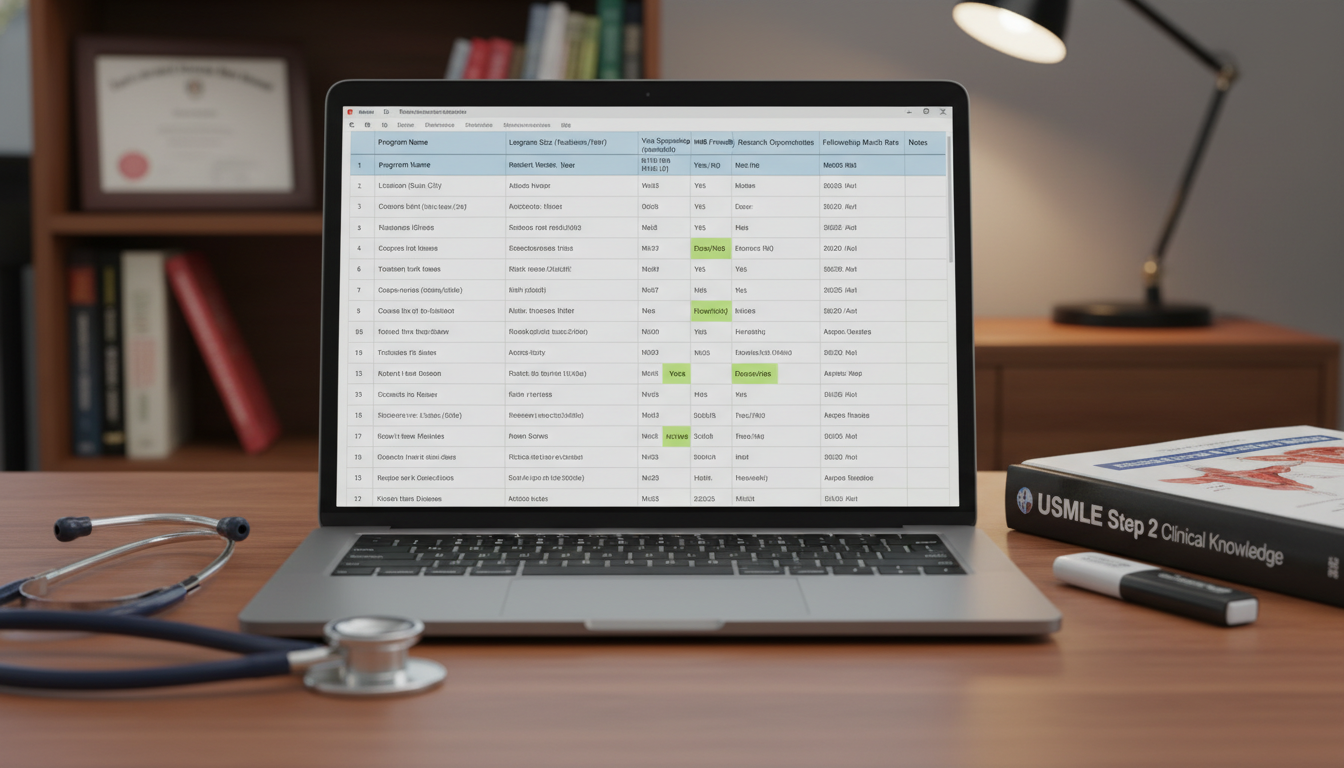
Step 1: Create a Master Spreadsheet
Include columns such as:
- Program name
- City/state
- Program type (university, university‑affiliated, community)
- Visa sponsorship (J‑1, H‑1B, both, none)
- IMG‑friendliness (high/medium/low; based on resident list)
- Minimum score requirements (if stated)
- YOG limits (if any)
- Notes on:
- Research strength
- Subspecialty strengths
- Fellowship options
- Tier (Reach/Target/Safety)
- Personal interest rating (1–5)
- Applied? (Yes/No)
- Interview received? (Later in the season)
Step 2: Initial Filtering (Hard Criteria)
Eliminate programs that:
- Do not sponsor any visas
- State “US citizens or permanent residents only”
- Have rigid policies you cannot meet (e.g., Step 3 required for J‑1, no IMG acceptance)
This first pass will significantly reduce the raw list to a realistic subset.
Step 3: Tier Assignment
Based on:
- Your scores vs published averages (if available)
- IMG representation
- Program reputation
Mark each program as Reach, Target, or Safety. Keep room to adjust as you gather more information.
Step 4: Personal Interest Ranking
Even among programs at the same tier, decide how much you want each one by considering:
- Location preference
- Clinical and research strengths aligned with your goals
- Culture and vibe (based on website, resident bios, social media)
Assign a simple 1–5 ranking:
- 5 = Dream program (within its tier)
- 3 = Good fit
- 1 = Backup only
When budget constraints limit how many programs you can apply to, this interest score helps you choose which to keep.
Step 5: Final Adjustments Based on Budget
Calculate total application costs:
- ERAS fees increase as you apply to more programs.
- Don’t forget USMLE transcript fees and other expenses.
If your ideal number (e.g., 120) is financially unrealistic, carefully trim:
- Remove lowest‑interest programs within each tier first.
- Maintain a healthy ratio: you still want a meaningful cluster of safety and target programs.
Step 6: Dynamic Updates During Application Season
Once interview invitations start:
- Track:
- Which tier is responding more
- Which geographical areas are more responsive
- If you get very few interviews early:
- Consider applying to a second wave of additional highly IMG‑friendly, less popular programs if ERAS is still open.
- If you get many interviews:
- You can slow additional applications, but be cautious; early season patterns can be misleading.
Mistakes to Avoid in Neurology Program Selection as a Non‑US Citizen IMG
Ignoring Visa Filters
- Applying to many programs that do not sponsor visas is the most common and expensive error for a foreign national medical graduate.
Over‑concentrating on Prestige
- Applying mainly to top‑tier academic centers with weak history of non‑US citizen IMGs often leads to few interviews.
Too Few Applications
- Applying to only 20–40 programs in neurology as a non‑US citizen IMG is usually risky unless your profile is exceptional and you have strong insider connections.
Not Considering YOG and State Rules
- Some states/programs quietly filter out older graduates, even if not clearly stated.
Underestimating Safety Programs
- Many community or hybrid neurology programs provide excellent training and strong fellowship outcomes; they are not “second‑class” options.
Not Tailoring Personal Statement and Emails
- While you cannot completely customize for each program, a “one‑size‑fits‑all” approach that ignores your genuine interest in specific regions or programs may harm your chances, especially when you reach out with interest emails later.
Putting It All Together: A Balanced Strategy for the Neuro Match
As a non‑US citizen IMG, your neurology residency program selection strategy should answer these core questions:
How many programs to apply to?
Usually 50–150+, depending on your profile strength and finances, with a strong emphasis on IMG‑friendly and visa‑sponsoring programs.How to choose residency programs wisely?
Use a structured, tiered approach:- Filter by visa and IMG policy.
- Validate IMG‑friendliness via resident rosters.
- Classify by Reach/Target/Safety.
- Prioritize based on clinical exposure, research, fellowships, location, and personal preference.
What program selection strategy protects you best?
- Start broad but focused: broad in number, focused on realistic, visa‑friendly neurology programs.
- Avoid program lists built only on reputation or hearsay.
- Track and adjust throughout the season as interview patterns emerge.
A thoughtful plan transforms the neuro match from a confusing, overwhelming process into a manageable project. With careful research, a realistic estimate of how many programs to apply to, and a clear program selection strategy, a non‑US citizen IMG can absolutely secure a strong neurology residency position.
FAQ: Program Selection Strategy for Non‑US Citizen IMGs in Neurology
1. As a non‑US citizen IMG, is neurology a realistic specialty for me?
Yes. Neurology historically matches a significant number of IMGs, including non‑US citizen IMGs. However:
- You must be strategic about visa‑sponsoring and IMG‑friendly programs.
- Strong US clinical experience in neurology and letters from neurologists significantly improve your chances.
2. Should I only apply to programs that offer H‑1B visas?
Not usually. If you restrict yourself to only H‑1B‑sponsoring programs, your application pool may become too small and competitive. Most foreign national medical graduates apply broadly to J‑1‑sponsoring programs and treat H‑1B as a bonus, unless there are very specific reasons (e.g., long‑term immigration planning) to insist on H‑1B.
3. How many neurology programs should I apply to if my scores are average and I graduated 3–4 years ago?
For an average profile non‑US citizen IMG, a practical range is 80–120 neurology programs, depending on your budget. Focus on:
- Programs that consistently have IMGs in their resident list
- Clear J‑1 sponsorship
- A good mix of university‑affiliated and community‑based academic centers
4. Is it worth applying to top‑tier academic neurology programs as a foreign national medical graduate?
Yes, but sparingly and strategically:
- Include some reach programs (e.g., 10–20% of your list), especially those that visibly have non‑US citizen IMGs among current residents.
- Do not let these programs dominate your list.
- Ensure that the majority of your applications go to realistic and safety programs where your profile and visa needs better align with program history.
By following these principles, you can approach neurology residency applications with a clear, data‑driven program selection strategy tailored to your situation as a non‑US citizen IMG.