Understanding the Unique Challenges for Non‑US Citizen IMGs in Preliminary Medicine
For a non‑US citizen IMG, designing a smart program selection strategy for a preliminary medicine year (prelim IM) is both crucial and uniquely complex. You are navigating:
- Immigration and visa considerations
- Limited categorical spots and separate prelim positions
- Highly variable program attitudes toward foreign national medical graduates
- The need to align your prelim IM year with a future advanced specialty (e.g., Neurology, Anesthesiology, Radiology, PM&R)
Before you decide how many programs to apply to or build a detailed program selection strategy, you need a clear understanding of:
What a Preliminary Medicine Year Is (and Isn’t)
- A preliminary medicine year is a 1‑year internal medicine internship.
- It does not automatically convert into a categorical IM position.
- It is usually taken before an advanced residency (e.g., Neurology, Radiology) or as a transitional year alternative in some cases.
- Many prelim IM programs are designed primarily for applicants who have already matched or intend to match into advanced specialties.
Why Being a Non‑US Citizen IMG Matters
As a foreign national medical graduate, you face several structural constraints:- Visa sponsorship (J‑1 vs H‑1B, or none at all) differs by program.
- Some programs or hospitals have institutional policies limiting or prohibiting visa sponsorship.
- Many internal medicine departments prioritize categorical IM residents and may consider prelim IM positions as “service-heavy,” sometimes more open to IMGs, but not universally.
- You may have fewer US clinical contacts and letters, making your application more metrics-driven.
How Prelim IM Ties into Long‑Term Career Plans
Your prelim year should serve a clear purpose:- Required clinical year for an advanced match (e.g., PGY‑1 for Neurology)
- A bridge year to strengthen your CV, obtain US letters, and reapply to a categorical or advanced specialty
- A year to acclimate to US healthcare and pursue research or networking for future opportunities
Clarity about your end goal (advanced specialty, geographic preference, visa type) must shape your program selection strategy from the start.
Step 1: Define Your Personal Profile and Risk Level
Before asking how many programs to apply to, you must objectively analyze your competitiveness. For a non‑US citizen IMG, small differences in your profile can dramatically change the optimal number and type of programs.
1. Academic Metrics and Exams
Key components:
- USMLE Step 1: Pass/Fail, but failure attempts still matter
- USMLE Step 2 CK: Often the most important score
- Any failed attempts: Step 1, Step 2 CK, or Step 3 (if taken)
- Time since graduation: Many prelim IM programs prefer ≤ 5–7 years since graduation
Classify yourself roughly as:
- Highly Competitive
- Step 2 CK ≥ 250
- No failures
- Recent graduate (≤3–5 years)
- Strong US clinical experience (USCE) and letters
- Moderately Competitive
- Step 2 CK ~235–249
- No more than one attempt, no major red flags
- Some USCE, decent letters
- At-Risk/Underdog
- Step 2 CK < 235 or multiple attempts
- Older graduation year (>7 years)
- Limited or no USCE
- Visa‑requiring with additional red flags (e.g., gap, prior unmatched cycle)
Your category doesn’t define your destiny, but it does influence how wide your program selection strategy must be.
2. Visa and Immigration Factors
As a foreign national medical graduate, clarify:
- Are you eligible only for J‑1?
- Do you meet requirements for H‑1B (e.g., Step 3 passed, state license eligibility)?
- Are you on another status (e.g., F‑1 OPT, other work authorization)?
Implications:
- Programs that do not sponsor any visa are automatically excluded.
- Some prelim IM programs sponsor J‑1 only and refuse H‑1B due to institutional cost/policy.
- H‑1B sponsoring prelim programs are relatively uncommon and often competitive.
If you require a visa and have exam attempts or are an older graduate, your strategy must be broad and realistic, focusing on programs known to welcome IMGs.
3. Career Goals and Specialty Alignment
Your advanced specialty target should heavily influence which prelim programs you rank:
- Neurology, Radiology, Anesthesiology, PM&R: Many applicants to these fields require a prelim IM or transitional year. Some advanced programs have linked, guaranteed prelim positions.
- If you are still undecided about your advanced specialty, a solid, educationally supportive prelim IM year can provide exposure and strong letters for next applications.
Ask yourself:
- Do I already hold an advanced position or am I planning to apply later?
- Will a high‑intensity, service-heavy program help or hurt my ability to prepare for future applications?
- Do I value research opportunities during the prelim year?
Your honesty here will prevent regret later.
Step 2: Researching and Filtering Programs Systematically
A deliberate program selection strategy requires a structured approach to research.

1. Start With Objective Filters
Use ERAS, FREIDA, program websites, and state GME pages to apply hard filters first:
- Program type: Internal Medicine → Preliminary (not categorical)
- Visa sponsorship: Explicit confirmation of J‑1 and/or H‑1B sponsorship
- Minimum USMLE scores and attempts: Many programs list cutoffs
- Years since graduation limit: E.g., “within 5 years of graduation”
For a non‑US citizen IMG:
- Exclude all programs that state “No visa sponsorship”.
- Be cautious with programs that do not mention visa at all—you must confirm via email or their website FAQ.
Document results in a spreadsheet with columns like:
- Program name, ACGME ID
- City/State
- Prelim IM spots (number of positions)
- Visa type (J‑1, H‑1B, none)
- USMLE cutoffs
- IMGs in current residents (Yes/No, approximate percentage)
- Years since graduation policy
- Notes (e.g., “emails not responded”, “IMG on resident roster from India”)
2. Identify IMG‑Friendly Programs
To optimize your program selection strategy, distinguish between:
- Clearly IMG‑Friendly
- Multiple current or recent residents are IMGs (website photos and bios)
- Explicitly mentions “we welcome international medical graduates”
- Has a history of sponsoring visas
- IMG‑Neutral
- Some IMGs, but majority US graduates
- No explicit statement about IMGs
- IMG‑Unfriendly
- No IMGs on rosters for several years
- Statements like “we do not sponsor any visas” or “US graduates preferred”
As a non‑US citizen IMG, prioritize:
- High proportion of IMG‑friendly and IMG‑neutral programs
- Only a small number of “reach” IMG‑unfriendly programs, if any
3. Consider Geography and Competition
Certain regions are more competitive or less IMG‑friendly:
- Highly competitive metro areas (NYC, Boston, San Francisco, Chicago core, major West Coast cities) attract many US grads and strong IMGs.
- Less competitive but IMG‑friendly regions (Midwest smaller cities, some Southern or community programs, rust-belt cities) may offer more realistic opportunities.
Balance:
- Apply to some programs in desirable locations (if they’re IMG/visa-friendly).
- Anchor your list with many programs in less competitive areas where non‑US citizen IMGs historically match.
4. Analyze Program Structure, Culture, and Support
A prelim IM year can be intense. Evaluate:
- Workload and call structure: Is it 80‑hour weeks, heavy night float?
- Educational culture: Do they offer teaching conferences, simulation, feedback?
- Support for future applications: Are program leadership and faculty willing to write strong letters and support your long-term goals?
- Research or scholarly activity: Not always critical in a 1‑year spot, but helpful if you are reapplying.
This qualitative analysis helps avoid purely “service-oriented” programs that might drain you without career benefit, unless you specifically prioritize high clinical exposure.
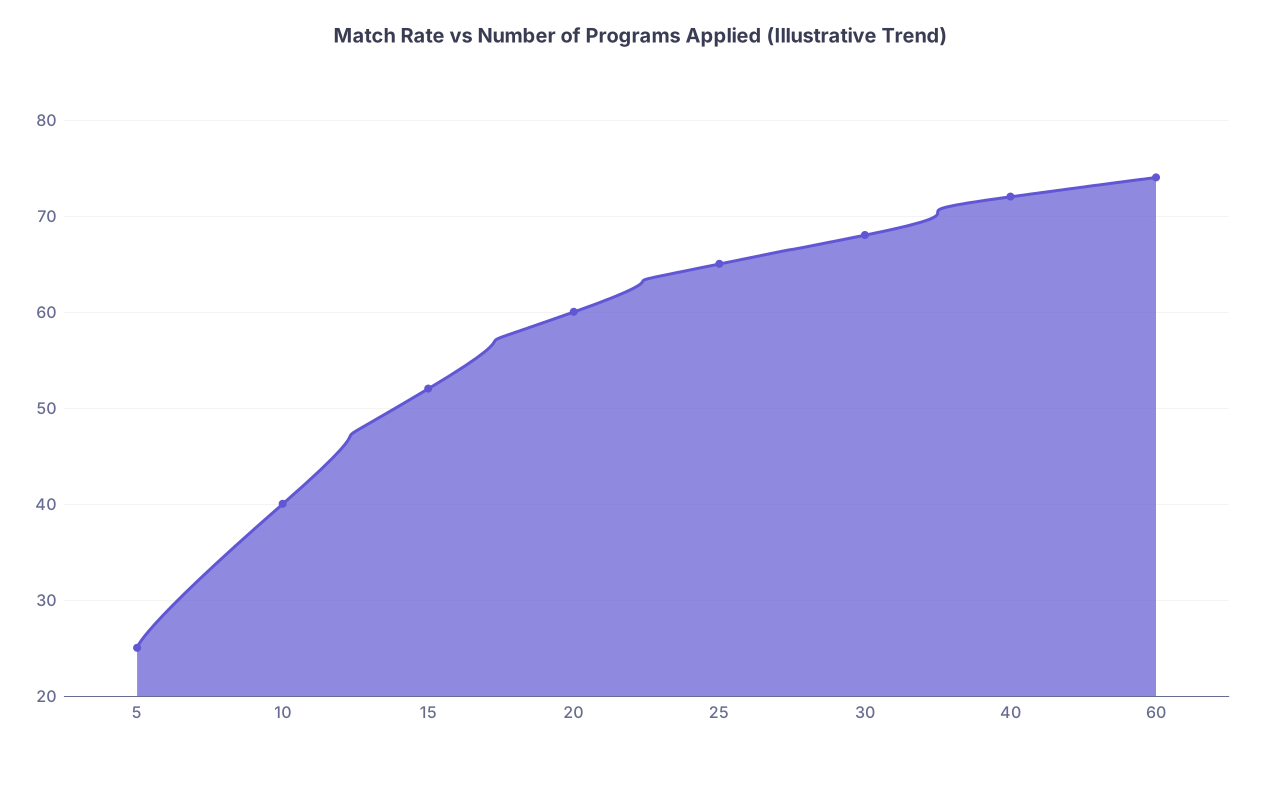
Step 3: How Many Programs Should You Apply To for Prelim IM?
The core question in any program selection strategy is: how many programs to apply to?
For a non‑US citizen IMG seeking a preliminary medicine year, suggested ranges (for the prelim IM portion of your applications) are:
1. If You Are Highly Competitive
Profile: Strong Step 2 CK (≥250), recent grad, strong USCE and letters, no attempts, visa required but with no additional red flags.
- Prelim IM Applications: ~25–40 programs
- Focus on:
- Programs linked to your advanced specialty or institution
- IMG‑friendly academic and community programs in a range of locations
- Rationale:
- You have good chances at interviews; over‑applying may waste money
- You can be more selective geographically and reputation-wise
2. If You Are Moderately Competitive
Profile: Step 2 CK ~235–249, maybe one attempt, some USCE, recent to moderately recent grad, J‑1 required.
- Prelim IM Applications: ~40–70 programs
- Strategy:
- Mix of academic community programs and solid community hospitals
- Prioritize IMG‑friendly, visa‑sponsoring programs outside the top metro hotspots
- Rationale:
- Your interview yield is less predictable; you must cast a wider net
- This range balances cost vs sufficient interview volume
3. If You Are At‑Risk/Underdog
Profile: Step 2 CK <235 or multiple attempts, older graduate, limited USCE, and requiring J‑1.
- Prelim IM Applications: ~70–120 programs (or more, if financially possible)
- Strategy:
- Very broad geographic range, including smaller cities and community sites
- Focus mostly on IMG‑friendly programs and those with many IMGs historically
- Include some preliminary programs in institutions known for giving second chances or valuing hard work
- Rationale:
- Interview rate may be low (5–10% or less), so you need volume
- Emphasize realism—the aim is to generate enough interviews to have a reasonable match probability
Note: These numbers refer only to your prelim IM applications. If you are also applying to advanced specialties, your total application count (advanced + prelim) will be higher.
Step 4: Building a Tiered Program List
To make smart decisions about how to choose residency programs, create a tiered list. This helps with both selection and later ranking.

1. Define Your Tiers
Classify each prelim IM program you’re considering into:
Reach Programs
- Historically match mostly US grads
- Located in very desirable cities or prestigious institutions
- Above your score range or with strict score cutoffs
Target Programs
- Match a mix of US and IMGs
- Your scores are at or slightly above their typical range
- Visa sponsorship is consistent and documented
Safety Programs
- Historically match many non‑US citizen IMGs
- Less competitive locations or hospitals
- Your scores and profile exceed their usual benchmarks
A balanced program selection strategy might look like:
- Highly competitive IMG: ~20–30% reach, 40–60% target, 20–30% safety
- Moderately competitive IMG: ~10–20% reach, 40–50% target, 30–50% safety
- At‑risk IMG: <10% reach, 30–40% target, 50–60% safety
2. Factor in Program Size and Number of Prelim Spots
Not all prelim IM programs are equal:
- A program with 15 preliminary positions has more capacity and may offer more opportunities than one with 2 prelim spots.
- Some departments use prelim residents heavily for service needs; this may create more positions but sometimes less educational support.
In your spreadsheet, note:
- Number of prelim IM positions per year
- Whether the positions are primarily for:
- The institution’s own advanced residents
- External applicants like you
Programs that reserve many prelim spots for linked advanced matches may have fewer open positions for independent applicants.
3. Consider Linked vs Unlinked Prelim Positions
If you have an advanced specialty in mind:
- Linked positions: Some advanced programs in Neurology, Anesthesiology, Radiology, etc., offer a “bundled” PGY‑1 + advanced training. If you match there, your prelim year is secured automatically.
- Unlinked positions: You apply separately to prelim IM and to advanced programs, then rank each.
For a non‑US citizen IMG:
- Linked positions are valuable if they sponsor your visa and are IMG‑friendly.
- If you are not yet matched to an advanced position, your main focus is on standalone prelim programs that will support your subsequent applications.
Step 5: Practical Tactics for Non‑US Citizen IMGs
Beyond how many programs to apply and high‑level program selection strategy, certain tactics can meaningfully improve your chances.
1. Crafting a Prelim‑Focused Personal Statement
For prelim IM positions:
- Emphasize your commitment to internal medicine fundamentals: managing complex inpatients, critical thinking, responsibility.
- Clarify your long‑term specialty goal (e.g., “I plan to pursue Neurology”) but reassure them you will be fully engaged in your IM duties.
- Highlight adaptability, work ethic, and comfort in high-acuity environments—qualities valued in prelim roles.
Avoid:
- Appearing disinterested in internal medicine.
- Suggesting that the prelim year is “only a stepping stone” with no value.
2. Leveraging US Clinical Experience Strategically
For a foreign national medical graduate, strong US letters (from inpatient IM rotations) can compensate for modest scores:
- Seek rotations in hospitals that also have residencies—ideally in internal medicine.
- Work closely with attendings and residents; request letters that specifically address:
- Your reliability
- Communication skills
- Ability to handle inpatient workflow
- Cultural adaptation
Mention the names of well-known IM departments or faculty in your CV and letters—even if those exact hospitals are not in your application list, the brand may help.
3. Communicating With Programs About Visa and Eligibility
Because you are a non‑US citizen IMG, clarity on visa is essential:
- Before applying broadly to borderline programs, check websites or email coordinators:
- “Do you sponsor J‑1 visas for preliminary medicine residents?”
- “Is there a cut‑off for years since graduation?”
Be concise and respectful; do not send long emails about your entire background. You are just confirming whether to apply.
4. Managing Costs While Applying Broadly
As an IMG, you might feel pressure to apply to 150+ programs across prelim and advanced specialties. To stay rational:
- Prioritize programs that are clear matches for your profile and visa needs.
- Avoid applying to many “no‑visa” programs just because of name recognition—these are usually wasted fees.
- If money is tight, invest more heavily in:
- USCE with strong letters
- A high‑quality Step 2 CK preparation (if not taken yet)
- Application to a well‑researched, realistic set of programs
Step 6: Putting It All Together – An Example Strategy
Imagine two different non‑US citizen IMG applicants to see how a realistic program selection strategy looks in practice.
Applicant A: Moderately Competitive, Neurology Goal
- Step 2 CK: 242
- No attempts, graduated 3 years ago
- 3 months USCE in internal medicine, strong letters
- Requires J‑1
- Applying to Neurology (advanced) and Prelim IM
Strategy:
- Neurology applications: 40–60 programs
- Prelim IM applications: 50 programs
- 5–8 reach programs in big cities with strong IM + Neurology departments
- ~25 target programs in mid‑tier cities with robust IMGs and J‑1 sponsorship
- ~17–20 safety programs in smaller cities/community hospitals with strong IMG representation
Result: A balanced list that supports both advanced and prelim needs, with enough volume to buffer uncertainty.
Applicant B: At‑Risk IMG Reapplying, No Advanced Match Yet
- Step 2 CK: 228, one attempt
- Graduated 8 years ago
- Some observerships, no US residency experience
- Requires J‑1
- Goal: Prelim IM to strengthen profile and plan to reapply to another specialty later
Strategy:
- Prelim IM applications: 90–110 programs
- Minimal reach; focus on target and safety
- Preference for hospitals with many IMGs and documented J‑1 sponsorship
- Willing to relocate to smaller or less popular regions
Complemented by:
- Intensively improved personal statement and CV
- Proactive networking with current residents and faculty
- Additional observership or research involvement during the application year
Frequently Asked Questions (FAQ)
1. As a non‑US citizen IMG, is it easier to match into a preliminary medicine year than a categorical IM position?
Not always. Some prelim IM programs are very competitive, especially those linked to prestigious advanced specialties or located in major cities. However, certain community-based prelim IM programs can be relatively more accessible for non‑US citizen IMGs, particularly when they have:
- Many IMG residents
- Established J‑1 sponsorship
- High service needs
It is more accurate to say that competition varies widely between prelim programs, so detailed research is essential.
2. Should I prioritize programs that offer both categorical and preliminary IM positions?
These hybrid departments can be beneficial:
- They often have larger departments, more rotations, and more faculty, which increases opportunities for letters and mentorship.
- Some may informally consider strong prelims for future categorical openings (though this is never guaranteed).
However, they can also be more competitive and prioritize categorical residents. Look closely at whether their current prelim residents are IMGs and whether they are supportive in terms of education and career advancement.
3. How many interviews do I need to feel reasonably safe for matching into a prelim IM position?
There is no precise cutoff, but as a rough guide:
- For many IMGs, 8–10+ interviews for a single track (e.g., prelim IM) is often associated with a decent chance of matching, assuming a broad rank list.
- Fewer than 5 interviews makes matching less certain, especially if the programs are very competitive.
Your goal is to generate enough interviews through smart, broad applications and honest self-assessment.
4. If I am mainly targeting another specialty, how much effort should I put into my prelim IM applications?
Treat your prelim IM applications seriously:
- Many advanced programs assume you will successfully complete an intensive intern year.
- A strong prelim IM experience, with good letters and evaluations, can rescue or elevate your candidacy if you need to reapply.
- Neglecting your prelim applications because you are focused on the advanced specialty can leave you unmatched for PGY‑1, even if you are strong on paper.
Invest thoughtful time into selecting prelim programs that fit your profile, visa needs, and long‑term goals. A well-planned program selection strategy for your preliminary medicine year is a critical pillar of your success as a non‑US citizen IMG.