Understanding the Unique Position of a Non‑US Citizen IMG in Preliminary Surgery
For a non-US citizen IMG, the pathway into surgical training often begins with a preliminary surgery year rather than a categorical position. A prelim surgery residency is a 1‑year (sometimes 2‑year) non‑categorical program that provides core surgical training but does not guarantee progression to PGY‑2 within the same program.
Before building your program selection strategy, it is crucial to understand how your profile interacts with the US training system:
Non-US citizen IMG vs US citizen IMG:
As a foreign national medical graduate requiring visa sponsorship, you carry additional risk for programs (visa paperwork, timing, funding concerns). This makes some programs more cautious.Prelim surgery vs categorical surgery:
Categorical spots are designed for long-term training to board eligibility. Preliminary spots often support:- Categorical surgery residents who might transfer in,
- Residents going into other specialties (anesthesiology, radiology, urology, etc.),
- Extra service needs (coverage), with fewer long-term career guarantees.
Non-US citizen IMG in prelim surgery:
You’re often competing for:- Prelim spots that are “service-heavy” with limited educational focus, or
- A small subset of programs that genuinely use preliminary positions as a pipeline for categorical entry.
All of this makes program selection the single most important part of your application strategy. Smart choices can compensate for limitations in scores or CV; poor choices can waste money, time, and an entire Match cycle.
This article will walk you step-by-step through how to choose residency programs, build a realistic list, and answer the question “how many programs to apply” as a non-US citizen IMG specifically targeting a preliminary surgery year.
Step 1: Clarify Your Goals for a Preliminary Surgery Year
Before you can choose programs, you must know what you want from your preliminary surgery residency. Not all prelim years serve the same purpose.
A. What Is Your Primary Objective?
Common objectives for a non-US citizen IMG in prelim surgery:
Transition to Categorical General Surgery
- Goal: Perform well as a prelim, then move into a categorical position in the same or another program.
- Priorities:
- Programs with a track record of “promoting” prelims to categorical,
- Structured teaching and mentorship,
- Fair evaluation systems and supportive PD/chair.
Gateway to Another Specialty (e.g., anesthesia, radiology, urology)
- Goal: Gain US clinical experience, demonstrate work ethic & surgical skills, then leverage that for another specialty.
- Priorities:
- Institutions that also have your target specialty,
- Strong letters of recommendation from surgeons recognizable to other departments,
- Good reputation for education and professionalism.
US Clinical Exposure + Letters + Time to Strengthen CV
- Goal: Use the year to:
- Obtain US letters,
- Publish, network,
- Improve Step performance (if still pending),
- Prepare for a stronger reapplication in surgery or another field.
- Priorities:
- Academic environment,
- Residents and faculty engaged in teaching and research,
- Time and support for scholarly activities.
- Goal: Use the year to:
Backup Option While Aiming for Categorical in the Same Match
- Goal: Apply to both categorical and preliminary in the same cycle: if categorical fails, prelim becomes your entry point.
- Priorities:
- Programs that rank both prelim and categorical tracks,
- Honest understanding of your competitiveness.
Clearly articulate your main and secondary goals. This will directly drive your program selection strategy.
B. Realistic Self-Assessment
As a non-US citizen IMG, program directors will evaluate:
- USMLE performance (especially Step 2 CK; Step 1 now pass/fail),
- Gaps since graduation,
- Quality and recency of clinical experience (especially US-based),
- English communication,
- Visa status and type required (J‑1 vs H‑1B),
- Letters of recommendation, ideally from US surgeons,
- Research productivity (more important at academic programs).
Write down your approximate standing:
- Strong, average, or at-risk scores?
- Year of graduation (YOG)?
- Any failures or attempts?
- US clinical experience: none/observerships/research/actual hands‑on externships?
Your honest self-assessment is the foundation for deciding not only how many programs to apply to, but also what type of programs should dominate your list.

Step 2: Understand Program Types and Where Non‑US Citizen IMGs Fit Best
Different institutions use preliminary surgery positions very differently. When developing your program selection strategy, categorize programs into broad types.
A. Academic University Programs
Characteristics:
- Large tertiary or quaternary care centers,
- High clinical volume, complex cases, subspecialty services,
- Strong research infrastructure,
- Competitive, often with many US grads and US IMGs.
Pros:
- Excellent letters from known faculty,
- Research and networking opportunities,
- Pathways into categorical positions or other specialties (anesthesia/radiology/etc.).
Cons:
- Visa sponsorship may be limited or require J‑1 only,
- Some academic programs view prelims primarily as service positions,
- High-performance expectations; weak residents may not be supported.
Fit for a non-US citizen IMG:
- Suitable if you have:
- Good to strong Step scores,
- Some US clinical exposure or research,
- Minimal red flags.
- Pay attention to whether they historically accept foreign national medical graduates and sponsor visas.
B. University‑Affiliated Community Programs
Characteristics:
- Community hospitals affiliated with a university,
- Moderate research opportunities,
- Mix of service and education,
- Often a middle ground in competitiveness.
Pros:
- Sometimes more open to non-US citizen IMG applicants,
- Reasonable case volume and hands-on experience,
- Slightly less competition than big-name academic hospitals.
Cons:
- Research infrastructure may be weaker,
- Fewer in-house subspecialties or fellowship programs,
- Varying quality of mentorship.
Fit:
- Often ideal for non-US citizen IMGs with:
- Solid, but not top-tier scores,
- Some clinical experience,
- Strong willingness to work hard and integrate quickly.
C. Pure Community Programs (Non-University)
Characteristics:
- Focus on service and community needs,
- Limited or no research,
- May have only a small number of surgery residents.
Pros:
- Often more open to international graduates,
- Significant operative and bedside responsibility,
- Potential for strong, personalized letters.
Cons:
- Fewer opportunities for subspecialty exposure or research,
- Less brand recognition if aiming for highly competitive fellowships or specialties,
- Some programs may under-invest in prelim education.
Fit:
- Best for non-US citizen IMGs whose main goal is:
- Strong clinical experience,
- US exposure and letters,
- Improving competitiveness for future cycles,
- Possibly moving into community-based categorical positions later.
D. Programs with Structured Prelim-to-Categorical Pipelines
Some programs explicitly mention:
- “Preliminary residents may be considered for available categorical openings,” or
- “Historically, we’ve promoted X prelims to categorical each year.”
These programs are extremely valuable if your primary objective is eventual categorical general surgery.
How to identify them:
- Program websites: look for a “preliminary surgery track” description,
- Ask current or former residents,
- Look at past residents’ outcomes on program social media or alumni pages.
These should be your top-priority targets if your goal is categorical surgery.
Step 3: Visa Policies and Institutional Track Record with Non‑US Citizen IMGs
For a foreign national medical graduate, visa policies are non-negotiable. You cannot afford to apply blindly to programs that will not sponsor you.
A. Know What Visa You Can Realistically Obtain
J‑1 Visa (ECFMG-sponsored):
- Most common route,
- Accepted by many academic and community programs,
- 2‑year home-country requirement afterward (with possible waivers).
H‑1B Visa:
- Fewer programs support it for prelim positions,
- Requires USMLE Step 3 typically before start date,
- More paperwork and cost for the program.
For a prelim surgery year, many programs will only sponsor J‑1 because of the uncertainty of long-term plans.
B. How to Screen for Visa Support
Use:
- FREIDA (AMA),
- Program websites,
- NRMP/ERAS information pages.
Look specifically for:
- “Accepts international medical graduates: Yes/No”
- “Visa types offered: J‑1, H‑1B, none”
- Past or current residents who are IMGs or non-US citizens (social media, residents’ bios).
If a program:
- Mentions “We do not sponsor visas,” eliminate it.
- Is unclear, approach with caution; you may email the program coordinator for clarification before applying if you are budget-limited.
C. Track Record with Non-US Citizen IMGs
Even if a program says they accept non-US citizen IMGs, the volume and recentness matter:
- Does their current or recent prelim cohort include IMGs requiring visas?
- Are non-US citizen IMGs limited only to prelim positions or present in categorical tracks as well?
- Red flag: “We have had an IMG once, many years ago” – can indicate low likelihood of selection.
Prioritize:
- Programs with multiple foreign national medical graduates in recent classes,
- Programs where non-US citizen IMGs hold leadership roles (chief residents, research fellows).

Step 4: Building Your Program List – Depth, Breadth, and Tiers
Now you can begin constructing your actual list using a structured program selection strategy.
A. Tiers Based on Competitiveness and Fit
Divide programs into three rough tiers for your prelim applications:
Reach Programs
- Strong academic centers with moderate visa support,
- Higher average Step scores, strong US grad presence,
- You meet basic criteria but may be less competitive than their average matched candidate.
Target Programs
- University-affiliated or solid community programs,
- Clear history of accepting non-US citizen IMGs,
- You are close to or above their historical IMG profile in scores/CV.
Safety Programs
- Community-based, IMG-friendly,
- Historically lower score thresholds,
- Strongly supportive of visas and IMGs,
- May be service-heavy but offer guaranteed robust clinical exposure.
A healthy preliminary surgery list will include all three tiers, but the distribution depends heavily on your profile.
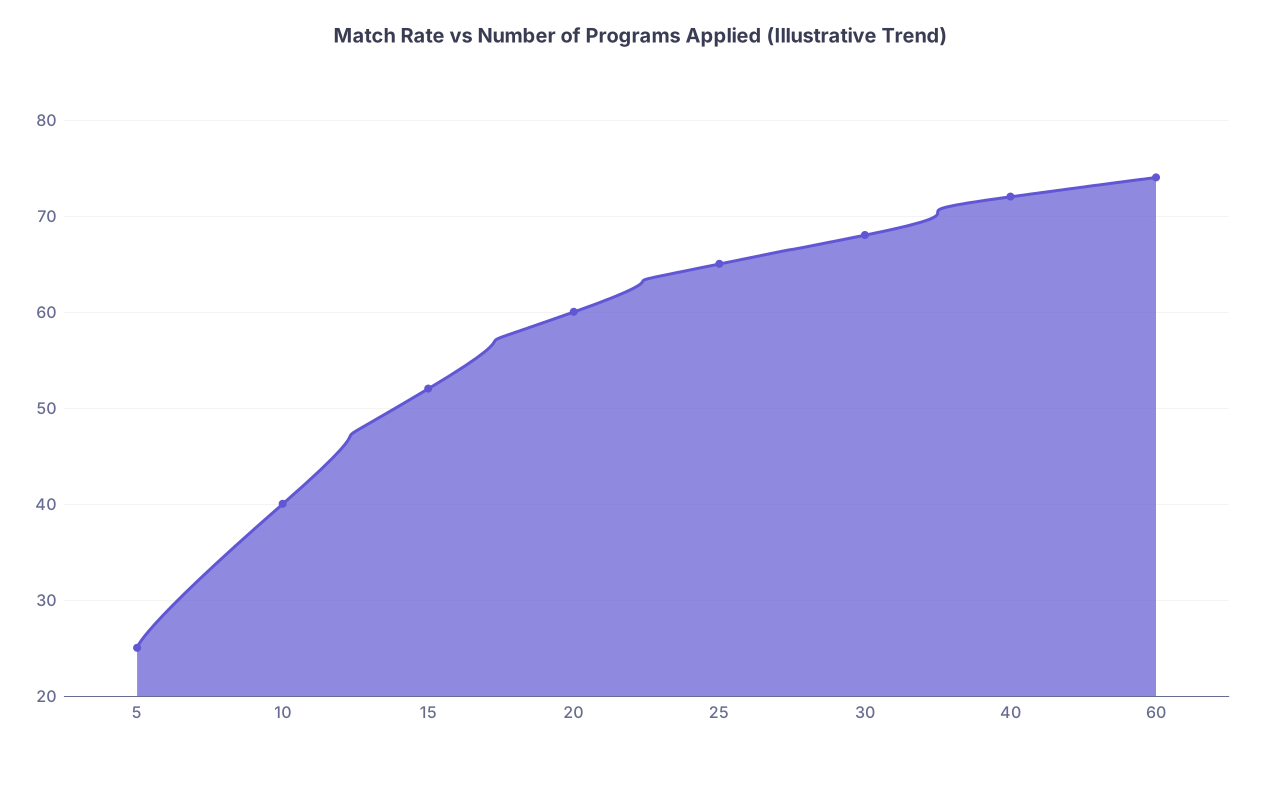
B. How Many Programs to Apply to for Preliminary Surgery as a Non-US Citizen IMG?
The question “how many programs to apply” does not have a single number. It rests on:
- Your competitiveness (scores, YOG, attempts),
- Your goal (categorical vs experience/letters),
- Your financial capacity,
- Willingness to relocate anywhere in the US.
However, for a non-US citizen IMG targeting prelim surgery:
Approximate guidelines:
Highly competitive applicant
(Step 2 > 250, recent YOG, US letters, no failures, some research):- Prelim programs: 20–40
- Plus categorical programs (if also applied): 30–60
- Total: up to 60–80 combined.
Moderately competitive applicant
(Step 2: 235–250, YOG < 7 years, at least some USCE, no major red flags):- Prelim programs: 40–60
- Categorical (if also applying): 20–40
- Total: often 60–80+.
At-risk or lower-tier applicant
(Step 2 < 235 or attempts, older YOG, limited USCE):- Heavy emphasis on prelims: 60–80+ prelim programs
- Limited categorical targets if finances allow, focusing on IMG‑friendly sites.
Key principle:
As a non-US citizen IMG, especially in a competitive field like surgery, err on the side of applying to more programs rather than fewer, as long as you are selective and programs meet your minimum criteria (visa, acceptance of IMGs, etc.).
C. Geographic Flexibility
If you limit yourself to certain regions (e.g., only the East Coast or only California), you drastically reduce your interview chances.
For a preliminary year:
- Be maximally flexible geographically, unless you have major constraints.
- Use geography primarily as a secondary filter after visa and IMG friendliness.
D. Balancing Prelim vs Categorical Applications
If your primary interest is:
Long-term general surgery: Apply to both categorical and prelim tracks:
- Categorical: more competitive; apply broadly.
- Prelim: a “safety net” to get into the US system.
Other specialty ultimately (e.g., anesthesia or radiology):
- Main focus on that specialty’s categorical programs (future cycle),
- Use prelim surgery mainly to obtain experience and letters, not necessarily as a route to categorical general surgery.
In all cases, ensure your personal statement(s) and communication clearly explain why a preliminary surgery year is a deliberate and thoughtful step, not a last-minute backup with no clear purpose.
Step 5: Practical Tools and Filters for Efficient Program Research
To implement your program selection strategy, you’ll need a systematic approach.
A. Use a Structured Spreadsheet
Create columns for:
- Program name
- State/City
- Program type (academic, university-affiliated, community)
- Visa types offered
- IMG-friendly? (Yes/No/Unknown)
- Number of prelim spots
- Historical promotion of prelims to categorical? (Yes/No/Unknown)
- Step score preferences (if stated)
- Your personal notes (e.g., “strong ICU exposure,” “research available,” “heavy service”)
This allows you to:
- Sort by visa type or IMG friendliness,
- Quickly prune non-viable programs,
- Track communications and interview invitations.
B. Primary Filters to Apply Early
When researching how to choose residency programs, apply filters in this order:
- Visa Sponsorship – Exclude any program that does not match your visa needs.
- IMG Policy – Exclude those that explicitly do not accept foreign medical graduates.
- Minimum Requirements (from website/FREIDA):
- Step score cutoffs,
- Maximum YOG gap,
- US clinical experience requirements.
Only then: 4. Program Type & Fit – Academic vs community, research vs service orientation. 5. Special Features – Prelim-to-categorical pipeline, presence of your target future specialty (if not surgery).
C. Secondary Information Sources
- Program websites: Read both surgery department pages and GME office info.
- Current residents: Look for email or LinkedIn; ask concise, respectful questions about prelim education and visa experiences.
- Forums and social media: Take with caution but useful to identify red flags (severe burnout, toxic culture, lack of support for prelims).
- Alumni from your medical school: Ask about their experiences and recommendations.
Step 6: Evaluating Programs from an Educational and Career Perspective
Not all preliminary surgery years will equally advance your long-term goals. Beyond simply matching, consider:
A. Quality of Education and Supervision
Ask or research:
- Is there a structured orientation for prelims?
- Are you assigned mentors or faculty advisors?
- Do prelims attend the same conferences, M&M, and didactics as categoricals?
- Do prelims receive operative opportunities or primarily floor/ICU coverage?
A year of pure service with minimal learning or OR exposure may yield weaker letters and a poorer foundation for future training.
B. Support for Career Advancement
Indicators of a supportive environment:
- When categoricals leave or transfers occur, are prelims considered first?
- Are there examples of prelims who successfully:
- Joined categorical surgery at the same program?
- Matched into other specialties using letters from this institution?
- How are prelims evaluated and counseled regarding future applications?
Programs that invest in their prelims’ career outcomes are far more valuable to a non-US citizen IMG.
C. Workload and Burnout Risk
Prelim spots can be notoriously busy. Questions to consider:
- Number of prelims per year vs patient volume,
- Call frequency,
- Presence of PAs/NPs, hospitalists, or night float systems,
- Support from seniors and attendings.
A brutal year with no time to study or apply for the next cycle can be counterproductive, especially if you need to:
- Improve scores,
- Do research,
- Prepare for interviews and Step 3.
Step 7: Financial Planning and Application Logistics
As a non-US citizen IMG, budget is a real constraint. A smart program selection strategy reduces wasted application fees.
A. Balance Numbers with Quality
Apply broadly enough, but only to programs where:
- You meet at least the minimum stated requirements,
- Visa sponsorship is clear,
- There is a realistic chance of being seriously considered.
Applying to many “dream” programs that essentially never rank non-US citizen IMGs is a poor use of funds.
B. Plan for Interview Season
- Anticipate travel or virtual arrangements (virtual has become more common but may vary).
- Time zone differences for virtual interviews if you are abroad.
- Build flexibility into your schedule for overlapping interviews.
C. Backup Planning
Consider:
- What if you do not match into either categorical or preliminary surgery?
- Are you open to preliminary internal medicine or transitional year as alternative routes into the US system?
- Can you afford a second application cycle?
A robust plan includes contingencies and honest self-reflection at each stage.
Frequently Asked Questions (FAQ)
1. As a non-US citizen IMG, is a preliminary surgery year a good idea if I ultimately want categorical general surgery?
It can be, if chosen strategically. A prelim surgery residency at a program that supports and promotes prelims, provides good operative exposure, and has strong mentorship can be an excellent stepping stone to categorical general surgery. However, it is not guaranteed. You must:
- Perform at a high level clinically,
- Build strong relationships with faculty,
- Be proactive in seeking categorical opportunities both within and outside your institution.
If your prelim program has no history of promoting prelims and offers minimal support, it can be much harder to move into categorical surgery afterward.
2. How many prelim surgery programs should I apply to as a non-US citizen IMG if I have an older year of graduation and average scores?
If you have risk factors such as older YOG (e.g., >7–8 years), average or below-average scores, or attempts on exams, you should plan to apply very broadly. For prelim surgery:
- 60–80+ prelim programs is reasonable,
- Include a strong proportion of safety and target programs that are IMG-friendly and sponsor visas.
Avoid spending most of your budget on highly competitive academic centers that historically take very few non-US citizen IMGs.
3. Should I prioritize programs that offer H‑1B visas for a prelim surgery year?
For preliminary surgery positions, J‑1 visa pathways are far more common and generally sufficient for a 1‑year training period. Many programs do not offer H‑1B for prelims due to administrative burden and the short duration of training. If you absolutely require H‑1B, your options will be limited and you must research carefully. In most cases, as a non-US citizen IMG, you should not restrict yourself solely to H‑1B-offering prelim programs unless there are compelling personal or legal reasons.
4. Is it worth applying to categorical surgery programs at the same time as prelim programs?
Yes, in many cases. If you are at least moderately competitive, applying to both categorical and preliminary surgery increases your chances of:
- Matching directly into categorical surgery, or
- Securing a preliminary spot as an entry point into the US system.
However, ensure that your application materials (personal statement, letters) are coherent and adaptable. You may choose:
- One personal statement emphasizing commitment to long-term general surgery for categorical programs,
- A slightly adjusted version that clearly explains why a preliminary surgery year is a thoughtful first step for the prelim track.
Coherence and sincerity in your narrative matter more than rigid separation.
By approaching program selection with a structured, data-driven mindset—especially around visa policies, historical acceptance of non-US citizen IMGs, educational quality, and realistic self-assessment—you transform the preliminary surgery year from a desperate backup into a deliberate, strategic step in your surgical career.