Understanding the Unique Challenge: Non‑US Citizen IMG in Diagnostic Radiology
Applying to radiology residency as a non-US citizen IMG is strategically very different from applying in primary care specialties. Diagnostic radiology is competitive, visa sponsorship is limited, and programs often prioritize applicants with US training or citizenship. A strong program selection strategy is therefore just as important as your exam scores or letters of recommendation.
This article focuses specifically on how to choose residency programs and design a realistic, data‑driven program selection strategy for a foreign national medical graduate aiming for a diagnostic radiology match in the US.
We will cover:
- Key realities of the radiology market for non‑US citizen IMGs
- How to research and categorize programs (and what to ignore)
- How many programs to apply to, based on profile strength
- Building a targeted list: reach, realistic, and safety programs
- Practical tactics to improve your odds within your chosen list
The goal is not just to “apply broadly,” but to apply smartly and strategically.
Step 1: Know the Landscape for Non‑US Citizen IMGs in Radiology
Before deciding where and how many programs to apply to, you must understand the structural challenges that affect your chances.
1. Visa Sponsorship: The First Filter
As a non‑US citizen IMG, visa sponsorship is non‑negotiable. Many programs either:
- Do not sponsor visas at all, or
- Only sponsor J‑1 (via ECFMG), or
- Rarely, sponsor H‑1B (with additional requirements)
Action points:
Check visa information early
- Use program websites, FREIDA, and program FAQs.
- Look for explicit statements:
- “We accept J‑1 visas only”
- “We sponsor J‑1 and H‑1B visas”
- “We do not sponsor visas”
Prioritize programs with a consistent record of sponsoring non‑US citizens
- Examine resident lists: are there IMGs? Are there foreign-sounding names?
- Check alumni pages: do graduates list foreign medical schools?
If a program says no visas, it’s generally not worth applying as a foreign national medical graduate unless you have independent work authorization (e.g., green card).
2. Competitiveness of Diagnostic Radiology
Diagnostic Radiology is:
- Moderately to highly competitive, especially at academic and coastal programs
- Heavily score‑sensitive (USMLE/COMLEX)
- Research‑friendly (especially for academic centers)
For non‑US citizen IMGs, the competition is even more intense because:
- Some program directors may be less familiar with international schools.
- Some institutions limit the proportion of visa-sponsored residents.
- Many radiology programs receive large volumes of applications and use filters.
You must accept that:
- Some programs are effectively “closed” to IMGs or to non‑US citizens.
- A high‑quality strategy can still get you interviews and a match—but your list must be realistic.
3. The Role of ERAS Filters
Programs often use filters for:
- USMLE Step 2 CK score (and sometimes Step 1 if available)
- Number of attempts on exams
- YOG (year of graduation)
- Visa status / citizenship
- US clinical experience
You cannot see these filters directly, but you should assume they exist and plan accordingly. This is why your program selection strategy must be broad enough to “break through” the statistical disadvantage, yet focused enough that you don’t waste money on programs that will almost certainly not consider you.
Step 2: Clarify Your Applicant Profile Honestly
To decide how many programs to apply to and which tiers to target, you must realistically assess your own profile.
1. Key Profile Components for Radiology
Important factors include:
- USMLE/COMLEX scores
- Number of attempts
- Year of graduation (YOG)
- US clinical experience (USCE) in radiology or medicine
- Research, especially radiology‑related
- Letters of recommendation (at least one radiologist if possible)
- Visa requirement (J‑1 vs H‑1B vs permanent resident)
2. Rough Profile Categories
These are broad, not absolute, but helpful for strategy:
A. Strong non‑US citizen IMG
- Step 2 CK: ~245+
- No exam failures
- YOG ≤ 3–4 years
- USCE including at least one radiology elective/observership
- Some research (ideally radiology or imaging‑related)
- Strong letters, including from US radiologists
B. Moderate non‑US citizen IMG
- Step 2 CK: ~230–244
- No or single non‑critical attempt (e.g., Step 1 below average but passed)
- YOG ≤ 6–7 years
- Some USCE (even if not in radiology)
- Limited research, but at least some academic exposure
C. At‑Risk non‑US citizen IMG
- Step 2 CK: <230 or multiple attempts
- YOG > 7–8 years
- Minimal or no USCE
- Weak or generic letters
- Limited or no research
This classification will guide how many programs to apply to and how to balance “reach” vs “realistic” vs “safety” programs.
Step 3: How Many Radiology Programs Should You Apply To?
There is no single correct number, but as a non‑US citizen IMG in diagnostic radiology, you generally need to apply to more programs than US grads, due to lower baseline interview probabilities.
Below are ballpark guidelines for diagnostic radiology match (for the R1/Advanced DR portion only; prelim/TY year is separate).
1. Strong Profile (Category A)
- Recommended range: 60–90 DR programs
- Rationale:
- You are competitive enough to be considered by many programs that sponsor visas.
- Still, as a non‑US citizen IMG, you will be filtered out by some institutions.
- 60–90 targeted applications typically produce enough interviews to rank 10–12 programs, which is associated with a strong chance of matching.
You might also apply to a small number of “reach” academic programs (top‑tier), but the majority should be mid‑tier academic and solid community programs that sponsor visas.
2. Moderate Profile (Category B)
- Recommended range: 90–130 DR programs
- Rationale:
- Your file may pass for some mid‑tier and IMG‑friendly programs but will be filtered out by more competitive ones.
- As a foreign national medical graduate requiring a visa, your odds at each individual program are lower, so you compensate with a broad but intelligent spread.
- At this level, you should be extremely strategic in program selection and avoid wasting applications on historically IMG‑unfriendly institutions.
3. At‑Risk Profile (Category C)
- Recommended range: 120–160 DR programs (if you still decide to pursue DR)
- Rationale:
- You will be filtered out at many programs based on scores/YOG/attempts.
- A realistic DR strategy at this profile level often includes a parallel plan:
- Either another specialty (e.g., internal medicine prelim + later fellowship), or
- A research year in radiology to strengthen your profile before reapplying.
For many at‑risk IMGs, a “spray and pray” approach to 150+ DR programs without strengthening the application is usually not effective. Consider whether a delayed, stronger application might be a better program selection strategy.
4. Prelim/TY Year Applications
Diagnostic radiology is usually an advanced position (PGY‑2 start). You will also need to apply to:
- Preliminary Internal Medicine or Surgery
- Or a Transitional Year (TY) if available
Typical numbers:
- Strong profile: 20–30 prelim/TY programs
- Moderate/at‑risk: 30–40 prelim/TY programs
These should be separate from your DR count and chosen using similar logic (visa sponsorship, IMG‑friendliness, geographic preferences).

Step 4: How to Choose Residency Programs Strategically
Now that you have a target number, you need a robust program selection strategy. The goal is to create a balanced list where each program is chosen for a reason, not just “any program that exists.”
1. Use Visa Sponsorship as an Initial Hard Filter
Start with:
- Programs that explicitly sponsor J‑1 and/or H‑1B
- Exclude programs with clear “No Visa Sponsorship” statements
- Mark as “unclear” those without any visa info (you may still apply selectively)
This immediately narrows your list to realistic targets for a non‑US citizen IMG.
2. Research IMG‑Friendliness
A key part of how to choose residency programs is evaluating whether they genuinely consider IMGs.
Look for:
- Current or recent residents who are IMGs
- Alumni lists showing international medical schools
- Program descriptions mentioning “we consider IMGs” or “we welcome diverse backgrounds”
- FREIDA filters (but be cautious—they can be outdated)
If you see multiple IMGs over several classes, especially with varied schools, the program is more likely to be IMG‑friendly.
Red flag: A program that has not had any IMGs in 5–10 years is usually not worth a precious application slot for a non‑US citizen.
3. Categorize Programs: Academic vs Community
For diagnostic radiology:
Academic programs
- Strong research culture, subspecialty exposure, often more competitive
- May prefer applicants with US research, publications, or home institution ties
- Some are IMG‑friendly, especially large university hospitals with heavy service demand
Community programs
- May have less research but strong clinical volume
- Some are more open to IMGs, especially in regions less desired by US grads
- Often very practical, hands‑on training in bread‑and‑butter radiology
A balanced list for a non‑US citizen IMG usually includes:
- A small proportion of aspirational academic programs (reach)
- A large core of mid‑tier academic and strong community programs (realistic)
- A smaller set of solid community programs in less competitive locations (safety)
4. Weigh Geography Wisely
Geography can significantly shape your program selection strategy:
- Highly competitive regions: Northeastern big cities, California, major coastal metros
- Moderately competitive: Midwest academic centers, Southern metro areas
- Less competitive: Smaller cities, rural or semi‑rural locations, some central states
If you are a non‑US citizen IMG, over‑concentrating your applications in high‑demand coastal cities can drastically lower your interview yield.
A strategic list often leans toward:
- Generous representation of Midwest and Southern programs
- Inclusion of states with historically more IMG‑friendly attitudes
- Select but limited number of programs in major coastal metros
5. Understand Program Size and Class Size
Larger programs with more residency positions per year often:
- Receive many applications, but
- Have more total interview spots and more chances per applicant
Smaller programs may:
- Have tighter “fit” criteria
- Offer fewer interview slots, making each spot more competitive
As a non‑US citizen IMG, prioritize medium to large programs that:
- Have at least 4–8 positions per year
- Show evidence of recruiting from diverse schools
Step 5: Building a Tiered Program List
Once you have filtered by visa, IMG‑friendliness, geography, and program characteristics, it’s time to assign tiers and verify balance.
1. The Three Tiers: Reach, Realistic, Safety
Use your honest profile assessment:
Reach programs
- More competitive regions/academic reputations
- Fewer IMGs historically
- Stronger average board scores
- You may only get a few interviews here, but they are worth some applications
Realistic programs
- Mid‑tier academic or strong community programs
- Clear IMG presence, consistent visa sponsorship
- Score expectations aligned with your profile
Safety programs
- Community‑heavy, less competitive locations
- Multiple IMGs, often including non‑US citizen IMGs
- Historically open to broader profile ranges
A healthy distribution for a moderate non‑US citizen IMG applying to ~110 DR programs might be:
- Reach: 15–20 programs
- Realistic: 60–70 programs
- Safety: 25–30 programs
The proportions can shift slightly depending on how strong or at‑risk your profile is.
2. Practical Example: Moderate Non‑US Citizen IMG
Profile:
- Step 2 CK: 238, first attempt
- YOG: 3 years ago
- One US observership in radiology, one in internal medicine
- 2 posters, 1 radiology‑related
- Needs J‑1 sponsorship
Program selection strategy (about 100–110 DR programs):
Filter 1: Visa
- Exclude all programs with “no visa sponsorship.”
- Prioritize those clearly stating J‑1 accepted.
Filter 2: IMG‑Friendliness
- From visa‑accepting list, select programs with ≥1–2 IMGs in recent years.
Filter 3: Geography and Tiering
- 15–18 reach programs: large university centers, a few coastal or big‑name places that list IMGs in their roster.
- 60–65 realistic programs: university‑affiliated and community programs with clear IMG presence in Midwest/South/interior states.
- 25–30 safety programs: smaller or less centrally located community programs with multiple IMGs and consistent J‑1 sponsorship.
One common mistake is to let reach programs dominate your list. For most non‑US citizen IMGs, realistic and safety programs should make up the bulk of the list.

Step 6: Tools and Tactics to Refine Your Program Selection
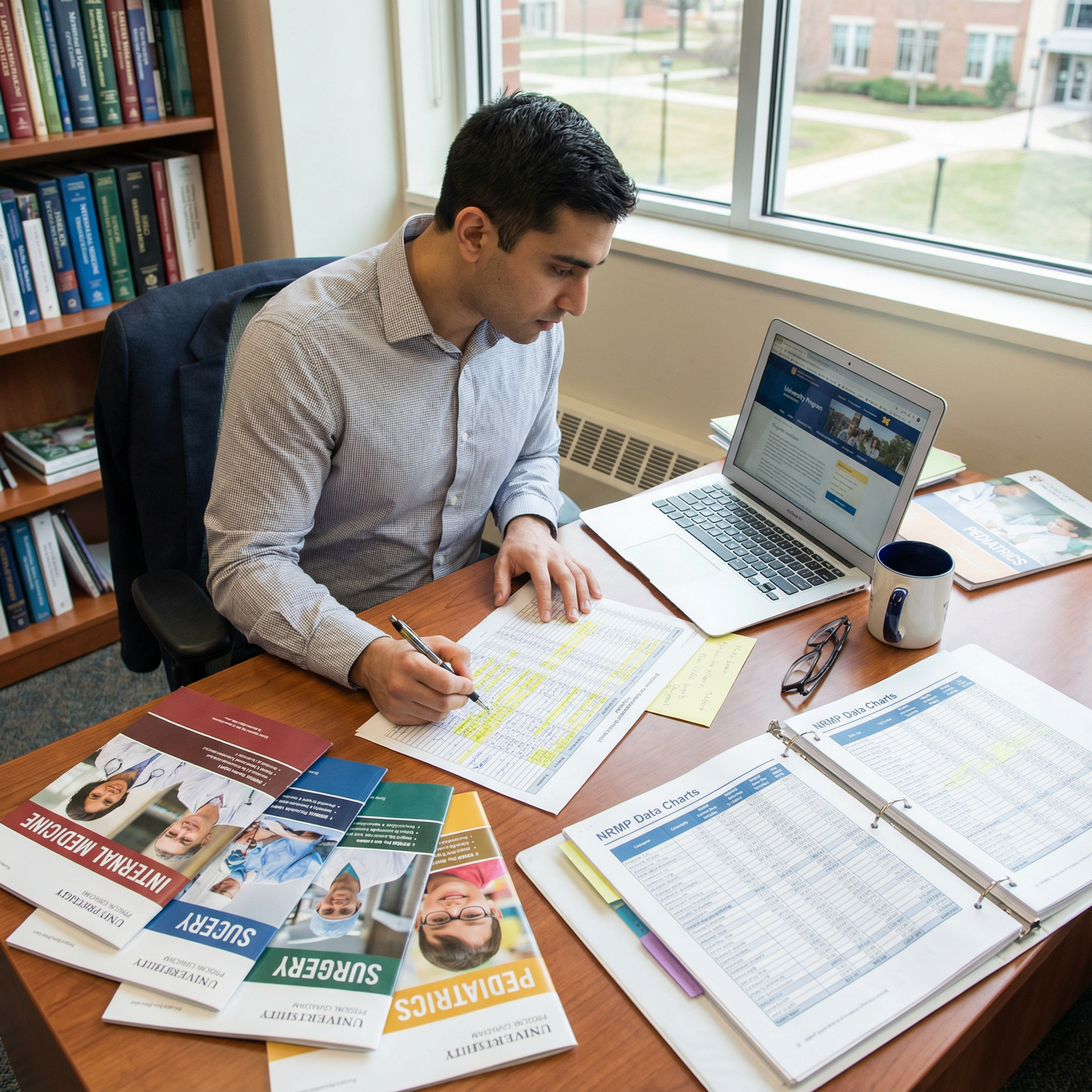
1. Use a Structured Spreadsheet
Create a spreadsheet with columns like:
- Program name
- City/state
- Visa sponsorship (J‑1, H‑1B, none, unclear)
- IMG status (friendly/unknown/unfriendly)
- Program size (positions per year)
- Academic vs community
- Your tier (reach/realistic/safety)
- Notes (IMGs on web page, research emphasis, call structure, etc.)
This helps avoid duplication, ensures balanced coverage, and keeps your program selection strategy organized.
2. Don’t Over‑Prioritize Reputation
As a non‑US citizen IMG in a competitive specialty, it is risky to heavily weight prestige. Many well‑regarded but mid‑tier programs provide excellent diagnostic radiology training and are more accessible to IMGs than “brand‑name” institutions.
Your focus should be on:
- Match probability (based on IMG history, visa sponsorship, tier)
- Training quality (case volume, modalities, subspecialty exposure)
- Board pass rates and fellowships taken by graduates
Top‑tier prestige can be a bonus, but not the central factor.
3. Read Between the Lines on Websites
Programs rarely say “we don’t like IMGs,” but you can infer:
- “We give preference to US medical graduates”
- “We rarely consider IMGs”
- “We require US clinical experience of X months”
- “We do not sponsor visas”
For a foreign national medical graduate, these are strong signals to avoid applying unless your profile is truly exceptional and clearly above their stated thresholds.
4. Use Network and Mentors
If you have:
- US radiology mentors
- Faculty from your observerships
- Former graduates from your home school who matched in DR
Ask them:
- Which programs are known to be IMG‑friendly?
- Which programs they recommend or advise avoiding for a non‑US citizen?
- Whether they can send an email or make a call on your behalf for specific programs?
Personal advocacy can sometimes overcome generic filters and put your application in front of a program director.
Step 7: Adapting Strategy Across Application Cycles
Not everyone matches on the first attempt. A non‑US citizen IMG who doesn’t match in radiology needs to re‑evaluate both their profile and their program selection strategy.
1. If You Did Not Match
Ask:
- How many interviews did you receive?
- 0–3 DR interviews: Your list was likely too ambitious, your profile underprepared, or your application filters (scores/YOG/visa) were too restrictive.
- 4–8 DR interviews: Your chances were non‑zero, but your rank list might have been short; you may need a modestly broader or rebalanced list.
- Did your rejection pattern suggest that IMG‑unfriendly programs dominated your list?
2. Strengthening Before Reapplying
Before spending money on another 100+ applications, consider:
- Research year in radiology (US‑based if possible)
- Additional USCE, particularly radiology observerships in places that sponsor J‑1
- Improving Step 3 (if you are eligible)
- Targeted networking with radiology departments
Once your profile is stronger, adjust your program selection strategy:
- Focus more heavily on programs connected to your research/USCE sites.
- Use mentorship to identify realistic new programs to add.
- Maintain, but do not excessively expand, your total number of applications.
Frequently Asked Questions (FAQ)
1. As a non‑US citizen IMG, what is the minimum number of diagnostic radiology programs I should apply to?
For a strong non‑US citizen IMG, applying to at least 60–70 DR programs is usually necessary to generate a comfortable number of interviews. For moderate applicants, 90–130 is more realistic, and at‑risk applicants may need 120–160 if they decide to proceed. These numbers apply only to DR; you should also apply to prelim/TY programs separately.
2. Should I apply to programs that do not explicitly mention visas on their website?
Yes, but selectively. If a program’s website is silent about visas but shows multiple IMGs in the resident list, it may still be open to J‑1 sponsorship. However, as a foreign national medical graduate, you should prioritize programs that clearly state “J‑1 accepted” or “visa sponsorship provided” and only use “unclear” programs as a small portion of your list.
3. Is it realistic for a non‑US citizen IMG to match into diagnostic radiology?
Yes, it is realistic—but it requires:
- Competitive scores and no major red flags
- Thoughtful program selection strategy focused on IMG‑friendly, visa‑sponsoring programs
- Sufficient number of applications (usually more than US grads)
- Strong supporting elements (USCE, LORs, possible research)
Each year, non‑US citizen IMGs do match into DR, especially through carefully curated application lists and focused strengthening of their profiles.
4. How much should geography matter in my program selection strategy?
Geography should matter, but not dominate. If you only apply to major coastal cities or a single region, you dramatically limit your odds. For most non‑US citizen IMGs, a successful strategy distributes applications across:
- Competitive regions (small portion)
- Moderately competitive regions (fair portion)
- Less competitive regions (large portion)
This balance aligns with reality: you want a good life location, but matching into diagnostic radiology is the primary goal, and geographic flexibility greatly improves your chances.
Designing a smart program selection strategy is one of the most powerful steps a non‑US citizen IMG can take toward a successful diagnostic radiology match. If you approach how to choose residency programs methodically—applying to the right number of programs, in the right tiers, with visa and IMG‑friendliness clearly in mind—you dramatically improve the return on every application you submit.