Understanding the Pathology Residency Landscape as a DO Graduate
Choosing where to apply for pathology residency is both a strategic and deeply personal decision—especially as a DO graduate navigating an increasingly competitive and unified Match. A thoughtful program selection strategy will influence not only your chances in the pathology match, but also the kind of pathologist you become and the career options you’ll have.
As a DO graduate, you bring strengths in clinical reasoning, holistic care, and often strong communication skills. The goal is to align these strengths with programs that will value them and support your career aspirations, whether you’re aiming for academic pathology, community practice, subspecialty fellowship, or a niche like forensic pathology or informatics.
In this article, we’ll walk through:
- How many programs to apply to for pathology as a DO graduate
- How to choose residency programs that fit your goals and profile
- Types of pathology residency programs and how they differ
- A practical step‑by‑step program selection strategy
- DO-specific considerations and ways to strengthen your application list
Throughout, we’ll refer to key concepts like osteopathic residency match, pathology residency, program selection strategy, and how many programs to apply so you can connect this guidance to what you see on NRMP, FREIDA, and program websites.
How Competitive Is Pathology for DO Graduates?
Pathology is often perceived as a “moderately competitive” specialty, but for a DO graduate, the reality is more nuanced.
Overall Competitiveness
Historically, pathology has had:
- A reasonable ratio of applicants to positions
- Periodic unfilled positions after the main pathology match
- Some programs that are extremely competitive and others that are more attainable
However, competitiveness varies widely by:
- Institution prestige (e.g., top academic centers vs. community programs)
- Geographic location (coasts and large urban centers vs. midwest/rural)
- Program type (AP/CP combined vs. AP-only, CP-only, or physician-scientist tracks)
DO Graduates in Pathology
Since AOA and ACGME accreditation merged, DO graduates are applying to a single Match pathway. DOs now match into pathology regularly, including in strong academic programs, but you should be realistic:
- Some “elite” programs still tend to favor MD applicants or those from research-heavy schools
- Many mid-sized academic and community programs are very DO-friendly
- Programs with a history of taking DOs are often explicitly proud of that diversity
As a DO graduate, your program selection strategy should:
- Identify DO-friendly and DO-neutral programs
- Balance aspirational, target, and safety programs
- Account for board scores, research exposure, and letters of recommendation
This context will shape your answer to how many programs to apply and which ones.
How Many Pathology Programs Should a DO Graduate Apply To?
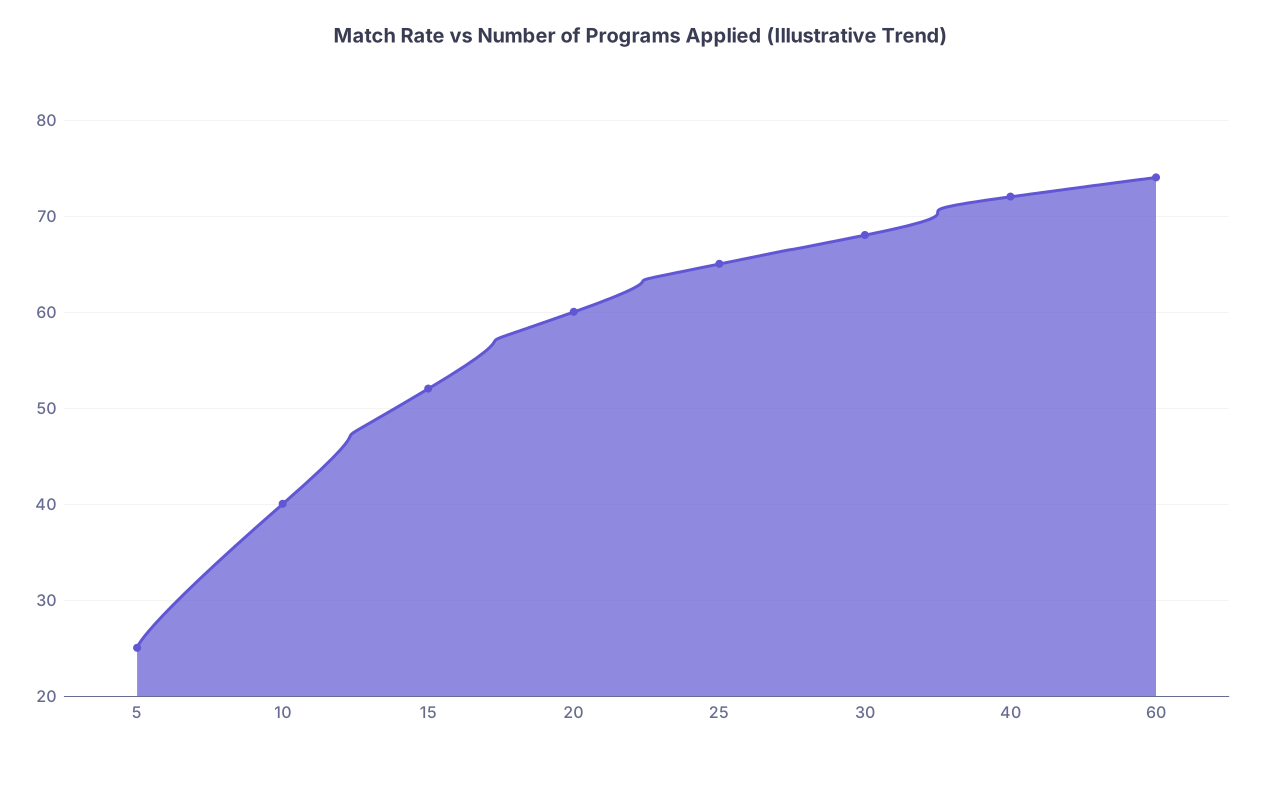
The question “how many programs to apply” doesn’t have a single correct number; it depends on your profile and risk tolerance. But you can use benchmarks.
General Numerical Ranges
For a typical DO applicant to pathology:
Strong applicant (very competitive)
- Step 1: Pass on first attempt
- Step 2 CK: at or above national average
- Strong letters (including at least 1–2 from pathologists)
- Some research, good clinical performance
- Reasonable geographic flexibility
- Recommended range: ~25–40 programs
Average applicant (solid but not standout)
- Step 1: Pass on first attempt
- Step 2 CK: slightly below to near average
- Good but not exceptional research or pathology exposure
- Mostly solid clinical evaluations
- Recommended range: ~35–55 programs
At-risk applicant (red flags or multiple weaknesses)
- Step failures/retakes, significant course remediation, or major gaps
- Limited pathology exposure or late specialty decision
- Restricted geography (e.g., only one region)
- Recommended range: ~50–70 programs
These ranges are not rigid rules, but they reflect a practical program selection strategy when aiming for a successful osteopathic residency match in pathology.
Factors That Influence How Many Applications You Need
Ask yourself the following:
Do I have any red flags?
- Step failures
- Major professionalism concerns
- Prolonged leave of absence
Higher risk → apply to more programs, focus on broader range.
How geographically flexible am I?
- Willing to go anywhere → fewer programs needed (within reason)
- Only 1–2 regions or specific cities → more programs needed
How strong is my pathology-specific profile?
- Pathology electives/sub-I’s, especially at academic centers
- Dedicated pathology letters of recommendation
- Research or scholarly activity in pathology or related fields
Stronger profile → more opportunities at selective programs.
How selective are my target programs?
- If your list is dominated by prestigious academic centers, you’ll need more applications and should add mid-tier and community options.
A practical rule of thumb: If your list is under 25 programs as a DO applicant, you must have a compelling reason and an excellent application profile.

Understanding Pathology Program Types and What They Mean for You
Before you can decide how to choose residency programs, you need to understand the major variations in pathology residencies and how they align with your career goals.
AP/CP Combined vs. AP-Only vs. CP-Only
Most US pathology residency positions are:
- AP/CP combined (4 years)
- Trains you in both anatomic pathology (surgical pathology, autopsy, cytology) and clinical pathology (laboratory medicine, transfusion, microbiology, etc.)
- Most common choice; provides broad flexibility for future jobs
- Ideal if you’re not yet sure which side of pathology you prefer
Less common tracks:
AP-only (3 years)
- Focused on surgical pathology and autopsy, often aimed at academic or subspecialized careers
- Sometimes bundled with a required subspecialty fellowship (e.g., AP + cytopathology)
- Best for those certain they want the AP route and often planning multiple fellowships
CP-only (3 years)
- Focused on lab medicine, transfusion, hematology, clinical chemistry, microbiology
- Attractive if you are drawn to lab leadership, informatics, or transfusion medicine
- Jobs may be more niche; many community practices still prefer AP/CP board-eligible pathologists
As a DO graduate, unless you have a highly specific plan, AP/CP combined is usually the safest and most versatile route.
Academic vs. Community vs. Hybrid Programs
Academic (University-based) Pathology Programs
- Strong emphasis on teaching, research, and subspecialty training
- Often have in-house fellowships (e.g., hematopathology, cytopathology, GI, dermpath)
- Larger faculty with subspecialty expertise
- Expectations may include scholarly projects, presentations, and possibly teaching students
- Often more competitive; some may have fewer DOs historically
Community Programs
- Smaller faculty, often generalist track
- Heavy emphasis on service and real-world diagnostic experience
- May send residents to outside institutions for certain rotations
- Fewer in-house fellowships; residents typically apply externally
- Often very DO-friendly and focused on practical training
Hybrid Programs
- Community-based but affiliated with a university
- Mix of strong clinical exposure with some academic opportunities
- Can offer a balanced training environment for DO graduates seeking both accessibility and quality
Your program selection strategy should balance these based on your goals:
- Aim for academic programs if you’re interested in research, academics, or competitive fellowships.
- Include community and hybrid programs to ensure solid training and improve match odds.
Size and Structure of the Program
Smaller programs (2–3 residents per year):
- Pros: Close faculty mentorship, more autonomy, tight-knit cohort
- Cons: Less redundancy; if faculty leave, exposure may narrow; limited subspecialty depth
Larger programs (5–10 residents per year):
- Pros: Wide subspecialty exposure, many fellows, strong academic network
- Cons: You may have to advocate for exposure to certain cases; can feel less personalized
As a DO graduate, both can be excellent, but you might benefit more from programs with strong mentorship and a track record of supporting nontraditional or diverse trainees.
Step-by-Step Program Selection Strategy for DO Graduates in Pathology
Here is a structured approach to building a realistic and effective application list.
Step 1: Clarify Your Career Goals and Constraints
Before you open FREIDA or the NRMP list, answer:
Career orientation
- Do you prioritize academic jobs, research, or teaching?
- Are you aiming for specific fellowships (e.g., hematopathology, forensic, dermpath, GI, molecular)?
Lifestyle and personal constraints
- Partner’s job, family responsibilities, visa issues if applicable
- Urban vs. suburban vs. rural preferences
- Climate, cost of living, proximity to support system
Risk tolerance
- Are you willing to apply broadly and move anywhere if needed for a better chance of matching?
- Or is geography non-negotiable, meaning you’ll apply heavily within a narrow region?
Write these out; they’ll guide which programs and how many you include in each category.
Step 2: Assess and Benchmark Your Application Profile
Objectively evaluate:
Board exams
- Step 1 (Pass/Fail, but failures matter)
- Step 2 CK score and timing
- COMLEX scores (and whether you took USMLE as a DO)
Academic history
- Any failure, remediation, or extended leaves
- Clinical clerkship evaluations, especially in pathology or related fields
Pathology-specific exposure
- Electives in pathology (home institution or away/audition rotations)
- Research in pathology or closely related disciplines
- Case reports, posters, abstracts, QI projects
Letters of Recommendation
- At least two letters from pathologists are recommended
- Strong personal advocacy from faculty is especially valuable for DO graduates
Create a rough self-rating: competitive, average, or at-risk (as discussed earlier). This will calibrate your target number of applications.
Step 3: Build an Initial Long List of Programs
Use:
- FREIDA (AMA)
- The ACGME program list
- Program websites
- Your school’s advising resources and alumni networks
Filter for:
- Pathology (AP/CP) and any AP-only or CP-only tracks of interest
- Programs that have historically taken DOs (check resident rosters on websites)
- Geographic regions you’re willing to consider
At this stage, don’t worry yet about trimming; aim for a “long list” of perhaps 70–100 programs.
Step 4: Research Each Program Using Key Criteria
For each program, look at:
DO-friendliness
- Are there current or recent DO residents?
- Does the website or program director mention DOs or osteopathic graduates positively?
Board pass rates and case volume
- Do residents consistently pass AP/CP boards?
- Is there adequate case diversity and volume for solid training?
Fellowship opportunities and placement
- In-house fellowships (CV, GI, dermpath, hemepath, cytopath, molecular, forensic, etc.)
- Recent fellowships obtained by graduates (strong signal of program reputation)
Faculty and mentorship
- Subspecialty areas represented
- Any faculty doing research or QI in areas you find interesting
Culture and support
- Resident wellness initiatives
- Call schedule and workload
- Evidence of supportive leadership (PD/APD messages, resident testimonials, low attrition)
Location and lifestyle
- Cost of living, commuting, call rooms, moonlighting policies (if any)
- Fit with your personal and family needs
Document this in a spreadsheet; include columns like:
- DO residents? (Yes/No)
- Board pass rate (if available)
- In-house fellowships
- Academic vs. community
- USMLE required or COMLEX accepted?
- “Feel”/impression from website and online reviews

Creating a Balanced, Strategic Application List
Once you’ve collected information, it’s time to refine your list into a balanced portfolio of programs.
Categorize Programs: Reach, Target, and Safety
A robust program selection strategy uses tiers:
Reach Programs (aspirational)
- Highly competitive academic centers or “name-brand” institutions
- Strong research, numerous fellowships, or top national reputation
- May have fewer DOs historically, but still worth trying if your profile is solid
- Ideal proportion: ~20–30% of your list
Target Programs (realistic matches)
- Mid-sized academic or hybrid programs with good reputations
- Clear DO presence among residents or alumni
- Solid board pass rates and fellowship matches
- Ideal proportion: ~40–50% of your list
Safety Programs (conservative choices)
- Community or smaller academic programs
- Clearly DO-friendly, possibly in less popular locations
- Still with adequate training volume and board pass outcomes
- Ideal proportion: ~20–30% of your list
For example, if you aim to apply to 45 programs:
- 10–15 reach
- 20–25 target
- 10–12 safety
This approach protects you from overconcentrating on aspirational programs that might be less receptive to a DO graduate.
Geographic Strategy
Combine tiers with geography:
If you’re flexible:
- Spread programs across multiple regions (Northeast, Midwest, South, West).
- This improves odds of interviews and ultimately matching.
If you have constraints:
- Increase the total number of applications within the allowed regions.
- Within each region, ensure a mix of reach/target/safety.
Budgeting and Application Costs
Residency applications are expensive, so your plan must be realistic financially:
- Calculate the ERAS fee based on your target number of programs.
- Factor in interview-related costs (even with virtual interviews, there may be technology and time-off considerations).
- If cost is an issue, slightly decrease reach programs first before cutting targets and safeties.
DO-Specific Tips to Strengthen Your Pathology Match Strategy
As a DO graduate pursuing pathology residency, you should be intentional in how you present yourself and choose programs.
Highlight Your Osteopathic Strengths
Pathology is about understanding disease in the context of the whole patient and clinical picture. As a DO:
- Emphasize your strong clinical grounding and holistic approach.
- Show how your osteopathic training makes you effective in tumor boards, multidisciplinary meetings, and clinician communication.
- Tie your experiences in OMM or primary care to attention to detail, systems thinking, and patient-centered perspectives.
Consider USMLE vs. COMLEX Requirements
Some programs:
- Require or strongly prefer USMLE scores.
- Others explicitly state they accept COMLEX and don’t require USMLE.
If you did not take USMLE, prioritizing programs that openly accept COMLEX is wise. For those that “recommend” USMLE, consider:
- Reaching out politely to clarify if strong COMLEX scores alone are acceptable.
- Considering them as reach rather than target programs.
Aim for Strong, Targeted Pathology Letters
For DO graduates, letters carry significant weight:
- Secure at least two letters from pathologists who know you and can speak to your diagnostic curiosity, work ethic, and teachability.
- If possible, complete an away rotation at a program you’re seriously considering and obtain a letter there. This can boost your visibility and credibility.
Use Electives and Rotations Strategically
- Take home institution pathology electives early enough to get letters.
- Use away rotations at programs (or in regions) you especially like.
- During these rotations, treat each day like an extended interview: punctual, prepared, inquisitive, and team-oriented.
Frequently Asked Questions (FAQ)
1. As a DO graduate, how many pathology programs should I apply to?
For most DO applicants in pathology:
- Strong applicants: ~25–40 programs
- Average applicants: ~35–55 programs
- At-risk applicants: ~50–70 programs
Your exact number should reflect your exam history, pathology exposure, and geographic flexibility. When in doubt, modestly err on the higher side for safety.
2. How can I tell if a pathology residency program is DO-friendly?
Look for:
- Current or recent DO residents on the program’s website
- Historical match lists from your school that include DOs at that program
- Program statements or PD comments that explicitly welcome DO applications
- Open acceptance of COMLEX scores and not requiring USMLE
If still in doubt, a brief, polite email to the program coordinator or PD can clarify their stance on DO applicants and COMLEX-only candidates.
3. Do I need research to match into pathology as a DO?
Research is helpful but not absolutely required for all programs. However:
- Academic and research-focused programs will weigh it more heavily
- Having at least one project (case report, poster, QI, or small chart review) shows initiative and scholarly interest
- Lack of research can be offset with strong clinical performance, solid letters, and meaningful pathology exposure—especially for community or hybrid programs
If you’re aiming for top-tier academic centers or competitive fellowships later, research becomes more important.
4. Should I prioritize programs with in-house pathology fellowships?
In-house fellowships are a valuable asset but not the only path to subspecialization. You should:
- Prefer programs with broad fellowship options if you’re leaning toward academics or subspecialty practice.
- Not automatically dismiss programs without fellowships—some community sites provide excellent training and send graduates to strong outside fellowships.
When evaluating, look at where recent graduates went for fellowship. That’s often more telling than whether the fellowship is on-site.
A deliberate, data-informed program selection strategy can significantly improve your chances of a successful osteopathic residency match in pathology. By honestly assessing your profile, understanding the range of pathology residency programs, and building a balanced list in terms of competitiveness and geography, you position yourself to both match and thrive.