Understanding Your Unique Position as a US Citizen IMG in Pathology
US citizen international medical graduates (IMGs) occupy a very specific space in the pathology residency match. You’re an American studying abroad, which gives you some advantages over non‑US IMGs (no visa issues, simpler credentialing), but you still face many of the same perception and screening hurdles as other IMGs.
Pathology is often considered a more IMG‑friendly specialty than many core fields like dermatology or orthopedic surgery. However, it has become more competitive in recent years, and successful applicants—especially US citizen IMGs—need a deliberate program selection strategy, not just a long list of random programs.
This article will walk you step‑by‑step through:
- How to think strategically about the pathology match as a US citizen IMG
- How many programs to apply to (with ranges for different applicant profiles)
- How to choose residency programs that fit your background, goals, and competitiveness
- How to build and refine a balanced list using data and honest self‑assessment
Throughout, the focus is practical: you’ll see specific criteria, examples, and a concrete workflow to help you construct your list.
Step 1: Honest Self‑Assessment Before Building Your List
Before you ask “how many programs to apply to,” you must answer “what kind of applicant am I?” Your program selection strategy (and your realistic match odds) depend heavily on this.
Key Factors to Assess
USMLE/COMLEX Scores
- Step 1 is now Pass/Fail, but many programs still screen applicants based on:
- Step 2 CK score
- Fail attempts on any step
- For pathology, approximate ranges for US citizen IMGs:
- Highly competitive: Step 2 CK ≥ 245, no fails
- Average competitive: Step 2 CK ~ 230–244, no fails
- Below average/risk: Step 2 CK < 230 or any failed attempt
- Step 1 is now Pass/Fail, but many programs still screen applicants based on:
Medical School and Transcript
- School location and reputation (Caribbean vs. Europe vs. Asia, etc.)
- Length of study, repeated years, or academic probation
- Honors, distinctions in pathology, or strong performance in basic sciences
Pathology‑Specific Exposure
- Electives or sub‑internships in pathology (especially in the US)
- Letters of recommendation from US pathologists
- Research or scholarly work in pathology (posters, abstracts, publications)
- Attendance at pathology meetings (e.g., USCAP, CAP)
Gaps and Red Flags
- Year of graduation (YOG) more than 5–7 years from application year
- Multiple attempts on USMLE/COMLEX exams
- Long unexplained gaps in training
- Prior unsuccessful match cycles
Non‑academic Strengths
- Strong communication skills and professionalism (critical in pathology sign‑out culture)
- US clinical experience (USCE) in any field
- Networking and mentorship relationships with US pathologists
Categorizing Yourself: A, B, or C Profile
For program selection, it’s helpful to place yourself roughly in one of three profiles:
Profile A: Strong US citizen IMG
- Step 2 CK ≥ 245, no fails
- Recent graduate (≤ 3 years)
- At least one US pathology elective or observership
- At least one strong LOR from a US pathologist
- Some scholarly activity (not necessarily extensive)
Profile B: Solid but Not Exceptional US citizen IMG
- Step 2 CK 230–244, no fails (or one minor red flag balanced by strengths)
- Graduate within 5 years
- Some US clinical exposure (pathology or other)
- Decent LORs, maybe one from US pathology
- Limited or no research, but clear interest in pathology
Profile C: High‑risk US citizen IMG
- Step 2 CK < 230 or any exam failure
- Older graduate (> 5–7 years), or with academic gaps
- Minimal US exposure or weak letters
- Multiple red flags (remediation, gaps, failed attempts)
Your recommended program selection strategy and how many programs to apply to will differ by profile.

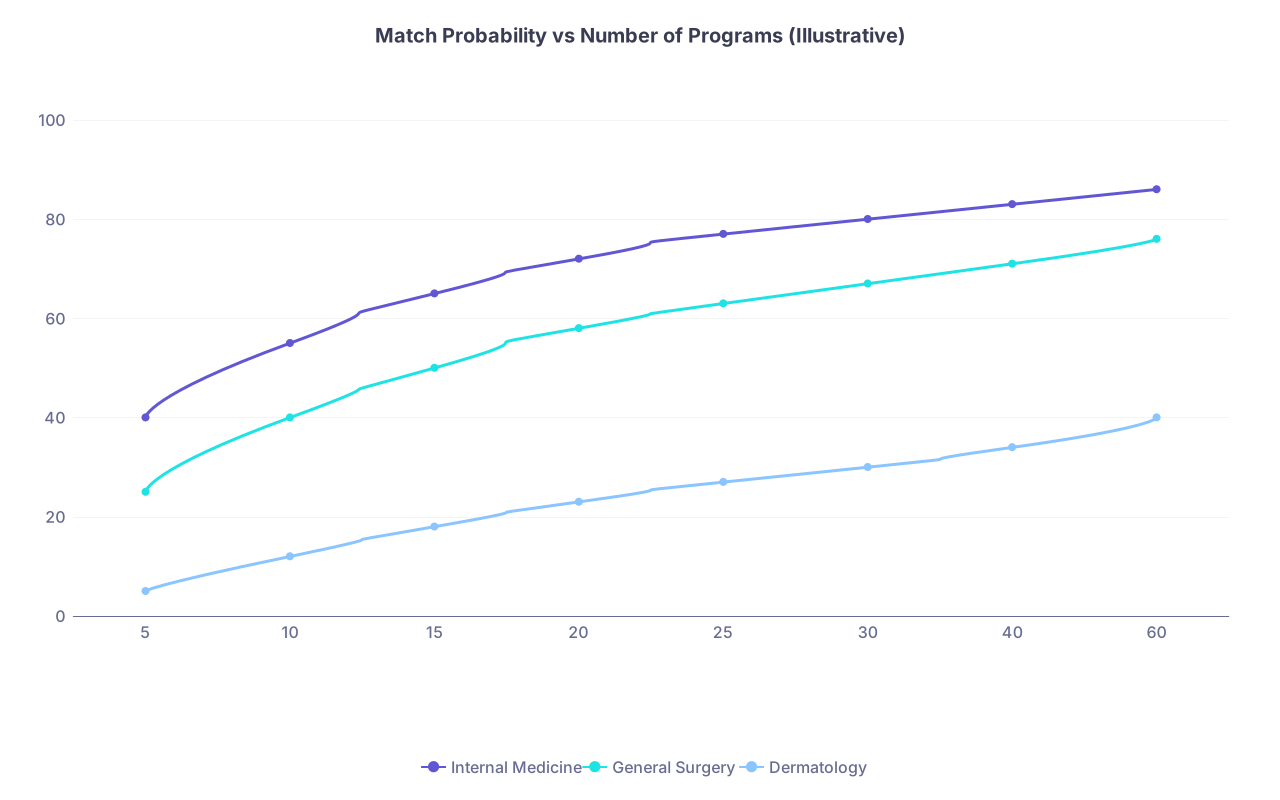
Step 2: How Many Pathology Programs Should You Apply To?
There is no universal magic number, but there are data‑informed ranges and practical considerations, especially for US citizen IMGs.
Factors That Influence the Number of Applications
- Your Competitiveness (A/B/C Profile Above)
- Pathology’s Relative Competitiveness in the Current Cycle
- Some years see more applicants due to lifestyle appeal and job market shifts.
- Financial and Time Constraints
- ERAS fees increase with each program tier.
- More applications mean more program‑specific work and interview scheduling challenges.
- Visa Needs
- As a US citizen IMG, you don’t need a visa, which actually increases your viable program pool compared with non‑US IMGs. Many programs that do not sponsor visas will still consider you.
Suggested Application Ranges for US Citizen IMGs in Pathology
These are starting points; you can adjust up or down based on your specific situation.
Profile A: Strong US Citizen IMG
- Recommended range: 35–55 programs
- Rationale:
- You are competitive at a wide range of programs, including some university academic centers.
- You can afford to be moderately selective but should not under‑apply, especially with recent fluctuations in interest in pathology.
- If highly constrained financially: Don’t go below ~30 unless you have strong home‑program support and extensive networking.
Profile B: Solid but Not Exceptional US Citizen IMG
- Recommended range: 55–80 programs
- Rationale:
- You may get screened out by the most selective academic centers.
- A higher volume increases your chance to reach IMG‑friendly, mid‑tier university and strong community programs.
- If you have clear red flags (older YOG, attempt): Lean toward the upper end (70–80).
Profile C: High‑Risk US Citizen IMG
- Recommended range: 80–120+ programs
- Rationale:
- You must compensate for red flags by maximizing visibility.
- You will rely heavily on IMG‑friendly, mid‑ to lower‑tier community and university‑affiliated programs, and programs with historical openness to IMGs.
- Caution: Volume alone cannot fully overcome major red flags. Simultaneously optimize your application (personal statement, LORs, updated experiences) and consider parallel plans (research years, other specialties, backup match cycle).
Balancing Cost vs. Benefit
For many American studying abroad, finances are tight. A few guiding principles:
Below a certain threshold, you are under‑applying.
An average US citizen IMG in pathology submitting only 25 applications is taking a large risk, even with strong scores.Above a certain threshold, returns diminish.
Past ~120 programs, you may be adding low‑yield programs or duplicative program types, unless your profile is very high‑risk.Strategic trimming is better than random cuts.
If you must reduce your list, remove:- Programs that explicitly exclude IMGs
- Programs with stated minimum scores or graduation years you do not meet
- Regions where you have no desire to live (to avoid declining interviews)
Step 3: Core Program Selection Strategy for Pathology
Once you know how many programs to apply to, the next question is how to choose residency programs. A good program selection strategy for a US citizen IMG in pathology should be data‑driven, tiered, and realistic.
1. Use a Tiered Targeting Approach
Divide your list into 3 rough tiers:
Reach Programs (10–20%)
- University programs with strong academic reputations
- Programs with lower IMG percentages historically
- Typically in very desirable cities or regions
- Example: A top‑20 research university pathology department
Target Programs (50–60%)
- Mid‑tier or solid academic centers that regularly take IMGs
- University‑affiliated community programs
- Programs with consistent match outcomes and structured training
- Example: University program in a mid‑size city with 20–40% IMGs
Safety Programs (20–30%)
- Community‑based programs or university affiliates with known IMG‑friendliness
- Programs in less competitive geographic areas
- Potentially newer programs (but ensure accreditation stability)
- Example: Community‑based pathology program in a less popular state with >50% IMGs
Your exact percentages can shift based on your profile. For example, a strong Profile A applicant might do 30% reach, 50% target, 20% safety, while a Profile C applicant should heavily emphasize safety and target programs.
2. Identify IMG‑Friendly Pathology Programs
As a US citizen IMG, you belong to the broader IMG category from a program’s historical standpoint, even if you don’t need a visa. You should prioritize programs that:
- Regularly list IMGs or US citizen IMGs among residents
- Feature international graduates on their resident pages
- Explicitly state they welcome IMGs and list requirements clearly
How to research this:
- Program websites: Check current resident bios and med school origins.
- NRMP “Charting Outcomes” and “Program Director Survey”: Understand attitudes toward IMGs in pathology.
- Forums and databases: Use Excel or a note‑taking app to track:
- Whether they accept IMGs
- Visa policies (J‑1/H‑1B – even if you don’t need them, this is a proxy for openness)
- Number/percentage of IMGs in recent years
3. Consider Geography Strategically
Geography strongly impacts your pathology match list:
More competitive locations:
- Major coastal cities (NYC, Boston, SF Bay Area, LA, Seattle)
- Highly desirable lifestyle states (California, Colorado, Hawaii)
- Programs in these regions often get flooded with applications and can be less IMG‑friendly.
Less competitive but often more IMG‑friendly:
- Midwest, some Southern states, smaller cities or suburban areas
- These may offer outstanding training with less applicant pressure.
You should absolutely apply to places you want to live, but balance them with less saturated regions.
4. Match Program Type to Your Career Goals
Ask yourself where you see your pathology career:
Academic Career (research, subspecialty, teaching):
- Prioritize university programs with:
- Subspecialty fellowships (e.g., hematopathology, cytopathology, GI, GU)
- Research infrastructure
- History of residents matching into competitive fellowships
- Prioritize university programs with:
Community Practice Focus:
- Consider:
- Community‑based or hybrid programs with high case volume
- Strong AP training, exposure to general sign‑out
- Emphasis on efficiency and real‑world practice
- Consider:
Well‑balanced lists typically include both types, but emphasize what aligns with your long‑term vision.

Step 4: Practical Criteria to Evaluate Individual Programs
Once you have a broad list, apply specific filters to refine it. Consider these aspects systematically.
A. Objective Filters
IMG Acceptance and Policies
- Do they list minimum USMLE/COMLEX scores?
- Do they specify a maximum year of graduation?
- Do they mention requiring US clinical experience?
If you clearly do not meet explicit criteria, remove them—these are low‑yield for you.
Program Accreditation and Stability
- Check ACGME status (avoid programs on probation without a clear recovery plan).
- Look at program size (very small programs can offer less peer support but more autonomy).
Case Volume and Training Breadth
- Balanced exposure to Surgical Pathology, Cytology, Hematopathology, Clinical Pathology, and Autopsy.
- Some small programs may have limited subspecialty exposure; decide if that fits your goals.
Board Pass Rates
- Many programs list their residents’ American Board of Pathology pass rates.
- Consistently high pass rates suggest strong teaching and structure.
B. Subjective & Career‑Oriented Filters
Subspecialty and Fellowship Opportunities
- Does the department offer in‑house fellowships (e.g., Heme, Cytopath, Dermpath)?
- Do graduates match into competitive external fellowships?
Resident Culture and Support
- Is there evidence of a collegial environment?
- Do residents stay for fellowship or leave immediately (could indicate dissatisfaction, but not always)?
- Do residents present at conferences or publish?
Faculty Interests and Mentorship
- If you’re academically inclined, identify potential mentors in pathology subspecialties you care about.
- Look at departmental research areas.
Location and Lifestyle
- Cost of living, commute, proximity to family or support network.
- For a US citizen IMG who may already have financial strain, cost of living is not trivial.
Example: Applying Filters Step‑by‑Step
Imagine you are a Profile B applicant (Step 2 CK 238, no fails, Caribbean grad, 2 years post‑grad, 1 US pathology elective, 1 US path LOR):
- Start with a raw list of 120 pathology programs nationwide.
- Remove programs that:
- Explicitly exclude IMGs or have never had IMGs (down to ~95).
- Require graduation within 1 year if you’re 2 years out (down to ~85).
- Flag as high‑priority:
- Programs where ≥25–30% of current residents are IMGs (around 40–50 programs).
- Balance your list by geography:
- Ensure not all programs are on coasts and big cities; add Midwest/South programs.
- Apply career filters:
- If you want GI pathology, ensure enough cases and faculty in this area.
- Finalize 65–75 programs that reflect a mix of reach, target, and safety, are IMG‑friendly, and align with your career goals.
Step 5: Building and Managing Your Final Program List
Now you understand how to choose residency programs. The next piece is implementation—creating and managing a list efficiently.
Create a Central Tracking System
Use an Excel/Google Sheet with columns such as:
- Program Name
- City/State
- Program Type (University, University‑affiliated, Community)
- IMG‑Friendly? (Y/N; with notes on percentage)
- Visa Policy (even if not personally needed)
- Minimum Score/YOG Criteria
- Subspecialty Strengths (e.g., Heme, GI, Dermpath)
- Resident Culture (notes from websites/social media)
- Tier (Reach/Target/Safety)
- Applied (Y/N)
- Interview (Y/N)
- Post‑interview Impression (later during interview season)
Iterative Refinement
Initial pass:
- Cast a wide net; list all potentially viable programs.
First filter:
- Remove those with hard disqualifiers (IMG exclusion, too strict step requirements).
Second filter:
- Evaluate IMG‑friendliness, geography, and program type; trim to your target number range.
Third filter (optional):
- If still above your budget or time constraints, prune further based on:
- Least desirable locations
- Minimal alignment with your career goals
- Weak or unclear educational structure
- If still above your budget or time constraints, prune further based on:
Adjusting Strategy in Real Time
During the application cycle:
If you receive very few interview invitations by mid‑to‑late October:
- Consider supplemental emails to programs expressing interest (especially where you have a specific connection or geographic tie).
- Seek advice from mentors or current residents in pathology about whether to add late applications to unfilled or smaller programs.
If you receive many interviews early:
- You may decide not to attend every single one if travel or time is overwhelming, but be cautious about canceling until your interview count is clearly strong (for pathology, many applicants feel comfortable with ~10–12+ interviews, though individual risk varies).
FAQs: Program Selection Strategy for US Citizen IMG in Pathology
1. As a US citizen IMG, do I still need to worry about visa policies?
Yes, but in a different way. You personally do not need visa sponsorship, which is an advantage. However, programs that sponsor J‑1 or H‑1B visas are often more IMG‑friendly overall. If a program never sponsors visas and has no IMGs in their resident roster, it may reflect a preference for US allopathic grads. You can use visa policies as a proxy marker of openness to international graduates even if you don’t require a visa.
2. How heavily should I weigh program reputation vs. IMG‑friendliness?
For a US citizen IMG, match success matters more than brand name alone. A well‑structured mid‑tier or community‑based program that consistently trains good pathologists and places residents into fellowships is often a better choice than a big‑name program that almost never interviews IMGs. Aim to include a few reach programs for ambition, but anchor your list around IMG‑friendly programs where your profile matches or exceeds their typical resident profile.
3. Is it risky to apply only to places where I “really want” to live?
Yes. Geographic preference is important for your happiness, but pathology spots in popular cities are in high demand. Limiting your list only to New York, California, and Florida, for example, can significantly reduce your chances as a US citizen IMG. A safer strategy is to apply broadly, including some less popular regions, then later rank programs based on a balance of training quality and lifestyle.
4. I have a Step 1 fail but passed Step 2 CK with a solid score. How should this change my strategy?
A Step 1 fail is a red flag, but not always a deal‑breaker in pathology, especially if:
- You passed on the second attempt
- You have a strong Step 2 CK (ideally ≥ 235–240)
- Your application shows genuine pathology interest and growth
You should:
- Apply at the higher end of the recommended range (80–120+ programs).
- Focus on IMG‑friendly programs and those without rigid policies on exam attempts.
- Address the fail briefly and maturely in your personal statement if appropriate, emphasizing what changed and how you improved.
By combining an honest self‑assessment, data‑driven understanding of how many programs to apply to, and a structured program selection strategy, you can approach the pathology match as a US citizen IMG with clarity and intention. Your goal is not just to submit a large number of applications, but to submit smart, targeted applications to programs where you can realistically train, thrive, and build the pathology career you envision.