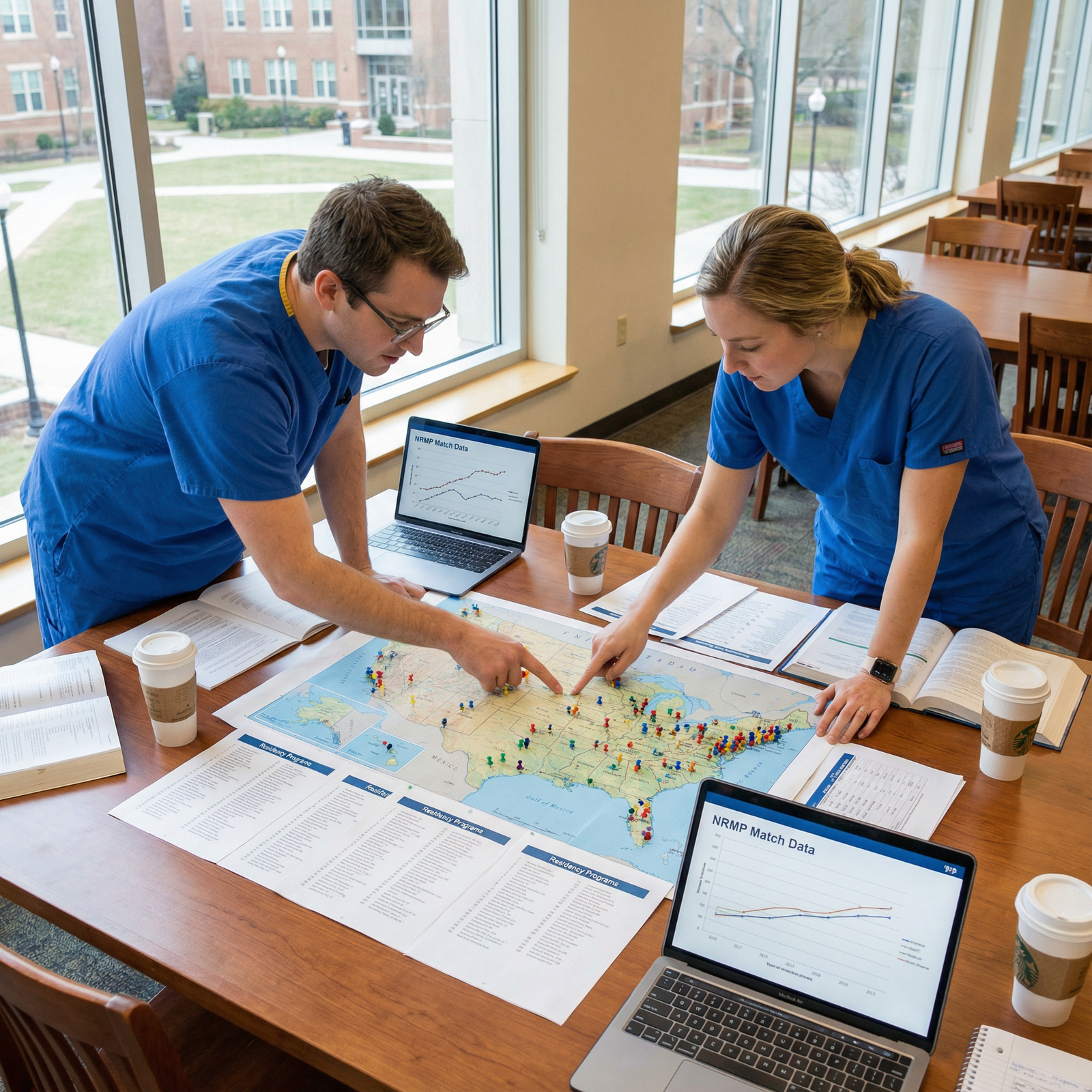
Understanding the Big Picture: Why Program Selection Matters So Much for Non‑US Citizen IMGs
For a non-US citizen IMG aiming for pathology residency in the United States, program selection is not just a logistical step—it is a strategy decision that can make or break your match outcome. Unlike US graduates, you must navigate:
- Visa sponsorship issues
- Limited interview opportunities
- Variable program attitudes toward foreign national medical graduates
- Differences in case volume, fellowships, and educational structure
A strong application can still fail if your program list is poorly chosen. Conversely, a mid-range application with a sharp program selection strategy can match very well.
This article focuses on helping you, as a non-US citizen IMG, design a realistic and smart approach to:
- How to choose residency programs in pathology
- How many programs to apply to
- How to build a balanced list tailored to your profile, visa needs, and career goals
- How to interpret filters such as USMLE score cutoffs, IMG-friendliness, and location
Throughout, we will focus specifically on pathology residency and the unique considerations for foreign national medical graduates.
Step 1: Know Your Profile and Risk Level
Before you can build a program list, you must first understand what kind of applicant you are. This is essential for deciding how many programs to apply to and what kind of programs are realistic.
1. Academic Metrics
Key components:
- USMLE Step 1: Now pass/fail, but many pathology programs still look at the context (first attempt, time since exam, and sometimes numerical score if available historically).
- USMLE Step 2 CK: Often crucial for a non-US citizen IMG. Competitive university programs may look for 230–240+; community programs or IMG-friendly programs may accept lower, depending on the overall profile.
- Attempts: Any failures must be considered honestly. Some programs automatically filter out any candidate with exam failures.
Actionable advice:
If you have multiple attempts or lower Step 2 CK (<220), you must compensate with:
- Strong pathology-relevant experience (electives, observerships)
- Excellent letters from US pathologists
- A broader application list (often 80–120 programs if financially feasible)
If you have strong scores (e.g., Step 2 CK ≥240, no fails, recent grad), you can:
- Consider a smaller but still cautious list (e.g., 50–80 programs)
- Target more university and academic programs
2. Graduation Year and Clinical Gap
Pathology is more forgiving than some other specialties, but time since graduation matters:
- Graduated within last 3–5 years: Generally acceptable for many programs.
- >5 years since graduation: You may face more filters; you need strong recent pathology exposure or research to show continued engagement.
- Significant practice in home country (especially in pathology or related research) can be a plus if well-documented.
Implications for program selection:
- If you graduated more than 5–7 years ago, focus on:
- IMG-friendly community programs
- Programs historically accepting older grads
- Institutions where you have some personal connection (observership, mentor, collaboration)
3. Pathology-Specific Experience
Pathology residency directors want evidence that you genuinely understand and are committed to pathology.
Strong positives:
- US observerships or electives in anatomic/clinical pathology
- Research or publications in pathology (especially in pathology journals or conferences like USCAP, CAP)
- Letters of recommendation from US pathologists who know your work
These can help you reach for better programs and compensate modest board scores or older graduation dates.
4. Visa Status and Requirements
As a non-US citizen IMG, you must be precise about your visa situation:
- Common options:
- J-1 visa (through ECFMG) – most common and widely accepted
- H-1B – fewer programs sponsor; requires Step 3 typically before start of residency
- Some programs do not sponsor any visas; others sponsor only J-1 or very rarely H-1B.
Actionable advice:
- Decide early if you are open to J-1 visa. If yes, your options expand significantly.
- If you insist on H-1B only, your program pool shrinks dramatically; you will need to:
- Apply to almost every pathology program that clearly sponsors H-1B
- Accept higher competition and potential need for outstanding scores/experience
Step 2: Researching Programs Systematically
Effective program selection requires structured research, not random choices.
1. Start with Reliable Databases
Use multiple sources to cross-check information:
FREIDA (AMA):
- Check for:
- Program size
- Visa sponsorship (J-1/H-1B/None)
- Minimum scores and attempts policies
- Be aware: Data may be outdated; always double-check program websites.
- Check for:
Individual Program Websites:
- Look for explicit statements on:
- Visa policy
- USMLE score thresholds
- Time since graduation
- Expectations for US clinical experience
- Number of positions per year, AP/CP or AP-only/CP-only structures
- Look for explicit statements on:
NRMP/ERAS data and specialty-specific match statistics:
- Check match outcome statistics for non-US citizen IMG in pathology.
- Consider average number of applications and interviews for successful matches.
Pathology forums, WhatsApp/Telegram groups, and IMG communities:
- Useful to learn which programs are truly IMG-friendly.
- Verify anecdotal information before relying on it.
2. Key Filters to Apply Early
To build an efficient list, apply a first-pass filter:
Visa Sponsorship
- Remove all programs that clearly state “No visa sponsorship” if you need a visa.
- Separate lists for:
- J-1 OK
- J-1 or H-1B
- H-1B only (if that’s crucial for you)
IMG-Friendliness
- Check if recent residents include foreign national medical graduates.
- Many programs show resident photos and bios; look for:
- International schools
- ECFMG certification noted
- Programs that have never taken IMGs are higher risk for you.
Score/Attempt Cutoffs
- Some programs clearly state:
- “We require Step 2 CK ≥ 220”
- “No more than 1 attempt on any USMLE exam”
- If you do not meet a stated minimum, consider not applying unless you have a strong inside connection.
- Some programs clearly state:
Graduation Date Limits
- Look for statements such as:
- “We prefer graduates within the last 5 years”
- These are not always absolute, but frequent rejections suggest such programs may be low-yield for older graduates.
- Look for statements such as:
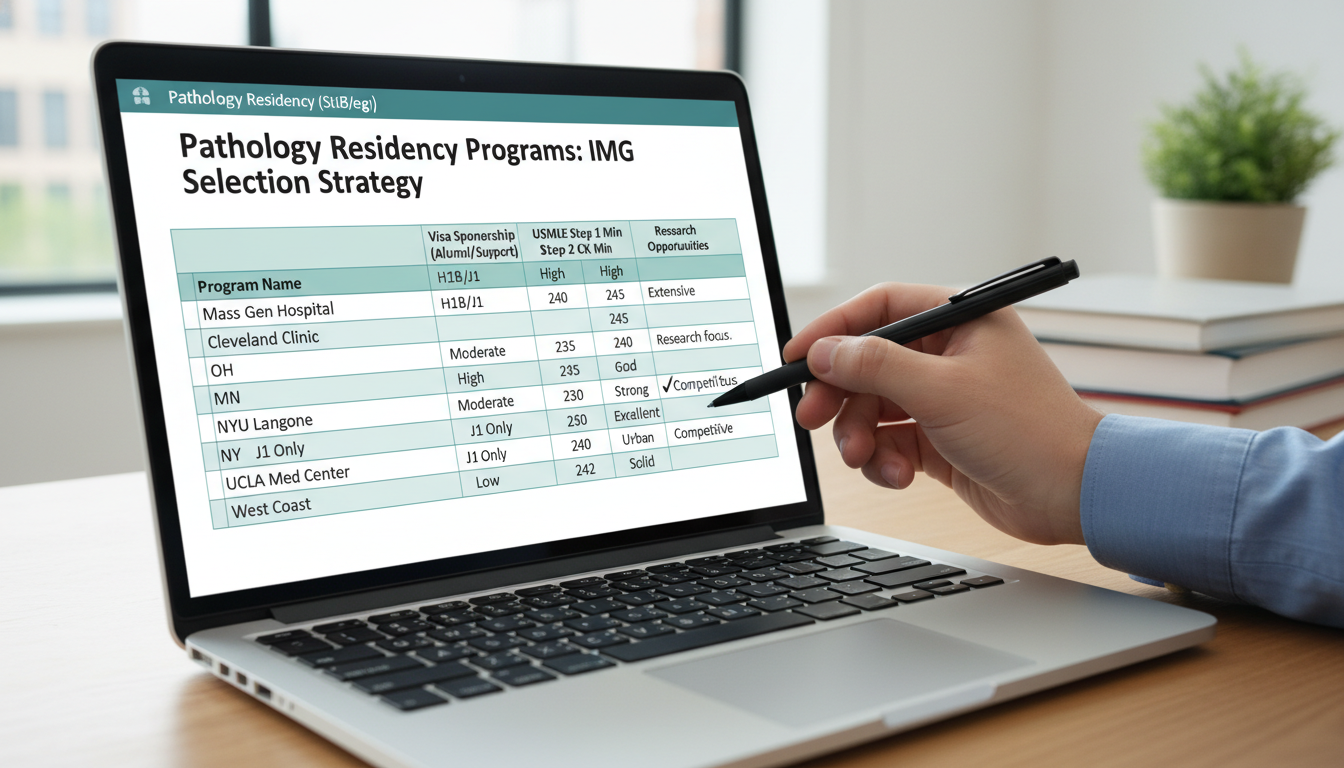
3. Create a Tracking Spreadsheet
An organized spreadsheet is essential for a solid program selection strategy.
Suggested columns:
- Program name & ACGME code
- Location (state, region, type of city)
- Visa: J-1 / H-1B / Both / None
- IMG-friendly? (Y/N + comments)
- USMLE min requirements (score and attempts)
- Graduation year limit
- Pathology program type:
- AP/CP combined
- AP-only or CP-only tracks
- Size of program (number of residents)
- Fellowships offered (e.g., heme, cytology, GI, molecular, etc.)
- Faculty/research focus areas (for academic careers)
- Subjective fit: Low / Medium / High
- Notes on strengths (e.g., strong CP training, community-based, high volume)
This will help you prioritize and adjust as you receive new information or as financial constraints shape how many programs you can apply to.
Step 3: How Many Pathology Programs Should a Non‑US Citizen IMG Apply To?
There is no single number that fits all, but pathology has its own dynamics. Non-US citizen IMGs typically need to apply more broadly than US graduates.
1. General Ranges for Pathology
For a non-US citizen IMG, approximate ranges (assuming you can afford the ERAS fees):
Very strong profile
- Step 2 CK ≥ 245, no fails
- Recent graduate (<3 years)
- US pathology experience + strong letters
- Some research or presentations
- Flexible on visa (J-1 acceptable)
→ Recommended: 50–70 programs
Average/typical non-US citizen IMG
- Step 2 CK 225–240, maybe one mild red flag (older grad OR limited USCE)
- Some pathology exposure or observerships
- Good letters from home and possibly US
→ Recommended: 70–100 programs
Higher‑risk profile
- Step 2 CK <225, or attempt(s) on USMLE
- Graduation >5–7 years ago
- Minimal US pathology experience
- Restrictive visa needs (e.g., H-1B only)
→ Recommended: 100–150 programs (and realistic expectations; may include a re-application plan)
These numbers are not rigid rules but reflect typical pathology match competitiveness for foreign national medical graduates.
2. Balancing Budget vs. Match Probability
ERAS applications are expensive, especially if you target 80–120 programs. You must balance:
- Financial cost of a broader application vs.
- The cost of reapplying next year if you do not match (lost time, exam validity, additional expenses, emotional stress).
For most non-US citizen IMGs in pathology, err on the side of slightly over-applying, especially if:
- Your visa needs are strict
- You lack US-based letters or experience
- Your Step 2 CK score is average or below average
3. Adjusting Based on Early Feedback
If you are already in the season and see few or no interview invitations by mid-October to early November:
- Re-check if you have missed some less competitive or more IMG-friendly programs that are still open.
- Ask mentors or advisors to review your application and program list.
- Consider reaching out politely to a few programs with genuine connections (e.g., former observers or research supervisors now at that institution).

Step 4: Building a Tiered List – Reach, Target, and Safety Programs
Once you know how many programs to apply to, the next step in your program selection strategy is to categorize programs by relative difficulty for someone with your profile.
1. Defining the Tiers
For a non-US citizen IMG in pathology, a rough framework:
Reach programs
- Highly ranked academic centers
- Historically low or moderate IMG intake
- Strong emphasis on research the resident may not yet have
- Prefer US grads and top international candidates
- Example: Big-name university programs in major cities
Target programs
- Mid-level university or strong community teaching hospitals
- Regularly accept IMGs (including non-US citizens)
- Moderate competitiveness, but realistic if you meet their average profile
Safety programs
- Smaller community programs or newer programs
- Clearly IMG-friendly with multiple non-US citizen residents
- May be in less popular locations (smaller cities, rural areas)
- May offer fewer fellowships but solid AP/CP training
2. Suggested Tier Distribution
For a typical non-US citizen IMG applying to 80 programs:
- 15–20% Reach (12–16 programs)
- 50–60% Target (40–50 programs)
- 25–35% Safety (20–28 programs)
If you are a higher-risk applicant, shift slightly:
- 10–15% Reach
- 40–50% Target
- 35–50% Safety
3. How to Classify a Program into a Tier
Consider:
- Match lists and current residents: Do they include foreign national medical graduates? From what kind of schools and countries?
- Program reputation: Use relative rank perception (specialty reputation, fellowship placements, research output).
- Stated minimums: If your Step 2CK is close to their minimum and you barely meet their requirements, consider it Reach.
- Geographic desirability: Big coastal cities tend to be more competitive. Programs in less popular states or smaller cities may be more accessible.
Example:
You are a non-US citizen IMG with:
- Step 2 CK: 235, one US pathology observership, 3 years since graduation, strong home letters, J-1 OK.
For a well-known university pathology program in a major city that has mostly US grads and occasional IMGs with research:
→ classify as Reach.
For a mid-sized university in the Midwest with multiple non-US citizen IMGs and clear J-1 sponsorship:
→ classify as Target.
For a community program in a smaller city with mostly IMGs, including older grads:
→ classify as Safety.
Step 5: Prioritizing Fit – Beyond Scores and Visas
Scores and visas get you through the door, but your long-term career and day-to-day life depend on fit.
1. Training Structure and Case Mix
Pathology residency varies much more than some other specialties in terms of:
- Autopsy volume
- Surgical pathology case complexity and subspecialization
- Cytology exposure
- CP areas: hematology, transfusion medicine, microbiology, molecular pathology, etc.
When evaluating how to choose residency programs, ask:
- Do they provide AP/CP combined training (most do, but some are AP-only or CP-only)?
- Are there fellowships in your areas of interest (e.g., hematopathology, GI, cytopathology, molecular)?
- Do graduates regularly match into competitive fellowships?
2. Academic vs. Community Orientation
Ask yourself:
Do you want a career in academic pathology (research, teaching, tertiary care centers)?
- More likely to thrive in academic/university programs with strong research and subspecialty training.
Do you want to work primarily as a community pathologist (diagnostic efficiency, broad skills, some lab management)?
- Community programs with high service volume may prepare you well.
As a non-US citizen IMG, both paths are possible, but academic positions can be more competitive and may scrutinize visa status and research record more closely.
3. Location, Support, and Lifestyle
As a foreign national medical graduate, your adjustment to life in the US is a real factor:
- Cost of living: Major coastal cities vs. midwestern or southern cities.
- Existing community: Are there other international residents? Support for newcomers?
- Weather, transportation, and social support: Particularly important if you have family with you on a visa.
While you cannot be overly selective on location as a non-US citizen IMG, you should think carefully about extremely isolated locations or cities without any support systems if that would significantly affect your mental health.
Step 6: Using Strategy to Improve Your Odds
Your program selection strategy can actively improve your pathology match probability beyond simple numbers.
1. Leverage Connections and Mentors
If you have:
- Worked with a US pathologist in an observership,
- Published with a faculty member in pathology,
- Attended USCAP or CAP and met faculty,
Ask whether they can:
- Provide honest advice on your program list
- Introduce you (informally) to colleagues at programs where you plan to apply
- Write a personalized letter mentioning your suitability for pathology
A strong, personal recommendation can sometimes push an application past automated filters.
2. Tailor Your Personal Statement and Experiences
For programs you particularly care about:
- Highlight specific fellowships or faculty interests that align with your goals.
- Emphasize your pathology exposure (autopsy, histology labs, research, case discussions) and commitment to the field.
- As a foreign national medical graduate, briefly address the value of your international experiences (e.g., diverse disease patterns, resource-limited diagnostic environments).
3. Manage Risk with Clear Expectations
Even with an excellent strategy, not matching is possible. Prepare:
A backup plan:
- Research positions in pathology
- Postdoctoral fellowships
- Additional observerships or advanced degrees related to pathology (e.g., molecular pathology, lab management)
A realistic mindset:
- You can improve your profile over 1–2 cycles.
- Many successful pathologists matched on their second try after reinforcing research or US experience.
Frequently Asked Questions (FAQ)
1. As a non-US citizen IMG, is pathology a realistic specialty for me?
Yes. Pathology is relatively IMG-friendly compared to many competitive specialties, and non-US citizen IMGs do match into pathology every year. Your chances are best if you:
- Have solid USMLE scores (especially Step 2 CK)
- Show clear commitment to pathology through observerships or research
- Apply broadly with a well-planned program selection strategy
- Are flexible with visa type (especially open to J-1)
2. How many pathology programs should I apply to if I have one failed USMLE attempt?
One failed attempt does not automatically exclude you, but it increases your risk level. For most non-US citizen IMGs with a single attempt:
- Consider 80–120 applications, depending on your Step 2 CK score, graduation year, and level of pathology experience.
- Focus on IMG-friendly programs and those that do not explicitly ban applicants with attempts.
- Strengthen the rest of your application (excellent letters, clear pathology focus, well-written personal statement).
3. Should I only apply to programs that offer H-1B if I strongly prefer it?
If you absolutely must avoid J-1, your list will be much smaller. Many pathology programs sponsor only J-1, and only a subset provide H-1B. The consequence:
- You may need to apply to every H-1B-sponsoring pathology program where you vaguely meet criteria, possibly 80+ applications.
- You will face more competition for fewer slots.
- If your primary goal is to train in the US, being open to J-1 usually increases your chances significantly.
4. How do I identify which programs are “IMG-friendly”?
Look for:
- Program websites or social media that show multiple foreign national medical graduates among current residents.
- Alumni lists with graduates from international schools.
- Comments from recent applicants in pathology forums and IMG groups (cross-check for reliability).
- Clear, welcoming language to IMGs on their website (rather than vague or restrictive wording).
Programs that regularly accept non-US citizen IMGs, sponsor visas, and are not limited to US grads are typically more “IMG-friendly” and should make up a large portion of your target and safety lists.
By carefully evaluating your own profile, understanding how many programs to apply to, and designing a rational mix of reach, target, and safety programs, you can create a powerful program selection strategy as a non-US citizen IMG in pathology. This strategy-driven approach—rather than random or reputation-based choices—will maximize both your chance of matching and the quality of training you ultimately receive.