Understanding the Big Picture: Pediatrics Residency as a Caribbean IMG
For a Caribbean medical school graduate targeting a pediatrics residency in the US, your program selection strategy can matter as much as your USMLE scores and clinical evaluations. Well-chosen applications maximize your chance to match, limit unnecessary costs, and position you for a sustainable and satisfying career in pediatrics.
As a Caribbean IMG—whether from SGU, Ross, AUC, Saba, or another Caribbean medical school—you face a more competitive landscape than most US MD seniors. Yet pediatrics remains one of the more IMG-friendly core specialties, with many community-based programs open to recruiting strong international graduates.
This article will walk you through:
- How to estimate how many programs to apply to for a pediatrics residency
- How to build a smart program selection strategy specific to Caribbean IMGs
- How to balance “reach,” “target,” and “safety” pediatric programs
- How to interpret Caribbean medical school residency and SGU residency match data
- Practical steps to filter programs and avoid common pitfalls
Throughout, the focus is pediatrics, but many principles apply across specialties.
Know Your Profile: The Foundation of Any Program Selection Strategy
Before deciding how to choose residency programs, you must know where you stand. Your profile as a Caribbean IMG in pediatrics is shaped by several core elements.
1. Academic Metrics
Key pieces:
- USMLE Step 1 (pass/fail, but attempts still matter)
- USMLE Step 2 CK score
- Any Step failures or multiple attempts
For pediatrics, competitive Step 2 CK scores are helpful but not as cut-throat as in fields like dermatology or orthopedics. Many community and mid-tier university-affiliated pediatric residencies will strongly consider Caribbean IMGs with:
- Step 2 CK in the 220–235+ range: Solid for many IMG-friendly peds programs
- 235–245+: Competitive for a broader range of programs, including some university-based programs that are open to IMGs
If you have repeated attempts, aim to compensate with:
- Strong letters of recommendation (LORs) in pediatrics
- US clinical experience, preferably pediatric sub-internships
- A well-crafted personal statement tailored to peds
2. Medical School and Caribbean IMG Status
Programs know Caribbean schools well, particularly SGU, Ross, AUC, and Saba. Many US pediatrics residency programs already have:
- A history of interviewing or matching SGU graduates
- Established relationships via core/clerkship sites and sub-I rotations
Understanding your school’s historical outcomes is invaluable. For example, SGU residency match lists often show pediatrics as a top specialty, with many graduates matching into community-based and some university-affiliated pediatric programs. Use this data as a baseline to gauge what’s realistic.
3. Clinical Experience and Letters
Pediatrics is relationship-driven:
- Pediatric sub-internships or AI (Acting Internships) in the US are high-yield
- Letters of recommendation from US pediatricians, ideally program leadership or clerkship directors, are especially valued
For a Caribbean IMG, strong peds-specific LORs can distinguish you from other applicants with similar scores.
4. Geography and Visa Needs
Your program selection strategy must incorporate:
- Visa requirement: J-1 vs H-1B vs no visa
- Geographic preference vs flexibility: Are you open nationwide or limited by family/personal reasons?
Needing a visa narrows your options, particularly for H-1B. Many pediatric programs sponsor J-1, fewer support H-1B. This will factor directly into how many programs to apply to.
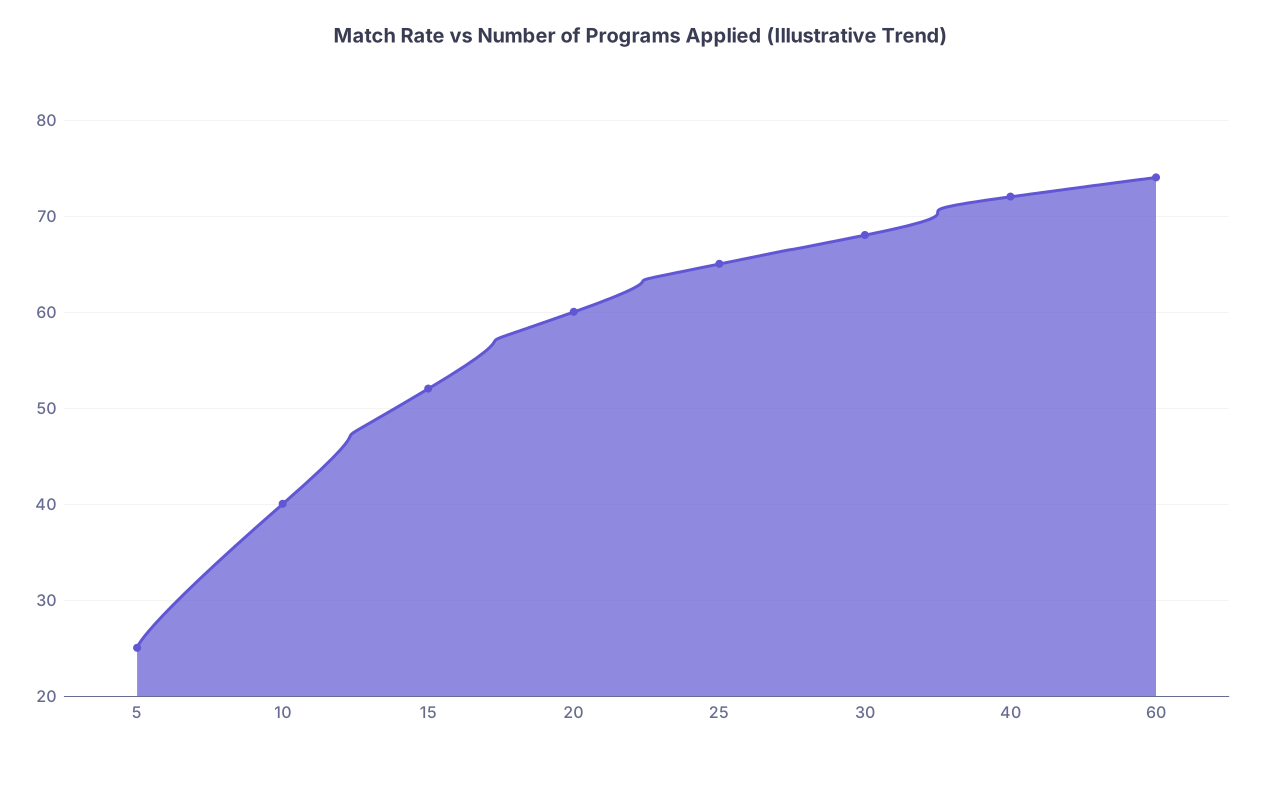
How Many Pediatrics Programs Should a Caribbean IMG Apply To?
There is no magic number, but you can apply a structured framework.
General Ranges for Caribbean IMGs in Pediatrics
Assuming you have:
- No major red flags (e.g., failed Step 2 CK, significant professionalism issues)
- At least one US peds rotation and strong peds LORs
Approximate ranges:
Stronger profile (Step 2 CK ~235–245+, good clinicals)
- 35–50 pediatric programs
Average competitive profile (Step 2 CK ~220–234, no significant failures)
- 50–70 pediatric programs
Weaker profile (Step 2 CK <220, attempts, or gaps)
- 70–100+ pediatric programs, with a heavy emphasis on IMG-friendly community programs
If you require an H-1B visa or have multiple red flags, consider the higher end of these ranges or even beyond, focusing on the few programs that historically consider similar applicants.
These numbers may feel high, but for a Caribbean IMG in pediatrics, they reflect the reality of national competition and the sheer variability in individual program IMG-friendliness.
Adjusting Number of Applications: Key Modifiers
You can increase or decrease the number based on:
- Broader geographic flexibility → fewer programs needed (you can cast a wide net across many regions)
- Severe geographic limitation (e.g., only the Northeast) → more programs needed in that area to compensate for fewer total options
- Very strong profile + strong home institution support → fewer programs may suffice
- Visa need / multiple attempts → more programs in general
An efficient program selection strategy for a Caribbean IMG balances cost, time, and probability of interviews. Err slightly on the side of “too many” rather than “too few,” especially if you’re applying only once and cannot risk going unmatched.

Building Your Program List: A Step-by-Step Strategy
Step 1: Clearly Define Your Tiers (Reach, Target, Safety)
For Caribbean IMGs, tiering is critical. Categories will vary depending on your profile, but a useful framework:
1. Reach Programs
- Strong university-based pediatric residencies
- Top children’s hospitals
- Programs with few or no IMGs historically
You might still apply to a small number (5–10) of these if:
- Your Step 2 CK is strong (say ≥240)
- You have excellent US peds LORs and honors in rotations
- Your Caribbean school is well-known with a good track record
2. Target Programs
- University-affiliated community programs
- Mid-tier children’s hospitals that regularly interview and match IMGs
- Programs where your school’s graduates have matched in recent years
This is where most of your list should lie—programs that routinely take Caribbean IMGs and offer solid training.
3. Safety Programs
- Community-based pediatric programs with a strong IMG track record
- Possibly smaller or less well-known institutions
- Programs in less competitive geographic regions (e.g., some Midwest or Southern states)
Your program selection strategy should ensure that a significant proportion (often 30–50% or more, depending on your risk profile) are realistic “safety” programs.
Step 2: Use Multiple Information Sources
To build and refine your list:
ERAS/FRIEDA (AMA’s Residency & Fellowship Database)
- Filter by pediatrics
- Check visa sponsorship policy
- Review program size and structure
Program websites
- Look at current and past residents—do they include Caribbean IMGs?
- Note any statements about international medical graduates or visa policies
Caribbean medical school residency lists (e.g., SGU residency match)
- Look up where recent graduates matched in pediatrics
- Identify programs with a recurring pattern of accepting graduates from your school or similar institutions
NRMP Charting Outcomes data
- Review pediatrics outcomes by US vs non-US IMGs
- Understand how your metrics align with successful candidates
Mentors and recent graduates
- Talk to senior students or alumni from your Caribbean school, especially those in pediatrics
- Ask where they interviewed and which programs were IMG-friendly
Step 3: Apply Clear Filters for Caribbean IMGs
To reduce wasted applications and maximize yield, consider filters like:
Visa Sponsorship
- Remove programs that explicitly state “No visas sponsored” if you require one
- Prioritize J-1/H-1B friendly programs depending on your needs
History with Caribbean Grads
- Give preference to programs with current or recent Caribbean IMGs in their resident list
- Programs with multiple SGU/Ross/AUC/Saba grads are usually more comfortable evaluating and supporting Caribbean IMGs
Pediatrics Focus and Culture
Look at:
- Presence of a children’s hospital or dedicated peds units
- Volume and diversity of pediatric cases
- Subspecialty exposure (NICU, PICU, peds emergency, etc.)
Even “safety” programs should offer robust pediatric training.
- Academic vs Community Balance
As a Caribbean IMG, your core priority is matching and getting solid training. However, if you have research and academic interests, consider:
- University-affiliated community programs
- Institutions with at least modest scholarly activity in pediatrics
- Red Flag Compatibility
If you have:
- A USMLE failure
- A gap in training
- Limited US clinical experience
Favor programs where alumni with similar issues have still matched (based on your school’s data, mentors, or advising office).
Special Considerations for Caribbean IMGs in Pediatrics
1. Using Caribbean Medical School Residency Data Strategically
Many Caribbean schools (SGU in particular) publish detailed residency match lists:
- Search specifically for pediatrics residency entries
- Look for patterns: certain programs appear repeatedly year after year
- Those recurring programs likely have:
- Familiarity and trust in your curriculum
- Faculty who understand the Caribbean medical education structure
- Established networks that can help you get interviews
For example, if the SGU residency match list shows a specific Midwest pediatric program matching 3–4 SGU grads over 5 years, that program is likely IMG-friendly, especially to your institution.
2. Balancing Brand Name vs Match Probability
It’s natural to be drawn to famous children’s hospitals or big-name universities. But as a Caribbean IMG, your program selection strategy needs to prioritize:
- High probability of interviews
- High likelihood of ranking enough programs to match
It is wise to:
- Limit very high “reach” institutions to a small subset of your list
- Aggressively fill out the rest with “target” and “safety” pediatric programs that actually interview IMGs
3. Interpreting “IMG-Friendly” in Pediatrics
“IMG-friendly” doesn’t just mean a program once had a single foreign graduate years ago. Consider a program IMG-friendly if:
- Current residents include multiple non-US IMGs or Caribbean grads
- They explicitly mention openness to IMGs on their website or in FAQs
- They sponsor visas with some regularity
Programs that regularly match multiple Caribbean IMGs each year are particularly good targets, especially if they’ve taken graduates from your specific school.
4. Geographic Strategy for Caribbean IMGs
Many applicants cluster heavily in:
- East Coast (New York, New Jersey, Pennsylvania, Massachusetts)
- Major urban centers across the US
But your odds may actually be higher if you expand to:
- Midwest (e.g., Ohio, Michigan, Indiana, Missouri, Kansas)
- South (outside of the largest metro areas)
- Smaller cities that may attract fewer US MD seniors
A flexible geographic stance can dramatically improve your peds match prospects.

Putting It All Together: A Sample Program Selection Strategy
Let’s walk through a realistic example for a hypothetical Caribbean IMG applicant.
Applicant Profile (Example)
- Caribbean school: SGU
- Step 1: Pass on first attempt
- Step 2 CK: 232 (one attempt)
- 3 months US clinical experience, including one pediatric sub-I
- 2 strong pediatric LORs from US attendings
- Requires J-1 visa
- Flexible on geography, prefers East Coast but open nationwide
Step-by-Step Strategy
1. Determine Rough Application Volume
Profile: Average-competitive Caribbean IMG for pediatrics.
- Target range: 50–70 pediatrics programs
2. Use Tiers
Reach (10 programs)
- Selected university-based pediatric programs known to have some IMGs
- A few stronger children’s hospitals that have interviewed SGU graduates previously
Target (30–40 programs)
- University-affiliated community pediatric programs with documented Caribbean IMGs
- Programs from SGU residency match lists appearing recurrently
- Mix of East Coast and Midwest
Safety (15–20 programs)
- Community programs in less competitive regions that regularly accept IMGs
- Places where SGU or similar schools have a consistent pipeline
3. Apply Filters
Remove any programs that:
- Explicitly state “US graduates only”
- Do not sponsor J-1 visas
- Have no evidence of ever taking an IMG, especially in pediatrics
Prioritize programs that:
- Have at least one Caribbean grad in the current or recent residency cohorts
- Are affiliated with hospitals where the applicant rotated or did a sub-I
4. Time and Cost Management
To manage ERAS fees and time:
- Create a “core list” of 40–45 programs to submit early
- Add another 10–20 selectively after speaking with mentors and reviewing early interview patterns, if needed
5. Reassess Mid-Season
- If interview invitations are sparse by late October:
- Consider applying to additional safety pediatric programs, especially in under-applied regions
- If interviews are strong and plentiful:
- No need to add more; focus on preparing for interviews and optimizing your rank list
This structured, data-driven approach is far superior to randomly applying to 100 pediatrics programs without any strategy.
Practical Tips and Common Pitfalls for Caribbean IMGs in Pediatrics
Practical Tips
Start Early
- Begin researching how to choose residency programs at least 6–9 months before applications open.
- Collect data on Caribbean medical school residency patterns and speak to alumni early.
Leverage Your School’s Resources
- Many Caribbean schools (including SGU) have dedicated residency advising teams.
- Ask them directly about your chances at specific pediatric programs based on recent outcomes.
Be Honest About Your Red Flags
- Address them head-on in your personal statement or an addendum.
- Choose programs known to have taken applicants with similar profiles.
Optimize Application Materials
- Strong, specific pediatric LORs can make a program see beyond your IMG status.
- Highlight your commitment to working with children, any volunteer work, and continuity of interest.
Network Strategically
- During US pediatric rotations, express your interest in that program (if realistic).
- Attend virtual open houses; ask thoughtful questions and follow up.
Common Pitfalls
Overloading on “Reach” Programs
- Applying to too many prestigious pediatric programs that rarely take IMGs can waste resources and reduce your true chances of matching.
Underestimating Safety Programs
- Some community-based programs offer excellent training and career opportunities.
- Don’t ignore them based purely on name recognition.
Ignoring Visa Realities
- Applying widely to programs that won’t sponsor your needed visa is a common and costly mistake.
Being Too Narrow Geographically
- Restricting yourself to a single city or state can drastically lower your chances, especially as a Caribbean IMG.
Applying Too Late
- Late applications can be disadvantaged when interview slots at pediatric programs are already filled.
FAQs: Program Selection Strategy for Caribbean IMG in Pediatrics
1. As a Caribbean IMG, how many pediatrics programs should I apply to?
Most Caribbean IMGs targeting a pediatrics residency should plan to apply to roughly 50–70 programs, adjusting based on competitiveness and visa needs:
- Stronger applicants: 35–50
- Average competitive: 50–70
- Weaker or with multiple red flags: 70–100+
When in doubt, slightly overshoot rather than undershoot—especially if you only want to apply once.
2. How do I know if a pediatric program is IMG-friendly?
Look for:
- Current or recent residents from Caribbean schools (SGU, Ross, AUC, etc.)
- Visa sponsorship listed on their website or in FRIEDA
- A pattern of Caribbean IMGs on recent Caribbean medical school residency or SGU residency match lists
- Open statements about considering IMGs in their FAQ or program description
If none of these are present, that program is less likely to be IMG-friendly.
3. Should I prioritize big-name children’s hospitals as a Caribbean IMG?
You can include a small number of big-name children’s hospitals or top university pediatric programs as “reach” options, especially if your profile is strong. However, most of your list should be:
- University-affiliated community programs
- IMG-friendly community pediatric residencies
Your primary goal is to secure a peds match; brand name is secondary to fit, training quality, and probability of matching.
4. What if I have a failed Step exam—can I still match pediatrics as a Caribbean IMG?
Yes, it’s still possible, but your program selection strategy must adapt:
- Apply to more programs (often 70–100+)
- Focus heavily on programs with a strong history of matching Caribbean IMGs
- Strengthen clinical performance and pediatric LORs
- Consider doing additional US peds rotations to demonstrate current competence
You may lean more heavily on community-based programs in less competitive regions and ensure your personal statement explains your growth and resilience convincingly.
A deliberate, data-driven program selection strategy can make the difference between matching in pediatrics and going unmatched as a Caribbean IMG. By understanding your profile, using residency data intelligently, and choosing programs aligned with your credentials and goals, you can give yourself the best possible chance at a successful pediatrics residency—and a fulfilling career caring for children.