Understanding the Plastic Surgery Residency Landscape as an MD Graduate
For an MD graduate aiming for plastic surgery, program selection strategy is as important as your Step scores or letters of recommendation. Plastic surgery—especially the integrated plastics match—is among the most competitive specialties in the allopathic medical school match. You cannot afford a random or superficial list.
Instead, you need a structured, data-informed approach that balances ambition, realism, and personal fit. This article will walk you step-by-step through how to create a smart program list, how to choose residency programs that align with your profile, and how many programs to apply to as a competitive or borderline applicant.
We’ll focus on the integrated plastic surgery pathway, assuming you are:
- An MD graduate (allopathic), and
- Applying to integrated plastic surgery residency rather than independent training.
While data changes slightly year to year, the principles of program selection strategy remain consistent.
Step 1: Clarify Your Goals and Constraints
Before opening ERAS or looking at individual programs, you need a clear picture of who you are as an applicant and what you need from a training program.
A. Self-Assessment: Where Do You Stand?
Key components:
Academic metrics
- USMLE Step 1 (even if pass/fail, many programs see numeric values if taken earlier)
- USMLE Step 2 CK
- Class rank, AOA status, honors in surgery and related rotations
- Any repeated years or professionalism issues
Research profile
- Number of publications (particularly in plastic surgery or surgical fields)
- Quality/impact of journals
- First-author vs co-author roles
- Presentations at regional/national meetings (ASPS, AAPS, etc.)
- Research years (if applicable)
Plastic surgery exposure
- Dedicated plastic surgery rotations (home or away)
- Letters of recommendation from plastic surgeons
- Longitudinal mentorship relationships
- Demonstrated interest (electives, projects, involvement in plastic surgery groups)
Non-cognitive strengths
- Communication skills
- Teamwork and leadership
- Professionalism and reliability
- Ability to handle high workload and stress
Potential red flags
- Low or failed USMLE attempts
- Disciplinary issues
- Gaps in training
- Minimal or no plastic surgery exposure
Be honest and specific. This self-assessment directly influences how many programs to apply to and the level of program competitiveness you target.
B. Personal Priorities and Life Circumstances
Even for an ultra-competitive specialty like plastic surgery, you must consider personal realities:
- Geographic ties (family, partner, children, visa status)
- Financial constraints (application fees, away rotation costs, moving expenses)
- Desire for academic vs community practice in the future
- Interest in subspecialty areas (craniofacial, microsurgery, hand, aesthetics, gender-affirming surgery)
- Tolerance for long workweeks, call frequency, and high-volume centers
Write these priorities down. They will help narrow your list and avoid “panic applying” to programs that are a poor fit for your long-term goals.
Step 2: Understand the Integrated Plastics Match and Competitiveness
Before you craft a program list, understand the landscape you’re entering.
A. Why Plastic Surgery Is So Competitive
Integrated plastic surgery is consistently:
- One of the highest Step score specialties
- One of the lowest ratio of positions to applicants
- Dominated by applicants with strong research and honors
Programs have very limited spots (often 1–3 per year), and many receive 200–300+ applications. That means selective screens based on:
- USMLE performance
- Research productivity
- Clinical performance and letters
- Known “fit” with the program (home/away rotators, institutional ties)
B. Typical Profiles of Matched MD Applicants
While exact data vary, matched integrated plastic surgery residents often have:
- Above-average Step 2 CK scores for surgical specialties
- Strong clinical evaluations, especially in surgery
- Significant research (often 5–15+ publications, though quality matters more than raw number)
- At least one strong letter from a plastic surgeon
- Often 1–2 away rotations in plastic surgery
If your profile is weaker in any area, you may need:
- A more broad and balanced program list, and/or
- Additional preparation such as a dedicated research year.
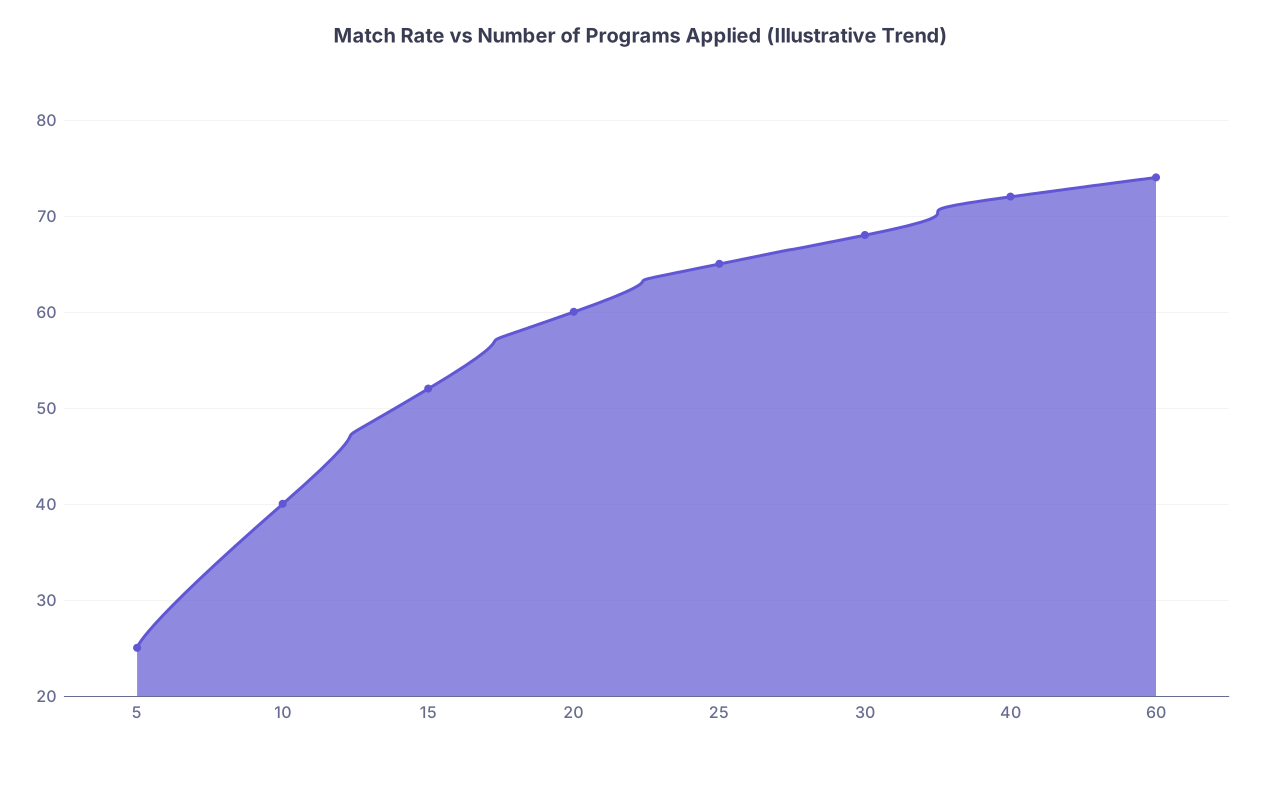
Step 3: How Many Plastic Surgery Programs Should You Apply To?
This is one of the most common and most anxiety-provoking questions in program selection strategy.
There is no one-size-fits-all number, but here are evidence-informed ranges for MD graduate residency applicants in integrated plastics. Adjust based on your specific situation.
A. Recommended Application Ranges
For integrated plastic surgery residency:
Highly competitive MD applicant
- Strong Step 2 CK (well above national mean for matched plastics)
- Honors in core rotations, AOA or top-tier class rank
- 10+ publications, including plastics
- Strong letters from known plastic surgeons
- At least one home or away rotation in plastics
- Suggested range: 30–40 programs
Solid but not “top-tier” applicant
- Above-average Step 2 CK
- Some honors, strong evaluations
- Several publications or ongoing projects
- Good letters, some plastic surgery exposure
- No major red flags
- Suggested range: 40–55 programs
Borderline or “at-risk” applicant
- Step 2 CK near or slightly below average for plastics
- Limited research or non-plastic surgery research only
- No home plastics program or limited exposure
- Minor red flags or weaknesses
- Suggested range: 55–70 programs
These ranges reflect the allopathic medical school match context and the extremely limited number of integrated plastics positions. Many MD applicants apply broadly to maximize interview opportunities.
B. Factors That Push You Toward Higher Numbers
You may want to apply toward the upper end of the range or beyond if:
- You lack a home plastic surgery program
- You have no away rotations in plastics
- You have below-average academic metrics or a failed exam attempt
- You’re geographically inflexible (only want one region)
- You are coming from a lesser-known or lower-ranked medical school
C. Factors That Allow You to Apply to Fewer Programs
You might lean toward the lower end if:
- You have exceptional metrics across the board
- You have strong institutional connections (home program, large network)
- You are geographically flexible
- You have robust, high-impact research and leadership in plastic surgery organizations
Remember: more applications do not guarantee more interviews. Programs value fit and substance over sheer volume. But in a specialty as competitive as plastics, under-applying can be dangerous.

Step 4: How to Choose Residency Programs – A Structured Framework
Once you have a target range for how many programs to apply to, the next step is building your list strategically. This is where a clear program selection strategy becomes critical.
A. Start with a Broad Database
Use these sources:
- FREIDA (AMA Residency & Fellowship Database)
- Program websites
- NRMP and specialty society resources (e.g., ASPS)
- Advice from your home plastic surgery faculty and residents
Create a spreadsheet with:
- Program name
- Location (city/state, region)
- Program type (academic, hybrid, community-affiliated)
- Number of residents per year
- Associated medical school/hospital system
- Research infrastructure (labs, funded mentors, protected time)
- Notable subspecialty strengths (microsurgery, craniofacial, hand, aesthetics)
B. Categorize Programs by Competitiveness and Fit
To choose rationally, group programs into tiers based on:
- Program prestige/competitiveness
- Your personal competitiveness
- Your fit with the program
A simple structure:
- Reach programs: Elite academic centers, prestigious names, extremely research-heavy or selective; you may be competitive but these are never “locks.”
- Target programs: Good academic or hybrid programs where your metrics and experiences are in line with current residents.
- Safety-leaning programs: Less research-heavy, less “brand name,” or newer programs where your profile may be above average.
Aim for a distribution like:
- 20–30% reach
- 40–60% target
- 20–30% safety-leaning
C. Core Criteria to Evaluate Programs
Use the following dimensions when deciding how to choose residency programs:
Clinical Exposure and Volume
- Case volume per resident
- Breadth of cases (reconstruction, craniofacial, microsurgery, hand, aesthetics)
- Level of autonomy vs fellow competition
- Presence of multiple high-volume sites
Research Opportunities
- Access to funded investigators
- Ongoing clinical trials or basic science work
- Dedicated research year(s) or flexible research blocks
- Publication expectations and support (writing mentorship, statisticians)
Program Culture and Mentorship
- Resident wellness and support
- Approachability of faculty
- Mentorship structure (assigned mentors, open-door policies)
- Program stability (leadership turnover, accreditation concerns)
Fellowship and Job Placement
- Where graduates go: top fellowships vs independent practice
- Match into competitive subspecialty fellowships (e.g., microsurgery, craniofacial)
- Alumni network and national presence
Geographic and Lifestyle Factors
- City size, cost of living
- Proximity to family/support system
- Partner job opportunities, schools if you have children
- Climate, transportation, safety
Program Size and Structure
- Number of residents per class
- Presence of fellows (and impact on resident experience)
- Call structure, night float, weekend expectations
Make a simple scoring system (e.g., 1–5 for each category) and tally an overall “fit score” for each program.
Step 5: Tailoring Strategy for Different Applicant Profiles
The ideal program selection strategy depends heavily on your starting point. Here are practical approaches for three common MD profiles.
A. The “Research-Heavy Academic” Applicant
Profile:
- Strong USMLE scores
- Multiple plastics publications
- Possibly a research year
- Interested in academic career
Program selection strategy:
- Heavily target programs with robust research infrastructure and T32 or similar funding
- Apply broadly to top academic centers, but don’t neglect solid mid-tier academic programs
- Look for programs with:
- Dedicated research residents
- NIH-funded faculty
- Track record of academic placements (faculty positions, fellowships at elite centers)
- Consider slightly fewer total programs, but ensure a good balance of reach/target/safety
B. The “Clinically Strong, Modest Research” Applicant
Profile:
- Above-average Step 2 CK
- Strong clinical rotation evaluations
- Good but not extensive research (1–3 publications or projects)
- Strong letters but limited national exposure
Program selection strategy:
- Apply broadly across a mix of academic and hybrid programs
- Emphasize programs known for excellent clinical training and resident autonomy, even if less research-heavy
- Include a good number of safety-leaning programs (newer programs, smaller markets)
- Highlight clinical strengths and teamwork in your application and interviews
C. The “Underdog” or Borderline Candidate
Profile:
- Step scores at or slightly below average for plastics
- Limited research or primarily non-plastics research
- No home plastics program, minimal exposure
- No major professionalism issues but few standout metrics
Program selection strategy:
- Consider whether to apply this cycle versus taking a research year in plastic surgery to improve competitiveness
- If applying now:
- Apply to the upper range (55–70+) of programs
- Prioritize programs known for being open to non-traditional or less research-heavy paths
- Consider programs with newer integrated plastics tracks or smaller markets
- Use away rotations strategically to:
- Generate strong letters
- Demonstrate concrete performance and fit

Step 6: Using Data and Mentorship to Refine Your List
Data and mentorship are critical for a realistic and effective program selection strategy.
A. Leverage Match and Specialty Data
Look at:
- NRMP Program Director Survey for plastic surgery
- NRMP Charting Outcomes in the Match (or its updated equivalents)
- Specialty organization surveys (ASPS, AAPS)
Use these to understand:
- Average scores of matched applicants
- Importance of research, letters, and other factors
- Typical number of programs ranked by matched vs unmatched applicants
Remember that past outcomes are not guarantees, but they offer valuable benchmarks.
B. Consult Faculty Mentors and Residents
Ask:
- Which programs align with your strengths and weaknesses?
- Which programs have reputations (good or bad) beyond what websites show?
- Are there hidden-gem programs with excellent training but less name recognition?
- Are there any programs where your mentor’s recommendation might carry extra weight?
Request direct, specific feedback on your preliminary list:
- “Are my reach/target/safety proportions reasonable?”
- “Are there programs I’m underestimating or overestimating in competitiveness?”
C. Analyze Current Residents’ Profiles
On program websites and through social media or institutional pages, examine:
- Where residents went to medical school
- Their research backgrounds
- Whether they took research years
- Geographic and training patterns (e.g., many from the same region or schools)
This helps you gauge:
- Whether your profile is typical, stronger, or weaker than their usual resident
- If programs seem to preferentially choose certain types of applicants
Step 7: Practical Tips for Managing Applications and Interviews
Once your list is set, execution matters.
A. Avoid Application Fatigue and Redundancy
- Customize personal statements or program-specific paragraphs for:
- Home/away rotation sites
- Top-choice or high-fit programs
- Use a general but polished personal statement for the rest, but avoid obvious generic language.
- Track deadlines and supplemental requirements (some programs require extra essays or forms).
B. Be Strategic with Interview Acceptances
In plastics, you may get fewer interviews than in less competitive specialties. Still, be deliberate:
- Prioritize programs that:
- Offer strong training
- Align with your long-term career goals
- Are realistically rankable for you
- Avoid overbooking interview days that would force cancellations later—cancellations can hurt your reputation.
C. Reassess After Interview Season Starts
As interviews roll in:
- Reevaluate whether you aimed too high or too low
- Consider:
- Are your “safety-leaning” programs actually offering interviews?
- Are reach programs responding at all?
Use this information to guide:
- Future cycles if you reapply
- Conversations with mentors about your application’s strengths and weaknesses
Step 8: Common Pitfalls in Program Selection Strategy (and How to Avoid Them)
Pitfall 1: Overemphasizing Prestige Alone
Choosing only top-name programs without considering:
- Fit
- Training environment
- Supportive culture
Solution:
- Include a balanced mix of program tiers.
- Prioritize where you can thrive and grow, not just the most recognizable name.
Pitfall 2: Ignoring Lifestyle and Geographical Realities
Believing you can live “anywhere” for 6–7+ years, then burning out because of:
- Isolation from support networks
- Very high cost of living
- Misalignment with partner/family needs
Solution:
- Honestly define geographic red lines early.
- Discuss with partners/family before finalizing your list.
Pitfall 3: Underapplying Because of Overconfidence
In a competitive field like integrated plastics, even stellar applicants can go unmatched.
Solution:
- Use realistic data and mentor input.
- Err slightly on the side of applying to more programs, especially beyond the very top tier.
Pitfall 4: Not Leveraging Mentors
Submitting your program list without input from:
- Plastic surgery faculty
- Residents who recently matched in plastics
Solution:
- Schedule dedicated meetings early (2–3 months before ERAS opens).
- Bring a draft list and your CV to make discussions concrete and actionable.
FAQs: Program Selection Strategy for MD Graduate in Plastic Surgery
1. As an MD graduate, how many integrated plastic surgery programs should I apply to?
For an MD graduate applying to integrated plastic surgery:
- Strong applicants often apply to 30–40 programs.
- Solid but not top-tier applicants typically apply to 40–55 programs.
- Borderline applicants often apply to 55–70+ programs.
Your final number should consider:
- Your Step scores
- Research productivity
- Plastic surgery exposure
- Presence/absence of a home plastics program
- Geographic flexibility
Discuss your specific situation with mentors to refine this range.
2. How should I balance reach, target, and safety-leaning programs?
A practical distribution:
- 20–30% reach (very prestigious, highly competitive)
- 40–60% target (where your profile matches current residents)
- 20–30% safety-leaning (newer or less research-intensive programs)
Use resident profiles, match data, and faculty input to categorize each program.
3. What matters more for plastics: research or Step scores?
Both are important, but their relative impact depends on the program:
- Many academic programs heavily value research productivity and potential for academic careers.
- All programs screen for adequate Step performance, especially Step 2 CK.
For the allopathic medical school match in integrated plastics:
- Strong Step scores help get your application viewed.
- Robust plastics-focused research often distinguishes competitive applicants from each other. Ideally, you want both solid metrics and substantive research, but a deficit in one area can sometimes be mitigated by exceptional strength in the other.
4. Should I take a research year before applying to plastic surgery residency?
Consider a research year if:
- Your current research output is minimal, especially in plastics.
- Your Step scores are average or slightly below typical matched plastics applicants.
- You lack strong plastic surgery letters or mentors.
A productive research year can:
- Boost your CV with publications and presentations
- Strengthen your mentorship network
- Improve your credibility as a serious integrated plastics match candidate
However, a research year is not a cure-all—it must be well-planned, with committed mentors and clear goals, to meaningfully enhance your application.
A thoughtful, data-driven program selection strategy is one of your most powerful tools in navigating the integrated plastic surgery residency match as an MD graduate. By honestly assessing your profile, applying to an appropriate number of programs, and strategically choosing where to apply, you maximize your chances of not only matching—but matching into a program where you can build the kind of surgical career you envision.