Navigating PM&R residency applications as a US citizen IMG (American studying abroad) is very different from applying as a US MD—and your program selection strategy can make or break your match. Thoughtful planning about where and how many programs to apply to is often more impactful than obsessing over one more practice question or one more draft of your personal statement.
This guide is written specifically for US citizen IMGs targeting Physical Medicine & Rehabilitation (PM&R) and focuses on a practical, data-driven approach to building a smart program list and maximizing your chances in the physiatry match.
Understanding Your Starting Point as a US Citizen IMG in PM&R
Before you can choose programs wisely, you need a clear-eyed view of how programs see you and where you realistically stand.
How PM&R Views US Citizen IMGs
PM&R is a moderately competitive specialty with a small number of positions compared to internal medicine or family medicine. The good news: many PM&R programs historically accept and even value IMGs, including US citizen IMGs. The challenge: competition has been increasing, and being a US citizen IMG is still considered a relative disadvantage compared with US MD graduates.
Common perceptions about US citizen IMGs in PM&R:
- Wide range of training quality depending on school
- Variable clinical exposure to the US healthcare system
- Possible questions about exam preparation and clinical skills
- Often strong life experience, resilience, and motivation
Your job in program selection is to target places that already have a track record of valuing IMGs and to avoid wasting time and money on programs that almost never interview IMG applicants.
Key Factors That Shape Your Strategy
Your program selection strategy should be heavily influenced by:
USMLE/COMLEX scores
- Step 1 (even if pass/fail) still matters contextually (first-pass vs repeat)
- Step 2 CK is critical—often the strongest standardized measure programs have
- COMLEX is less influential in PM&R unless you’re dual-applying or targeting DO-heavy programs
Attempts and Gaps
- Any failed attempts on Step 1/2/3
- Gaps after graduation or long time since graduating (>5 years) raise scrutiny
Year of Graduation (YOG)
- Recent grads (0–3 years out) are more competitive
5 years since graduation often requires stronger scores, US experience, and clear explanation
US Clinical Experience (USCE) in PM&R
- Rotations or electives in PM&R carry more weight than general medicine for this specialty
- Strong letters from US physiatrists, especially at academic centers, can significantly boost your application
Geography & Personal Limitations
- Family ties, visa needs (less of an issue as a US citizen IMG, but still relevant for dual citizenship), and willingness to relocate anywhere
- If you insist on only a few cities, your program selection strategy must be more conservative and your list larger
Before building your list, write a brief self-assessment:
- Step 1: pass/fail, first attempt?
- Step 2 CK score:
- Years since graduation:
- USCE in PM&R: yes/no, where, how long:
- Research or PM&R projects: yes/no:
- Geographic flexibility: high / moderate / low
You’ll use this profile to calibrate how many programs to apply to and which tiers to target.
How Many PM&R Programs Should You Apply To as a US Citizen IMG?
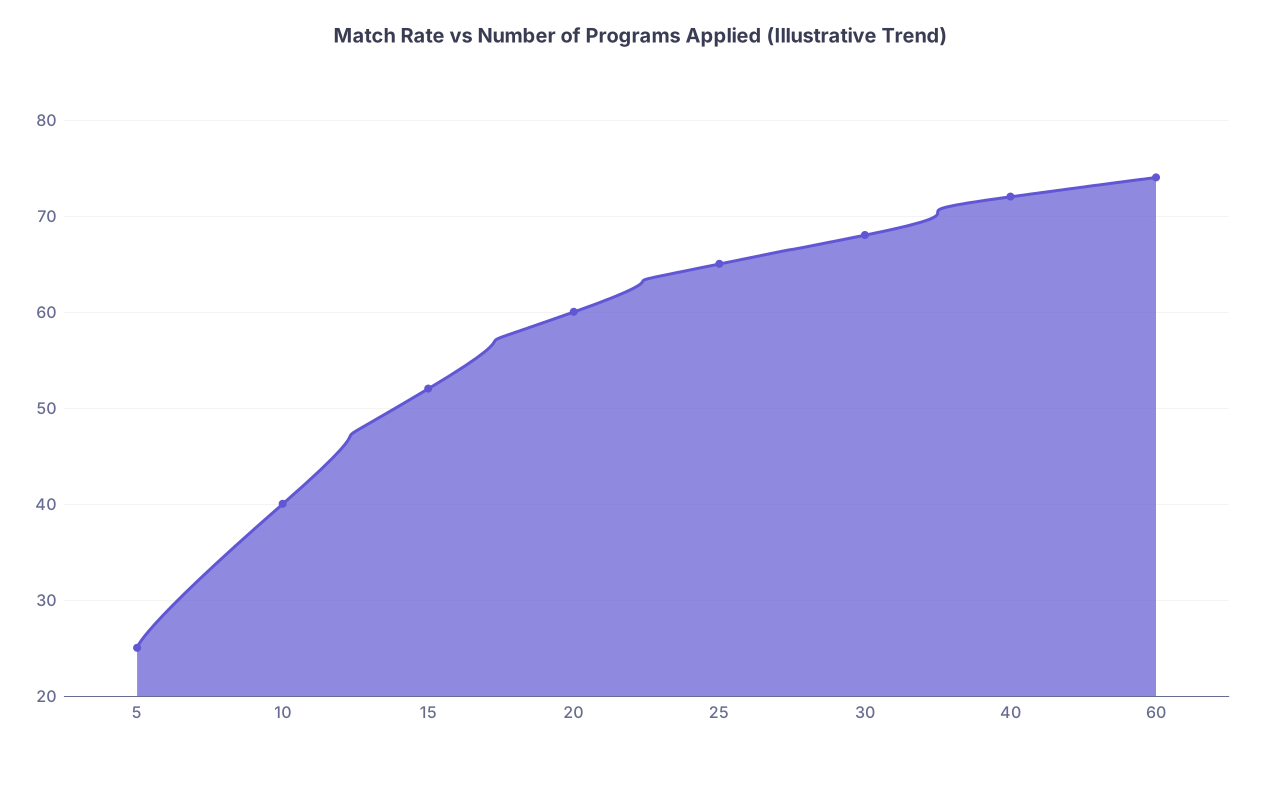
Every US citizen IMG asks this: How many programs to apply to? There is no one-size-fits-all answer, but there are data-informed ranges and rules of thumb.
General Recommendations for US Citizen IMGs in PM&R
Approximate ranges (for PM&R only, assuming you’re not dual-applying):
Highly competitive US citizen IMG profile
- Strong Step 2 CK (e.g., ≥ 245–250)
- No failures, recent grad, strong US PM&R rotations + letters
- Apply to: 25–40 PM&R programs
Average-competitive US citizen IMG profile
- Step 2 CK roughly 230–245
- No major red flags, some USCE (ideally including PM&R), reasonable YOG
- Apply to: 40–60 PM&R programs
Below-average or red-flag profile
- Step 2 CK < 230, any failures, older YOG (>5 years), limited USCE
- Apply to: 60–80+ PM&R programs (and strongly consider dual-applying)
These numbers assume:
- You are geographically flexible
- You are including IMG-friendly programs and not only the most competitive ones
- You are using a smart program selection strategy, not just mass-applying randomly
If you limit yourself to a particular coast or region, increase your number by 15–20 programs to maintain similar odds.
Why More Is Not Always Better
As an American studying abroad, it can be tempting to submit 80–120 applications “just to be safe.” But:
- Many programs almost never interview IMGs; applying to them is low yield.
- Application fees escalate quickly and can add up to thousands of dollars.
- Writing truly tailored personal statements and thoughtful supplemental responses becomes impossible at very high numbers.
- Programs can see through obviously generic applications.
A better question than “how many programs to apply” is:
“How many appropriate programs am I applying to, given my profile and goals?”
Your goal is a wide but targeted approach, not blind volume.
Building a Smart PM&R Program List: Tiered Strategy
A structured program selection strategy helps you avoid emotional guessing. Use a tiered approach—similar to college admissions—with:
- “Reach” programs
- “Target” programs
- “Safety” (or safer) programs
Step 1: Define Your Tiers
These are relative to your profile, not an absolute ranking.
Reach programs (10–20% of your list)
- Historically fewer IMGs and strong preference for US MDs
- Highly ranked academic centers, prestigious name recognition
- Very strong research profile and often higher average board scores
Target programs (50–60% of your list)
- Regularly interview and match US citizen IMGs or non-US IMGs
- Mid-range academic centers, strong community-based programs
- Reasonable board expectations, open to diverse backgrounds
Safer programs (20–30% of your list)
- Clearly IMG-friendly with multiple current or recent IMG residents
- Community-based or newer programs
- Often slightly lower board score expectations, more flexible with YOG, more emphasis on work ethic and fit
For a US citizen IMG:
- Bias your list toward target and safer programs
- Keep reach programs to a realistic fraction—don’t let “dream programs” dominate your list
Step 2: Identify IMG-Friendly PM&R Programs
To find programs that align with a US citizen IMG profile:
Review Current and Recent Residents
- Visit program websites and check resident bios
- Look for:
- Graduates from Caribbean, Eastern Europe, Asia, or other international schools
- Names or bios that explicitly identify IMGs
- If you see several IMGs over multiple years, that program is more likely IMG-friendly
Ask Recent Graduates or Seniors
- Talk to older students from your school who matched into PM&R
- Ask which programs:
- Offered interviews
- Were receptive to IMGs
- Some Caribbean and international schools keep internal lists of IMG-friendly programs
Use NRMP, FREIDA, and Program Websites
- FREIDA Database can filter by IMG percentage and program size
- NRMP Charting Outcomes (by specialty) shows general trends, though not program-specific
- Program websites often mention “We welcome applications from international medical graduates” or specify criteria (e.g., recent YOG, minimum Step 2 score)
Red Flags That a Program May Be Less IMG-Friendly
- No IMGs in the last several years of residency classes
- Explicit preferences only for US MD/DO graduates
- Extremely competitive location/program with few spots (e.g., top-10 academic centers in high-demand cities) and no IMG footprint
You do not need every program to be explicitly IMG-friendly—but they should at least be open to US citizen IMGs.
Key Filters to Use in Your Program Selection Strategy
Once you’ve identified a pool of potentially IMG-friendly PM&R programs, apply filters based on your situation.
1. Program Type and Setting
Think intentionally about academic vs community vs hybrid:
Academic Programs
- Pros: More research, subspecialty exposure, prestige
- Cons: Often more competitive, may favor US MDs
- Strategy: Reasonable to include a few as reach or target, especially if you have strong research or US academic PM&R letters
Community or Community-Affiliated Programs
- Pros: Often more open to IMGs, more hands-on experience, potentially more supportive environment
- Cons: May have fewer research opportunities
- Strategy: Should form the backbone for most US citizen IMGs, especially those without standout research
VA-Heavy Programs
- PM&R programs often involve Veteran’s Affairs hospitals
- Generally positive: broad rehabilitation exposure, strong training in neuromuscular and pain conditions
2. Geographic Strategy
As a US citizen IMG, be geographically flexible whenever possible:
- Broad geography = more options
- Willingness to consider Midwest, South, and smaller cities increases available IMG-friendly programs
- Limited geography = increased risk
- If you will only live on one coast or in 1–2 states, you must:
- Apply to more programs within that region
- Accept higher risk of not matching PM&R and consider a backup plan
- If you will only live on one coast or in 1–2 states, you must:
Geographic factors to consider:
- Family responsibilities or spouse’s job
- Cost of living
- Desire for urban vs suburban vs smaller city environment
- Weather tolerance (e.g., harsh winters in the Midwest/Northeast)
3. USMLE and Attempts Thresholds
Read program requirements carefully:
- Look for:
- Minimum Step 2 scores (e.g., “We prefer 230+”)
- Pass requirement on first attempt
- Maximum years since graduation
If you:
- Have a Step failure: prioritize programs that do not explicitly exclude applicants with attempts and where residents include other IMGs
- Have a lower Step 2 score: prioritize programs without stated minimums and with a history of accepting IMGs
Avoid over-filtering yourself (some programs may accept lower scores than advertised if other aspects of your application are strong), but don’t waste applications on programs that say “no attempts accepted” if that applies to you.
4. Year of Graduation (YOG) and Gaps
If you graduated more than 3–5 years ago:
- Prioritize programs that:
- State they accept older graduates
- Show current residents who graduated long ago
- Emphasize life experience or nontraditional backgrounds
If you have gaps:
- Programs may be more willing to consider you if:
- Your gap is well-explained and you have meaningful activity (research, observerships, MPH, etc.)
- Your letters and recent clinical work are strong and current
5. Strength of Fit and Interest in PM&R
Programs often ask: “Why PM&R?” and “Why our program?”
Prioritize programs where you can demonstrate authentic fit, such as:
- You’ve rotated there or at least in the same city/region
- They emphasize areas you’re genuinely interested in:
- Sports medicine
- Pain medicine
- Brain injury rehabilitation
- Spinal cord injury
- Pediatric rehab
- Mission-driven programs aligned with your story (e.g., veterans, disability advocacy, community service)
You’ll be able to write better, more individualized personal statements and interview answers when your list isn’t purely random.
Balancing Risk: Single-Specialty vs Dual-Application Strategies
For many US citizen IMGs, particularly those with weaker profiles or major red flags, dual-applying is a serious consideration.
When a PM&R-Only Strategy Might Be Reasonable
PM&R-only may be reasonable if you have:
- Step 2 CK in a competitive range (e.g., ≥230–235)
- No attempts, recent YOG
- Solid US PM&R rotations with strong letters
- At least a few publications/posters or PM&R-related activities
- Geographic flexibility
Even then, your program list should be well-rounded and reasonably large (e.g., 40–60 programs).
When to Strongly Consider Dual-Application
Consider adding a backup specialty if:
- Step 2 CK < 230 or you have exam failures
- Longer time since graduation (>5 years) with limited recent USCE
- Minimal or no PM&R-specific clinical experience
- You are geographically very restricted
Common dual-application pairings with PM&R for IMGs:
- Internal Medicine (broad, more positions, can later pursue pain, sports, or neuro rehabilitation-related pathways)
- Family Medicine
- Preliminary Medicine year + PM&R advanced programs
If dual-applying, adjust your answer to “how many programs to apply”:
- Maintain a reasonable PM&R list (e.g., 40–60)
- Add a sufficient number of backup specialty programs based on that field’s competitiveness
Make sure your personal statements and letters are aligned with the programs and specialty you’re targeting—avoid sending a PM&R passion essay to a family medicine program.
Practical Step-by-Step Plan for Selecting PM&R Programs
Here’s a concrete workflow you can follow as a US citizen IMG preparing for the physiatry match.
Step 1: Clarify Your Profile and Risk Level
Write a 1-page summary including:
- Scores and attempts
- YOG and gaps
- USCE (especially PM&R)
- Research and extracurriculars
- Geographic flexibility
Label yourself (honestly) as:
- Higher competitiveness
- Average competitiveness
- Higher risk
This will guide how many programs to apply to and how heavily to weight safer options.
Step 2: Create an Initial Master List (60–100 Programs)
Use:
- FREIDA
- Program websites
- Word-of-mouth from prior graduates
Include:
- All PM&R programs in regions you’re willing to live
- Known IMG-friendly programs from your school’s alumni history
Don’t worry about being overinclusive at this stage.
Step 3: Screen for IMG-Friendliness and Hard Exclusions
For each program:
- Check resident bios for IMGs
- Look for explicit statements about:
- Minimum Step requirements
- Attempts policy
- YOG limits
Remove:
- Programs that clearly never take IMGs (no IMGs over many years + explicit US MD preference)
- Programs with hard requirements you do not meet (e.g., “No exam attempts accepted” when you have one)
You may trim your list down to 40–80 programs, depending on your starting point.
Step 4: Tier the Remaining Programs
Create three columns (Reach, Target, Safer) based on:
- Your academic metrics relative to posted or perceived thresholds
- The percentage of IMGs in current resident classes
- Program prestige and research intensity
- Geographic desirability
Approximate distribution:
- 10–20% Reach
- 50–60% Target
- 20–30% Safer
For example, if you’re planning to apply to 60 programs:
- 8–10 Reach
- 32–36 Target
- 12–18 Safer
Step 5: Final Reality Check and Budget
Estimate:
- ERAS costs for your number of applications
- Travel or virtual interview logistics
Ask yourself:
- Does this list reflect my true geographic flexibility?
- Do I have enough safer programs given my risk level?
- Am I wasting money on ultra-competitive programs that never take IMGs?
Make adjustments: you may swap a few reach programs for additional target/safer options.
Step 6: Align Application Materials with Your List
- Prepare one main PM&R personal statement plus smaller, targeted modifications for:
- Academic-heavy programs
- Programs with specific strengths (sports, pain, SCI, TBI, etc.)
- Tailor your experiences section to highlight:
- USCE
- PM&R exposure
- Rehabilitation, disability, sports, or neuro-related activities
Make a spreadsheet:
- Columns for program name, tier, IMG-friendliness notes, geographic location, research emphasis, special tracks, and deadlines
- Columns for whether you’ve:
- Sent a tailored email or updated CV
- Connected with anyone at the program (mentor, attending, resident)
Being organized allows you to follow up thoughtfully and present a coherent narrative to each program.
FAQs: Program Selection Strategy for US Citizen IMGs in PM&R
1. As a US citizen IMG, can I realistically match into PM&R?
Yes. Many US citizen IMGs successfully match into PM&R every year. Your chances depend on:
- Step 2 CK score and attempts
- US PM&R rotations and letters
- Year of graduation and clinical gaps
- Willingness to be geographically flexible
- Using a smart, IMG-aware program selection strategy
You may not start at the most famous academic centers, but there are numerous solid PM&R programs that welcome IMGs and provide excellent training.
2. What is a reasonable number of PM&R programs to apply to if I’m an average US citizen IMG?
For an average-competitive US citizen IMG (Step 2 CK around 230–245, no major red flags, some USCE), a reasonable range is 40–60 PM&R programs, primarily focused on target and safer options.
If you limit geography, have lower scores, or older YOG, consider 60–80+ programs and possibly a dual-application strategy.
3. How do I know if a PM&R program is IMG-friendly?
Signs of IMG-friendliness include:
- Multiple IMGs among current residents or recent graduates
- Explicit statements on the website welcoming IMGs
- Program participation in outreach to international schools
- Positive experiences from alumni of your medical school
Conversely, if a program’s resident list is exclusively US MD/DO for many years and their criteria are very rigid, they may be less receptive to IMGs.
4. Should I dual-apply to another specialty as a US citizen IMG aiming for PM&R?
Consider dual-application if:
- Your Step 2 CK is < 230 or you have exam failures
- You have limited PM&R exposure or no US PM&R rotations
- You’re several years out from graduation without strong recent clinical experience
- You’re geographically restricted
Common backup fields include internal medicine and family medicine. If you dual-apply, keep your PM&R strategy robust (don’t abandon it) and ensure your application materials are clearly specialty-specific.
A thoughtful, data-driven program selection strategy can significantly improve your chances in the physiatry match as a US citizen IMG. Focus on IMG-friendly programs, maintain geographic flexibility, balance reach/target/safer options, and apply to an appropriate number of programs based on your risk profile. With planning and persistence, a successful PM&R residency match is achievable.