Understanding the Role of a Preliminary Medicine Year
A strong program selection strategy in preliminary medicine starts with clearly understanding what a preliminary medicine year (prelim IM) is—and what it is not.
What is a preliminary medicine year?
A preliminary medicine year is a one-year internal medicine residency position, typically PGY-1, completed prior to entering an advanced specialty. Common specialties requiring a prelim IM year include:
- Neurology
- Anesthesiology
- Radiology and Interventional Radiology
- Dermatology
- Physical Medicine & Rehabilitation (PM&R)
- Radiation Oncology
- Ophthalmology
- Some specialties that also accept a transitional year (TY)
Your prelim IM year serves as your clinical foundation, particularly for hospital-based specialties that rely heavily on inpatient medicine skills: managing acutely ill patients, coordinating care, and functioning effectively on multidisciplinary teams.
Prelim medicine vs. categorical internal medicine
It’s important to distinguish prelim IM from categorical IM:
Preliminary Internal Medicine
- Duration: 1 year
- Does not lead to board eligibility in internal medicine
- Designed as a prerequisite for another specialty
- Your “home” specialty is the advanced program you match into
Categorical Internal Medicine
- Duration: 3 years
- Leads to eligibility for ABIM certification
- Primary pathway for careers in general internal medicine, hospitalist work, and IM subspecialties
Your program selection strategy will depend heavily on whether your priority is the advanced specialty match (e.g., neurology, anesthesiology) or whether you may want flexibility to switch to internal medicine later. Most applicants using prelim IM as a “bridge” to another field prioritize the advanced specialty first; however, the quality of your prelim year still matters immensely for your training and professional reputation.
Why prelim IM choice matters more than people think
Some applicants see the prelim IM year as a “check-the-box” requirement and focus solely on their advanced applications. That’s a mistake. Your prelim medicine year will determine:
- How strong your clinical skills are when you start your advanced specialty
- The strength of letters of recommendation you can obtain during internship
- Your well-being and burnout risk during a challenging transitional year
- Your network and mentorship connections within internal medicine
- Your overall professional development and confidence as an independent physician
Treating your prelim IM selection as an afterthought can result in unnecessarily harsh schedules, poor support, or a mismatch with your learning needs. A thoughtful program selection strategy helps align your prelim year with your long-term goals while maintaining your mental health and safety.
Strategic Framework: How to Choose Residency Programs in Preliminary Medicine
When thinking about how to choose residency programs for a preliminary medicine year, use a structured framework so you’re not just guessing or following anecdotes.
Step 1: Clarify your primary and secondary goals
Your program selection strategy should be anchored in clear goals. For most prelim IM applicants, these include:
Primary goal – Match into an advanced specialty
- Secure a strong, solid prelim year that:
- Satisfies licensing and advanced program requirements
- Prepares you clinically for that specialty
- Does not jeopardize your performance in the advanced program
- Secure a strong, solid prelim year that:
Secondary goals – Quality of your intern year
- Reasonable call schedule and hours
- Supportive culture and supervision
- Breadth and depth of clinical exposure
- Geographic or family needs
Tertiary goals – Contingency planning
- If your advanced match doesn’t go as planned, do you want:
- A pathway to convert to categorical IM (rare, but possible in some programs)?
- The option to reapply more strongly to your desired specialty?
- Networking and mentoring that opens alternative career paths?
- If your advanced match doesn’t go as planned, do you want:
Once you’re clear on goals, you can evaluate each program against them instead of being swayed by name recognition alone.
Step 2: Determine your geographic constraints
Geography is a major driver in program selection strategy:
- Do you have a locked-in advanced program (e.g., you matched early via ophthalmology or urology)?
- If yes, your search will focus around that region.
- Are you applying simultaneously to advanced and prelim programs in the same NRMP cycle?
- If yes, aim for geographic clusters of both prelim and advanced programs so you’re not split across the country.
- Do you have significant personal considerations?
- Family, partner’s job, childcare, immigration constraints, cost of living
Map your preferences:
- Must-have regions (e.g., spouse’s job city, visa sponsorship availability)
- Preferred regions
- Acceptable regions you’d only choose if necessary to secure a spot
This helps prioritize which programs to target with more effort (e.g., tailored personal statements, emails, away rotations) and where to be more broad but less intensive.
Step 3: Align prelim IM with your advanced specialty needs
Different advanced specialties benefit from slightly different prelim IM experiences:
- Neurology: Strong emphasis on general medicine, stroke care, ICU exposure, neurology consults
- Anesthesiology: Solid critical care, perioperative medicine, cardiopulmonary management
- Radiology / IR: Broad inpatient exposure, good understanding of indications and interpretations of imaging, ICU and ED rotations
- Dermatology: Less intensive inpatient-heavy programs may be acceptable; outpatient exposure and protected time for scholarly activity can be helpful
- PM&R: Strong exposure to complex medical comorbidities, neurology, and rehabilitation coordination
- Radiation Oncology / Ophthalmology: Good general medicine foundation; excessively punishing schedules may be counterproductive if you plan to do research or board prep
Ask yourself:
- How heavy an ICU and night-float load will actually benefit my future specialty?
- Will an excessively malignant culture or brutal schedule compromise my learning, mental health, or my performance on Step 3/board exams?
- Does this program have a track record of prelims going into my advanced specialty (even if at other institutions)?
Use these answers to prioritize programs whose strengths align with your future field, not just general prestige.

Key Factors to Evaluate in Prelim IM Programs
When developing your program selection strategy in preliminary medicine, focus on a limited set of high-yield program characteristics rather than getting lost in every minor detail.
1. Program type and structure
Not all prelim IM programs are structured the same way:
University-based academic programs
- Strengths: complex pathology, subspecialty exposure, research environments, teaching culture
- Considerations: can be more demanding, heavier call schedules, sometimes less individualized attention for prelims
University-affiliated community programs
- Strengths: good balance of teaching and autonomy, often more reasonable lifestyle, strong hands-on experience
- Considerations: research resources and subspecialty exposure may be less extensive than large academic centers
Pure community programs
- Strengths: high autonomy, often better work-life balance, tight-knit teams
- Considerations: fewer subspecialty services on-site; may have variable teaching intensity and less name recognition
For a preliminary medicine year, many applicants do very well in quality community or community-affiliated programs that provide excellent clinical training without the intensity of a tertiary-care academic center. A big-name academic center is not mandatory for most advanced specialties.
2. Workload, schedule, and culture
This is arguably the most critical aspect for a prelim year:
Call structure
- Night float vs. 24-hour calls
- Frequency of weekend calls
- Cross-coverage expectations
Service intensity
- Typical census per intern on wards
- Number of new admissions per call day
- Balance between floor, ICU, ED, electives, and ambulatory rotations
Program culture
- Resident camaraderie and morale
- Approachability of attendings and chiefs
- Responsiveness of leadership to feedback
- Respect for duty hours and time off
When you interview or speak with current residents, ask targeted questions:
- “What does a tough week look like at this program?”
- “How many patients do you typically carry on wards?”
- “How often do you exceed duty hours, and how does the program respond?”
- “Do you feel supported at 2 a.m. when something goes wrong?”
Aim for programs where the culture is humane, supervision is reliable, and the workload is high enough to learn but not so heavy that you just survive.
3. Educational quality and supervision
Even though it’s only one year, you want high-quality education:
- Regular, protected didactics (morning reports, noon conference)
- Bedside teaching by attendings and senior residents
- Faculty genuinely invested in prelims (not just categoricals)
- Strong mentorship, especially if your advanced field is represented locally
You should explicitly ask:
- “How are preliminary residents integrated into the educational structure?”
- “Do prelims have access to the same conferences and resources as categoricals?”
- “Is there any formal mentorship or advising for prelims, especially those going into [your advanced specialty]?”
4. Alignment with advanced programs and future networking
Several scenarios shape this consideration:
- You already matched into an early specialty (e.g., ophthalmology, urology) and are now applying for a linked or nearby prelim.
- You are applying simultaneously to advanced + prelim via NRMP and want a geographically compatible pair.
- You are reapplying or strengthening your application for a competitive advanced specialty and want a prelim experience that helps (e.g., strong letters, research access).
Key questions:
- Does the internal medicine department have close relationships with the specialty you’re pursuing (locally or through alumni)?
- Will you have opportunities to:
- Work with faculty in your intended specialty?
- Participate in related projects or QI initiatives?
- Obtain targeted letters that speak to your readiness?
Even if your advanced program is elsewhere, your prelim program can meaningfully enhance your professional network and application strength for fellowships or future positions.
5. Practical considerations: salary, benefits, and support
Do not ignore the logistical realities of your internship:
- Salary and differential for nights/weekends
- Health insurance, disability insurance, parental leave policies
- Meal stipends, parking costs, housing support
- Availability of mental health resources, wellness initiatives, and backup coverage
For a high-cost city, a lower salary with no housing support can have a major impact on stress and quality of life. A good program selection strategy incorporates these factors, especially when comparing otherwise similar options.
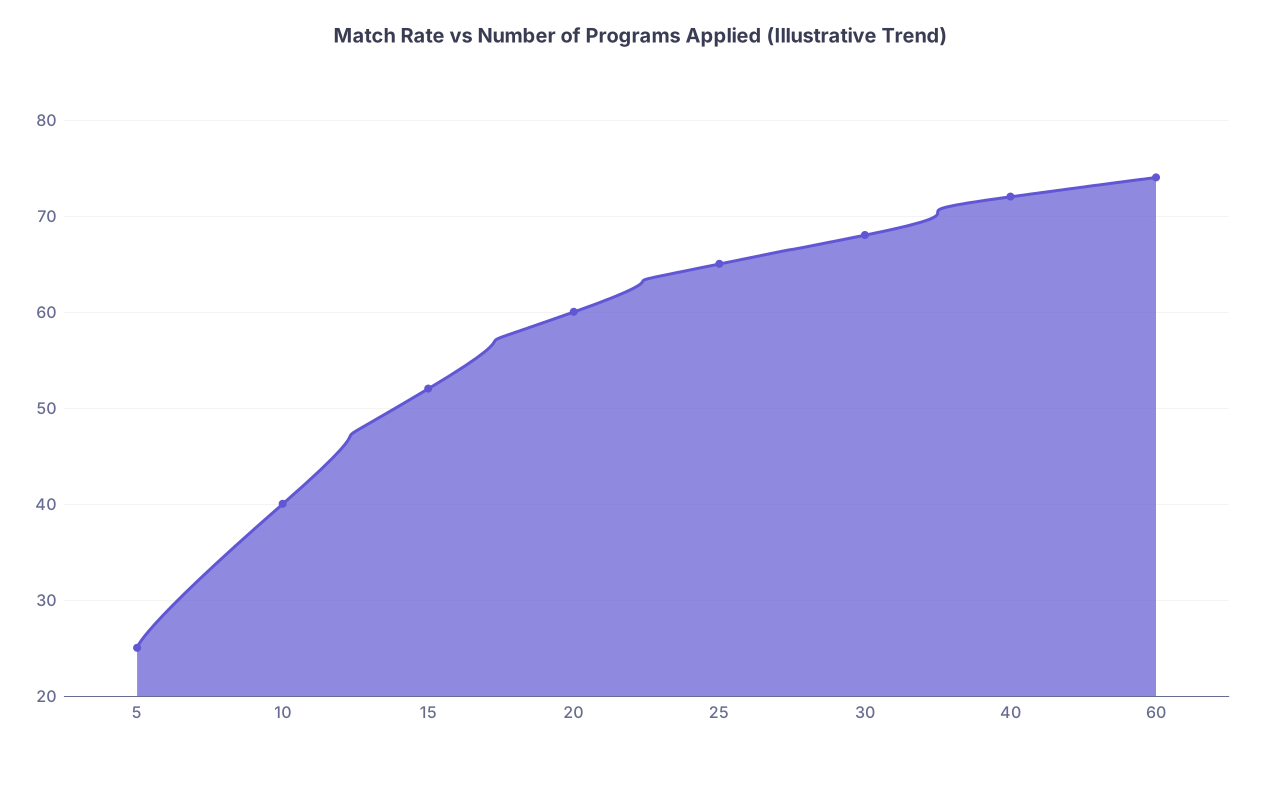
How Many Programs to Apply to for a Prelim Medicine Year?
The question of how many programs to apply to is central to any program selection strategy. There is no single number for everyone, but you can apply a risk-based framework.
Step 1: Understand your competitiveness as a prelim IM applicant
Your required application breadth for prelim IM depends on:
- USMD, DO, or IMG status
- USMLE/COMLEX scores and attempts
- Strength of clinical evaluations and letters
- Red flags (gaps in training, professionalism issues, prior unmatched cycle)
As a general trend:
US MD/DO applicants with solid scores and no major red flags
- Can be more targeted in prelim IM applications, especially if they are also highly competitive for their advanced specialty.
IMGs or applicants with weaker metrics
- Should apply more broadly to mitigate risk, particularly if prelim IM is the critical link to an advanced spot.
Step 2: Consider your advanced specialty competitiveness
Your advanced specialty often dictates risk tolerance:
More competitive specialties (e.g., dermatology, radiology, anesthesiology in some cycles, ophthalmology, radiation oncology)
- Many applicants applying here are broadly strong; prelim IM spots may also be competitive, especially at high-tier academic centers linked to those specialties.
Moderately competitive specialties (e.g., neurology, PM&R in some settings)
- Prelim IM is still essential, but you may have a bit more flexibility, especially if also considering TY programs.
If you are uncertain about your advanced match, it is risky to be overly narrow in prelim IM applications. The aim is to maintain enough breadth so that you are not left without a PGY-1 position.
Step 3: Practical numerical ranges (general guidance)
These ranges are not rigid rules but can serve as starting points. Adapt them to your circumstances, geography, and advisor input.
For prelim IM only (assuming you already have a secured advanced spot, e.g., early match Ophtho/Uro):
- Strong US MD/DO, no major red flags:
- 10–20 prelim IM programs, focused by geography and program quality.
- US MD/DO with some concerns, or IMG with strong profile:
- 20–30 prelim IM programs.
- Independent/IMG with significant red flags:
- 30+ prelim IM programs across multiple regions.
For applicants applying simultaneously to advanced + prelim IM via NRMP:
- Strong US MD/DO applying in competitive specialties:
- 12–20 advanced programs and 15–25 prelim IM programs (plus possibly some TYs).
- Moderate applicants or IMGs:
- 20–40 advanced programs, depending on specialty, and 25–40 prelim IM programs or combined prelim/TY pool.
Remember that it’s not just about how many programs to apply to—it’s about strategic distribution:
- A core group of realistic but desirable programs
- A safety group of solid, less competitive programs in acceptable locations
- A stretch group of highly desirable/competitive programs
Step 4: Use your Match data and advising resources
Your medical school’s residency advising office and specialty-specific mentors will have data on:
- Historical match outcomes for students similar to you
- Typical application numbers for prelim IM among your peers
- Programs that traditionally welcome students from your school
Use this data to refine your numbers. If everyone with your profile category from your school applied to ~25 prelim programs and matched well, you might not need 50; if prior cycles show more difficulty, consider broadening.

Building Your Personal Prelim IM Program List: A Step-by-Step Strategy
Now that you understand the main variables, here is a practical program selection strategy to go from “all available programs” to a personalized, targeted list.
Step 1: Define your filters
Start with non-negotiable constraints:
- Visa sponsorship (if applicable): filter for J-1/H-1B policies
- Geographic must-haves: family, partner, cost-of-living thresholds
- Program type: academic, community, or mixed
- Block structure or presence of specific rotations you prioritize (e.g., ICU emphasis vs. more outpatient)
Generate a preliminary spreadsheet with:
- Program name and NRMP code
- Location and program type
- Visa and licensing requirements
- Linked advanced positions (if applicable)
- Your initial “tier” (High, Medium, Safety)
Step 2: Gather program-specific intel
For each shortlisted program, gather information from:
- Program website and ACGME data
- FREIDA and NRMP reports
- Residents’ perspectives on forums, but use these cautiously and not as your sole data source
- Any alumni or upperclass students who recently matched there
Focus on high-yield questions:
- What is the typical workload?
- How are prelims treated compared with categoricals?
- What is the call schedule and ICU time?
- Are there any advanced specialties on-site that align with your interests?
Update your spreadsheet with notes for each program, including potential pros and cons.
Step 3: Sort into tiers and ensure balance
You should have three main tiers:
Tier 1 – Preferred / Reach
- Strong reputation or location
- Highly aligned with your goals
- May be more competitive
Tier 2 – Solid / Realistic
- Good training, reasonable culture
- Match well with your profile
- You would genuinely be comfortable training there
Tier 3 – Safety / Backup
- Less competitive or in less popular regions
- Still meet baseline standards for educational quality and support
- Serve mainly to protect against going unmatched
Check your total:
- Do you have enough Tier 2 and Tier 3 programs to feel secure given your risk profile?
- Are you overloading Tier 1 at the expense of realistic options?
Aim for a pyramid structure: plenty of realistic and safety options, with a smaller but meaningful set of reaches.
Step 4: Link your prelim strategy to your advanced strategy
If you’re applying for both prelim IM and advanced programs in the same cycle:
- Identify geographic concentrations where you are applying to both prelim and advanced programs (e.g., Midwest cluster, East Coast cluster).
- For each cluster, ensure you have:
- A mix of academic and community prelim options
- A range of competitiveness levels
- Enough slots that, statistically, at least one prelim and one advanced program in the region should be within reach
Pairing your lists geographically increases the chance you’ll train in the same general area for PGY-1 and PGY-2+, which can make transitions, licensing, housing, and family life much smoother.
Step 5: Reassess after interview invitations
As the season progresses:
- Track invitations for advanced programs and prelim IM separately.
- If you are getting relatively more advanced interviews but fewer prelims than expected:
- Add more prelim IM programs (if still early enough in the season)
- Consider applying to some transitional year programs as an additional safety net
If the opposite occurs (many prelims, few advanced):
- Still attend prelim interviews, but you may:
- Prioritize programs with possible pathways to stay for categorical IM (if the advanced match does not work out)
- Seek out prelim programs that value mentorship and reapplication support in your advanced field
Your program selection strategy should be dynamic, not fixed on the day you submit ERAS.
Common Pitfalls and How to Avoid Them
Even well-informed applicants can stumble in prelim IM planning. Here are frequent pitfalls and ways to avoid them.
Pitfall 1: Underestimating the rigor of prelim IM
Some applicants assume that because it’s “only one year,” the details don’t matter. Consequences:
- Burnout in excessively malignant environments
- Weak letters of recommendation
- Poor performance affecting Step 3 or in-service exams
Solution: Treat your prelim IM year with the same seriousness you give your advanced specialty—especially in choosing the environment where you will spend your most formative clinical year.
Pitfall 2: Applying to too few programs
This is especially risky if:
- You are an IMG or independent applicant
- Your scores are below average or you have exam attempts
- You are targeting very popular geographic areas exclusively
Solution: Use a realistic, data-informed estimate of how many programs to apply to, and err slightly on the side of applying more broadly to prelim IM than you might initially think—particularly if your advanced match is not guaranteed.
Pitfall 3: Ignoring program culture and support
Even programs with good reputations can be poor fits if the culture is toxic or unsupportive.
Solution:
- Ask residents about morale, leadership responsiveness, and backup systems.
- Pay attention to how program leadership treats residents during interview day.
- Look for explicit structures: mentorship, wellness programs, debriefing after adverse events.
Pitfall 4: Failing to coordinate prelim and advanced applications
Some applicants plan the two tracks separately and end up:
- Matched prelim and unmatched advanced, or vice versa
- Matched in geographically distant regions causing personal or logistical strain
Solution: Always consider your prelim IM and advanced specialty strategies together. Use the supplemental rank order list wisely to pair advanced and prelim programs when possible, and seek advisor guidance for complex ranking scenarios.
Frequently Asked Questions (FAQ)
1. Is it better to do a prelim medicine year at a big-name academic center or a smaller community program?
Neither is universally better. For a preliminary medicine year, the right choice depends on:
- Your advanced specialty’s needs (e.g., heavy ICU exposure vs. balanced workload)
- Your personal preferences for environment, supervision, and autonomy
- Your tolerance for intensity vs. desire for a more humane schedule
Many residents going into advanced specialties thrive in well-run community or community-affiliated programs that offer excellent clinical training and a more sustainable lifestyle. Prestige matters less for most advanced fields than the quality of your skills and recommendations.
2. How should I rank prelim IM programs relative to transitional year (TY) programs?
TY programs often provide more variety and lighter inpatient load, while prelim IM typically has more inpatient medicine and ICU time. If your advanced specialty heavily relies on strong inpatient medicine skills (e.g., neurology, anesthesiology, critical-care–oriented fields), a prelim IM may be more aligned. If your field is less inpatient-heavy (e.g., dermatology, radiation oncology in some contexts), a TY may be entirely adequate.
Rank based on:
- How each program’s curriculum supports your future specialty
- The culture and workload (burnout risk)
- Geographic and personal priorities
Many applicants rank a mix of prelim IM and TY programs to maximize options.
3. Can I switch from a prelim IM spot to a categorical IM spot at the same institution?
Occasionally, yes—but it should never be assumed. Some programs:
- Explicitly state that there is no automatic conversion pathway.
- Rarely open spots due to attrition or expansion, which may be offered to strong prelims.
If this flexibility is important to you:
- Ask directly (and diplomatically) during interviews about the history of prelim-to-categorical transitions.
- Understand that even if it happened before, it is not guaranteed for you.
4. Do prelim IM programs care as much about my Step 1/Step 2 scores as advanced programs do?
They care—just sometimes in a different way. For prelim IM:
- Programs often use Step/COMLEX scores for initial screening, especially in competitive or high-volume regions.
- Once past the screening threshold, your clinical performance, letters, and communication skills carry significant weight.
For most applicants, you should assume that strong scores help, but thoughtful applications, well-chosen programs, and strong clinical evaluations will ultimately shape your options more than a few points on a test.
By approaching prelim IM applications with a clear program selection strategy, you can align your preliminary medicine year with your advanced specialty goals, protect your well-being, and maximize your chances of a successful and satisfying Match outcome.