Understanding the Unique Nature of a Preliminary Surgery Year
For an MD graduate residency applicant, a preliminary surgery year is very different from applying directly to a categorical general surgery position. Before you can create an effective program selection strategy, you need to understand what a prelim surgery residency actually is—and what it isn’t.
What is a Preliminary Surgery Residency?
A prelim surgery residency is a one-year (PGY-1) position in general surgery that does not guarantee advancement to a PGY-2 surgery year. It is distinct from:
- Categorical general surgery: A full 5–7 year training track with the intention of training you to board eligibility in general surgery.
- Transitional year: A broad-based clinical year across multiple specialties, often considered more “cush” than surgical prelims.
Preliminary surgery positions exist in two main contexts:
Non-designated preliminary surgery (NDP)
- One-year contract only
- Commonly used by:
- Applicants planning to enter anesthesiology, radiology, PM&R, or other specialties that require a surgical prelim year
- Applicants who did not match into categorical surgery (or another specialty) and are improving their CV
- Continuation to PGY-2 surgery is typically not guaranteed, though some residents may later move into available categorical slots.
Designated preliminary surgery
- The prelim year is “designated” as part of an advanced training position (e.g., integrated into a vascular, urology, or other specialty match plan).
- Advancement to the linked specialty is usually defined by the primary (advanced) program.
When you plan your allopathic medical school match strategy as an MD graduate, you need to be clear whether you’re:
- Ultimately aiming for categorical general surgery, and using prelim surgery as a stepping stone, or
- Committed to another specialty (e.g., anesthesia, radiology) that requires or prefers a preliminary surgery year, or
- Needing a clinical year to strengthen your application or maintain US clinical practice.
Your long-term goal will shape which programs you select and how many you should apply to.
Clarifying Your Goals: Why Are You Pursuing a Preliminary Surgery Year?
Before you can answer how to choose residency programs or how many programs to apply for prelim surgery, you must define your main objective. Your program selection strategy should differ significantly depending on your category.
1. Categorical Surgery Is Your Ultimate Goal
You are an MD graduate who:
- Applied to categorical general surgery and didn’t match, or
- Is unsure of competitiveness and wants a backup, or
- Plans to reapply to categorical surgery after a prelim year.
Implications for program selection:
- Prioritize prelim programs where:
- Past prelims successfully transitioned into categorical surgery positions—either at that institution or elsewhere.
- Faculty are supportive of helping prelim residents with letters, research, and networking.
- You’ll get strong operative and clinical exposure to build a better application.
2. Another Specialty Is Your Endpoint, Using Prelim Surgery as a Required/Preferred Year
For example, you are heading toward:
- Anesthesiology
- Radiology (diagnostic or interventional)
- Radiation oncology
- PM&R
- Certain subspecialty fellowships that value surgical exposure
Implications for program selection:
- Balance clinical rigor with manageable workload so you can:
- Prepare for and apply to your advanced specialty
- Attend interviews (if they will occur during your prelim year)
- Maintain wellness and avoid burnout
- Prioritize programs with:
- Reasonable prelim expectations
- Good reputation and strong letters but not necessarily the most malignant or high-volume environment
3. You Need a Clinical Year for Other Reasons
Examples:
- Strengthen your profile after academic difficulty, a leave of absence, or prior non-match
- Maintain clinical engagement while pursuing research
- International or nontraditional background requiring robust US clinical performance
Implications for program selection:
- Look for programs:
- Open to nontraditional paths
- Known to provide mentorship for reapplication
- Offering strong evaluations and letters to support future applications
Being honest about which of these scenarios matches you will directly inform both the type of prelim surgery residency you target and your risk tolerance in program selection.

Building Your Program List: Core Selection Criteria
Once you know your goals, you can systematically build your list of preliminary surgery year programs. This section focuses on how to choose residency programs thoughtfully, rather than just applying everywhere.
1. Program Type and Structure
Key questions:
- Is the position non-designated or designated preliminary?
- How many prelim vs categorical residents does the program have each year?
- Is there a history of prelims moving into categorical positions?
If your goal is categorical surgery:
- Prefer programs where:
- Prelims routinely fill into “rising” categorical spots (e.g., when a categorical leaves).
- The program leadership openly discusses pathways for prelims.
If your goal is another specialty:
- Confirm that:
- The workload allows you time to prepare for your advanced specialty applications.
- The program’s reputation and letters are respected in that specialty (e.g., anesthesia PDs value the program).
2. Clinical Intensity, Case Volume, and Autonomy
For a prelim surgery residency, intensity varies widely:
High-intensity, high-volume academic centers
- Many complex cases, trauma, subspecialties
- Typically heavier work hours
- Excellent for operative exposure and strong letters
- May be demanding, with limited flexibility
Community-based or smaller academic-affiliated programs
- May have more hands-on operative experience earlier
- Variable research exposure
- Sometimes more collegial, with a bit more flexibility
Ask about:
- Average weekly hours (realistic, not just what’s on paper)
- Call structure (in-house vs home call)
- Typical operative cases for prelims
- Whether prelims get OR time or mainly floor/ICU coverage
Your program selection strategy should match your capacity for intensity:
- If you need to rebuild your application for categorical surgery, you may accept a more grueling but high-opportunity environment.
- If your main goal is a required prelim year before another specialty, a balanced environment is often better than the most demanding one.
3. Educational Culture and Support for Prelims
Not all programs invest equally in their prelim residents. Key indicators to assess:
- Do prelims attend the same didactics, conferences, and skills labs as categorical residents?
- Are prelims assigned academic mentors?
- Does the program director meet with prelims to discuss their future plans?
Request data (when possible):
- What have prelim graduates done in the last 3–5 years?
- How many successfully matched into:
- Categorical general surgery
- Other competitive specialties (anesthesia, radiology, etc.)
- Fellowships or research positions?
Programs that can clearly articulate prelim outcomes are usually more invested in your success.
4. Geographic Factors and Personal Considerations
Your MD graduate residency experience will be profoundly shaped by location:
- Family/support system nearby
- Cost of living (especially if salary is modest)
- Commuting time and call-room facilities
- Ability to travel for interviews (if applicable to your specialty timeline)
Geography also affects future networking:
- Training in the region where you ultimately want to practice can help you build connections and get regional letters.
5. Institutional Reputation and Fit for Your Future Goals
For those ultimately seeking:
Categorical surgery:
- Programs recognized for solid surgical training and good fellowship placements can help your reapplication.
- Strong trauma/acute care, robust case logs, and good board pass rates are positive signs.
Other specialties:
- Anesthesia PDs, radiology PDs, etc., often know which surgery departments train reliable, hard-working residents.
- Ask residents in your intended specialty which prelim programs they respect.
Remember: While name recognition matters, quality of mentorship and letters often matters more than pure brand.
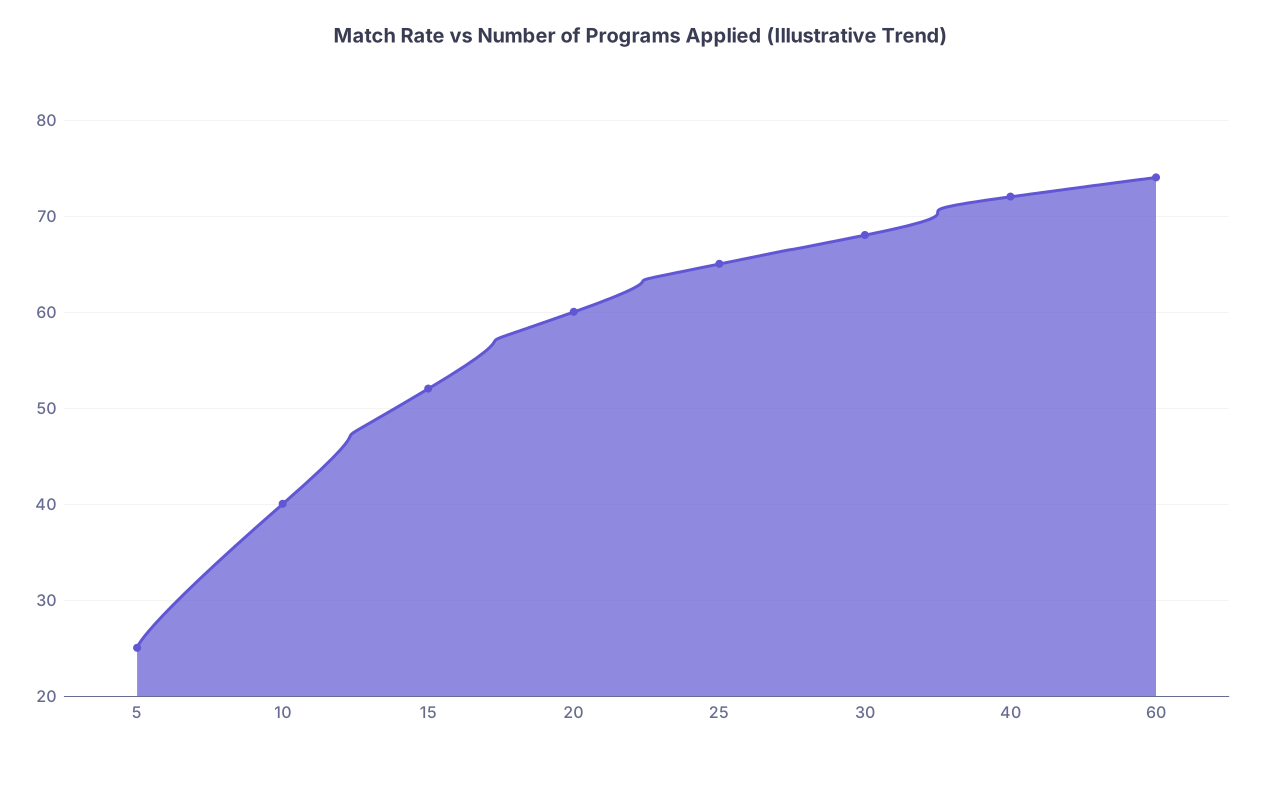
How Many Preliminary Surgery Programs Should MD Graduates Apply To?
The question of how many programs to apply is central to any program selection strategy. For MD graduates from an allopathic medical school, the numbers for a preliminary surgery year are different from categorical surgery.
Key Factors That Influence Application Volume
Your Overall Competitiveness
- US MD with strong scores, solid clerkship evaluations, and no major red flags:
- Can be more selective and apply to fewer programs.
- MD with:
- Marginal scores
- Limited surgical exposure
- Academic gaps or previous non-match
- May need to be more aggressive with application numbers.
- US MD with strong scores, solid clerkship evaluations, and no major red flags:
Your Primary Goal
- Prelim as backup to a primary categorical (e.g., anesthesia, radiology, or categorical surgery)
- Prelim as only current plan to stay in training or rebuild your application
Type of Programs You Target
- If you only aim at highly competitive academic centers, you may need more applications.
- If you include a mix of academic, community, and safety programs, you may need fewer.
General Numeric Ranges (Not Absolute Rules)
These are approximate ranges often used as a baseline for allopathic medical school match applicants pursuing prelim surgery. They must be individualized:
Highly competitive US MD (strong scores, strong rotation evaluations, good letters)
- Prelim as backup to another match plan:
- 8–15 prelim surgery programs
- If prelim is the main goal:
- 15–20 programs
- Prelim as backup to another match plan:
Average US MD applicant (some minor limitations but overall solid)
- Prelim as backup:
- 10–20 prelim programs
- Prelim as primary plan:
- 20–30 programs
- Prelim as backup:
At-risk applicant (academic issues, previous non-match, limited US experience)
- Prelim as main plan:
- 25–40 programs, sometimes more depending on risk tolerance
- Prelim as main plan:
These ranges are not rigid rules. They are a starting point to help answer how many programs to apply while considering cost and feasibility.
Balancing Breadth vs Focus
Applying broadly increases your chance of securing a position, but:
- ERAS costs escalate quickly
- You’ll receive more interview offers than you can meaningfully evaluate or attend
- Excessive breadth without strategy can dilute your time and energy
Instead, use a tiered approach:
Tier 1 (Reach): 20–25% of your list
- Highly competitive academic or “top-name” institutions
- Excellent if you match, but not your only plan
Tier 2 (Target): 40–50% of your list
- Academic/community hybrid programs where your profile is well aligned
- Moderate competitiveness, reasonable chance of interview and match
Tier 3 (Safety): 25–40% of your list
- Community programs, newer residencies, or less geographically desirable locations
- Programs where your stats and experiences are well above the average applicant
This tiered strategy allows you to be realistic while still aiming high.

Practical Steps to Build and Refine Your Prelim Surgery Program List
Now that you understand how to choose residency programs conceptually and how many programs to apply in general, here’s a step-by-step method to create your personal list.
Step 1: Define Your Constraints and Preferences
Write down:
- Regions you strongly prefer or must avoid (family, visas, spouse/partner considerations)
- Program types you prefer (academic vs community vs hybrid)
- Intensity level you can realistically tolerate
- Whether your priority is:
- Maximal operative exposure/brand name (for categorical reapplication)
- Balanced workload (for future specialty readiness and wellness)
This prevents you from impulsively adding programs that don’t fit your life or goals.
Step 2: Use Databases and Official Program Information
Leverage:
- ACGME program listings
- FREIDA and individual program websites
- NRMP/ERAS data (e.g., number of prelim vs categorical positions)
For each program, track:
- Number of prelim spots
- Prelim structure (non-designated vs designated)
- Presence of high-volume services (trauma, vascular, colorectal, transplant, etc.)
- Stated philosophy toward prelims (some explicitly say they aim to support prelim-to-categorical moves; others do not)
Create a spreadsheet with:
- Program name & location
- Type (academic, community, hybrid)
- Prelim positions offered
- Institution reputation (subjective but useful)
- Notes on support/mentorship and prelim outcomes
- Personal “tier” rating (Reach/Target/Safety)
Step 3: Seek Insider Perspectives
Whenever possible, talk with:
- Your home institution’s general surgery faculty and PDs
- Current or former residents in:
- The programs you’re considering
- Your intended ultimate specialty (anesthesia, radiology, etc.)
Ask specifically:
- “How are prelim surgery residents treated in this program?”
- “Do prelims get solid OR exposure or mainly off-service coverage?”
- “Do prelims who work hard typically get strong letters and support?”
These qualitative insights can be more valuable than any website.
Step 4: Right-Size Your List
Using the general ranges above and your competitiveness:
- Set a target number of programs (e.g., 22 total).
- Allocate by tier (e.g., 5 reach / 12 target / 5 safety).
- Double-check that:
- You have enough geographic diversity so local market shocks won’t derail your match.
- You’re not overly dependent on a single region or type of program.
Step 5: Adjust in Response to Feedback and Interview Invitations
As the season progresses:
If you’re getting few invitations, consider:
- Expanding to more safety programs or less-desired locations
- Asking mentors to make calls or send emails on your behalf
If you’re overwhelmed with invitations:
- Prioritize interviews based on your tiered list
- Politely decline those clearly not aligned with your goals or geography
Your program selection strategy is dynamic, not fixed; it should evolve with real-time feedback.
Making the Most of a Preliminary Surgery Year
Your ultimate success doesn’t end with matching; it depends on how you use your prelim year.
Strategies if You Want Categorical Surgery
Identify mentors early:
- Senior residents and faculty who value teaching and advocacy
- Be explicit about your goal to reapply in categorical surgery.
Excel clinically:
- Be the intern people want on their team—reliable, prepared, communicative.
- Your reputation spreads quickly; strong informal feedback supports strong letters.
Seek meaningful OR and ICU experiences:
- Ask to scrub cases whenever possible.
- Take ownership of pre-op/post-op care so attendings can see the full scope of your work.
Build a focused scholarly product:
- Case report, QI project, or retrospective study is often enough
- Aim for at least 1–2 tangible items to put on your CV.
Strategies if Your Final Destination Is Another Specialty
Communicate with both:
- Your prelim surgery leadership, and
- Your target specialty mentors (e.g., anesthesia PDs).
Protect time for:
- Studying for specialty boards (if relevant)
- Preparing applications and personal statements
- Attending interviews if they occur during your prelim year
Request letters from:
- At least one respected surgeon-attending who can attest to your work ethic and clinical reasoning
- A leader or mentor from your target specialty
In all scenarios, remember that a preliminary surgery residency is a professional audition: how you conduct yourself in this year can open or close many doors.
FAQs: Program Selection Strategy for MD Graduates in Preliminary Surgery
1. As a US MD graduate, is a preliminary surgery year risky for my long-term career?
A preliminary surgery year is a tool, not inherently a risk. It becomes risky if:
- You start it without a clear goal (categorical surgery vs another specialty).
- You enter a program that doesn’t support prelim residents or offer opportunities for advancement.
If you approach it strategically—choosing programs with good mentorship and outcomes and excelling once you arrive—it can significantly strengthen your application and professional network.
2. Should I prioritize big-name academic centers or community programs?
It depends on your aim:
- For categorical surgery reapplication, big academic centers can provide brand-name letters and exposure but may be very demanding, and prelims may have limited OR time.
- Some community or hybrid programs offer more hands-on cases, closer faculty relationships, and strong letters for motivated interns.
Mix both on your list. Evaluate each program’s track record with prelim residents more than just its name.
3. If I match into a prelim surgery residency, how do I transition into a categorical spot later?
Common pathways include:
- Applying in the next NRMP cycle for categorical surgery, using:
- Strong letters from your prelim faculty
- Improved clinical and operative experiences
- Transitioning into vacant categorical positions at your own institution if available:
- This often requires outstanding performance and clear departmental support.
- Applying to off-cycle or “R” positions at other institutions when they arise.
Your success will depend on your performance, networking, and mentorship during your prelim year.
4. Is it necessary to apply to both categorical and preliminary surgery programs in the same cycle?
If you’re interested in a surgery career but unsure of your competitiveness, many MD graduates apply to both categorical and prelim surgery programs:
- Categorical applications represent your main goal.
- Prelim applications act as an insurance policy—you stay in training, build your CV, and can reapply later if you don’t match categorically.
Discuss this strategy with mentors and your dean’s office to determine what balance (and how many programs to apply in each category) makes sense for your profile.
By carefully aligning your aims with a deliberate program selection strategy, choosing the right mix of programs, and planning thoughtfully for how you will use your preliminary surgery year, you can turn this one-year position into a powerful stepping-stone toward your long-term career goals.