Understanding the Role of a Preliminary Surgery Year
A preliminary surgery year is a one-year, non-categorical position in general surgery. Unlike categorical positions, it does not guarantee continuation in the same program or specialty beyond PGY-1. Yet for many applicants, a prelim surgery residency can be a powerful stepping stone.
Common reasons applicants pursue a preliminary surgery year include:
- Reapplying to categorical general surgery after an unmatched cycle
- Transitioning into another competitive specialty (e.g., radiology, anesthesiology, urology)
- Strengthening the overall application (USMLE performance, clinical evaluations, letters of recommendation)
- Meeting visa or licensure requirements while planning next steps
- Gaining operative and acute care exposure for future fields (e.g., EM, critical care)
Because your prelim year is only 12 months, program selection strategy matters even more than for categorical applicants. You have less time to build relationships, prove yourself, and position your application for the next move.
When crafting your program selection strategy, keep three core questions in mind:
- What do I want to achieve by the end of this year?
- Which types of programs are best positioned to help me achieve those goals?
- Given my profile, how many programs to apply to and at what competitiveness level is realistic?
Answering these clearly before ERAS opens will shape every decision you make, from initial program list to rank order list.
Clarify Your Goals Before You Build a Program List
Before worrying about how to choose residency programs, you need a specific, honest goal for your preliminary surgery year. This will drive your program selection strategy more than anything else.
Step 1: Define Your Primary Objective
Most applicants fall into one of these categories:
Pathway A: Transition to Categorical General Surgery
- You ultimately want a categorical general surgery spot—either at the same institution or elsewhere.
- Your prelim year should emphasize surgical training quality, operative exposure, and advocacy from faculty.
Pathway B: Pivot to Another Specialty
- You plan to reapply to or enter another specialty (e.g., radiology, anesthesiology, EM, PM&R).
- Your prelim year is a vehicle to show clinical excellence, reliability, and professionalism in a demanding setting while you network and reapply.
Pathway C: Strengthen Overall Application / Career Direction Unclear
- You’re unsure whether you’ll pursue surgery long term or another specialty.
- You need strong evaluations, US clinical experience, and time to explore options.
Your primary objective should be written in one sentence. For example:
“Use my preliminary surgery year to secure a categorical general surgery position by obtaining strong operative evaluations and letters from academic surgeons.”
or
“Use my preliminary surgery year to become a more competitive anesthesiology applicant by demonstrating excellent perioperative care, reliability, and teamwork.”
Step 2: Translate Your Objective into Program Features
Once you have a clear objective, turn it into a checklist of program characteristics that matter most for you.
For example:
If you want to convert to categorical general surgery:
- Programs with a history of converting prelims to categorical spots
- Strong mentorship and clear feedback
- High operative volume and meaningful intern-level participation
- Exposure to division chiefs and program leadership who write influential letters
If you intend to switch specialties:
- Institutions with multiple residency programs (anesthesia, radiology, EM, etc.)
- Faculty known to be supportive of career changes
- Reasonable workload that still allows time to work on applications, research, and interviews
If your main goal is US experience or letter-building:
- Programs that provide consistent clinical responsibility (not purely “service work” with little teaching)
- Attending staff who work closely enough with interns to write detailed letters
- Supportive culture rather than malignant environment
Write out 5–7 “must-have” or “strongly prefer” characteristics. These become your lens when evaluating each program.

Key Factors in Choosing Preliminary Surgery Programs
Once your goals are clear, you can evaluate programs more systematically. Below are the major factors that should shape your program selection strategy in preliminary surgery.
1. Academic vs Community vs Hybrid Programs
Each setting offers distinct advantages and trade-offs.
Academic Medical Centers
Pros:
- Broad exposure to complex pathology and subspecialty services
- Research infrastructure (if you have time/interest)
- Strong name recognition and powerful letters from academic surgeons
- More likely to host many other specialties (helpful if you plan to pivot)
Cons:
- Workload can be very high
- Competition among residents/fellows may limit operative independence
- Some academic centers treat prelims as primarily service positions
Best suited for:
- Applicants aiming for categorical surgery at academic centers
- Those targeting competitive fellowships or other academic specialties
Community Programs
Pros:
- Often greater operative autonomy at intern level
- Closer relationships with faculty; easier to stand out
- Potentially less bureaucratic, more flexible support for career shifts
Cons:
- Less subspecialty depth
- Less prestige/recognition for letters at some institutions
- Fewer residency programs on-site (if you’re pivoting specialties)
Best suited for:
- Applicants who need hands-on experience and strong clinical letters
- Those comfortable with less “brand-name” but potentially stronger mentorship
Hybrid Programs
Hybrid programs combine an academic affiliation with community rotations.
Pros:
- Mix of high-acuity tertiary care and community experience
- Broader faculty network for letters and advocacy
- Often more balanced workload and teaching culture
Cons:
- Experience can be highly variable between sites
- Prelim roles may differ dramatically by rotation
Best suited for:
- Applicants looking for a middle ground between prestige and autonomy
- Those intending to keep multiple options open
2. History of Supporting Preliminary Residents
When evaluating a prelim surgery residency, investigate:
- Conversion Rate: How many prelims have matched into categorical surgery (at that institution or elsewhere) in recent years?
- Transparent Pathways: Do they clearly outline how a preliminary resident can be considered for an in-house categorical position if a spot opens?
- Career Support: Do faculty meet with prelims to discuss future plans, write strong letters, and advocate during the Match or SOAP?
Red flags:
- Programs that consistently take many prelims but almost never convert them
- No clear data or unwillingness to discuss outcomes for prior prelim interns
- Reputation (from residents or forums) that prelims are “disposable labor”
3. Operative and Clinical Experience
Your letters and evaluations will be built on what you actually do.
Key questions to ask or research:
- What is a typical intern operative log for a prelim?
- Are prelim interns assigned to the OR regularly, or mainly to floor/ICU “coverage” roles?
- How many night float or non-operative rotations will you have?
- Do prelims get similar responsibilities to categorical interns?
For someone aiming for categorical surgery, having enough chances to scrub cases, present in M&M, and manage postoperative patients is crucial. If you’re pivoting specialties, operative numbers may be less important than the quality of your clinical evaluations and interactions with staff across services.
4. Workload, Culture, and Support
A single intense year can be transformative—or demoralizing. With only 12 months, burnout can derail your main objective.
Consider:
- Resident-reported culture: Are seniors and attendings approachable? Are prelims integrated into the resident family?
- Schedule and duty hours: Chronic violations may make it impossible to study or apply to other programs effectively.
- Support services: Access to counseling, mentorship, academic coaching.
When you talk to current residents, ask specifically:
- “How are prelims treated here compared to categoricals?”
- “Are prelims included in teaching conferences, retreats, wellness activities?”
- “Do prelims have attendings who know them well enough to write strong letters?”
5. Geographic and Personal Factors
While you should not choose solely on geography, it remains important:
- Proximity to family or support systems
- Cost of living and housing
- Visa considerations (for IMGs)
- Future specialty hubs (e.g., if you want to match anesthesiology, being near programs you’ll apply to may help for networking or away rotations)
Use geography as a secondary filter—after you’ve identified programs that fit your goals.
How Many Programs to Apply to in Preliminary Surgery
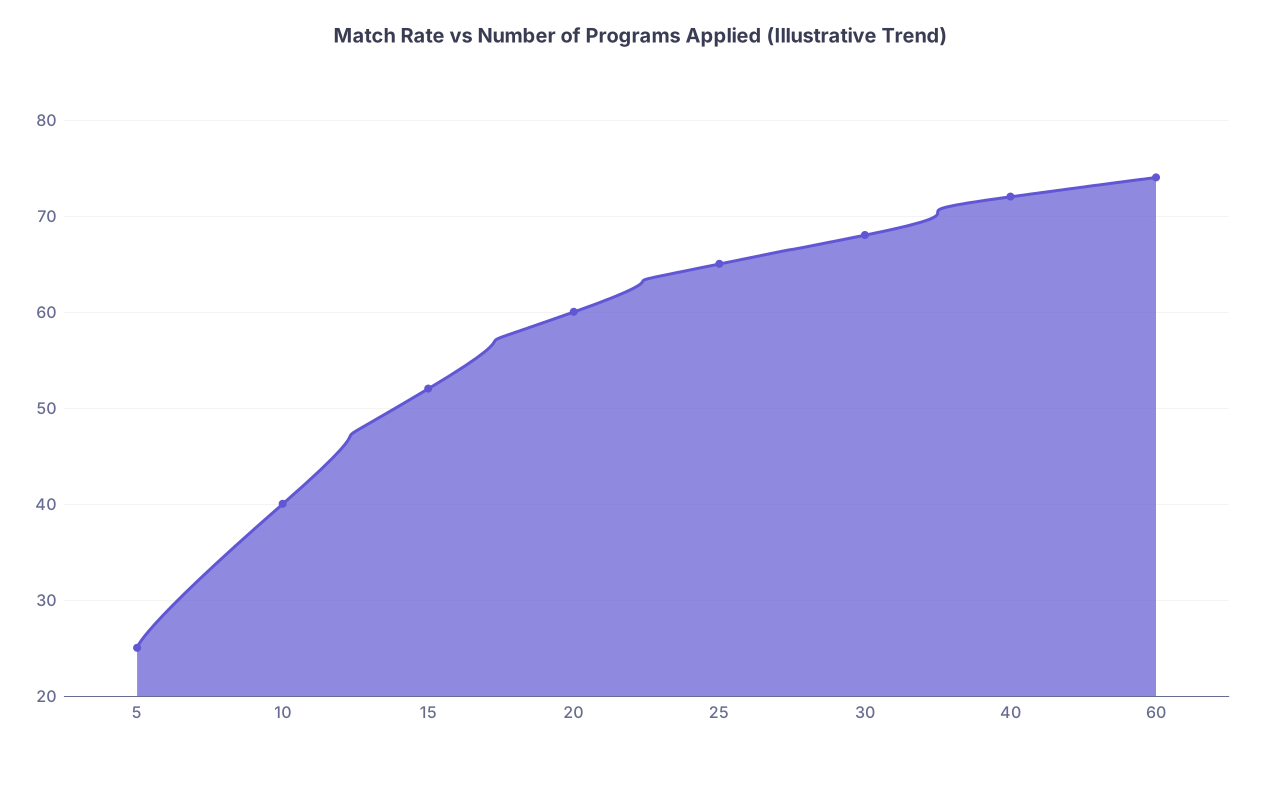
“How many programs should you apply to?” is one of the most common and anxiety-provoking questions. There is no universal number, but you can use a rational framework based on your competitiveness and risk tolerance.
Step 1: Honestly Assess Your Competitiveness
Consider:
- USMLE/COMLEX scores
- Number of attempts or failures
- Medical school reputation and performance (e.g., AOA, class rank)
- Clinical experience in the US (for IMGs)
- Red flags (gaps, professionalism concerns)
You could loosely think in three bands:
Relatively Strong Applicants
- Solid scores (>230 Step 2 CK for many contexts; adjust based on year and norms)
- No major red flags
- U.S. MD/DO or well-known IMG background
- Good letters and some research
Moderate-Risk Applicants
- Mid-range scores, perhaps one exam difficulty
- Limited US experience or weaker institutional reputation
- Some gaps or contextual issues but explained
High-Risk Applicants
- Multiple attempts or low scores
- Older graduation year with limited recent clinical work
- Prior unmatched cycles without significant improvement
- Significant application red flags
Step 2: Establish a Target Range
For preliminary surgery specifically, the application numbers can be somewhat lower than for categorical positions—but only if your goal is realistic and your application is solid. As of recent cycles (and recognizing trends can change), a rough guideline:
Relatively Strong applicants
- Target: ~25–40 prelim surgery programs
- Rationale: Many will prefer categorical, but a strong file can secure a prelim spot with fewer applications.
Moderate-risk applicants
- Target: ~40–60 prelim surgery programs
- Rationale: Increased volume compensates for variability in interview offers.
High-risk applicants / IMGs with significant barriers
- Target: ~60–80+ prelim surgery programs
- Rationale: Broader reach is necessary; combine academic, community, and hybrid programs, including less sought-after locations.
These ranges assume you are applying primarily for prelim surgery. If you are dual-applying (e.g., categorical general surgery + prelim, or another specialty + prelim), your total applications may be higher, but you should still maintain a thoughtful distribution.
Step 3: Balance Reach, Match, and Safety Programs
As you decide how to choose residency programs within your application list, stratify them:
Reach programs (10–20%)
- Highly academic, competitive locations, or places with limited prelim spots but strong reputations.
Core/likely programs (50–70%)
- Programs whose profiles align with your metrics and background. These should be your main focus.
Safety programs (20–30%)
- Less competitive locations or programs with a historical emphasis on service. These may not be ideal, but they significantly reduce the risk of going unmatched for the year.
A realistic program selection strategy ensures that you are not applying only to dream programs or only to extremely service-heavy ones. Aim for a healthy mix.

Building a Strategic Program List: Step-by-Step
To move from theory to action, here’s a practical, stepwise approach to building your preliminary surgery application list.
Step 1: Start Wide, Then Filter
Begin with all ACGME-accredited general surgery programs that offer preliminary positions. Use:
- FREIDA
- ACGME public program search
- Program websites (some list separate prelim tracks and numbers)
Then filter based on:
- Visa policies (if applicable)
- Geographic no-go zones (places you absolutely cannot live)
- Minimum score requirements (if stated and you do not meet them)
This first pass will give you a “potential universe” of programs.
Step 2: Categorize by Program Type and Competitiveness
From your universe list, label programs:
- Academic / Community / Hybrid
- Perceived competitiveness (high / moderate / lower), based on:
- Reputation and size
- Location desirability
- Applicant chatter (forums, residents, advisors)
Aim to have representation in each category.
Step 3: Research Programs in More Depth
For each program seriously under consideration, identify:
- Number of prelim positions per year
- Total general surgery residents (size of program)
- Explicit statements about:
- Role of preliminary residents
- Past rates of categorical conversion
- Expectations for operative logs
- Faculty and institutional support for research or other specialties
Practical tip: Create a spreadsheet with columns such as:
- Program name, city, state
- Academic/community/hybrid
- History of converting prelims? (Yes/No/Unknown)
- Culture rating (from interviews/contacts)
- Pros/Cons
- Personal notes (e.g., “good for anesth pivot,” “strong ICU experience”)
Step 4: Align with Your Goal Pathway
Revisit the three goal pathways:
For categorical surgery aspiration:
- Prioritize programs with a track record of helping prelims secure categorical positions.
- Favor those where prelims share similar rotations and expectations as categoricals.
- Consider programs with active surgical research if you intend to apply to competitive categorical spots later.
For switching specialties:
- Favor institutions housing the specialty you will target (e.g., anesthesiology residency if you’re planning to apply anesthesia).
- Ensure there is at least some flexibility in schedule or support for interviews later in the year.
- Identify potential mentors in the target specialty early.
For general improvement and exploration:
- Seek programs with strong teaching, structured feedback, and protected didactics.
- Prioritize culture and wellness; high-quality feedback and survivable workload will matter more than prestige.
Step 5: Reality Check with Mentors and Residents
Share your preliminary list with:
- A trusted faculty advisor (ideally in surgery or your future specialty)
- A recent graduate who has gone through a prelim surgery residency
- Any residents you know at programs on your list
Ask for blunt feedback:
- “Given my profile, am I over- or under-reaching?”
- “Are there programs here known to treat prelims poorly?”
- “Which of these would you prioritize or drop if you were in my position?”
Use this input to adjust your list and confirm that your program selection strategy is realistic.
Maximizing the Value of Your Prelim Year After Selection
Program selection is only half of the equation. Once you match into a preliminary surgery year, how you use it will determine whether you move successfully toward your next step.
1. Set Expectations and Communicate Early
Within the first 1–2 months:
- Meet with your program director or associate PD.
- Clearly but professionally state your goals (e.g., “I hope to transition into a categorical general surgery position; I would appreciate any feedback on what I need to achieve”).
- Ask about:
- How to be considered for internal categorical spots
- Whom to work with for strong letters
- Institutional processes for external applications
For those switching specialties, discreetly connect with program leadership in your target specialty as the year progresses, respecting professionalism and team needs.
2. Choose Opportunities Strategically
You won’t have time for everything, so prioritize:
- High-impact attendings: Those known for teaching and writing strong letters
- Rotations that showcase your strengths: ICU, trauma, acute care, or services where interns have major responsibility
- Projects that can be completed within the year (e.g., case reports, quality improvement, clinical reviews)
Focus on depth and follow-through rather than scattering yourself across many incomplete projects.
3. Protect Time for Applications and Exams
If you will be reapplying (categorical or other specialty):
- Plan your months: identify lighter rotations where you can work on personal statements, ERAS, and interview prep.
- For exams (e.g., Step 3), coordinate with your chief residents and PD to schedule during less-intense blocks, if possible.
- Use your days off and limited free time efficiently; prelim years can be demanding, so structured planning is essential.
4. Consistently Demonstrate Reliability and Professionalism
Across all goals, your reputation is your currency:
- Be dependable with sign-outs, notes, and follow-through.
- Avoid complaining or gossip; word spreads quickly among small surgical departments.
- Own your mistakes, learn from them, and show growth.
Evaluations and informal comments from staff often carry as much weight as official letters.
Frequently Asked Questions (FAQ)
1. Is a preliminary surgery year worth it if I ultimately don’t want to be a surgeon?
It can be, depending on your goals. Many non-surgical specialties value the rigorous clinical training, procedural exposure, and resilience developed in a prelim surgery year. Anesthesiology, radiology, EM, and critical care–oriented fields often view this background positively. However, it’s important to choose a program that won’t overwhelm you to the point where you can’t study or apply to your target specialty.
2. How do I know if a program truly supports prelims or just uses them for service?
Look for objective indicators: past prelim outcomes, explicit website statements, and resident testimonials. During interviews or email exchanges, ask directly:
- “How many prelims have transitioned into categorical roles in the last 3–5 years?”
- “Are prelims integrated into educational conferences and mentoring structures?”
If answers are vague or evasive, proceed cautiously.
3. Can I secure a categorical surgery position at the same institution after a prelim year?
Yes, but it is never guaranteed. Some programs regularly convert prelims when positions open due to attrition, while others almost never do. If this is your goal, prioritize programs that:
- Publicly state a pathway for prelim-to-categorical transition
- Have a recent track record of such conversions
- Involve prelims on the same services and didactics as categoricals
4. Should I apply to both categorical and prelim surgery programs in the same cycle?
Many applicants do. A common strategy is to apply broadly to categorical positions while also applying to a range of prelim programs as a safety net. If you do this, be transparent but strategic in your personal statements and interviews. Some programs value seeing your commitment to surgery overall, while others may prioritize applicants who list them as a primary choice. Tailor your narrative carefully and ensure your total number of applications remains manageable.
Designing an effective program selection strategy for a preliminary surgery year requires self-awareness, structured planning, and honest assessment of your strengths and risks. By clarifying your goals, understanding different program types, calculating how many programs to apply to based on your competitiveness, and actively managing your year once matched, you can transform a one-year prelim surgery residency into a powerful launchpad for the next phase of your medical career.