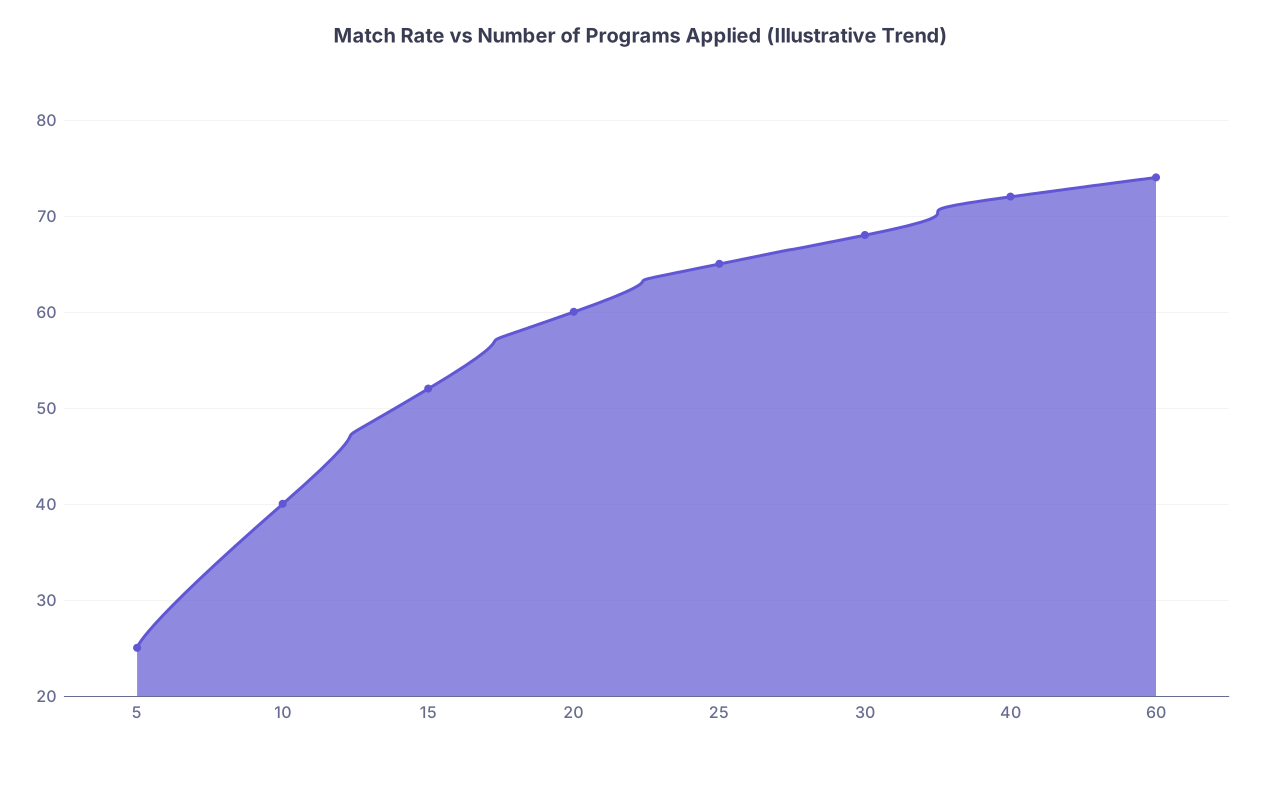
Residency program selection is one of the most important—and most misunderstood—parts of the FM match strategy for any American studying abroad. As a US citizen IMG, you face a unique mix of advantages and challenges: you’re a US national, but you trained outside the US system. That combination shapes how you should think about which family medicine residency programs to target, how many to include, and how to build a realistic but ambitious list.
This guide walks you through a practical, data‑driven program selection strategy specifically for US citizen IMGs interested in family medicine residency.
Understanding Your Position as a US Citizen IMG in Family Medicine
Family medicine is one of the most IMG‑friendly specialties, but that doesn’t mean you can apply randomly and hope for the best. To design a smart program selection strategy, you need to understand:
- Where US citizen IMGs tend to match
- What parts of your profile matter most
- How you compare to the typical FM applicant
How US Citizen IMGs Fit into the FM Match
Key points about family medicine as a specialty:
- Generally more IMG‑friendly than most specialties
- Many community and university‑affiliated community programs regularly interview and rank IMGs
- Geographic and institutional prestige is highly variable: from very academic departments to small community hospitals in underserved areas
As a US citizen IMG, you have some advantages compared with non‑US IMGs:
- No visa sponsorship needed (most of the time)
- Fewer administrative barriers for some institutions
- Often stronger cultural familiarity with US healthcare and communication norms
But you still face:
- Bias at some university and top‑tier academic programs that strongly prefer US MD/DO
- Extra scrutiny of your medical school and clinical experience
- Limited alumni presence in many programs’ historical match data
Family medicine is relatively forgiving about pedigree compared to specialties like dermatology or orthopedic surgery, but program selection still matters enormously.
Key Profiling Factors That Drive Your Strategy
Before you think about how many programs to apply to or how to choose residency programs, you must define your own competitiveness. The major factors for an FM match as a US citizen IMG include:
USMLE/COMLEX Scores and Attempts
- Step 1 (pass/fail): failures are a red flag, but can be overcome in FM with strengths elsewhere.
- Step 2 CK:
- Competitive for many FM programs: ~230+
- Reasonable/average: ~215–229
- At‑risk/lower: <215 or with failures on any step
- Multiple attempts or failures: need a broader, more IMG‑heavy list.
Year of Graduation (YOG)
- Recent graduates (0–3 years from graduation) are more competitive.
- 4–7 years out: still doable in FM, but some programs will automatically screen out.
7–10 years out: requires a very deliberate, mostly IMG‑heavy strategy.
Clinical Experience in the US
- Hands‑on US clinical experience in family medicine or primary care is highly valued.
- Strong US letters from FM or IM attendings are particularly important.
- No USCE: you’ll need to target more IMG‑heavy and community‑based programs.
Red Flags
- Exam failures, professionalism issues, failed clerkships, unexplained gaps.
- Not automatic deal‑breakers in family medicine, but they must be offset by strengths and a wider program list.
Geographic Flexibility
- Willingness to apply broadly (including rural, underserved, and colder or less popular regions) dramatically boosts odds.
- If you’re restricted to 1–2 states, you must over‑apply and choose programs very strategically.
How Many Programs Should You Apply To in Family Medicine?
There is no single magic number, but there are rational ranges based on your profile. As a US citizen IMG in family medicine, your goal is to apply to enough programs to generate 10–12+ interviews—this usually correlates with a strong chance of matching.
General Application Volume Guidelines for US Citizen IMGs in FM
These ranges assume you are not restricting yourself severely by geography and that your application is overall complete and on time.
1. Strong Profile (USMLE Step 2 CK ≥ 235, recent YOG, USCE, no red flags)
- Typical range: 30–50 FM programs
- Why?
- Family medicine is less hyper‑competitive; strong US citizen IMGs often reach 12–15+ interviews with 30–40 well‑chosen applications.
- Going well above 50 often yields diminishing returns if your targeting is good.
2. Average Profile (Step 2 CK ~215–234, 0–5 years since graduation, some USCE, maybe minor “soft” weaknesses)
- Typical range: 50–80 FM programs
- Why?
- To ensure adequate interview numbers, especially if you want to filter for decent training and some geographic preference.
- Enough volume to overcome some programs’ institutional bias against IMGs.
3. At‑Risk / Weaker Profile (Step 2 CK <215, exam failures, older YOG, limited USCE, or significant red flags)
- Typical range: 80–120+ FM programs
- Why?
- You’ll need to compensate for automatic filters at many institutions.
- Heavier focus on IMG‑friendly, community‑based, and smaller or less popular regions.
These are starting points, not rigid rules. A smarter question than “how many programs to apply” is:
“How many appropriate programs can I realistically identify and afford to apply to—while staying broad enough to get 10–12+ interviews?”
Cost vs. Benefit: Financial Reality for US Citizen IMGs
ERAS fees escalate with volume, and flights for interviews (even virtual era travel is less intense but still present for second looks) can add up. Consider:
- Application budget: Be honest about what you can spend. Sometimes 60 well‑chosen programs are better than 100 random ones.
- Return on investment: Don’t waste money on programs that:
- Explicitly do not accept IMGs
- Rarely or never interview US citizen IMGs
- Have strict step cutoffs you don’t meet
Building a Targeted Program List: A Step‑by‑Step Strategy
Once you have a rough target number of programs, you need a structured program selection strategy to decide which ones to include. This is where many US citizen IMGs either under‑reach (only “safe” programs) or over‑reach (too many “dream” programs).
Step 1: Define Your Constraints and Preferences
First, write down:
Absolute constraints
- Visa requirements (usually not an issue if you’re a US citizen, but note they may still ask your citizenship)
- Places you truly cannot live (because of family, legal issues, etc.)
Strong preferences (important but not absolute):
- Region or climate (Northeast vs Midwest vs South vs West)
- Urban vs suburban vs rural
- Proximity to family or support system
- Opposed vs unopposed FM program (whether other residencies share the hospital)
For most US citizen IMGs, being flexible on geography is one of the biggest advantages they can give themselves.
Step 2: Identify IMG‑Friendly Family Medicine Programs
You want to map out where US citizen IMGs actually match. Use:
- NRMP’s “Charting Outcomes” and “Program Director Survey” (for big‑picture trends).
- FREIDA (AMA residency database) to:
- Filter for family medicine
- Look at program size, location, and self‑reported IMG percentages (US IMG vs non‑US IMG when available)
- Program websites:
- Browse current residents’ bios and see how many are IMGs, particularly US citizens.
- Look for graduates of Caribbean, Mexican, Eastern European, or other international schools.
Your preliminary list should prioritize programs that clearly show:
- Multiple IMGs in training
- Match lists that repeatedly include US citizen IMGs
- A stated openness to international graduates
Step 3: Categorize Programs into Tiers Relative to You
Instead of thinking of programs as “top” or “low tier” in absolute terms, define tiers relative to your own competitiveness. For each program, consider:
- Their historical IMG presence
- Any stated score requirements or preferred characteristics
- How they describe themselves (community vs academic, IMG experience, etc.)
Create three categories:
Reach Programs
- More academic or competitive family medicine programs that:
- Take a few IMGs but heavily favor US MD/DO
- Have higher average scores or strict cutoffs you’re at or just below
- Example: University‑based FM program in a major city that has 1–2 IMGs per class, mostly high‑scoring.
- More academic or competitive family medicine programs that:
Target Programs
- FM programs where:
- They regularly train IMGs (including US citizens)
- Your scores and YOG are around or slightly below their typical range
- These should be the core of your list.
- FM programs where:
Safety Programs
- Programs that:
- Are very IMG‑friendly (lots of IMGs in current or recent classes)
- Are in less popular geographic regions or smaller communities
- Explicitly mention welcoming IMGs or have track records from schools similar to yours
- Programs that:
Your final list might roughly look like this:
Strong applicant (30–50 total):
- 5–10 reach
- 15–25 target
- 10–15 safety
Average applicant (50–80 total):
- 10–15 reach
- 20–35 target
- 20–30 safety
Weaker/at‑risk applicant (80–120 total):
- 10–20 reach
- 25–40 target
- 40–60 safety
The goal is not to avoid ambitious programs—but to anchor your list with enough realistic options.

Step 4: Check Minimum Requirements and Automatic Filters
Before finalizing any program on your list, verify:
- USMLE/COMLEX requirements:
- Minimum Step 1/2 scores or “first attempt only” policies
- Policies on multiple attempts or gaps
- IMG acceptance policy:
- Some programs clearly state “no IMGs”
- Others say “IMGs considered if they have US clinical experience”
- YOG cutoffs:
- Many programs prefer graduates within 3–5 years; some explicitly state a max YOG
As a US citizen IMG, don’t assume “US citizen = no IMG barrier.” If the website says “US medical school graduates only” or “no IMGs,” skip it; your money is better spent elsewhere.
Step 5: Balance Geography with Match Probability
A common mistake for American studying abroad is over‑concentrating 60–80% of their applications in one or two regions (often New York, Florida, or California). For family medicine:
Most competitive / saturated regions:
- Major metro areas in California, Florida, Texas, and New York
- Prestigious university‑based FM programs in large cities
Often more open to IMGs:
- Midwest (Ohio, Michigan, Indiana, Illinois, Missouri, etc.)
- Some Southern states (e.g., Alabama, Mississippi, Arkansas)
- Less urban or rural regions in the Northeast and West
Your strategy:
- If you have strong geographic preference, apply more heavily there—but offset with applications in more IMG‑friendly regions.
- If you’re flexible, deliberately spread applications:
- 30–50% to more competitive or preferred metro regions
- 50–70% to less saturated or more IMG‑friendly states
Evaluating Program Fit: What Really Matters for US Citizen IMGs in FM
Once you’ve identified a long list of eligible family medicine programs, refine it based on fit—both for your educational goals and your likelihood to match.
Educational and Clinical Factors
Prioritize these when deciding how to choose residency programs:
Breadth of Training
- Inpatient vs outpatient balance
- OB (obstetrics) volume and procedures if you’re interested in full‑scope FM
- Exposure to pediatrics, geriatrics, behavioral health, and chronic disease management
Community and Patient Population
- Underserved/Medicaid/immigrant communities can be excellent training environments.
- Consider language skills: if you speak Spanish, Arabic, etc., programs serving those communities may value you more.
Opposed vs Unopposed
- Unopposed: FM residents often get more hands‑on responsibility and broad procedural exposure.
- Opposed: Shared hospital with IM, surgery, EM, etc.; may provide more academic resources but sometimes less autonomy.
Board Pass Rates and Graduate Outcomes
- Look for FM board pass rates and where graduates practice or subspecialize.
- A good family medicine residency prepares you for independent practice anywhere in the US.
Program Culture and IMG Friendliness
For a US citizen IMG, culture can dramatically affect your training experience:
- Look for programs that:
- Feature international graduates prominently on their site.
- Mention support for transitioning to US healthcare.
- Highlight diversity, equity, and inclusion.
Red flags that a program may not be IMG‑supportive:
- No IMGs visible in resident bios over several years.
- Website messaging that heavily emphasizes “US MD/DO only” vibe.
- Rigid, unwelcoming language about “exceptions are rarely granted” for IMGs.
Personal Circumstances and Support Systems
Being American studying abroad often means you’re returning to the US without the same on‑the‑ground network as US MD students. Consider:
- Proximity to family or trusted friends who can support you psychologically and practically.
- Cost of living (your PGY‑1 salary goes further in the Midwest than in San Francisco).
- Presence of mentors or alumni from your medical school nearby.
Family medicine residency is demanding; being somewhere you have at least some support may make a big difference.

Practical Application Tactics for US Citizen IMGs
Program selection isn’t just about which programs you choose—it’s also about how you present yourself to them.
Tailoring Your Personal Statement and Experiences
If you’re aiming for family medicine:
- Emphasize:
- Longitudinal patient care
- Community engagement or public health work
- Experiences in primary care, outpatient clinics, or underserved populations
- For programs in rural or underserved areas:
- Highlight any rural rotations, volunteer work, or commitment to underserved communities.
For US citizen IMGs, linking your American background with your international training can be powerful:
- Show how studying abroad has made you adaptable, culturally competent, and resilient.
- Connect experiences from your international medical training to US healthcare needs (e.g., managing chronic disease with limited resources, cross‑cultural communication).
Signaling Genuine Interest
Some programs receive large numbers of IMG applications; they look for signals that you are truly interested:
- Geographic ties (grew up there, family nearby, prior work/study in the region).
- Rotation or observership at that institution or in that city.
- Specific mention in your personal statement (if you write a regional or program‑specific version for a small subset of your most desired programs).
Avoid generic, copy‑paste wording; even subtle personalization improves how you’re perceived.
Adjusting Strategy After Interview Invitations Start
Your program selection strategy doesn’t stop on ERAS opening day. As interview season unfolds:
- Track:
- Which types of programs invite you (IMG‑heavy vs academic, region, type).
- How many interviews you have by early–mid November.
If by mid‑November you have fewer than ~6–7 interviews:
- Consider:
- Applying to an additional batch of very IMG‑friendly or less popular FM programs if they still have positions listed.
- Reaching out politely to programs with a strong fit where you haven’t heard back, especially if you rotated there or have major geographic ties.
If you already have 10–12+ interviews:
- You are likely in a good position for the FM match.
- Focus your time and energy on preparing well for each interview and ranking programs thoughtfully rather than adding more applications.
Frequently Asked Questions
1. As a US citizen IMG, can I realistically match into family medicine in the US?
Yes. Family medicine is among the most welcoming specialties for IMGs, and US citizen IMGs do match successfully each year. Your odds depend on your:
- Exam performance (especially Step 2 CK)
- Recency of graduation
- US clinical experience and letters
- Program selection strategy and willingness to apply broadly
For most US citizen IMGs who apply strategically and obtain ~10–12+ FM interviews, the probability of matching is high.
2. How many family medicine programs should I apply to if I only want to stay in one state?
If you strictly limit yourself to one state—especially a competitive one—you must compensate with volume and careful selection. Rough guide:
- Strong profile: 40–60 applications within that state (if that many FM programs exist and are realistic).
- Average or weaker profile: Consider:
- 60–80+ programs if multiple FM programs exist in that state, and
- Expanding to neighboring states to avoid an extremely narrow, high‑risk strategy.
Restricting yourself geographically always increases your match risk, even in family medicine.
3. I had a Step 1 or Step 2 CK failure. Can I still match into FM as a US citizen IMG?
Yes, many family medicine programs will consider applicants with prior exam failures, especially if:
- You show a clear upward trend (e.g., strong Step 2 CK score after a Step 1 failure).
- You have solid US clinical experience and strong letters.
- Your application is otherwise consistent and professional.
You will likely need to:
- Apply to the higher end of the ranges (80–120+ programs).
- Focus on IMG‑friendly, community‑based programs and less saturated regions.
- Be transparent and thoughtful in addressing the failure if asked in interviews.
4. Should I apply to internal medicine and family medicine together as a backup?
This is a personal decision. Some US citizen IMGs do apply to both IM and FM, especially if they:
- Are open to either primary care pathway
- Have concerns about competitiveness
- Want to maximize interview numbers
If you choose to dual‑apply:
- Make sure your personal statements and letters are clearly tailored to each specialty.
- Be prepared to explain your reasoning coherently if asked by interviewers.
- Understand that splitting your focus can complicate your narrative, but if managed well, it can increase your overall match chances.
A thoughtful program selection strategy—grounded in realistic self‑assessment, smart use of data, and broad but targeted applications—is one of the most powerful tools you have as a US citizen IMG seeking a family medicine residency. Combining that with strong preparation, authentic interest in primary care, and flexibility in geography will give you the best chance of a successful FM match.