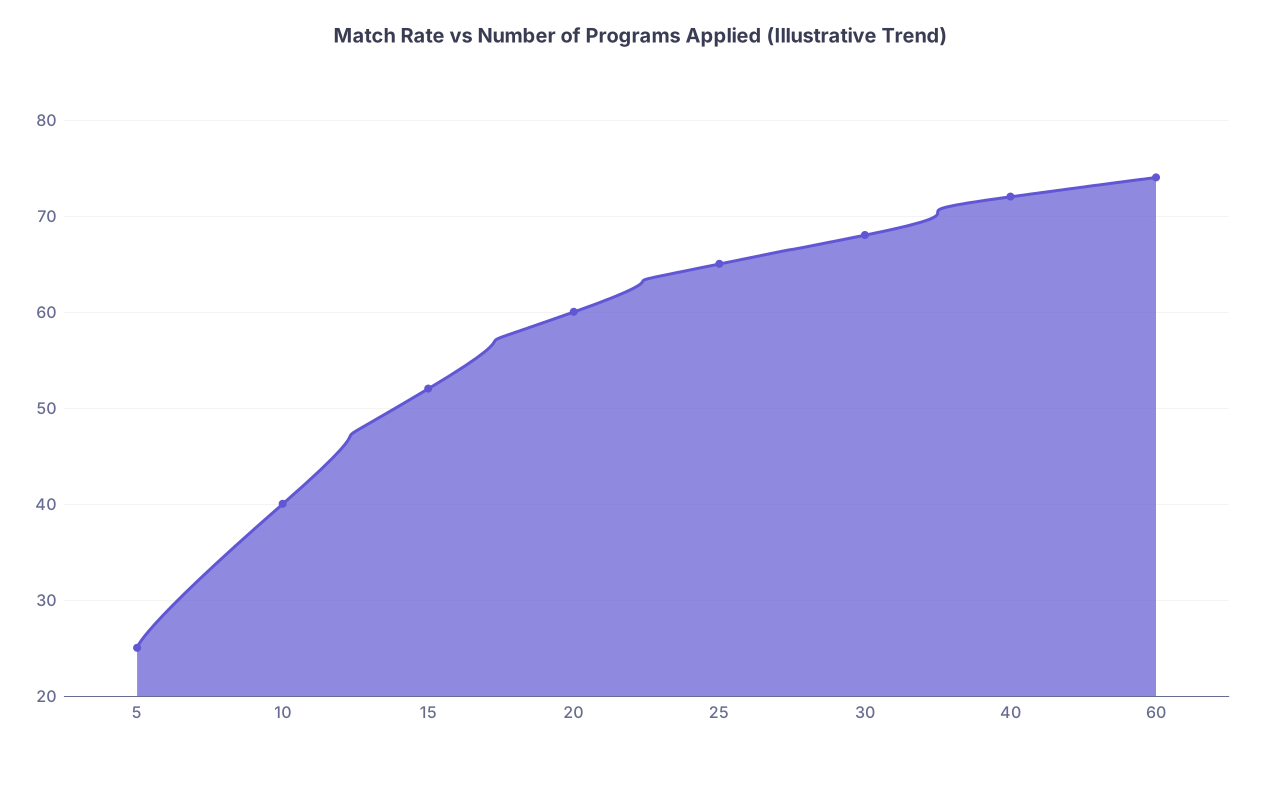
Understanding the Unique Challenge: Non‑US Citizen IMG in Interventional Radiology
Interventional Radiology (IR) is one of the most competitive residency pathways in the United States—doubly so for a non-US citizen IMG or any foreign national medical graduate. Designing a smart program selection strategy can make the difference between a successful IR match and an exhausting, expensive cycle with no interviews.
Unlike some other fields, IR has:
- Fewer total residency positions nationwide
- Strong emphasis on US clinical and research experience
- Heightened scrutiny of visa sponsorship requirements
Because of this, “how many programs to apply” is only one part of the equation. The real question is: which programs should you apply to, and why? This article lays out a structured, step-by-step program selection strategy tailored specifically for non-US citizen IMGs seeking interventional radiology residency.
We’ll cover:
- The IR training landscape and visa realities
- How to research and categorize programs
- How many programs to apply to, based on your profile
- How to create a tiered list and prioritize wisely
- Practical examples and red flags to watch for
Throughout, the focus is on an actionable framework you can personalize to your own situation.
Step 1: Know the IR Training Pathways and What They Mean for IMGs
Before deciding how to choose residency programs, you must understand the IR training pathways and which ones are most realistic for a foreign national medical graduate.
1. Integrated IR (IR/DR)
- 6-year categorical residency (PGY-1 to PGY-6, or advanced IR from PGY-2 with separate prelim year).
- You match directly into IR through ERAS and NRMP.
- Very competitive; many programs favor US grads with strong radiology performance and research.
Pros for IMGs:
- Clear, direct pathway to IR from the start
- You are firmly in the IR track—less uncertainty after radiology
Cons for non-US citizen IMG:
- Many programs restrict non–US citizens, especially for integrated IR
- Some integrated IR programs accept no or very few IMGs
- Smaller number of positions overall
2. Independent IR Residency
- 2-year training after completion of a DR (Diagnostic Radiology) residency.
- You match into DR first, then later apply to Independent IR.
- Many current IR attendings came through this pathway.
Pros:
- More DR programs open to IMGs and willing to sponsor visas
- You can build a strong US CV during DR, making yourself more competitive when applying to IR
Cons:
- Longer and more uncertain route; Independent IR spots are also competitive
- Requires strategic DR program selection (ideally in a place that has IR or strong IR connections)
3. Early Specialization in IR (ESIR)
- ESIR is a DR pathway that allows you to complete some IR training during DR and shorten Independent IR to 1 year.
- Not a separate match, but a feature within selected DR programs.
Why this matters for program selection:
For many non-US citizen IMGs, the pragmatic IR match strategy is often DR → ESIR → Independent IR, not exclusively aiming at Integrated IR. When building your program list, you should consider:
- Integrated IR programs that accept and sponsor non-US citizen IMG applicants
- DR programs with ESIR or strong IR exposure that are IMG- and visa-friendly
Your program selection strategy should therefore include both IR and DR programs, not IR alone, unless your profile is exceptionally strong and you are comfortable with higher risk.

Step 2: Understand Visa Constraints and Policy Filters
For a non-US citizen IMG, visa policies are not a detail—they are a hard filter that dramatically shapes your program list.
2.1 Common Visa Types
J-1 visa (ECFMG-sponsored):
- Most common for IMGs.
- Accepted by many academic centers.
- Some IR-heavy institutions prefer J-1 due to funding and policy simplicity.
H-1B visa (employer-sponsored):
- More complex and expensive for programs.
- Many programs, especially small ones, avoid H-1B for residents.
- Some IR programs explicitly say “J-1 only” or “No H-1B.”
Action: Decide ahead of time whether you’re willing to accept J-1, or if you must have H-1B (e.g., due to home-country obligations, family reasons, or 2-year home residency rule concerns).
2.2 How to Check Visa Policies for IR and DR Programs
When researching programs, always check:
Program website – “For IMGs,” “Eligibility,” or “FAQ” pages
- Look for phrases like:
- “We sponsor J-1 visas only”
- “We do not sponsor H-1B”
- “Visa sponsorship considered on a case-by-case basis”
- “We do not sponsor visas”
- Look for phrases like:
FREIDA / AAMC databases
- Filter by visas accepted.
- Confirm whether a program has ever listed visa sponsorship.
Emailing the program coordinator (if unclear)
- Ask:
“I am a non-US citizen IMG planning to apply for the upcoming cycle. Could you confirm whether your IR/DR residency program sponsors J-1 and/or H-1B visas?”
- Ask:
Make visa policy a binary filter in your program selection strategy. If a program clearly does not sponsor visas, do not waste an application there.
Step 3: Build a Realistic Self-Profile Before Asking “How Many Programs to Apply?”
“How many programs to apply” in interventional radiology depends heavily on your actual competitiveness as a foreign national medical graduate.
3.1 Core Competitiveness Factors in IR for IMGs
Assess yourself honestly on:
USMLE / Step scores (or equivalents)
- IR is highly score-sensitive, especially for integrated IR.
- IMGs with older Step 1 attempts or low Step 2 scores are at a disadvantage for IR, but might remain competitive for some DR programs if other parts of the CV are strong.
US clinical experience in radiology or IR
- Observerships, electives, sub-internships, or formal rotations.
- Letters of recommendation from US IR or DR faculty carry major weight.
Research in IR or radiology
- Case reports, posters, abstracts, QI projects, and especially peer-reviewed IR publications.
- Time spent in US research (1–2 years) at IR departments adds credibility.
IMG “distance” from graduation
- IR tends to favor more recent graduates (≤5 years from medical school).
- If you are >5 years out, your best path may be DR with strong IR exposure and research.
Communication skills and fit
- Well-structured personal statement clearly articulating why IR.
- Strong performance in interviews, particularly in explaining your path and visa status.
3.2 Rough Applicant Categories for Planning
This is a simplified framework to guide your program selection strategy:
Category A – Strong Non‑US Citizen IMG IR Applicant
- High USMLE scores (e.g., Step 2 CK > 250 or equivalent)
- Multiple US IR/DR rotations and at least one strong IR letter
- IR-related research (abstracts, posters, or publications)
- Recent graduate (≤3 years), no major red flags
Category B – Moderate IR Applicant, Stronger DR Candidate
- Decent scores (e.g., Step 2 CK 235–245 range)
- Some US clinical exposure, possibly limited IR exposure
- Some research, maybe not exclusively IR
- 3–6 years from graduation or minor red flags
Category C – Challenging IR Applicant, DR-Focused
- Low or borderline scores, attempts, or significant graduation gap
- Limited or no US IR rotations
- Little research or non-IR research
- Visa needs restrict many programs
Your category will shape how aggressive you must be with the number and type of programs you apply to.
Step 4: Designing a Program Selection Strategy (IR + DR)
Once you know your profile and visa constraints, you can build a structured IR match program selection strategy.
4.1 Decide Your Mix: IR vs DR
For most non-US citizen IMG applicants, especially in Category B and C, a mixed approach is safer:
Category A (strong IR profile):
- Apply broadly to Integrated IR programs that are known to consider IMGs.
- Also apply to a solid number of DR programs with ESIR or strong IR training as a backup.
Category B (moderate):
- Emphasize DR programs with ESIR or influential IR divisions.
- Apply to some IR programs, but understand odds are lower.
- Build your IR case during DR training, then apply to Independent IR.
Category C (challenging):
- Focus predominantly on DR programs that sponsor your visa type.
- Target programs with a track record of IMGs and opportunities to work with IR faculty.
- Aim for strong DR training → later attempt ESIR/Independent IR.
4.2 How Many Programs to Apply (Practical Ranges)
These are approximate ranges, not guarantees, tailored to a non-US citizen IMG in IR/DR:
Category A – Strong IR IMG
- Integrated IR: 40–60 programs (depending on visa and budget)
- DR (with ESIR / strong IR): 25–40 programs
Total: 65–100 programs (IR + DR combined)
Rationale: IR spots are limited; even strong IMGs must compensate with volume.
Category B – Moderate Profile
- Integrated IR: 20–35 programs (higher if budget allows)
- DR (broadly, prioritizing those with ESIR / IR presence): 40–70 programs
Total: 60–100+ programs
Rationale: You need more DR programs to statistically secure interviews, while still signaling IR interest.
Category C – Challenging Profile
- Integrated IR: 5–15 “reach” applications (optional, strategic)
- DR: 70–120 programs, depending on budget and visa constraints
Total: 75–130+ programs
Rationale: Focus on maximizing DR interview volume; IR is a future goal, not an immediate match objective.
Always adjust these ranges to your personal constraints (finances, time, and documentation) and evolving feedback from mentors.

Step 5: How to Choose Residency Programs – A Tiered, Evidence-Based Method
Once you know roughly how many programs to apply to, the next question is how to choose residency programs in a way that’s systematic and rational.
5.1 Create a Master List
Include:
All Integrated IR programs that:
- Consider IMGs
- Sponsor your visa type
DR programs that:
- Have ESIR or a strong IR division
- Are known to accept IMGs and sponsor visas
Use sources like:
- FREIDA (filter by IR/DR, visa type, IMG friendliness)
- NRMP and program directories
- Program websites (look at current residents’ backgrounds and photos)
- Word-of-mouth from seniors, mentors, and IMG forums (with caution)
5.2 Categorize Each Program by Four Factors
For every program, assign values (e.g., High / Medium / Low) in a simple spreadsheet:
Visa & IMG friendliness
- Explicit visa sponsorship (J-1 vs H-1B)
- Presence of current IMGs in IR/DR residency
- Historical acceptance of non-US citizen IMG residents
Fit for IR goals
- Dedicated IR division with multiple attendings
- ESIR designation for DR programs
- Case volume and procedures (from website or institutional reports)
- Presence of IR fellowships or Independent IR
Competitiveness relative to your profile
- Top-tier academic vs mid-tier vs community programs
- Your Step scores compared to their typical resident profile (if available)
- Your research and rotations compared to their expectations
Practical considerations
- Geographic location (visa adjudication locations, family, cost of living)
- Size of program (smaller programs may take fewer or no IMGs)
- Communication from program (responsive coordinator, information clarity)
5.3 Build Tiers: Reach, Target, and Safety
Using the factors above, divide your list:
Reach Programs
- Very competitive academic centers or elite IR hubs
- You are below or at the lower end of their typical profile
- Still visa-friendly and not explicitly anti-IMG
Target Programs
- Your profile roughly matches current/previous residents
- Active IR division or ESIR for DR
- Visa sponsorship is clear and positive
Safety Programs
- Historically more open to IMGs
- Mid-size or community-affiliated DR programs with IR access
- You are likely above their typical competitiveness profile
Example Mix for Category B Applicant (approx. 80 programs total):
Integrated IR:
- 5–10 reach
- 10–15 target
- 5–10 safety (relative, because even “safety” IR is competitive)
DR:
- 10 reach
- 25–30 target
- 15–20 safety
Keep in mind that in IR, “safety” is relative; there are no truly guaranteed programs, especially for a foreign national medical graduate. Tiers refer to probability, not certainty.
Step 6: Signal IR Interest Strategically Without Over-Narrowing
As a non-US citizen IMG, you must demonstrate genuine IR interest without closing doors to DR-only programs that might be your real pathway.
6.1 Tailor Your Personal Statement
Consider having:
Primary IR-focused personal statement
- For Integrated IR programs and DR programs with ESIR / strong IR
- Emphasize:
- Clear narrative of how you discovered IR
- Your US IR experiences and mentors
- Long-term career vision in IR
DR-focused statement with IR interest as a “subtheme”
- For DR programs where IR pathways are limited or unclear
- Emphasize:
- Broad interest in diagnostic radiology
- Intention to explore subspecialties, including IR
- Openness to academic or community radiology careers
This approach shows seriousness about IR when relevant, but doesn’t appear “too IR-only” to DR programs that might worry you’ll be dissatisfied if IR doesn’t work out.
6.2 Letters of Recommendation
For IR programs and IR-friendly DR programs, prioritize:
- 1–2 letters from IR attendings (US-based if possible)
- 1–2 from DR attendings or departments where you rotated
For DR-only targets, a balance of DR and IR letters is ideal; avoid using only IR letters for a DR-only program with minimal IR presence.
Step 7: Budgeting and Application Efficiency
Applying to 80–120+ programs is expensive and stressful, particularly for a non-US citizen IMG.
7.1 Budget Realistically
Estimate costs:
- ERAS application fees (escalating with number of programs)
- USMLE transcript fees
- NRMP registration
- Interview-related expenses (travel if in-person, or technology/time for virtual interviews)
- Visa document fees down the line
If budget is constrained, prioritize quality over sheer quantity:
Remove programs that:
- Clearly state “no visas”
- Have never had an IMG and state strong preference for US grads
- Are in locations you would decline even if matched
Optimize for:
- Programs with IR presence and visa sponsorship
- Programs where your profile is competitive
- A healthy mix of reach/target/safety
7.2 Use Data as the Season Progresses
As interview invitations come (or don’t), adapt:
If you receive almost no IR interviews but several DR interviews:
- Shift your mental emphasis and preparation to DR success.
- Plan to build IR credentials during DR.
If you receive multiple IR interviews:
- Maintain DR interviews as backup; IR is competitive even at the ranking stage.
- Be strategic in ranking by including DR programs where you would be happy.
Step 8: Common Pitfalls for Non‑US Citizen IMGs in IR Program Selection
Avoid these frequent errors:
Overconcentration on elite IR institutions
- Applying to mostly top 20 IR/DR centers and ignoring mid-tier, community, or hybrid programs that may be more IMG-friendly.
Ignoring visa policies
- Applying to large numbers of programs that explicitly don’t sponsor visas, wasting money and time.
All-in on IR, neglecting DR
- For most foreign national medical graduates, IR-only applications are extremely high risk.
- DR is often the necessary bridge, not a consolation prize.
Underestimating the importance of ESIR and IR presence in DR programs
- Choosing DR programs randomly without considering whether you’ll have real access to IR training and mentors.
Not using a structured spreadsheet or tiering method
- Relying on vague impressions instead of systematically rating programs leads to emotional, inconsistent decisions.
FAQs: Program Selection Strategy for Non‑US Citizen IMG in Interventional Radiology
1. As a non-US citizen IMG, should I apply only to Integrated IR programs?
No. Even a strong non-US citizen IMG faces steep competition in Integrated IR. A safer and more realistic IR match strategy for most foreign national medical graduates is to:
- Apply to a broad set of Integrated IR programs that accept IMGs and sponsor your visa, and
- Apply to a larger set of DR programs, prioritizing those with ESIR or strong IR divisions.
This dual approach keeps the IR dream alive while giving you a robust backup plan through DR.
2. How many IR and DR programs should I apply to if I am a moderate-strength candidate?
For a typical Category B non-US citizen IMG:
- Integrated IR: around 20–35 programs
- DR: around 40–70 programs, with emphasis on:
- Visa sponsorship
- Demonstrated IMG-friendliness
- ESIR or strong IR faculty presence
Total applications often fall between 60–100+, adjusted for finances, risk tolerance, and mentor advice.
3. How can I quickly tell if a program is IMG-friendly and worth applying to?
Use this quick checklist:
- Does the website explicitly say they sponsor J-1 or H-1B visas?
- Are there current or recent IMG residents listed (especially non-US citizens)?
- Does FREIDA show visa types accepted and any prior IMGs?
- Does the program have a history of responding to IMG inquiries (ask the coordinator if unclear)?
If the answer to all of these is negative or unknown, and your budget is limited, it may be better to prioritize other programs.
4. If I match DR without ESIR, is an IR career still possible?
Yes, though it may be more challenging. Many interventional radiologists historically trained via:
- Strong DR residency → robust IR rotations and mentorship → Independent IR or prior fellowship routes.
To maximize your chances:
- Choose a DR program with at least some IR presence, even if not formally ESIR.
- Seek IR mentors early during DR.
- Participate in IR research and elective rotations.
- Plan ahead to apply for Independent IR or other advanced IR training when eligible.
A well-thought-out program selection strategy—grounded in your true competitiveness, visa constraints, and realistic pathways—is essential for a non-US citizen IMG aiming for interventional radiology. By combining broad, rational application numbers with careful program research, tiering, and IR-focused planning, you significantly increase your odds of finding a match that supports your long-term IR goals.