

Understanding the Big Picture: Why Program Selection Matters So Much for Non‑US Citizen IMGs
For a non-US citizen IMG (foreign national medical graduate), program selection is not just about preferences—it is a core match strategy and a visa strategy.
You face three simultaneous challenges:
- Securing interviews in a competitive specialty (psychiatry)
- Navigating visa requirements (usually J‑1 or H‑1B)
- Competing against US graduates and US-IMGs with structural advantages
Because of this, a thoughtful program selection strategy can make the difference between:
- Matching vs. not matching
- Matching in a supportive environment vs. struggling in residency
- Being able to stay in the US for training vs. losing your visa pathway
This article focuses specifically on how a non-US citizen IMG should approach:
- Which psychiatry programs to target
- How many programs to apply to
- How to interpret filters and “IMG-friendliness”
- How to build a tiered application list that maximizes your psych match chances
Throughout, keep in mind: your goal is not only to get interviews, but also to get them at places where you are realistically competitive and where you can thrive.
Step 1: Know Your Applicant Profile Honestly
Before you can build a strong program selection strategy, you must define your starting point as objectively as possible. This is uncomfortable but essential.
Core Profile Components to Assess
For a psychiatry residency psych match, you should honestly rate yourself in the following areas:
Citizenship & Visa Needs
- Non-US citizen, requiring:
- J‑1 via ECFMG (most common, more widely accepted), or
- H‑1B (fewer programs sponsor; requires USMLE Step 3 by rank list deadline)
- Some programs say “We do not sponsor visas” – these are not viable for you.
- Non-US citizen, requiring:
USMLE / COMLEX Scores
- Step 1: Pass/Fail (for recent grads), but past numerical scores still matter where present.
- Step 2 CK: Extremely important. Psych is relatively less score-obsessed than some specialties, but many programs still have filters (e.g., Step 2 CK ≥ 220–230).
- If you have failed an exam, your strategy must compensate with higher application volume and IMG-friendly programs.
Year of Graduation (YOG) & Gap Years
- Many programs have informal or formal cutoffs (e.g., YOG ≤ 5–7 years).
- Long gaps can be offset by clinical experience, research, or consistent involvement in psychiatry or medicine.
US Clinical Experience (USCE) in Psychiatry
- Strong plus: Hands-on electives, sub-internships, observerships with meaningful letters.
- Priority: Psychiatry-specific USCE over general internal medicine or surgery.
Research & Academic Profile
- Psych-related publications, posters, or QI projects strengthen your application, especially at university programs.
- Lack of research is not fatal for community-based programs, but it matters at academic centers.
Communication Skills & Personal Statement
- Psychiatry heavily values communication, empathy, and professionalism.
- LORs that highlight your patient rapport and teamwork are critical.
Self-Rating Framework
Give yourself a rough category:
Category A (Relatively Strong Non-US Citizen IMG)
- Step 2 CK ≥ 240
- YOG ≤ 3–4 years
- No exam failures
- Solid USCE in psychiatry (≥ 2–3 months)
- At least some psych-related research or scholarly work
- Strong English skills and psychiatry-focused LORs
Category B (Average Non-US Citizen IMG)
- Step 2 CK ~225–239
- YOG 3–7 years
- Possible minor gaps or one non-major issue (e.g., limited USCE, no research)
- Maybe 1 exam failure but compensated by other strengths
Category C (At-Risk Non-US Citizen IMG)
- Step 2 CK < 225
- Multiple exam attempts or failures
- YOG > 7 years
- Minimal or no USCE; weak psych exposure
- Significant unexplained career gaps
Your category determines how many programs to apply to, and which tiers to prioritize.
Step 2: Decide How Many Psychiatry Programs to Apply To
One of the most common questions is: “How many programs should I apply to?”
For a non-US citizen IMG in psychiatry, the answer depends mainly on your profile category.
General Ranges for Psychiatry (Non-US Citizen IMG)
These are typical target ranges, not strict rules:
Category A (Strong)
- Recommended: 50–80 programs
- If cost is not a major barrier: up to 90 for safety
- Focus on a balanced mix of university-affiliated and community programs that are IMG-friendly and visa-sponsoring.
Category B (Average)
- Recommended: 80–120 programs
- This group benefits most from a broad, strategic program selection.
- Must include a significant number of community-based, IMG-heavy programs.
Category C (At-Risk)
- Recommended: 120–150+ programs
- You are applying in a risk profile where volume becomes one of your main tools.
- Focus heavily on IMG-friendly, community, and less competitive geographic regions.
Factors That Might Push You to Apply to More Programs
Increase your numbers if:
- You require H‑1B only (many psych programs offer J‑1 only).
- You have multiple attempts on USMLE.
- You have no US clinical experience.
- You are >5–7 years from graduation.
- You are aiming only for very desirable locations (e.g., New York City, California) but have an average profile.
When You Can Apply to Fewer Programs
You may safely stay on the lower end of the ranges if:
- You have excellent scores and strong USCE in psychiatry with glowing US LORs.
- You are genuinely open to a wide range of locations, including Midwest, South, less popular states.
- You have no visa complications (e.g., dual citizen or permanent resident).
(But this article focuses on non-US citizens who need sponsorship.)
Financial and Emotional Costs
Each extra application is more money, but for a non-US citizen IMG, a slightly larger ERAS bill is often worth the increased match probability.
A good rule:
If you are wondering between 70 vs. 90 programs and can afford it, for a non-US citizen IMG in psychiatry, 90 is usually safer than 70, provided your list is strategic (not random).

Step 3: Understand Program Types and What They Mean for a Foreign National Medical Graduate
Not all psychiatry residencies are equally suitable for a non-US citizen IMG. You need to understand the program ecosystem to shape your program selection strategy.
1. University/Academic Programs
- Often affiliated with a large medical school.
- More research opportunities, subspecialty exposure (addiction, forensics, child, etc.).
- Sometimes more competitive, often with higher score expectations.
- Visa policy varies: some sponsor J‑1 only; fewer sponsor H‑1B.
Good fits if:
- You have strong scores, research, and USCE.
- You can clearly demonstrate academic/teaching interest.
2. University-Affiliated Community Programs
- Based at community hospitals but affiliated with a university.
- Often more IMG-friendly than pure university programs.
- Provide solid training with some academic exposure.
- Visa sponsorship tends to be more flexible (often J‑1 friendly).
Good fits for many non-US citizen IMGs:
- Moderate scores with some USCE.
- Willing to work hard and contribute clinically.
3. Community-Based Programs (Non-University)
- Located in community hospitals, sometimes in smaller towns or less popular locations.
- Often the most IMG-friendly and may have larger proportions of IMGs.
- Emphasis on high clinical volume and service.
- Many sponsor J‑1; some also sponsor H‑1B.
Essential targets if you are average or at-risk:
- Especially in Midwest, South, or non-coastal states.
4. Newly Accredited or Expanding Programs
- New psychiatry residencies are opening in multiple states because of mental health workforce shortages.
- May be more open to considering non-traditional applicants because they are building their brand.
- Training quality can be variable initially, but can still be a path to a solid career.
Strategic consideration:
- These programs can be very valuable for Category B/C applicants.
- Look for evidence of supportive leadership and faculty quality (website, program director’s background, affiliated hospitals).
Step 4: Identify IMG-Friendly and Visa-Friendly Psychiatry Programs
For a non-US citizen IMG, two filters are absolutely non-negotiable:
- They must be willing to sponsor a visa you can accept.
- They must at least sometimes take IMGs or foreign graduates.
Where to Find This Information
Use multiple sources; never rely only on one:
- FREIDA (AMA):
- Check “Types of visas accepted” and “International medical graduates” fields.
- Program Websites:
- Look for explicit statements: “We sponsor J‑1 visas through ECFMG” or “We do not sponsor visas.”
- Check current residents’ profiles and see how many have international backgrounds.
- Doximity, Residency Explorer, SDN, and forums:
- Can give anecdotal data on IMG-friendliness and interview patterns. Use cautiously but can guide you.
- Current Residents & Alumni Networks:
- Reach out (professionally and respectfully) via LinkedIn or hospital profiles to ask targeted questions.
Red Flags for a Foreign National Medical Graduate
Be cautious with programs that:
- Explicitly state: “No visa sponsorship” or “US citizens/permanent residents only.”
- Say: “We rarely consider IMGs” or “We require US medical school graduation.”
- Do not list any IMGs among current or recent residents.
- Have extremely high test score expectations (e.g., Step 2 CK ≥ 250 preferred) and no history of taking IMGs.
Positive Signs for Non-US Citizen IMGs
Prioritize programs where:
- The website clearly states:
- “We sponsor J‑1 visas”
- “We sponsor both J‑1 and H‑1B visas” (if you need H‑1B, this is critical)
- Current residents include:
- Graduates from India, Pakistan, Middle East, Latin America, Eastern Europe, Caribbean, Africa, etc.
- The program mentions:
- “We value diversity,” “We welcome IMGs,” or highlights global backgrounds explicitly.
- The program location is:
- In less saturated “big name” states (e.g., outside California/NYC/Boston) – these often are more open to IMGs.
Step 5: Build a Tiered Program List (Targeted, Not Random)
A powerful program selection strategy involves tiering your list instead of sending random applications to every program.
How to Create Your Tiers
For each psychiatry program, classify it into:
Reach Programs (Top ~20–30%)
- More competitive (well-known universities, major cities).
- You meet minimum requirements but may be slightly below their average profile.
- Apply if there is at least a plausible chance (e.g., they have taken non-US citizen IMGs with similar stats before).
Match/Target Programs (Middle ~40–60%)
- Your profile closely matches their usual resident profile (scores, USCE, YOG).
- They are clearly IMG- and visa-friendly.
- Often university-affiliated community or solid community programs.
Safety Programs (Bottom ~20–30%)
- Programs with:
- High proportion of IMGs
- Less competitive geographic locations
- Lower historical score thresholds
- You are above their typical minimums and they clearly sponsor visas.
- Programs with:
Example Breakdown by Category
If you are Category B (Average) and plan to apply to 100 programs:
- 20–25 Reach
- 45–55 Target
- 25–35 Safety
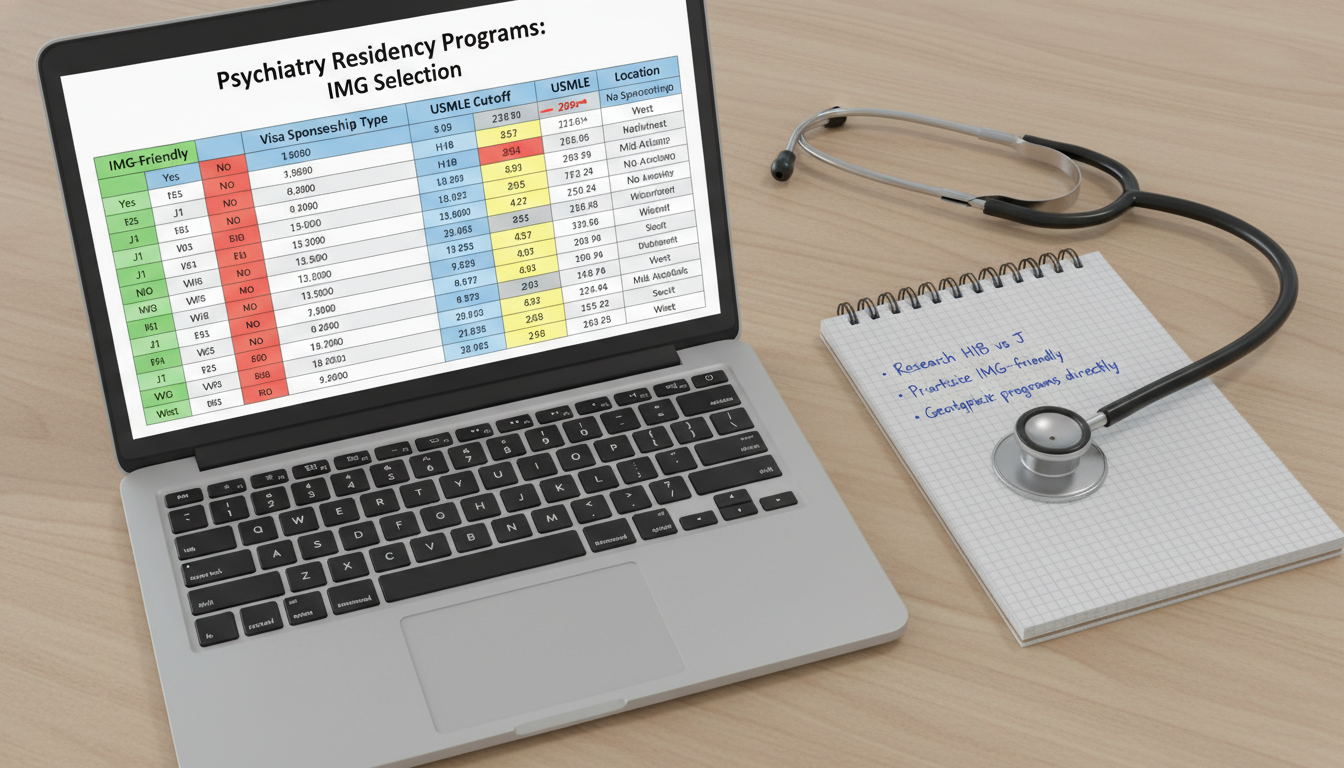
For each program, record in a spreadsheet:
- Visa sponsorship (J‑1 / H‑1B / both / none)
- Proportion of IMGs in current residents
- Minimum or average Step 2 CK if known
- YOG limits if any
- Any red flags (no IMGs, no visas, unclear policy)
- Personal notes (e.g., “strong psychotherapy focus,” “great community psychiatry,” etc.)
This organized approach ensures you truly understand how to choose residency programs instead of mass-applying blindly.
Step 6: Geographic and Lifestyle Strategy for Psychiatry
Your willingness to be flexible about location is a major factor in your psych match chances.
More Competitive Locations
These are often hard for non-US citizen IMGs, especially if average or at-risk:
- Major coastal cities (NYC, Boston, San Francisco, LA, Seattle, Miami)
- Very prestigious academic centers in any city
You can still apply (especially if you are Category A), but do not build your entire list in these areas.
More Open Regions
Historically more welcoming to IMGs and foreign national medical graduates:
- Midwest: Ohio, Michigan, Indiana, Illinois (non-Chicago), Wisconsin, Minnesota, Iowa, Kansas, Missouri, Nebraska, Dakotas.
- South: Texas (varies by program), Alabama, Arkansas, Kentucky, Tennessee, Oklahoma, Louisiana, Mississippi, Georgia (outside Atlanta), Carolinas (varies).
- Some Northeast and Mountain states outside large metro hubs.
If your main goal is “match in psychiatry in the US” (not “match in a specific city”), prioritize these regions.
Location vs. Training Quality
Many community and smaller-city programs provide:
- Excellent clinical exposure
- Strong psychopharmacology training
- Opportunities for psychotherapy, addiction, community psych, etc.
Later, you can still pursue:
- Fellowships in addiction, child & adolescent, consult-liaison, forensics, geriatric psychiatry
- Employment in major cities after training
For non-US citizen IMGs, first secure residency; then optimize geography and subspecialty.
Step 7: Special Considerations for Visa Strategy (J‑1 vs. H‑1B)
As a non-US citizen IMG, your program selection strategy must integrate visa realities.
J‑1 Visa
- Most common visa for foreign national medical graduates.
- Sponsored by ECFMG.
- Majority of psychiatry programs that take IMGs are comfortable with J‑1.
- Requires you to return to your home country for 2 years after training unless you secure a waiver (e.g., underserved area job, Conrad 30 program).
Program selection implication:
If you are open to J‑1, your list of viable psychiatry programs is much larger.
H‑1B Visa
- Employer-sponsored work visa.
- Fewer psychiatry programs sponsor H‑1B due to cost and complexity.
- Almost always requires USMLE Step 3 passed by the rank list deadline or when they file the petition.
Program selection implication:
If you insist on H‑1B only:
- Your program list will be much shorter.
- You must research carefully which psychiatry programs explicitly offer H‑1B.
- You may need to apply to the maximum possible number of H‑1B-friendly programs (often 80–120, depending on what you find).
If you can accept either J‑1 or H‑1B:
- You maximize interview chances, then later decide based on offers.
- This is usually the most practical strategy for non-US citizen IMGs.
Step 8: Putting It All Together – Sample Program Selection Strategy
Consider a hypothetical example.
Case Example
Dr. X is a non-US citizen IMG from India with:
- Step 2 CK: 233 (one attempt)
- YOG: 2019
- 2 months of US psychiatry observerships
- 1 internal medicine elective
- No research, but strong psych LORs
- Requires J‑1 visa (open to J‑1 or H‑1B if available)
Profile: Category B (Average)
Dr. X’s Strategy
Number of Programs
- Target: 100–110 psychiatry programs
Filters Applied
- Must sponsor J‑1 visa (H‑1B a bonus)
- Evidence of IMGs among current residents
- No explicit exclusion of older YOG (or YOG limit ≥ 5 years)
- Step 2 CK cutoff ≤ 225–230
Geographic Mix
- 60–70%: Midwest and South, plus some Northeast/Mountain states
- 30–40%: Selected East/West Coast programs that are clearly IMG-friendly
Tiering
- ~25 Reach:
- University-affiliated programs in decent locations with visible IMGs
- ~50 Target:
- University-affiliated community and established community programs
- Moderate IMG presence, routine J‑1 sponsorship
- ~25–35 Safety:
- Community programs in smaller cities with high IMG percentages
- Newer or expanding programs with clear J‑1 sponsorship
- ~25 Reach:
Ongoing Refinement
- Update spreadsheet as new information appears (program changes, resident feedback).
- Use interviews and rotations to learn more and refine rank list later.
This is a realistic, data-driven program selection strategy that maximizes the psych match probability for a foreign national medical graduate with a typical profile.
FAQs: Program Selection Strategy for Non‑US Citizen IMGs in Psychiatry
1. As a non-US citizen IMG, how many psychiatry programs should I apply to?
- Strong profile (Category A): 50–80 programs
- Average profile (Category B): 80–120 programs
- At-risk profile (Category C): 120–150+ programs
These ranges assume you are targeting only programs that sponsor visas and are at least somewhat IMG-friendly. If you need H‑1B specifically, you may need to apply to as many qualifying programs as you can identify, because the pool is smaller.
2. How do I know if a psychiatry residency is IMG-friendly and visa-friendly?
Check:
- Program website:
- Look for statements like “We sponsor J‑1 visas via ECFMG” or “We accept international medical graduates.”
- Current residents:
- Scan resident profiles for international medical schools.
- Databases (FREIDA, Residency Explorer):
- Check fields for visa sponsorship and IMG presence.
- Contact program coordinators carefully:
- If not clear online, a brief, polite email asking:
- “Do you sponsor J‑1/H‑1B visas?”
- “Do you consider IMGs who require visa sponsorship?”
- If not clear online, a brief, polite email asking:
If a program clearly says “No visa sponsorship” or “US graduates only,” do not apply as a non-US citizen IMG.
3. Should I prioritize location or program quality as a foreign national medical graduate in psychiatry?
For most non-US citizen IMGs, especially Category B/C, the priority is to secure a psychiatry residency position first, even if the location is not your dream city.
- Prioritize:
- Visa sponsorship
- IMG-friendliness
- Reasonable working conditions and educational environment
- Be flexible with:
- City size
- State or region
- Immediate prestige
After residency, you can move to a different state, pursue fellowships, or work in larger cities. Psychiatry offers good mobility after training.
4. Is it worth applying to very competitive academic programs as a non-US citizen IMG?
It depends on your profile:
- If you are Category A (strong scores, USCE, research):
- Yes, you should include some competitive academic programs as reach options.
- If you are Category B or C:
- Limit applications to elite programs; they are unlikely to interview you unless there is a special connection.
- Instead, invest most of your applications in university-affiliated and community programs that have a track record of accepting IMGs.
As part of a balanced program selection strategy, having some reach programs is fine, but your psych match success will usually depend on target and safety programs.
By approaching your psychiatry residency applications with a clear, organized program selection strategy tailored to non-US citizen IMGs, you substantially increase your chances of matching—and not just matching anywhere, but matching into a program where you can grow into the psychiatrist you want to become.


