Understanding the Big Picture: Program Selection as a Caribbean IMG
For a Caribbean medical school graduate, choosing where to apply for residency isn’t just a logistical step—it’s a core strategic decision that can determine whether you match, where you train, and how your career unfolds. The questions are immediate and stressful:
- What is a smart program selection strategy?
- How many programs to apply to given my profile?
- Which specialties and programs are realistically attainable for a Caribbean IMG?
- How does being from a Caribbean medical school affect my residency options?
Unlike most US MD seniors, Caribbean IMGs often face steeper competition, fewer “automatic” interviews, and less institutional support. That reality means you cannot afford a random or emotional approach; you need a structured, data-based program selection strategy tailored to your profile, goals, and constraints.
This article walks you through a comprehensive, step-by-step approach to program selection, specifically for Caribbean IMGs—whether you are at SGU, AUC, Ross, Saba, or another Caribbean school. You’ll learn how to choose residency programs, how many programs to apply to, and how to position yourself intelligently in the Caribbean medical school residency landscape.
Step 1: Know Your Applicant Profile and Risk Level
Before deciding where to apply, you must accurately understand what you’re bringing to the table. Program selection strategy starts with honest self-assessment.
1. Core Academic Metrics
Key elements:
- USMLE Step 1 status and score
- Pass/Fail era: programs still care how you passed if they see a numerical score (old attempts or NBME performance).
- Fails or multiple attempts are significant red flags, especially for competitive specialties.
- USMLE Step 2 CK
- Now the single most important numeric metric.
- Competitive for IM/Peds/FM: often ≥ 230–235 is strong; 220–230 is workable; < 215 increases risk.
- Attempts
- Any failed attempt on Step 1 or Step 2 CK significantly narrows your options and raises the bar for the rest of your application.
2. Educational Background and Timeline
- School and reputation
- SGU, Ross, AUC, Saba and a few others are more widely recognized; some programs are more open to them due to long-standing relationships.
- Lesser-known Caribbean schools may face additional scrutiny.
- Year of graduation (YOG)
- YOG within 1–3 years: best positioned.
- YOG 4–6 years: needs explanation and stronger overall profile.
- YOG > 7 years: more challenging, focus on community programs and FM/IM primarily.
3. Clinical Experience and Letters
- US clinical experience (USCE)
- Core rotations in the US through your Caribbean school are good, but audition electives/sub-internships with strong letters help more.
- Hands-on experience is valued more than observerships.
- Letters of Recommendation (LoRs)
- 1–2 strong LoRs from US academic faculty in your chosen specialty are critical.
- Programs often want at least one letter from a physician in that specialty.
4. Non-Academic Factors
- Visa status
- US citizen/green card: far more flexibility.
- Need for visa (J-1 or H-1B): some programs automatically exclude; others are open but more selective.
- Red flags
- Gaps in training, professionalism issues, multiple exam failures.
- These do not automatically doom your chances, but they demand a tailored program list.
Risk Categories for Caribbean IMGs
Roughly categorize yourself:
- Lower-Risk Caribbean IMG
- Step 2 CK ≥ 235
- No exam failures
- Recent graduate (< 3 years)
- USCE with strong US LoRs
- No significant red flags
- Moderate-Risk Caribbean IMG
- Step 2 CK 220–234
- Maybe one minor concern (older YOG, small gap, or weaker LoRs)
- Standard Caribbean school graduate
- Higher-Risk Caribbean IMG
- Step 2 CK < 220 or exam failure(s)
- Older YOG (> 4–5 years)
- Limited USCE, visa needed
- Significant red flags
Your risk category is the foundation of your program selection strategy, influencing both the kind of programs and how many programs to apply to.

Step 2: Choosing Specialty and Matching It to Your Profile
1. Understand Specialty Competitiveness for Caribbean IMGs
Some specialties are much more accessible to Caribbean graduates than others. As a broad rule:
More IMG-Friendly (especially for Caribbean IMGs):
- Internal Medicine (IM)
- Family Medicine (FM)
- Pediatrics (Peds)
- Psychiatry
- Pathology (sometimes)
- Neurology (varies by region)
- PM&R (Physical Medicine & Rehabilitation) – moderate, but improving
More Challenging, but Not Impossible:
- Emergency Medicine
- General Surgery
- Ob/Gyn
- Anesthesiology
Highly Competitive / Rare for Caribbean IMGs:
- Dermatology
- Plastic Surgery
- Neurosurgery
- Orthopedic Surgery
- ENT, Urology, Ophthalmology, Radiation Oncology, etc.
If your dream specialty sits in the “highly competitive” category, you must decide between:
- Applying to it plus a backup like IM/FM (dual-application strategy), or
- Focusing on a more attainable specialty where you can realistically match and build a career.
2. Align Specialty With Your Metrics
For a Caribbean IMG, program directors often compare you not to other IMGs, but to the entire applicant pool. Use a realistic lens:
- Strong profile (e.g., Step 2 CK ≥ 240)
- Competitive for IM, Peds, FM almost everywhere, and some mid-tier programs in EM/Anes/ObGyn/Gen Surg if other factors are strong.
- Mid-range profile (Step 2 CK 220–235)
- Focus on IM/FM/Peds/Psych, some community programs in less competitive specialties if strong USCE and LoRs.
- Below 220 or exam failure
- Prioritize FM, IM, possibly Psych, and heavily community-focused programs; consider smaller or less popular geographic regions.
3. Dual-Application Strategy: Pros and Cons
Many Caribbean IMGs consider applying to two specialties (e.g., EM + IM, Surgery + IM, Anesthesia + IM).
Pros:
- Increases total number of interview opportunities.
- Provides a safety net if your primary specialty is too competitive.
- Particularly useful if you enjoy both fields and can explain your interest coherently.
Cons:
- Requires twice the tailoring for personal statements and LoRs.
- Risk of looking unfocused if programs know you are applying broadly to different fields.
- Costs more in ERAS fees and time.
Guideline:
Use dual-application if:
- Your dream specialty is realistically borderline with your stats.
- You are truly okay training in your backup specialty.
- You have at least one letter in each specialty and can craft distinct personal statements.
Step 3: Building a Smart Program Selection Strategy
Once you’ve settled on a realistic specialty path, you need a structured program selection strategy—where specifically to apply, and in what volume.
1. Understand Types of Programs
Academic University Programs
- Large teaching hospitals, affiliated with medical schools.
- Typically more competitive, more US MD/DO applicants.
- Some are IMG-friendly, especially in IM, FM, Psych.
University-Affiliated Community Programs
- Community hospitals linked to a university.
- Often more open to IMGs and Caribbean grads.
- Good training; may still have robust academic exposure.
Community (Independent) Programs
- Standalone community hospitals, often in smaller cities.
- Frequently most IMG-friendly.
- Great for Caribbean IMGs, especially those needing more opportunities.
In a Caribbean medical school residency context, you will likely target a mix, but lean heavily toward community and community-affiliated programs, especially if you’re moderate- or higher-risk.
2. Using Data to Identify IMG-Friendly Programs
Your program list must be data-driven, not based on reputation alone.
Use multiple sources:
- FREIDA (AMA Residency Database)
- Filter by specialty, visa sponsorship, and IMG percentage.
- Check “International graduates” data and total positions.
- Program Websites
- Look for: “We consider IMGs,” “We sponsor J-1/H-1B visas,” and current residents’ alma maters.
- NRMP “Charting Outcomes in the Match”
- Compare your stats to matched IMGs in your specialty.
- Word-of-Mouth and School Match Lists
- SGU residency match data (and match lists from other Caribbean schools) show where similar applicants have successfully matched.
- Use SGU residency match and similar lists to identify historically IMG-friendly programs.
3. Tiering Programs: Reach, Target, and Safety
To avoid an unbalanced list, categorize programs:
- Reach Programs
- Slightly above your stats or in highly desirable locations (e.g., East/West Coast big cities).
- Might take some Caribbean IMGs but usually with higher scores or strong research.
- Target Programs
- Your stats are near or slightly above their typical accepted range.
- Regularly match Caribbean IMGs with similar profiles.
- Safety Programs
- More IMG-heavy, community-based, in less competitive locations.
- Your stats are above the mean of their recent matched residents.
Ideal distribution for a Caribbean IMG:
- Lower-risk: ~20–30% reach, 40–50% target, 20–30% safety.
- Moderate-risk: ~10–20% reach, 40–50% target, 30–40% safety.
- Higher-risk: 0–10% reach, 30–40% target, 50–60% safety.
Step 4: How Many Programs Should You Apply To?
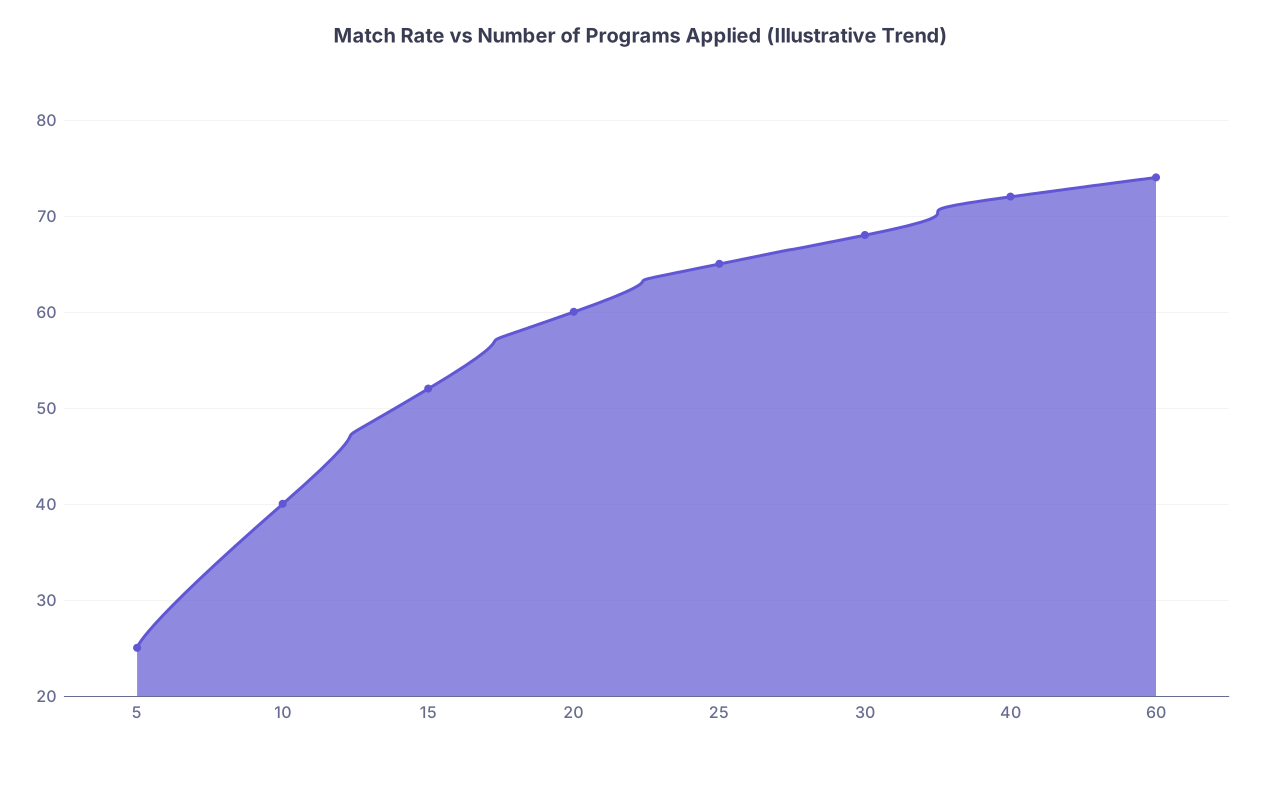
This is one of the most critical and most misunderstood questions: how many programs to apply to as a Caribbean IMG?
The right number depends on specialty, risk category, and budget. Below are general ranges, assuming at least one attempt on each USMLE step and no catastrophic red flags.
1. Internal Medicine (Categorical)
Lower-risk Caribbean IMG
- 40–70 programs
- Mix of academic and community; favor IMG-friendly academic centers.
Moderate-risk
- 70–120 programs
- Focus more on community and IMG-heavy programs with some academic reach.
Higher-risk
- 120–150+ programs
- Predominantly community hospitals, smaller cities, and less popular regions (Midwest, South, rural areas).
2. Family Medicine
- Lower-risk
- 30–60 programs
- Moderate-risk
- 60–100 programs
- Higher-risk
- 100–140+ programs
Family Medicine is relatively IMG-friendly, but Caribbean IMGs still need a broad net to be safe.
3. Pediatrics, Psychiatry, Neurology
- Lower-risk
- 40–70 programs
- Moderate-risk
- 70–110 programs
- Higher-risk
- 110–140+ programs
These fields can be IMG-friendly but vary widely by region and specific program philosophy.
4. Surgery, EM, Anesthesiology, ObGyn (As Primary Specialty for Caribbean IMG)
For these, especially if you are not top-tier:
- Higher academic stats (Step 2 CK ≥ 240, strong USCE and LoRs):
- 60–100 programs, plus serious consideration of a backup specialty.
- More average or below-average stats:
- Consider dual-application strongly (e.g., Anesthesia + IM, EM + IM, Surgery prelim + IM/FM).
- Total 80–150 applications across both specialties.
Cost and Diminishing Returns
ERAS fees escalate quickly. You must balance cost against match probability:
- For most Caribbean IMGs, applying to more programs is cheaper than reapplying next year.
- However, beyond a certain point, additional applications often go to programs that are:
- Clearly out of reach, or
- Historically closed to IMGs.
A focused 100–120 applications in realistic, IMG-friendly programs is better than a random 200.

Step 5: Geographic Strategy and Visa Considerations
1. Geography: Go Where the Positions Are
Caribbean IMGs often match better when they are flexible about location.
More Competitive Regions for IMGs
- Major coastal cities: New York City, Boston, San Francisco, Los Angeles, Miami, Chicago’s top academic centers.
- Highly desirable states: California, New York (central NYC), Massachusetts, Colorado, Washington.
These may still have IMG-friendly spots, but the competition is intense.
More Open Regions
- Midwest (e.g., Ohio, Michigan, Indiana, Iowa, Kansas, Missouri, Wisconsin, Minnesota)
- South (e.g., Georgia, Alabama, Mississippi, Louisiana, Arkansas, Tennessee, Texas – select programs)
- Some Northeast and Mid-Atlantic community programs outside major metros.
Strategy:
Anchor a portion of your list in areas where historical match data show more IMGs and Caribbean graduates (including insights from SGU residency match lists and similar data sources).
2. Visa Policy
If you require a visa, this must shape your list:
J-1 Visa
- Most commonly offered; relatively easier to find programs.
- FREIDA and program websites often state if they sponsor J-1.
H-1B Visa
- More limited; requires passing Step 3 early and more institutional resources.
- More commonly available in IM and sometimes in other fields at academic centers.
Action Steps:
- Filter programs by visa sponsorship in FREIDA and on program websites.
- Avoid wasting applications on programs that explicitly do not sponsor any visas.
- If you are a US citizen/green card holder, you still benefit from applying to IMG-friendly locations since those programs may be more open to Caribbean grads in general.
Step 6: Tactical Execution – From Master List to Final Application
1. Build a Master Spreadsheet
Create a spreadsheet including:
- Program name
- ACGME ID
- City/State
- Type (academic/university-affiliated/community)
- IMG percentage and number of Caribbean grads (based on residents page)
- Visa policy (None / J-1 / H-1B / both)
- Average Step requirements (if published)
- Notes (friend’s recommendation, known to favor SGU, etc.)
- Tier (Reach / Target / Safety)
This visual overview is your core program selection strategy document.
2. Tailor Your Application Materials
Personal Statements
- One per specialty; optionally slightly tailored for 2–3 key programs.
- Emphasize strengths that matter to community settings (work ethic, teamwork, adaptability) and to academic settings (research, teaching, leadership) accordingly.
Letters of Recommendation
- At least 3 letters that are specialty-specific.
- Choose the strongest 3–4 for each specialty and assign them properly in ERAS.
Program-Specific Signals (if any)
- If your specialty uses preference signaling (e.g., in some versions of EM, IM, etc.), be strategic: signal programs where you are realistically competitive and genuinely interested, not just top names.
3. Timeline Management for Caribbean IMGs
- Before ERAS Opens:
- Solidify specialty (and backup if needed).
- Take Step 2 CK and get result if possible.
- Secure LoRs, personal statements, and CV updates.
- When ERAS Opens and Application Submission Begins:
- Submit on the earliest recommended date; Caribbean IMGs benefit from being early.
- Apply broadly according to your planned numbers.
- Post-Submission:
- Track interviews as they come in.
- If you’re getting very few invitations compared to peers, consider:
- Expanding your list (if timeline/cost allows).
- Reaching out politely to programs where you have a connection or did rotations (no mass spamming).
Practical Example: Two Caribbean IMG Profiles
Example 1: “Maria” – SGU Graduate, Moderate-Risk
- Step 1: Pass on first attempt
- Step 2 CK: 228
- YOG: Current year
- USCE: 24 weeks core IM/FM/Peds in the US; 8 weeks electives, including sub-I in IM
- Visa: Needs J-1
- Specialty Choice: Internal Medicine only
Strategy:
- Specialty: IM only (no backup needed based on stats).
- Geographic focus: Midwest and South, some Northeast community programs.
- Program mix: ~20% academic, 50% community-affiliated, 30% community.
- Application volume: 90–110 IM programs.
- Extra: Prioritize programs with known SGU residency match history or high IMG representation.
Example 2: “David” – Non-Big 4 Caribbean School, Higher-Risk
- Step 1: Failed once, passed on second attempt
- Step 2 CK: 216
- YOG: 3 years ago
- USCE: 12 weeks observerships, 4 weeks hands-on elective in FM
- Visa: US permanent resident
- Specialty Choice: Family Medicine primary, IM as secondary consideration
Strategy:
- Specialty: FM primary, IM secondary but only highly IMG-friendly programs.
- Geographic focus: Broad—Midwest, South, and rural/less central locations nationwide.
- Program mix: Mostly community and smaller community-affiliated programs.
- Application volume:
- 100–120 FM programs
- 40–60 highly IMG-friendly IM programs
- Total: ~140–180 applications, carefully targeted.
FAQs: Program Selection Strategy for Caribbean IMGs
1. As a Caribbean IMG, can I realistically match into a competitive specialty?
It’s possible, but the odds are much lower compared to IM or FM. For highly competitive fields (Derm, Ortho, Neurosurgery, etc.), Caribbean IMGs need:
- Top-tier scores (e.g., Step 2 CK ≥ 245–250),
- Significant research (often with publications),
- Strong US academic connections and letters,
- Ideally US citizenship/green card.
Most Caribbean graduates match into IM, FM, Peds, Psych, and related specialties. If you pursue a competitive field, strongly consider a backup specialty with a robust program selection strategy.
2. How do I know if a program is truly IMG- or Caribbean-friendly?
Look for:
- Current residents: Are there multiple IMGs or graduates from Caribbean schools (SGU, Ross, AUC, Saba, etc.)?
- Program website / FREIDA: Does it indicate willingness to sponsor visas and consider IMGs?
- Historical match lists: Your school’s match lists (e.g., SGU residency match data) can show if previous Caribbean graduates matched there.
- Reputation and word-of-mouth: Ask seniors, attendings, or mentors familiar with specific programs.
No single indicator is perfect; combine all of them to make an informed judgment.
3. Should I apply to only places where Caribbean grads have matched before?
Not exclusively. Previous Caribbean matches are a strong positive sign, but lack of visible Caribbean grads doesn’t automatically mean rejection. Programs change leadership and policies over time. Use past matches as one important filter, not your only one:
- Prioritize programs with prior Caribbean or IMG matches.
- Add some reasonable “new” programs where your profile fits and their stated criteria are welcoming.
4. Is it better to apply to more programs or focus on stronger tailoring?
You need both breadth and strategic focus as a Caribbean IMG:
- Breadth (enough programs) ensures you generate sufficient interviews.
- Targeting and tailoring (careful specialty choice, IMG-friendly programs, proper LoR selection, and appropriate personal statements) ensure those applications are truly competitive.
If forced to choose, as a Caribbean IMG it’s usually safer to apply to a somewhat larger number of well-chosen programs than a smaller list—even if your personal statements are not hyper-customized for every single institution. Aim for a balance where your list is large enough for odds, but each program is on your spreadsheet for a clear, rational reason.
A thoughtful, data-driven program selection strategy tailored to your profile as a Caribbean IMG can dramatically improve your chances of a successful match. Start early, be honest about your strengths and limitations, and build a plan that reflects both ambition and realism.