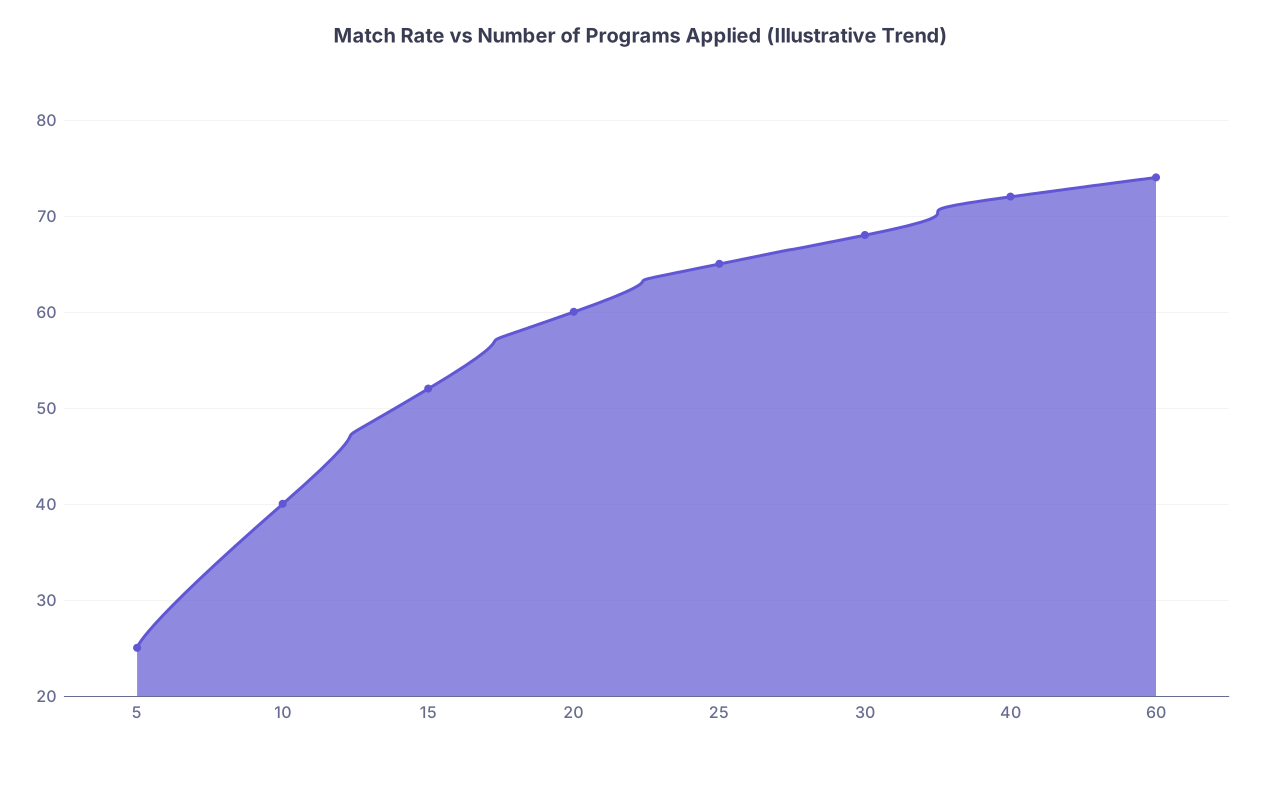
Understanding the Landscape: Psychiatry Residency for Caribbean IMGs
Caribbean international medical graduates (IMGs) have a long track record of successfully matching into psychiatry, and schools like SGU, AUC, and Ross regularly report growing numbers in this field. Still, psychiatry is increasingly competitive, and a thoughtful program selection strategy is essential—especially if you are asking yourself not just how many programs to apply, but which ones and why.
As a Caribbean IMG, your situation is different from a US MD or DO applicant:
- Some programs are friendlier to IMGs than others.
- State licensure rules vary (some restrict certain Caribbean schools or number of attempts).
- Your application may have strengths (e.g., rich life experience, communication skills, cultural competency) that align especially well with psychiatry, but you must target programs that recognize and value them.
- The Caribbean medical school residency pathway often requires applying to more programs than a typical US graduate, but volume alone is not enough—you need smart targeting.
This article will walk you through a structured, step-by-step program selection strategy for Caribbean IMGs interested in psychiatry, including:
- How to determine how many programs to apply to
- Concrete filters and criteria to build your list
- How to balance “reach,” “target,” and “safety” programs
- Practical tactics to improve your psych match odds, including regional focus and networking
- FAQs specific to Caribbean IMGs aiming for psychiatry
Step 1: Clarify Your Profile and Target Before You Build a List
Before you pull up a single program website, you need a clear, honest picture of your own application and your realistic goals. This drives your program selection strategy far more than any generic number recommendation.
A. Know Your Metrics and Red Flags
Key elements to consider:
- USMLE/COMLEX scores
- Did you pass Step 1 and Step 2 CK on the first attempt?
- Are your scores close to, above, or below the recent psychiatry match averages for IMGs?
- Attempts and gaps
- Any exam failures?
- Extended time between graduation and applying (YOG > 3–5 years)?
- Unexplained leaves or major career gaps?
- Citizenship and visa status
- US citizen / permanent resident vs. requiring J-1 or H-1B sponsorship.
- Medical school reputation and performance
- From a well-established Caribbean school (e.g., SGU, Ross, AUC, Saba) vs. smaller or newer schools.
- Clerkship locations and quality of US clinical experience.
- Class rank, honors, or strong psychiatry evaluations.
For SGU residency match applicants and other large Caribbean schools, your institution’s track record in psychiatry provides a helpful benchmark. Look at:
- Annual match lists: Where did alumni in psychiatry match? Which states and types of programs?
- Any affiliated or pipeline psychiatry programs?
Use these data points to roughly tier yourself:
- Strong Caribbean IMG psychiatry candidate
- Step 2 CK around or above the US average
- No failures, recent grad (≤ 2–3 years)
- Solid US clinical experience with strong LORs in psychiatry
- Clear interest in psychiatry (research, electives, personal statement)
- Moderate candidate
- Step 2 CK somewhat below average or one minor red flag (older YOG, 1 fail)
- Adequate USCE and reasonable LORs
- Demonstrated but not extensive psychiatry interest
- At-risk candidate
- Multiple exam attempts, significantly below-average Step 2 CK
- Older grad (> 5 years) or larger gaps in training
- Limited USCE, especially in psychiatry
Your self-assessment strongly influences how many programs to apply and which tiers to target.
B. Define Your Priorities in Psychiatry
Psychiatry is diverse. Your priorities shape the program selection strategy:
- Do you prefer academic vs community programs?
- Are you interested in specific subfields such as:
- Child & adolescent
- Addiction
- Forensic
- Geriatric
- Consultation-liaison
- Are you OK with smaller cities or rural areas to improve match odds?
- Any geographic constraints (family, visas, state licensure)?
Write down:
- Your non-negotiables (e.g., must sponsor J-1; must be in the Northeast; can’t take older grads), and
- Your flexible preferences (e.g., academic vs community, research emphasis).
This clarity will be crucial when you filter programs.

Step 2: Decide How Many Psychiatry Programs to Apply To
There is no single magic number of applications that guarantees a psych match, but solid data and experience can guide you.
A. General Ranges for Caribbean IMGs in Psychiatry
For Caribbean IMGs, psychiatry is one of the more attainable specialties, but you still need a broad application strategy. Rough ranges (for categorical psychiatry positions):
Strong Caribbean IMG candidate
- Typically: 40–60 programs
- If flexible on location and program type: closer to 40–50 may be enough.
- If you have specific geographic limits: aim nearer 60.
Moderate Caribbean IMG candidate
- Typically: 60–90 programs
- This group benefits most from careful targeting and avoiding outright IMG-unfriendly programs.
At-risk Caribbean IMG candidate
- Often: 90–120+ programs
- You must be highly strategic, focus on community and IMG-friendly programs, and consider prelim/transitional options as back-up if psychiatry-only match looks uncertain.
Remember: These are general planning ranges, not guarantees. Submitting 100 applications to programs that never take IMGs is far less valuable than submitting 70 carefully chosen programs with a proven history of interviewing Caribbean graduates.
B. Balancing Volume with Quality
Ask yourself:
- Can you realistically write tailored personal statements (or at least adjusted paragraphs) for your top 20–30 programs?
- Can you track each program’s requirements and deadlines accurately?
- Do you have the budget for ERAS application fees at higher volumes?
Your program selection strategy should balance:
- Enough volume to statistically generate interviews
- Targeting to avoid wasting applications on hopeless programs
- Depth of preparation so you can excel in interviews at the programs most likely to rank you
If your financial resources are limited, prioritize:
- Programs with documented IMG matches (look at recent resident rosters)
- Programs that clearly state they accept Caribbean IMGs and sponsor your visa type
- States and regions known to be more IMG-friendly (e.g., parts of the Midwest, South, and some Northeast community programs)
Step 3: Build an Initial List Using Strategic Filters
Once you know your profile and approximate target number, you can build an initial master list. Use a structured approach instead of random browsing.
A. Start with Databases and Official Sources
Use tools such as:
- FREIDA (AMA residency database)
- Program websites
- Your school’s match data (e.g., SGU residency match list in psychiatry)
- NRMP data and program director surveys (for trends, not specific programs)
From these, identify all ACGME-accredited psychiatry programs and start filtering.
B. Filter by Must-Have Criteria
Apply your non-negotiables first:
IMG Eligibility
- Explicitly states “We consider IMG applicants” or shows IMGs among current residents.
- Check resident bios: are there Caribbean grads (SGU, AUC, Ross, etc.)?
Visa Sponsorship
- If you need a visa, confirm whether the program sponsors J-1 (most do) and/or H-1B (fewer do).
- Programs that don’t mention visa sponsorship may still sponsor, but this is a riskier bet; prioritize clearly supportive ones.
USMLE/COMLEX Requirements
- Some programs have explicit score cutoffs (e.g., Step 1 ≥ 220, Step 2 CK ≥ 230, no failures).
- If you’re below a published cutoff, it’s generally not worth applying unless there’s a compelling reason (e.g., strong connection, inside advocate).
Year of Graduation Limits
- Many academic programs prefer grads within 5 years, some within 3 years.
- Community/IMG-friendly programs may accept older grads if there’s continuous clinical activity.
State Licensure Constraints
- Certain states have rules about specific Caribbean schools or exam attempts.
- Verify whether your school is recognized by that state’s medical board and whether any exam attempt limits might block eventual licensure.
After applying these filters, you should have removed clearly incompatible programs from your list.
C. Prioritize IMG-Friendly Programs
Look for signals that a program is a good fit for a Caribbean medical school residency applicant:
- Current residents or recent grads from Caribbean schools (check photos and bios).
- Program or department explicitly highlighting diversity and inclusion, or having a history of IMG leadership roles (chief residents, fellows).
- Community-based or hybrid programs, often with more flexible criteria than elite academic centers.
If you’re from a large Caribbean school (e.g., SGU), use its match data:
- Identify psychiatry programs that have matched SGU grads in the past 3–5 years.
- These are high-yield targets—they already understand your curriculum and credentials.
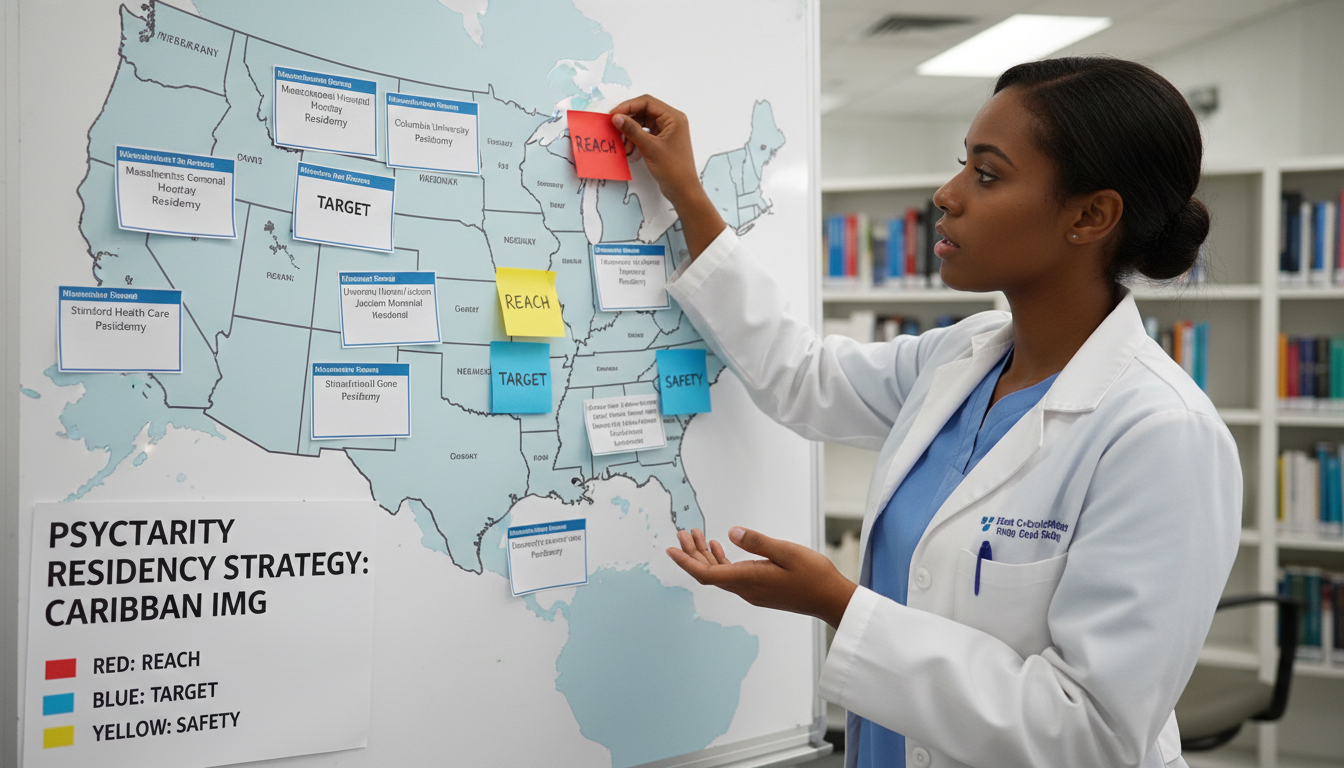
Step 4: Refine Your List – Reach, Target, and Safety Programs
Once you have a filtered master list, refine it into categories. This is central to an effective program selection strategy.
A. Categorize Programs by Competitiveness vs Your Profile
Use these working definitions:
Reach Programs
- Historically more competitive (well-known academic centers, popular urban locations).
- Accept some IMGs, but proportions are smaller.
- Your metrics are at or slightly below their typical range, or they rarely match Caribbean grads.
- Example: Large Northeast academic program with strong research.
Target Programs
- Clearly IMG-friendly with multiple Caribbean residents.
- Your metrics and profile are well aligned with their typical accepted applicants.
- Mix of academic-affiliated and community programs, often in mid-sized cities.
Safety Programs
- Strong evidence of consistently taking Caribbean IMGs, sometimes with lower average scores.
- Often community-based, smaller cities or less competitive regions.
- Your metrics are at or above the usual range, and you meet all criteria comfortably.
B. Suggested Proportions for Caribbean IMGs in Psychiatry
The mix will vary based on your profile, but a rough guideline:
Strong candidate (40–60 programs)
- Reach: ~20–30%
- Target: ~40–50%
- Safety: ~30–40%
Moderate candidate (60–90 programs)
- Reach: ~10–20%
- Target: ~40–50%
- Safety: ~30–50%
At-risk candidate (90–120+ programs)
- Reach: ≤10%
- Target: ~30–40%
- Safety: ~50–60%
This diversification improves your psych match odds while still leaving room for aspirational programs.
C. Factor in Geography and Lifestyle Sensibly
Psychiatry has many excellent programs outside major coastal cities. For Caribbean IMGs, expanding beyond the “big name” locations can make all the difference.
Consider:
- Broaden geographic scope where possible: Midwest, South, and some interior states can be much more IMG-friendly than hyper-competitive coastal urban centers.
- Be realistic about living conditions: Are you willing to live in a smaller city or a colder climate for 4 years to train in a solid program? For many applicants, this trade-off dramatically improves match chances.
You do not have to love the city forever; you need a place that will train you well and open doors for your career.
Step 5: Program Deep Dives – What to Look for in Psychiatry
Now that you’ve narrowed your list, do deeper research on each psychiatry residency program to ensure alignment with your goals.
A. Educational Quality and Clinical Exposure
For psychiatry specifically, examine:
Breadth of clinical sites
- Inpatient psychiatry, outpatient clinics, emergency psychiatry, consult-liaison, addiction services.
- Variety of patient populations: urban, suburban, rural, diverse demographics.
Supervision and teaching structure
- Is there structured didactic time protected from clinical duties?
- Are there psychotherapy training opportunities (CBT, psychodynamic, group therapy)?
Subspecialty exposure
- Access to electives or rotations in child & adolescent, geriatric, forensic, addiction, etc.
B. Support for IMGs and Caribbean Graduates
Pay attention to:
- Presence of current Caribbean IMG residents (try to reach out respectfully via email or social media for insights).
- Faculty or chiefs who are themselves IMGs; they often understand your journey.
- Program culture around mentorship and academic support.
A program that has embraced Caribbean trainees before is more likely to support you through the challenges of training and licensure.
C. Research, Fellowship, and Career Outcomes
While not every Caribbean IMG needs a research-heavy program, it’s worth noting:
- Does the program have residents presenting at conferences (APA, AACAP, etc.)?
- Does it place graduates into fellowships (e.g., child & adolescent, addiction, consult-liaison)?
- Do alumni practice in locations or settings you aspire to?
This may influence the weight you give to certain programs on your rank list later, even if it doesn’t change your how many programs to apply decision.
Step 6: Practical Tactics to Strengthen Your Psych Match Odds
Program selection is not only about choosing where to apply; it’s also about strategically engaging with those programs.
A. Use Electives and Audition Rotations Wisely
For Caribbean IMGs, US clinical experience—especially psychiatry rotations—is critical:
- Apply for away electives or audition rotations at programs that:
- Are already on your target/safety list
- Have a history of interviewing or matching Caribbean grads
A strong performance on an audition rotation can:
- Overcome modest scores or other weaknesses
- Generate powerful, program-specific letters of recommendation
- Put a human face to your application
B. Network and Signal Genuine Interest
Steps you can take:
- Attend virtual open houses and Q&A sessions.
- Interact appropriately on social media (X/Twitter, LinkedIn) with programs and faculty: share academic content, ask thoughtful questions, not flattery.
- If allowed, send polite, concise emails to program coordinators or directors highlighting your interest—especially if you have a geographic or institutional connection.
For top-choice programs, emphasize:
- Your specific interest in their curriculum or patient population
- Any prior connection to their region or institution
- How your background as a Caribbean IMG adds value to their patient care and team diversity
C. Have a Realistic Back-Up Strategy
Even with a strong program selection strategy, the match can be unpredictable. Consider:
- Whether you will:
- Re-apply next cycle if unmatched, or
- Pursue a prelim year (e.g., internal medicine or transitional) to stay clinically active
- How many years you are willing to reapply to psychiatry vs. pivoting to another specialty
For many Caribbean IMGs, being honest about backup plans reduces stress and keeps you focused.
Putting It All Together: Example Strategies
To illustrate how these concepts work in practice, here are two sample application strategies.
Example 1: Strong SGU Graduate Targeting Psychiatry
Profile:
- SGU grad, YOG 2024
- Step 1: Pass (pre-2022 numeric: 235)
- Step 2 CK: 244, first attempt
- 2 US psychiatry electives with strong letters
- US citizen, no visa issues
- Flexible on location, mild preference for Northeast
Program strategy:
- Target ~50 psychiatry programs
- Initial filters:
- IMG-friendly, as evidenced by residents or match lists
- No strict cutoff above her scores
- J-1 or no-visa requirement is fine
- Mix:
- Reach (10–12): mid- to high-tier academic Northeast & Midwest programs with some IMGs
- Target (20–25): university-affiliated and strong community programs in various regions with multiple Caribbean residents
- Safety (15–18): solid community programs in less competitive regions, smaller cities
Outcome aim:
- Secure 12–18 interviews, which is often plenty to secure a psych match when ranking wisely.
Example 2: Moderate Caribbean IMG with Red Flags
Profile:
- Caribbean grad (smaller school), YOG 2019
- Step 1: Pass after 1 fail (pre-2022 numeric: 215)
- Step 2 CK: 222, first attempt
- 1 US psychiatry observership + 1 US internal medicine rotation
- Needs J-1 sponsorship
Program strategy:
- Target 80–90 psychiatry programs
- Initial filters:
- Must accept IMGs and sponsor J-1
- No explicit prohibition on exam failures; prefer programs that don’t list strict cutoffs
- Prefer programs that accept grads up to 5–7 years out if actively clinical
- Mix:
- Reach (5–10): a few IMG-friendly academic or hybrid programs where metrics are slightly above or near lower thresholds
- Target (25–35): community/university-affiliated programs with several IMGs, including some from less-known schools
- Safety (40–45): heavily IMG-populated community programs, more rural/suburban regions, smaller cities
Outcome aim:
- Focus on generating 8–12 interviews, and be proactive about audition rotations, strong letters, and genuine interest signals.
FAQs: Program Selection Strategy for Caribbean IMGs in Psychiatry
1. How many psychiatry programs should a Caribbean IMG apply to?
Most Caribbean IMGs aiming for psychiatry apply to 40–120 programs, depending on their profile:
- Strong candidates: often 40–60 programs
- Moderate candidates: 60–90 programs
- At-risk candidates: 90–120+ programs
The exact number depends on your scores, attempts, year of graduation, visa needs, and geographic flexibility. Volume matters, but targeting IMG-friendly programs is even more important than simply increasing the count.
2. How can I identify IMG-friendly psychiatry programs?
Look for:
- Current or recent residents from Caribbean or other international schools on the program’s website
- Clear statements that they consider IMGs and sponsor visas
- Presence of Caribbean graduates in the SGU residency match or other schools’ public match lists
- Community or hybrid programs outside the most competitive metropolitan areas
If you see multiple Caribbean IMGs in a program’s roster, that is a strong signal of IMG-friendliness.
3. Should I apply to very competitive academic psychiatry programs as a Caribbean IMG?
You can include some reach academic programs, especially if:
- Your scores are strong
- You have US psychiatry research or publications
- The program has a history of accepting IMGs
But these should be a minority of your applications. For most Caribbean IMGs, the core of a successful program selection strategy involves:
- Strong community and university-affiliated programs
- Institutions with clear and consistent IMG representation
- Regions that are historically more welcoming to IMGs
4. How do I balance personal preferences with match probability?
Use a tiered approach:
- First, filter for non-negotiables (visa, IMG acceptance, licensure compatibility).
- Next, create a mix of reach, target, and safety programs.
- Within that mix, favor programs that fit at least some of your preferences (geography, academic vs community, specific interests).
Recognize that you may need to compromise on location or type of program in order to secure a solid training spot. Once you complete residency, you’ll have much more flexibility in choosing where and how you practice psychiatry.
By combining realistic self-assessment, thoughtful filters, and strategic diversification of programs, a Caribbean IMG can build a powerful program selection strategy for psychiatry. Use data from your own school’s match history, especially if you’re at a place like SGU with a robust residency match record, and focus on aligning your strengths with programs that understand and value Caribbean medical graduates.