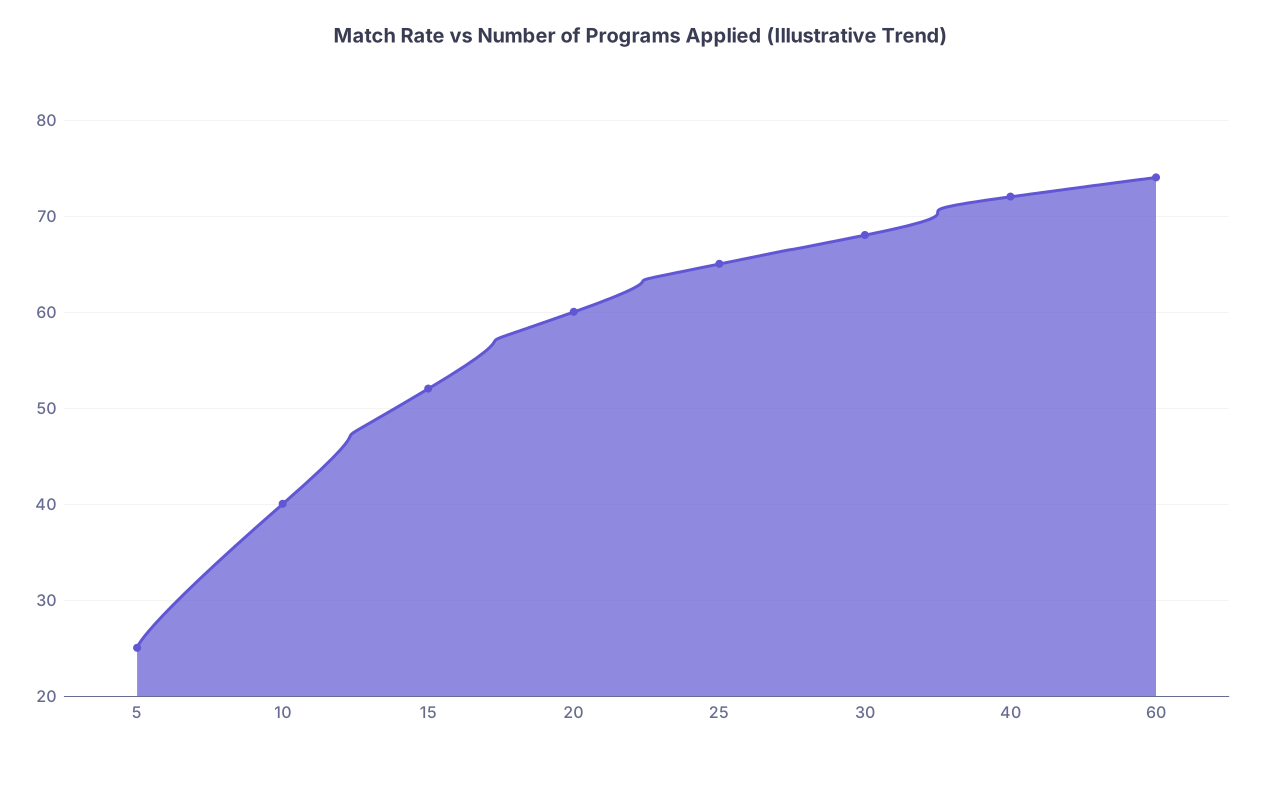
Radiation oncology is one of the most competitive and rapidly evolving specialties in medicine. As a DO graduate, building a smart, data-driven program selection strategy is critical not only for matching, but for landing in a training environment where you can thrive. This guide will walk you through how to choose residency programs, how many programs to apply to, and how to think strategically about the osteopathic residency match landscape in radiation oncology.
Understanding the Radiation Oncology Landscape as a DO Graduate
Radiation oncology residency (“rad onc”) is small in absolute numbers and has historically been highly competitive. For DO applicants, there are unique dynamics to consider.
Small specialty, big implications
- Few positions: There are relatively few radiation oncology residency positions nationwide compared to internal medicine, pediatrics, etc.
- High applicant quality: Applicants often have strong board scores, research, and academic backgrounds.
- Research-heavy culture: Many programs are at major academic centers and value publications, presentations, and interest in academia.
DO graduate residency context
For a DO graduate residency applicant in radiation oncology, you should be aware of:
Allopathic vs. osteopathic bias
- Some programs are historically more MD-heavy, but the unified ACGME accreditation has opened more doors for DOs.
- Program culture varies widely—some are very DO-friendly; others rarely interview DOs.
USMLE vs. COMLEX
- Many radiation oncology programs still strongly prefer or require USMLE scores, even if you have COMLEX.
- If you only have COMLEX, you will need to target programs that explicitly accept COMLEX or demonstrate equivalent academic strength through research and letters.
Research expectations
- DO schools may offer fewer built-in research opportunities compared to some MD schools.
- Competitive rad onc programs often expect at least some scholarly activity: case reports, abstracts, quality improvement, or clinical research.
Understanding this context is the first step in building a realistic, personalized program selection strategy.
Step 1: Define Your Applicant Profile Honestly
Before you can decide how many programs to apply to or which ones to target, you must know where you stand. This self-assessment will shape your program selection strategy and your eventual osteopathic residency match outcomes.
Key components of your profile
Consider the following elements:
Exams and academic metrics
- USMLE Step 1 (if taken), Step 2 CK
- COMLEX Level 1, Level 2 CE
- Any failed attempts or significant score gaps
- Clinical grades and class rank (if available)
Radiation oncology exposure
- Number and quality of rad onc rotations (home vs. away)
- Letters of recommendation from radiation oncologists
- Evidence of understanding the field (personal statement, experiences)
Research and scholarly work
- Publications (especially in oncology/radiation oncology)
- Posters, oral presentations, abstracts
- Ongoing projects you can discuss during interviews
DO-specific strengths
- Unique experiences (OMM/OMT, holistic care training, community focus)
- Military background, leadership, advocacy, community outreach
- Prior health care work or non-traditional paths
Red flags or challenges
- Failed exam attempts
- Remediation or professionalism concerns
- Gaps in training
Categorizing your competitiveness
It can help to loosely place yourself in one of three tiers within the DO applicant pool:
Highly competitive DO applicant
- Strong USMLE/COMLEX scores (above national averages for matched rad onc), no failures
- Multiple strong rad onc letters, possibly from well-known faculty
- Research productivity, ideally in oncology
- Strong clinical evaluations and clear interest in the field
Moderately competitive DO applicant
- Solid but not exceptional scores (around or slightly below typical matched averages)
- At least one or two strong rad onc letters
- Some research or scholarly activity
- Solid clinical performance
Underdog DO applicant
- Lower or mixed board scores, or failed attempt
- Limited rad onc exposure or letters
- Minimal research
- Strong narrative and personal growth but fewer traditional credentials
This honest categorization will directly inform how many programs to apply to and where to focus your energy.
Step 2: Building Your Long List – How Many Programs to Apply?
For radiation oncology, especially as a DO graduate, erring on the side of applying broadly is usually wise.
General guidelines for DO applicants in rad onc
While exact numbers change year to year, a practical starting point for how many programs to apply might be:
Highly competitive DO applicant:
- Apply to 25–40 radiation oncology programs.
- Consider being selective based on geography and program “fit,” but still broad.
Moderately competitive DO applicant:
- Apply to 40–60 radiation oncology programs.
- Cast a wide net, including a mix of aspirational, realistic, and safety programs.
Underdog DO applicant:
- Apply to 60–80+ radiation oncology programs (or as many as financially feasible).
- Maximize reach; also consider creating a backup plan (e.g., transitional year, preliminary year, or a different specialty).
These are not rigid rules. Use them as starting points and adjust based on:
- Financial constraints (ERAS fees accumulate rapidly)
- Geography constraints (e.g., family, visa status)
- Competitiveness of your specific year (monitor data from NRMP and specialty societies)
Strategic balance: breadth vs. depth
Your program selection strategy should balance:
- Breadth: Enough programs to generate a healthy number of interviews.
- Depth: Time to thoroughly research programs, tailor your application, and prepare for interviews.
A common mistake is to send out a massive number of applications with little research. Programs can see through generic applications, especially in a small field like radiation oncology. Focus on:
- Personalizing your experiences and goals to the specialty
- Writing a tightly focused personal statement
- Highlighting features that match rad onc program values (academic curiosity, empathy, multidisciplinary teamwork, technical interest)

Step 3: How to Choose Residency Programs Targeted to DO Applicants
Once you’ve estimated how many programs to apply to, the next task is how to choose residency programs that are realistic and compatible with your goals.
Filtering for DO-friendliness
To increase your chances in the osteopathic residency match for radiation oncology:
Check program websites and past residents
- Review resident rosters: Are there DOs currently or historically in the program?
- Programs with a history of training DOs are often more receptive.
Review program requirements
- Do they explicitly accept COMLEX?
- Do they require USMLE scores?
- Any minimum score cutoffs listed?
Contact current DO residents
- Ask about how supportive the program is of DO graduates.
- Inquire about any structural barriers (e.g., bias, lack of understanding of COMLEX, etc.).
Programs with a track record of DO trainees should be prioritized, especially if you do not have USMLE scores.
Academic vs. community vs. hybrid programs
Most rad onc programs are in academic centers, but there is a spectrum:
Large academic centers
- Heavy research focus
- Strong sub-specialization and advanced technology
- Often more competitive, but also more visible DO champions in some places
Smaller academic or community-affiliated programs
- May offer closer mentorship and more hands-on experience
- Sometimes more open to DO graduates, especially if they emphasize clinical excellence
Choosing between them depends on:
- Your interest in a research or academic career
- Desire for subspecialty fellowship training
- Geography and lifestyle priorities
Objective and subjective filters
Create a spreadsheet to systematically apply filters. Consider:
Objective filters
- Location (region, city size, proximity to family)
- Visa policies (for IMGs or DOs needing visas)
- Required exams (USMLE vs COMLEX)
- Research expectations (protected time, publication record)
- Call structure and workload
Subjective filters
- Program culture (collaborative vs. competitive)
- Resident satisfaction (from word-of-mouth or online forums)
- Diversity and inclusion efforts
- Faculty mentorship style
Scoring or ranking programs across these domains can help refine a long list of, say, 70–80 programs down to a more realistic and targeted 40–60.
Step 4: Match Strategy Specific to Radiation Oncology
Radiation oncology has unique elements that should shape your program selection and application approach.
Integrating research into your strategy
Because rad onc is academically oriented:
If you have strong research:
- Target more academically intensive programs and NCCN/NCI-designated cancer centers.
- Emphasize your projects, publications, and long-term academic interests.
If you have limited research:
- Highlight other strengths: clinical performance, leadership, advocacy, teaching.
- Apply broadly to a mix of top-tier and mid-tier programs.
- Consider a research year or post-doc only if you’re deeply committed and understand the trade-offs.
For a DO graduate, even a few meaningful oncology-related projects can differentiate you significantly, especially if you can discuss them with depth during interviews.
Away rotations as a strategic tool
Away rotations can be powerful, especially in a small specialty:
Where to do aways:
- Programs where DOs have matched previously
- Target geographic areas where you’d be happy long-term
- At least one academically strong program, if you’re interested in research
Goals of an away rotation:
- Demonstrate clinical competence and professionalism
- Build relationships with faculty who can write strong letters
- Show commitment to the specialty and the program’s mission
For DO applicants, a strong performance on an away can sometimes overcome a modest score profile by providing “real-world” endorsements from known faculty.
Balancing rad onc with backup options
Given the fluctuating competitiveness and small size of the rad onc match:
- Consider whether you want a single-specialty, all-in strategy or a parallel/backup strategy.
- Some DO applicants:
- Apply primarily to radiation oncology but also to internal medicine, preliminary medicine, or transitional year programs.
- Use a prelim or TY year to strengthen their CV and reapply.
This is highly individual. Discuss with mentors and consider:
- Your financial capacity for multiple cycles
- Emotional bandwidth for a reapplication
- Degree of flexibility about specialty choice
A realistic, well-thought-out backup plan does not show lack of commitment; it shows maturity and self-awareness.

Step 5: Refining Your List and Executing Your Application
Once your long list is built and filtered, it’s time to finalize and execute.
Creating a tiered program list
Divide your final list into tiers:
Reach programs
- Highly prestigious programs or those with historically fewer DOs
- Strong academic centers with very competitive metrics
Target programs
- Programs where your scores and experiences align closely with past matched DO or MD applicants
- Places with DO graduates or DO-friendly cultures
Safety programs
- Programs that have consistently taken DOs, may be in less-desired locations, or are less research-intensive
- Your metrics are comfortably above program norms, as best you can tell
A rough distribution for a moderately competitive DO applicant (applying to ~50 programs) might be:
- 10–15 reach programs
- 20–25 target programs
- 10–15 safety programs
Tailoring your application content
Your program selection strategy should be matched by an equally thoughtful content strategy:
Personal Statement
- Make it clearly oriented to radiation oncology, not generic oncology.
- Discuss how your DO background shapes your approach to cancer care (holistic, musculoskeletal knowledge, patient-centered perspectives).
- Highlight any rad onc experiences that guided your decision.
Letters of Recommendation
- Aim for at least 2–3 letters from radiation oncologists, ideally including one from an away rotation.
- If possible, obtain a letter from a faculty member known in the field or involved in national organizations.
CV and ERAS experiences
- Prioritize oncology-related activities, research, and leadership roles.
- Clearly label radiation oncology shadowing, electives, tumor boards, and multidisciplinary clinic experiences.
Monitoring and adjusting during application season
After applications are submitted:
- Track interviews received by program type (reach/target/safety, DO-friendly vs. not).
- If you receive few early interviews:
- Reach out to programs where you have a personal connection or have rotated.
- Update programs later in the season with new publications, abstracts, or accomplishments (if allowed).
Use this feedback to adjust your expectations and to inform future cycles if needed.
Putting It All Together: A Sample Strategy for a DO Graduate
To illustrate how this might look in practice, consider a fictional DO graduate:
- COMLEX scores modestly above average; USMLE Step 2 taken with a solid score
- One home rad onc rotation, one away rotation at a mid-tier academic program
- Two oncology-related posters, one first-author case report
- Strong letters from home and away radiation oncologists
- No exam failures, good clinical grades
A reasonable program selection strategy might be:
- Number of programs: Apply to about 45–55 radiation oncology programs.
- Program characteristics:
- Majority DO-friendly or with DOs in recent classes.
- Mix of academic centers and smaller hybrid/community programs.
- A few top-tier academic centers as reach programs due to decent research exposure.
- Tiers:
- 10–12 reach programs (mostly large NCI-designated centers)
- 20–25 target programs (solid academic/community mix; known DOs)
- 10–15 safety programs (consistent DO acceptance, slightly less competitive)
- Backup consideration:
- Apply to a small number (5–10) of transitional year or preliminary internal medicine programs in desirable locations, as a contingency.
- Execution:
- Strong personal statement emphasizing rad onc interest and DO perspective.
- Personalized emails to key programs where mentors have connections.
- Timely updates with any new research acceptances.
This approach blends breadth, realism, and aspiration—exactly what you should aim for as a DO graduate targeting the rad onc match.
FAQs: Program Selection Strategy for DO Graduates in Radiation Oncology
1. As a DO applicant, do I need to take USMLE for radiation oncology residency?
While not absolutely mandatory everywhere, USMLE is strongly recommended for a DO graduate targeting radiation oncology. Many programs still use USMLE for initial screening and may not know how to interpret COMLEX alone. If you have time and are early enough in your training, taking USMLE Step 2 CK can significantly expand the set of programs you can reasonably consider.
2. How many radiation oncology programs should I apply to as a DO graduate?
It depends on your competitiveness, but general ranges:
- Highly competitive DO: 25–40 programs
- Moderately competitive DO: 40–60 programs
- Underdog DO: 60–80+ programs, plus a robust backup plan
These ranges should be individualized based on your scores, research, geographic flexibility, and financial considerations.
3. How can I tell if a rad onc program is DO-friendly?
Look for:
- Current or recent DO residents on the program website
- Clear statements that they accept COMLEX and/or have no preference between MD and DO
- Positive feedback from DO residents or alumni you contact
- A history of DO matches reported in forums, match lists, or specialty groups
While not definitive, a visible DO presence is a strong sign of receptiveness.
4. Should I have a backup specialty if I apply in radiation oncology as a DO?
For many DO applicants, especially those with borderline metrics or limited research, it is prudent to at least consider a backup:
- Transitional year (TY) or preliminary internal medicine
- Another specialty you would genuinely be willing to pursue
This decision is personal and should be made with guidance from trusted mentors, but a backup plan can reduce stress and protect you from an “all-or-nothing” scenario in a small, competitive field like radiation oncology.
By approaching the osteopathic residency match in radiation oncology with a structured program selection strategy, an honest self-assessment, and a realistic plan for how many programs to apply to, you dramatically improve your chances of matching into a program that fits your goals and values—as a DO and as a future radiation oncologist.