Understanding Your Goals as an MD Graduate in OB GYN
The transition from allopathic medical school to residency is one of the biggest inflection points in your career. For an MD graduate interested in an OB GYN residency, your program selection strategy can be just as important as your exam scores or clinical evaluations. A thoughtful approach to how you build your list, how many programs to apply to, and how you assess “fit” can significantly influence your chances in the obstetrics match.
Before you start building spreadsheets or asking advisors how many programs to apply, take time to clarify three core dimensions:
Career goals
- Do you envision yourself in academic medicine, doing research and teaching?
- Are you drawn to community practice, with a focus on clinical work and work‑life balance?
- Are you interested in subspecialty training (MFM, REI, Gyn Onc, MIGS, FPMRS) and thus want strong fellowship pathways?
Personal priorities
- Geographic ties (family, partner’s job, support systems)
- Tolerance for call intensity and night float
- Desire for specific OB GYN exposure (high‑risk OB, minimally invasive surgery, family planning, global health, etc.)
Competitiveness profile
- USMLE/COMLEX scores, clinical grades, class rank
- Strength of OB GYN letters and departmental support
- Research output and leadership
- Red flags (gaps, failures, professionalism concerns)
A clear understanding of these will shape your program selection strategy far more effectively than just asking, “Is OB GYN competitive?” or “What’s the magic number of programs?”
How Competitive Are You? Honest Self‑Assessment for the Obstetrics Match
Your starting point as an MD graduate in allopathic medical school match planning is an honest, data‑driven self‑assessment. This informs not only how many programs to apply to, but also which tier of programs to target.
1. Objective Metrics
While programs review applications holistically, certain objective metrics commonly serve as initial screens:
- USMLE Step 2 CK (especially now that Step 1 is Pass/Fail)
- Clerkship grades, especially in OB GYN and core rotations
- AOA or honors societies, if your school participates
- Research productivity (number and quality of abstracts, posters, publications)
Create a rough competitiveness profile:
“Strong” applicant for OB GYN residency
- Step 2 CK at or above recent OB GYN national mean or higher
- Multiple honors in clerkships (especially OB GYN)
- Strong OB GYN letters from well‑known academic faculty
- Some scholarly work (OB GYN or women’s health preferred, but not required)
“Average” competitive applicant
- Step 2 CK around or slightly below national mean
- Mix of high pass/pass with some honors
- Solid letters from OB GYN attendings (even if not nationally known)
- Limited research, but strong clinical narrative and professionalism
“At‑risk” or “borderline” applicant
- Step 2 CK significantly below national mean, or exam failures
- Mostly pass grades, limited honors, or concerning narrative comments
- Remediated courses or leaves of absence
- Very limited OB GYN exposure or no strong specialty‑specific letter
This is not a judgment on your value as a physician—it’s a tool for planning a realistic program selection strategy.
2. Qualitative Strengths and Red Flags
Residency program directors in OB GYN increasingly emphasize:
- Professionalism and teamwork
- Operative potential and manual dexterity
- Communication skills, empathy, and patient rapport
- Resilience and adaptability (especially in labor & delivery)
Identify any red flags early:
- Failures (USMLE Step 1 or Step 2, course remediation)
- Gaps in training
- Transferring schools
- Significant professionalism concerns
You don’t need to eliminate OB GYN as a goal if you have these; you do need to adapt your program selection strategy by applying more broadly, targeting programs historically open to non‑traditional applicants, and strengthening your narrative.

Key Factors in Choosing OB GYN Residency Programs
Once you understand your own profile, the next step in your program selection strategy is learning how to choose residency programs that align with your goals and realistically fit your competitiveness level.
1. Academic vs. Community vs. Hybrid Programs
Think of OB GYN residency programs along a spectrum:
Academic Programs
- University‑based, tertiary care centers
- Multiple fellowships (MFM, Gyn Onc, REI, MIGS, FPMRS)
- Strong research infrastructure and expectations
- Larger resident classes
- Often more competitive in the allopathic medical school match
Community Programs
- Focus on general OB GYN practice
- High clinical volume, particularly in L&D and general gynecology
- Less emphasis on research
- May or may not have academic affiliations
- Often more accessible for MD graduates with average or below‑average metrics
Hybrid/Community‑Academic Affiliates
- Blend of academic and community features
- May offer some fellowship exposure and research with strong operative experience
- Good choice for applicants wanting solid training without intense academic pressure
When building your list, consider a mix based on your goals:
- Planning for fellowship or academic career → Heavier tilt toward academic and hybrid programs
- Planning for general practice, possibly in underserved settings → Community and hybrid programs with strong surgical experience
2. Clinical Exposure and Case Volume
Regardless of setting, an OB GYN residency must prepare you to:
- Independently manage labor and delivery (including VBACs, operative vaginal deliveries in some programs)
- Perform common gynecologic procedures (laparoscopy, hysteroscopies, abdominal and vaginal hysterectomies)
- Manage high‑risk pregnancies and complex gynecologic pathology
When reviewing programs:
- Look at ACGME case logs or program‑reported volumes if available
- Ask on interview day about:
- Average numbers of C‑sections and hysterectomies per graduate
- Exposure to MIGS, robotic surgery, family planning, and ultrasound
- L&D model (resident‑run vs. midwife‑heavy vs. hospitalist‑heavy)
For MD graduates aiming at a surgical or procedural focus, these numbers matter—strong case volume can differentiate excellent training from minimal exposure.
3. Fellowship Opportunities and Subspecialty Strengths
If you have a strong inclination toward subspecialty training:
- Prioritize programs with in‑house fellowships in your area of interest.
- Review where recent graduates matched for fellowships (MFM, Gyn Onc, REI, MIGS, FPMRS, Complex Family Planning).
- Ask whether residents are supported to attend national conferences (ACOG, SGO, SMFM, etc.) and present research.
Even if you’re undecided, training at a program with robust subspecialty exposure can keep doors open.
4. Culture, Wellness, and Support
Fit is not a cliché in OB GYN; it deeply affects your training. During interview season, pay attention to:
- How residents describe wellness, mentorship, and support
- Call schedules and night float structure
- Policies on pregnancy and parental leave for residents
- How attendings involve residents in decision‑making and the OR
Red flags might include:
- Recurrent mentions of burnout, limited support, or excessively hostile environments
- Very high attrition rates or frequent resident transfers
- Limited transparency about duty hours and case distribution
Conversely, strong signs:
- Residents speak candidly and seem genuinely content
- Clear wellness initiatives (protected didactics, mental health resources, backup systems)
- Program leadership explicitly values resident education over service
5. Geographic and Lifestyle Considerations
Geography plays a significant role in how to choose residency programs:
- Family or partner considerations
- Couples match planning
- Proximity to aging parents or support systems
- Cost of living
- Salary vs. housing and childcare costs
- Urban vs. suburban vs. rural settings
- Long‑term plans
- If you want to practice in a particular region, training there can improve network connections and job prospects.
You can absolutely prioritize geography, but be realistic: if you limit yourself strictly to one or two major metro areas, you must adjust how many programs to apply within those areas.
How Many OB GYN Programs Should You Apply To?
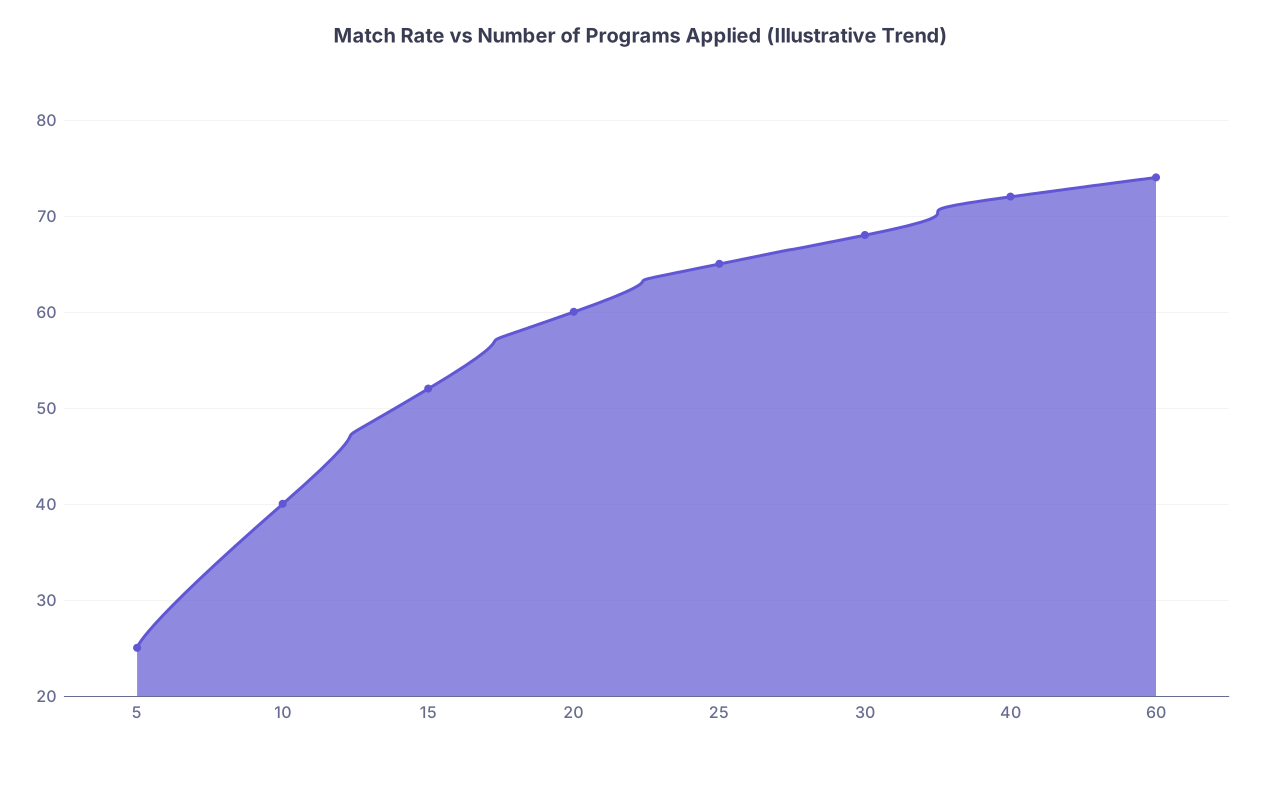
There is no universal “correct” number, but there are rational ranges based on your competitiveness and constraints. As an MD graduate in the obstetrics match, your program selection strategy should balance:
- Maximizing your chance to match
- Avoiding unnecessary financial and emotional strain
- Staying aligned with your true priorities
1. Typical Application Ranges for OB GYN
For MD graduates from allopathic medical schools (no major red flags), recent trends suggest:
Highly competitive applicants
- Strong scores, honors, strong letters, research
- Often apply to 25–40 OB GYN programs
Average competitive applicants
- Solid but not stellar metrics
- Typically apply to 40–60 OB GYN programs
Borderline or at‑risk applicants
- Lower scores, failed exams, limited OB GYN exposure, or other red flags
- Often apply to 60–80+ OB GYN programs
These are general guidelines for how many programs to apply to, not rigid rules. Your own constraints (geography, couples match, visa, SOAP risk) may push you higher or lower.
2. Adjustments for Specific Situations
Strong geographic restrictions (e.g., want only Northeast or only West Coast):
- You will likely need to apply to more programs within your chosen region, often at the upper end of the ranges.
Couples Match:
- You often need a larger combined list, because both partners must match in compatible locations. Planning 50–70 programs each is common, with careful mapping of overlaps.
Significant red flags:
- Failed Step exams, multiple leaves, or professionalism concerns → apply broadly and early, maximizing your range of programs and being open to smaller or less well‑known programs.
Dual interest (e.g., OB GYN + another specialty):
- Complex and needs individualized advising; splitting focus can reduce your competitiveness in each specialty.
3. Strategic Distribution: Reach, Target, and Safety
Borrow a structure from college applications and apply it to the obstetrics match:
Reach programs (15–25%)
- Programs where your metrics and profile are below their historic averages or they are highly competitive academic centers.
Target programs (50–60%)
- Programs that historically match applicants with profiles similar to yours—these should form the core of your list.
Safety programs (15–25%)
- Programs where you are likely to be above their typical applicant metrics, including smaller or less geographically popular locations.
Example for an average MD graduate applying to 50 programs:
- ~10 reach
- ~30 target
- ~10 safety
This distribution helps ensure you’re not overloading your list with ultra‑competitive “dream” academic centers while neglecting realistic opportunities.

Step‑by‑Step Program Selection Strategy for OB GYN
To move from theory to action, here is a practical, stepwise approach to building your OB GYN program list.
Step 1: Define Non‑Negotiables and Preferences
Write down:
Absolute non‑negotiables
- “Must be within driving distance of my partner’s job”
- “Must have in‑house MFM fellowship”
- “Cannot live in cities above X cost of living index”
Strong preferences (but not deal‑breakers)
- Size of resident class (small vs. large)
- Level of operative exposure vs. research
- Specific focus areas (global health, family planning, MIGS)
Clarity here prevents you from later applying to dozens of programs you’ll never realistically rank highly.
Step 2: Generate a Broad Initial List
Use:
- FREIDA, AAMC Residency Explorer, individual program websites
- Input from mentors, advisors, and recent OB GYN graduates from your school
- Specialty interest group sessions or departmental meetings on the obstetrics match
Generate an initial list larger than you intend to apply to (e.g., 80–100 programs). Don’t worry about trimming yet.
Step 3: Categorize by Competitiveness and Fit
For each program, consider:
- Approximate competitiveness (academic reputation, required metrics if disclosed)
- Match outcomes (where their residents go afterward)
- Geographic viability
- Fit with your goals (fellowships, volume, culture)
Label each as:
- R = Reach
- T = Target
- S = Safety
- X = Poor fit / remove
As you gather more information, you might recategorize. Talk to:
- Current or former residents (via alumni network, social media, interest groups)
- Advisors with insight into OB GYN programs
- Faculty who know how specific programs treat residents
Step 4: Narrow to a Balanced, Realistic List
Trim your list down to your target application number (e.g., 40–60 programs for a typical MD graduate). Confirm:
- You have a healthy mix of R/T/S programs
- You are not overly concentrated in one very competitive city or region unless necessary
- Every program left on your list is a place you would seriously consider ranking
Step 5: Prepare for Signaling (If Applicable)
If your cycle includes program signaling (as some specialties are adopting):
- Use your highest‑priority signals for programs you truly would prioritize and where you are a plausible match.
- Avoid using all top signals on “reach” programs with minimal realistic chance of interviewing you.
Signals are a major component of present‑day program selection strategy; use them intentionally.
Step 6: Continually Update During Interview Season
Once interview offers begin:
- Track which programs respond and when.
- Consider adding a few more applications (if not late) if you see very few interviews from your target tier.
- Be honest about your bandwidth; scheduling 20+ interviews can be logistically and emotionally draining.
Your goal is not simply to collect interviews, but to focus on programs where you could truly thrive.
Common Pitfalls and How to Avoid Them
Even strong MD graduates can undermine their obstetrics match prospects by mismanaging their program selection strategy. Watch for these common issues:
1. Over‑reliance on Name Recognition
Prestigious academic centers are appealing, but:
- They are often among the most competitive in OB GYN.
- They may not automatically provide better operative experience than a high‑volume community program.
- They can contribute to an unbalanced list heavy in “reach” programs.
Mitigation: For every “dream” academic program, identify 2–3 solid target or safety programs you would still be happy attending.
2. Ignoring Personal Fit and Wellness
Matching at a “top” OB GYN residency that doesn’t support your learning style or wellness needs can lead to burnout. During interviews, ask:
- “How has the program responded to resident feedback in the past few years?”
- “What changes have been made to improve wellness or workload?”
- “Can you describe a time when a resident struggled and how the program supported them?”
Assess not just the words, but the tone and specifics of the responses.
3. Applying Too Narrowly Geographically Without a Backup Plan
If you apply to only a small number of programs in one city or state and you’re not a standout applicant, you significantly increase your risk of going unmatched.
Mitigation:
- If geography is non‑negotiable, maximize the number of programs you apply to in that area, and still consider a few backup regions or less competitive nearby areas.
4. Underestimating the Financial and Emotional Cost
Application fees, interview travel (if in‑person), or time off from rotations for virtual interviews add up. Strategize early:
- Budget realistically
- Plan your clinical schedule to allow interview flexibility
- Remember that strategic applications trump simply more applications
FAQs: Program Selection Strategy for MD Graduates in OB GYN
1. As an MD graduate, is OB GYN too competitive for me if my scores are average?
Not necessarily. The allopathic medical school match in OB GYN is competitive, but many MD graduates with average scores match successfully every year. Focus on:
- Strong OB GYN letters from faculty who know you well
- A clear, consistent narrative about why OB GYN fits you
- A balanced list of programs (reach/target/safety) and sufficient application volume (often 40–60 programs for average applicants)
- Demonstrating reliability, work ethic, and teachability in your OB GYN rotations
2. How important is research for an OB GYN residency application?
Research is helpful but not mandatory for many OB GYN programs, especially community or hybrid programs. It becomes more important if:
- You are aiming for academic careers or fellowships
- You want to match at highly competitive university programs
Even small projects (case reports, quality improvement, posters) demonstrate initiative. However, strong clinical performance and letters often carry more weight than research for many programs.
3. Should I apply broadly or only to places where I have geographic ties?
Geographic ties help, but restricting yourself too narrowly can be risky. A safe strategy is:
- Prioritize programs in regions where you have ties or genuine interest
- Still include a broader mix of programs in other regions, especially if your metrics are average or below average
- Explicitly mention geographic ties and reasons for interest in your personal statement or program‑specific communication when appropriate
4. How do I know if my program list is large enough?
Ask yourself:
- Do I have at least 12–15 realistic interviews in mind as a goal (data suggest this provides a strong likelihood of matching in many specialties, including OB GYN)?
- Does my list include a balanced mix of reach, target, and safety programs?
- Have I incorporated my personal constraints (geography, couples match, visa status) realistically?
If you’re uncertain, review your list with an OB GYN advisor or program director at your medical school. They can provide specialty‑specific insight into whether your program selection strategy and number of programs are appropriate for your profile.
By grounding your decisions in a realistic self‑assessment, clearly defined goals, and a thoughtful distribution of programs, you can approach the obstetrics match with confidence. For an MD graduate, a strategic, data‑informed, and honest approach to program selection in OB GYN often matters as much as any single exam score—and it’s completely within your control.