Understanding the Landscape: Cardiothoracic Surgery Residency for MD Graduates
Cardiothoracic surgery remains one of the most competitive and demanding specialties in medicine. For an MD graduate residency candidate, crafting a smart program selection strategy is just as important as building an impressive CV. Choosing where to apply—and how many programs to apply to—directly affects your odds of an allopathic medical school match in this field and your long-term career trajectory in heart surgery.
Today’s landscape includes multiple pathways to cardiothoracic surgery residency:
- Traditional pathway:
- General Surgery Residency (5 years) → Cardiothoracic Surgery Fellowship (2–3 years)
- Integrated pathway (I-6):
- Direct Cardiothoracic Surgery Residency from medical school (6 years)
- Early specialization / fast-track models (4+3, etc.) at some institutions
Before deciding how to choose residency programs, you must be crystal clear on:
- Your pathway preference (I-6 vs. traditional)
- Your risk tolerance (how competitive you are vs. how selective you can afford to be)
- Your geographic, lifestyle, and career priorities
- Your timeline (are you willing to reapply or consider preliminary/transition options if needed?)
This article will walk you through a stepwise, evidence-informed program selection strategy tailored to MD graduates targeting cardiothoracic surgery, with a particular focus on:
- How many programs to apply to
- How to build a balanced list
- Concrete criteria to evaluate programs
- Practical tactics to maximize interview invitations and match success
Step 1: Assess Your Competitiveness Objectively
Before you can build a rational program list, you must understand where you stand in the national applicant pool. For an MD graduate residency candidate targeting cardiothoracic surgery, especially an integrated I-6 spot, competitiveness is intense.
Core elements of competitiveness
USMLE / COMLEX Scores
- Step 1 may be pass/fail but your numeric score (if known) and Step 2 CK are still important.
- I-6 programs often interview applicants with Step 2 CK scores well above the national average.
- For traditional track (General Surgery first), competitive academic programs still look closely at Step 2.
Clinical Performance
- Honors or high performance in:
- Surgery clerkship
- Sub-internships (especially Cardiothoracic or General Surgery)
- Strong, specific comments in dean’s letter/MSPE.
- Honors or high performance in:
Research and Scholarly Output
- Cardiothoracic programs strongly value:
- Publications (especially in cardiothoracic, cardiac, thoracic, or vascular surgery)
- Abstracts, posters, presentations at conferences (STS, AATS, ACC, etc.)
- Dedicated research years significantly strengthen academic applications, but are not mandatory everywhere.
- Cardiothoracic programs strongly value:
Letters of Recommendation
- 1–2 letters from cardiothoracic surgeons are highly valuable.
- Letters from:
- General surgeons
- Surgery chair or program director
- Priority is detailed, enthusiastic advocacy over big names with generic content.
Institutional Prestige / Network
- Graduating from a strong allopathic medical school with a cardiothoracic presence can help.
- However, MDs from less well-known schools match successfully if other components are excellent.
Additional Differentiators
- Advanced degrees (MPH, MS, PhD) with relevant focus
- Significant leadership, teaching, or quality improvement projects
- Meaningful longitudinal commitment to CT surgery (mentorship, shadowing, labs)
Rough competitiveness tiers (for planning, not self-worth)
These are broad categories to guide program selection strategy:
- Tier 1 – Highly Competitive
- Step 2 CK comfortably above national means for matched surgical applicants
- Strong surgery grades (mostly honors)
- Multiple CT-related publications or substantial research portfolio
- Strong CT surgeon letters
- Tier 2 – Solid Candidate
- Step 2 CK around national mean for matched surgery applicants
- Mostly high passes with some honors, strong narrative comments
- Some research, not all CT-specific, or fewer total outputs
- Good, specific letters including at least one surgeon
- Tier 3 – At-Risk / Underdog
- Step 2 CK near or below national mean, or retake/failed exam history
- Mixed evaluations or some concerning comments
- Limited research
- Fewer subspecialty connections or weaker letters
Be honest with yourself. This self-assessment will shape how many programs to apply to and how selective you can reasonably be, especially if aiming for integrated I-6 cardiothoracic surgery residency.
Step 2: Decide on Pathway and Risk Level
Choosing between integrated CT and traditional pathway
Integrated (I-6) Cardiothoracic Surgery Residency
- Pros:
- Earlier and more concentrated exposure to heart surgery training
- Direct mentorship and identity as a CT surgeon from day one
- Shorter total training time (often 6 years instead of 7–8)
- Cons:
- Extremely competitive, low number of positions
- Less flexibility if later you consider switching specialties
- Best for:
- Highly committed MD graduates with early, sustained CT interest and strong portfolios
- Pros:
Traditional Pathway (General Surgery → CT Fellowship)
- Pros:
- More positions overall; more flexibility and broader training
- Time to mature clinically and confirm CT as a career
- Options to pivot to vascular, trauma, surgical oncology, etc., if interests change
- Cons:
- Longer path to independent practice
- CT fellowship still competitive, especially at top centers
- Pros:
Many applicants apply to both:
- I-6 programs as “reach” options
- Categorical General Surgery programs (including strong CT exposure) as the primary or backup route
Your program selection strategy should reflect:
- Your risk tolerance (Is it I-6 or bust? Or would you be content and well-served by the traditional path?)
- Your geographic and lifestyle flexibility
- Willingness to reapply if you don’t match the first cycle
Step 3: How Many Programs to Apply To?
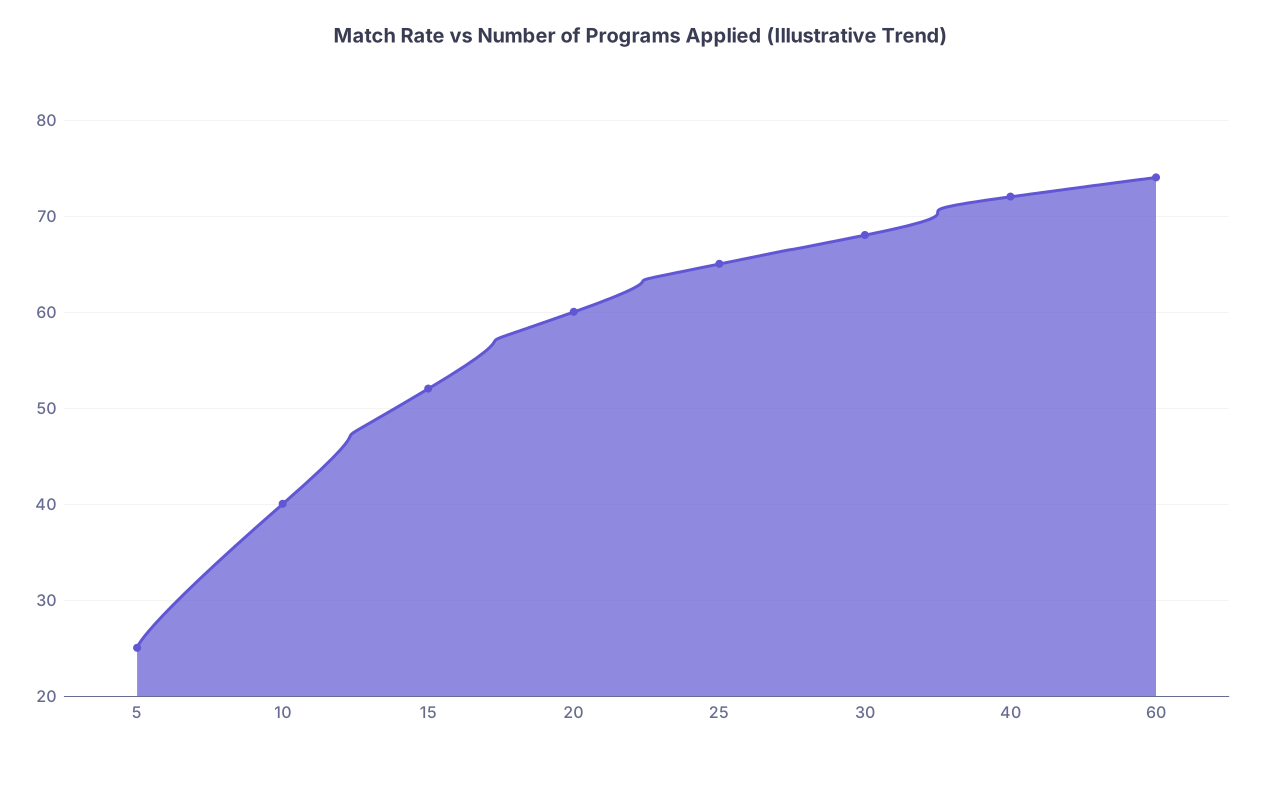
The question of how many programs to apply is central to an effective strategy. Numbers will vary by competitiveness tier, but cardiothoracic surgery (especially I-6) demands a broad approach.
For Integrated (I-6) Cardiothoracic Surgery Programs
- Nationwide, positions are limited and applicant-to-seat ratios are high.
- Many strong applicants still do not match into I-6 even with excellent applications.
Suggested ranges for MD graduates:
- Tier 1 (Highly Competitive)
- I-6 CT: 15–25 programs, essentially all that fit your geographic and program-type preferences
- Plus: A substantial list of General Surgery programs (see below)
- Tier 2 (Solid Candidate)
- I-6 CT: 20–30 programs (most/all accredited I-6s except those clearly misaligned with your goals)
- Plus: Robust General Surgery list
- Tier 3 (At-Risk / Underdog)
- I-6 CT: Selectively 10–20 programs (strong fit where you have connections or compelling narrative)
- Heavily emphasize General Surgery applications
Because of the risk, most MD graduates should not apply to I-6 programs alone. Even competitive candidates should back up with a reasonable number of General Surgery applications.
For General Surgery Programs (Traditional Pathway)
The number depends heavily on your competitiveness and any red flags.
- Tier 1
- Categorical General Surgery: 25–40 programs
- Focus on academic centers with robust cardiothoracic exposure, but include a few strong community-based programs.
- Tier 2
- Categorical General Surgery: 35–60 programs
- Ensure a mix of academic, hybrid, and community programs across multiple regions.
- Tier 3
- Categorical General Surgery: 50–80 programs
- Cast a wide geographic net and include a higher proportion of community and mid-tier academic programs.
- Consider a small number (5–10) of preliminary surgery positions as an extra safety net (but treat these as backup, not primary plan).
Balancing cost, time, and yield
Application fees and time to tailor documents are real constraints. A strategy that often works:
- Prioritize programs where you have:
- Regional ties (grew up, went to school, family)
- Research or rotation connections
- Strong alignment of interests (e.g., congenital, aortic, transplant, minimally invasive)
- Then expand to additional programs that are:
- Realistic based on your metrics
- Willing to consider MD graduates from a broad range of schools
Think in terms of “diminishing returns”: going from 10 to 25 programs greatly increases your chances; going from 60 to 80 may add only a little.

Step 4: Building a Balanced Program List
Once you know how many programs to apply to, the next task is how to choose residency programs and build a balanced list.
Key axes for program selection strategy
- Program Type
- Academic tertiary/quaternary centers
- University-affiliated community programs
- Community-based with strong CT affiliations
- Geography
- Regions where you have support systems or ties
- Willingness to relocate to underrepresented areas (Midwest, South, rural)
- Competitiveness Tier of Programs
- “Reach” programs: top-tier academic or extremely competitive geographic zones
- “Target” programs: solid academic or hybrid programs where your profile is well-aligned
- “Safety” programs: less competitive or more geographically flexible programs
How to categorize specific programs
Use publicly available data plus personal insights:
- Program websites and social media
- FREIDA, ERAS listings
- NRMP data (if available for applicable tracks)
- Conversations with:
- Residents and fellows in CT surgery
- Your home institution’s CT and general surgery faculty
- Recent graduates who matched into surgery or CT
Ask mentors to help you classify programs into your own reach/target/safety buckets.
Specific criteria for cardiothoracic-focused candidates
When choosing General Surgery programs with an eye toward CT fellowship later, look beyond prestige:
Presence and Strength of In-House CT Division
- Active cardiac, thoracic, and/or congenital services
- Volume of open heart, lung, esophageal, and complex cases
- Reputation of CT surgeons and fellowship program (if present)
Resident Access to Heart Surgery Training
- Ability for surgery residents to scrub into major CT cases
- Availability of CT rotations for junior and senior residents
- Opportunities for research with CT faculty
Fellowship Outcomes
- Where graduates go for CT fellowships
- Whether residents regularly match into good CT fellowships
Culture and Fit
- Operative autonomy vs. fellowship crowding
- Morale, mentorship culture, and attitude toward residents with CT interests
For integrated I-6 programs, examine:
- Case variety (adult cardiac, thoracic, congenital exposure)
- Graduates’ career paths (academic vs. private, transplant, aortic, structural heart, etc.)
- Early CT exposure structure
- Research infrastructure and expectations
- Mentorship and size of faculty group
Step 5: Practical Tactics to Refine and Optimize Your List
Use a scoring system
Create a spreadsheet and rank each program on factors important to you; for example:
- Strength of CT exposure (1–5)
- Geographic acceptability (1–5)
- Academic orientation and research potential (1–5)
- Resident happiness and support (1–5)
- Your perceived chance of obtaining an interview (1–5)
Sum or weight these scores and sort programs to refine your priorities. This makes your program selection strategy more systematic and less emotional.
Align your story with your list
Program selections should make narrative sense:
- If your application strongly emphasizes heart surgery training and research, a list full of programs without CT presence looks inconsistent.
- If your entire personal statement is about academic cardiac surgery, but your list is dominated by non-academic programs, that mismatch can be noticeable.
Your chosen programs should reflect your:
- Career goals (academic vs private, cardiac vs thoracic vs congenital)
- Personal circumstances (family, geography, visa status)
- Training preferences (large vs small program, heavy research vs clinically focused)
Use signals if available
Some specialties and institutions use signaling systems (preference signaling, supplemental applications) to identify genuinely interested applicants. If CT or General Surgery programs you’re targeting participate:
- Use your limited signals on:
- Programs where you are a realistic candidate
- Places that are top priorities for fit, geography, or mentorship
- Avoid signaling pure “reach” programs where your chance of an interview is extremely low.
Be ready to adjust in real time
Application strategy isn’t fully static:
- If you recognize late that you significantly under-applied, you may add a small number of programs within the ERAS system’s open timelines (recognizing late applications are less ideal).
- If you realize your interests within CT have shifted (e.g., more thoracic oncology than cardiac), you might re-evaluate which programs offer the right case mix and research.

Step 6: Leverage Mentors, Networking, and Home Advantages
Maximize your home institution
If your allopathic medical school has a cardiothoracic division:
- Seek early mentorship:
- Meet CT faculty: ask about your application and pathway choice.
- Request honest feedback on competitiveness and program tiers.
- Rotate on CT and General Surgery:
- Demonstrate work ethic, curiosity, and team orientation.
- Ask for letters of recommendation from surgeons who know you well.
- Discuss specific programs with faculty:
- “How do you view X program in terms of CT training?”
- “Where do you think I’d be competitive?”
Away rotations and sub-internships
For cardiothoracic-minded MD graduates:
- Consider doing away rotations:
- At I-6 CT programs you are serious about
- At strong General Surgery programs with major CT services
- Goals of an away rotation:
- Confirm fit with program culture and workload
- Build advocates who can speak to your skills in real time
- Demonstrate sustained interest in CT surgery
Away rotations can influence both interview offers and rank list decisions, but they must be done thoughtfully (one or two key rotations, not a scattershot approach).
Networking at conferences and meetings
If you have access:
- Attend meetings (STS, AATS, regional surgical societies)
- Present your research if possible
- Introduce yourself to:
- Surgeons doing work in your interest area
- Faculty from programs on your application list
- Later, you can mention those interactions in applications or during interviews as a point of connection.
Step 7: Integrating Strategy with Life and Career Goals
Your program selection strategy should not be purely numerical or prestige-driven. For long careers in cardiothoracic surgery, sustainability matters.
Consider:
Geographic Needs
- Support system (partner, family, childcare)
- Cost of living and willingness to move to far regions
- Visa or immigration constraints, if applicable
Lifestyle and Culture
- Some programs have more intense 24/7 CT coverage demands than others.
- Resident well-being, mentorship, and support for life events can be crucial.
Long-Term Career Direction
- If you envision:
- High-end academic career in advanced cardiac, transplant, or structural heart: you might lean toward highly academic programs with NIH-funded labs and busy transplant services.
- Mixed practice or community-based CT: you might prioritize breadth of exposure and real operative autonomy over research volume.
- If you envision:
Backup and Contingency Planning
- For I-6 applicants:
- What is your plan if you don’t match? General Surgery the next year? Research year?
- For General Surgery applicants:
- Are you comfortable re-entering the match if you only obtain preliminary positions?
- Is there a threshold of program type or location below which you would choose to reapply?
- For I-6 applicants:
Being intentional about these questions will help you build a program list that optimizes not just the chance of an allopathic medical school match, but also the chance of a satisfying career.
Putting It All Together: Sample Strategy Scenarios
Scenario 1: Highly Competitive MD from a Research-Heavy Institution
- Strong Step 2 CK, multiple CT publications, letters from well-known CT surgeons.
- Strategy:
- Apply broadly to I-6 programs: 20–25 programs (most major academic I-6s).
- Apply to 25–30 academic General Surgery programs that:
- Have strong CT divisions
- Send residents regularly into CT fellowships
- Use signals and away rotations to emphasize top 3–5 programs.
- Emphasize heart surgery training and academic interests in application materials.
Scenario 2: Solid Candidate with Strong Clinical Skills but Limited CT Research
- Good Step 2 CK, strong clinical performance, light research mainly in general surgery or QI.
- Strategy:
- Apply to I-6 CT programs: 20–25, focusing on programs known to value clinical performance and mentoring potential.
- Apply to 40–50 General Surgery programs:
- Mix of academic and hybrid programs
- Strong CT presence where possible
- One away rotation at a strong academic program.
- Personal statement: emphasize clinical excellence, growing CT interest, openness to traditional path.
Scenario 3: Underdog Applicant with Red Flags
- Marginal Step 2 CK or failed attempt, good improvement trend, but limited research.
- Strategy:
- Apply to I-6 CT selectively: 10–15 programs where:
- You have personal ties or faculty connections
- Reputation for holistic review
- Apply aggressively to 60–70 General Surgery programs, heavily including:
- Community and mid-tier academic programs
- Possibly a few preliminary positions as backup.
- Application narrative: highlight resilience, growth, and long-term commitment to surgery and CT ambitions.
- Apply to I-6 CT selectively: 10–15 programs where:
In all scenarios, consultation with mentors is essential, and lists should be refined based on their insider knowledge.
FAQs: Program Selection Strategy for MD Graduates in Cardiothoracic Surgery
1. Should I apply only to integrated (I-6) cardiothoracic surgery programs if that’s my dream?
For almost all applicants, the answer is no. I-6 positions are extremely limited, and even excellent candidates may not match. A safer strategy is to apply to I-6 programs and to a robust list of Categorical General Surgery programs that provide strong CT exposure. The traditional pathway still leads to outstanding careers in heart surgery, and using it as a parallel or backup route is wise.
2. How do I know if I’m competitive enough for an I-6 cardiothoracic surgery residency?
There is no absolute cutoff, but competitive applicants typically have:
- Strong Step 2 CK scores
- Honors or high-level performance in surgical rotations
- Clear CT exposure (rotations, shadowing, mentorship)
- Demonstrable academic productivity, ideally with CT-related research
- Compelling letters from CT and general surgeons
Ask CT faculty at your institution or mentors familiar with the match to review your CV and give an honest assessment of your competitiveness and target program tier.
3. If I’m primarily interested in thoracic (lung/esophageal) surgery rather than cardiac, does that change my program list?
Yes, it should inform both program choice and application narrative. When evaluating programs, examine:
- Thoracic surgery case volume (lung, esophagus, mediastinum)
- Thoracic oncology and minimally invasive/robotic programs
- Faculty interests and ongoing research
Some centers are more cardiac-heavy; others have balanced or thoracic-dominant practices. Emphasize this focus in your personal statement and ask thoracic surgeons specifically about training opportunities during interviews.
4. Is it better to train at a big-name general surgery program without strong CT exposure, or a less well-known program with excellent CT opportunities?
For someone committed to cardiothoracic surgery, quality and quantity of CT exposure often matter more than sheer name recognition, especially when it comes time to apply for CT fellowship. Ideally, you want a program where:
- You can work closely with CT faculty who will advocate for you.
- Residents are integrated into major CT cases.
- Graduates successfully match into solid CT fellowships.
Prestige can help, but direct mentorship and operative experience with CT surgeons are crucial for your heart surgery training and future opportunities.
By combining an honest self-assessment with a structured program selection strategy—thinking carefully about pathway, competitiveness, and how many programs to apply to—you can create a balanced and realistic application plan that maximizes your chance of matching and sets you up for a sustainable, rewarding career in cardiothoracic surgery.