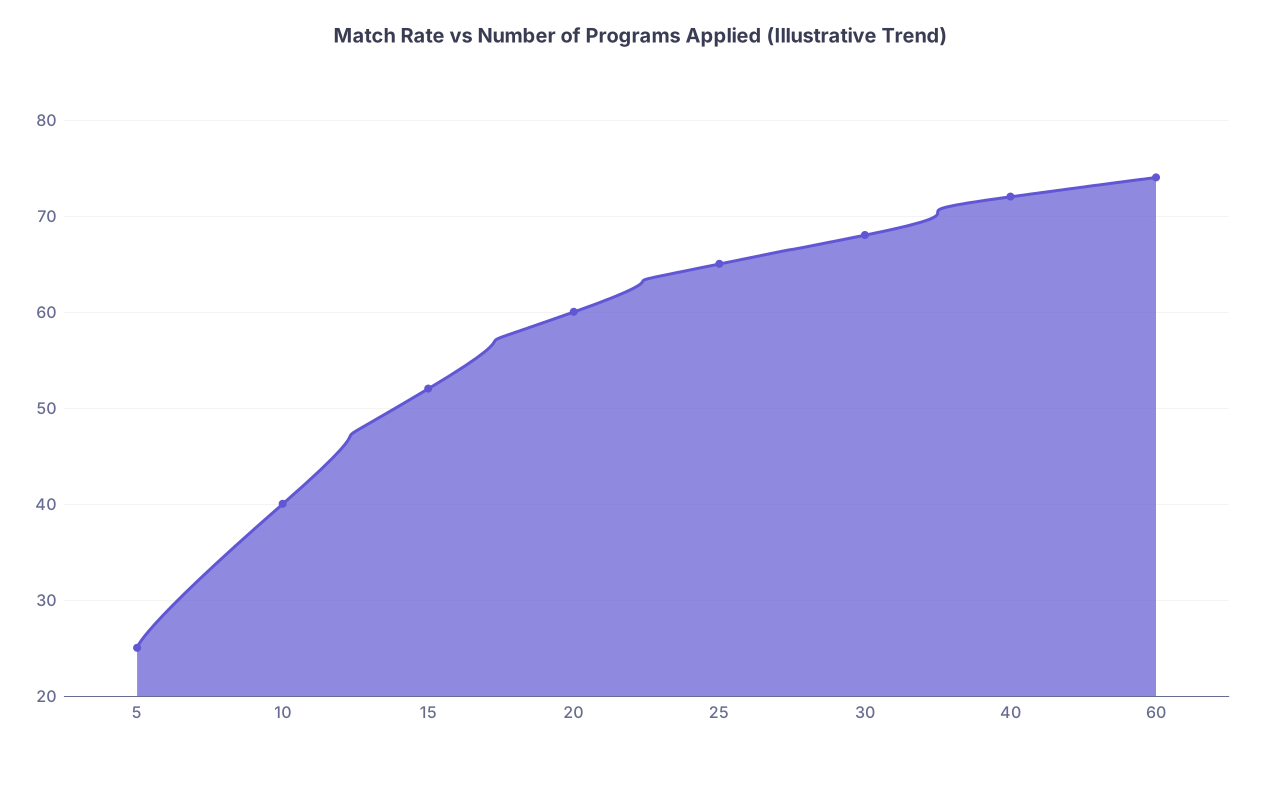
Choosing where to apply for psychiatry residency is one of the most important strategic decisions you’ll make as an MD graduate. Your program list will influence not only your chances of matching, but also the kind of psychiatrist you become and the life you build during training. This article will walk you through a step-by-step program selection strategy tailored specifically to an MD graduate seeking a psychiatry residency, with a strong focus on how many programs to apply to and how to choose them wisely.
Understanding the Psychiatry Match Landscape for MD Graduates
Before you build a program list, you need a clear sense of the current allopathic medical school match environment for psychiatry.
Psychiatry’s Competitiveness: Where It Stands Now
Psychiatry has become significantly more competitive over the last decade. There are more applicants (both MD and DO, plus IMGs), more interest in lifestyle-friendly specialties, and increased visibility of mental health needs.
Key realities for an MD graduate:
- As a U.S. allopathic MD graduate, you start with a relative advantage compared to some other applicant groups.
- That said, “MD graduate residency” does not guarantee a psychiatry match—you still need a thoughtful program selection strategy.
- Psychiatry is not as cutthroat as dermatology or plastics, but it is no longer a “safety” specialty.
You cannot control the applicant pool, but you can control how strategically you build your list.
Core Concept: Balancing Reach, Target, and Safety Programs
Think of your programs in three broad categories:
Reach programs
Highly competitive or “aspirational” for your profile (e.g., big-name academic centers, top-tier coastal programs, highly research-focused residencies).Target programs
Programs where your metrics and experiences are well-aligned with the average applicant they tend to interview and match.Safety programs
Solid, well-accredited programs where your statistics and experiences are stronger than the median applicant, often in less popular locations or smaller markets.
A smart program selection strategy for psychiatry residency almost always mixes all three—reaches, targets, and safeties—tailored to your competitiveness.
Step 1: Assess Your Candidacy Honestly
You cannot design a realistic psych match strategy without an honest self-assessment. This is the foundation of how to choose residency programs intelligently.
Key Objective Metrics
Consider where you fall on these primary axes:
USMLE/COMLEX performance
- Step 1: Now pass/fail, but failures still matter.
- Step 2 CK: Often the most important standardized metric left.
- Red flags: exam failures, large score gaps, incomplete attempts.
Clerkship and Psychiatry-Specific Performance
- Overall clinical grades (Honors/High Pass/Pass).
- Psychiatry clerkship grade and narrative comments.
- Sub-I/acting internship in psychiatry, if applicable.
Academic History
- Any leaves of absence, remediation, course failures, professionalism issues.
- Research productivity (especially in psychiatry or mental health-related fields).
- AOA or other academic distinctions.
Letters of Recommendation
- At least 2 strong letters from psychiatrists; ideally 1 from a department leader, rotation director, or research mentor.
Subjective but Crucial Factors
Depth of Commitment to Psychiatry
- Longitudinal psych-related activities (research, advocacy, community mental health).
- Psychiatry student interest group, teaching, or leadership.
- Personal statement and narrative coherence around why psychiatry.
Geographic Flexibility
- Willingness to train in less “popular” or competitive regions dramatically changes how many programs you need to apply to.
Red Flags / Contextual Concerns
- Gaps in training, legal or professionalism issues, or major career changes.
- Personal circumstances that constrain where you can train.
Rough Competitiveness Tiers for MD Graduates
While every file is unique, you can loosely map yourself into one of these:
Strong MD Applicant (Higher-Competitiveness)
- Strong Step 2 CK score (often above national mean).
- Solid clinical performance, with Honors or HP in medicine and psychiatry.
- Multiple strong psych letters, possibly research or leadership in psychiatry.
- No significant red flags.
Solid / Typical MD Applicant (Middle-Competitiveness)
- Step 2 CK around national mean.
- Mostly Pass/High Pass grades, solid but not spectacular.
- Some psych-related activities, decent letters.
- No major red flags.
At-Risk or Non-Traditional MD Applicant (Lower-Competitiveness)
- Step 2 significantly below mean, or exam failures.
- Academic gaps, remediation, or professionalism concerns.
- Limited psych exposure or late switch to psychiatry.
- Restricted geography or other constraints.
Your self-placement among these broad categories drives both how many programs to apply to and which.
Step 2: How Many Psychiatry Programs Should an MD Graduate Apply To?
One of the most common questions is: “How many programs should I apply to for psychiatry?” The honest answer: it depends on your competitiveness and flexibility, but you can anchor on evidence-based ranges.
General Ranges for U.S. MD Graduates Applying in Psychiatry
These are approximate application counts for categorical psychiatry residency positions:
Strong MD applicant, geographically flexible
- Target: 25–40 programs
- Rationale: You’ll likely receive a healthy number of interviews if your application is polished.
Solid/typical MD applicant, geographically flexible
- Target: 40–60 programs
- Rationale: Increases the number of interview opportunities across a range of program tiers.
At-risk MD applicant and/or geographically restricted
- Target: 60–80+ programs
- Rationale: You are compensating for risk factors or location limits by casting a wider net.
These are guidelines, not hard rules. Your advisor or dean’s office can help tailor the number, but underapplying is far riskier than slightly overapplying, as long as you curate your list intelligently.
Interviews Matter More Than Raw Application Count
Evidence from match data suggests that:
- Around 10–12 interviews for psychiatry is generally a comfortable zone for a strong chance of matching.
- For some at-risk applicants, 8–10 interviews might still be sufficient if the programs are well-chosen and rank lists are realistic.
- Applying to 80 programs but getting only 3 interviews is a red flag that your strategy needs rethinking.
Your aim in building your list is not just volume; it’s maximizing the probability of landing enough interviews across a balanced set of programs.

Step 3: Building a Smart Program List – A Structured Approach
Once you’ve estimated how many programs to apply to, the next challenge is how to choose residency programs and not just fire off applications randomly.
Step 3A: Define Your Non-Negotiables
These are factors that, if not met, you would seriously regret choosing a program—even if it’s prestigious.
Common non-negotiables for psychiatry applicants:
Geography
- Must be within X hours of family or partner.
- Cannot live in certain regions for personal, financial, or visa-related reasons.
Program Structure
- You need a program that sponsors visas (if applicable).
- You need strong psychotherapy training or a clear biological psychiatry orientation.
- Availability of child/adolescent, addiction, or other fellowships on-site.
Lifestyle / Personal Needs
- Access to specific religious, cultural, or community supports.
- Cost of living limits.
- Availability of spousal employment or reasonable commuting options.
Use these to filter out programs that are automatically poor fits before you even start ranking competitiveness.
Step 3B: Gather and Organize Program Data
Use a structured approach to researching programs:
Sources
- FREIDA, ACGME program listings.
- Individual program websites (rotation structure, call, didactics).
- Program Instagram/Twitter accounts (for culture and resident life).
- NRMP/Charting Outcomes for historical competitiveness trends.
- Advice from recent graduates and current residents.
Create a Spreadsheet Include columns such as:
- Program name, city, region
- Size of program (number of residents)
- Academic vs community
- Research emphasis (low/moderate/high)
- Psychotherapy training strength
- Subspecialties/fellowships
- Call schedule, night float structure
- Program vibe (based on resident testimonials, social media)
- Visa sponsorship (if needed)
- Preliminary competitiveness rating (reach/target/safety) for you
- Personal notes (why it appeals or why not)
This running database becomes the backbone of your program selection strategy.
Step 3C: Classify Each Program: Reach, Target, or Safety
Using your self-assessment and program data:
Reach psychiatry programs for MD grads often include:
- Highly ranked academic centers in major metro areas.
- Research-intensive institutions with strong NIH funding.
- Programs in extremely popular cities (NYC, SF Bay Area, LA, Boston, Seattle) with large applicant pools.
Target psychiatry programs may be:
- University- or university-affiliated programs in mid-sized cities.
- Solid academic-community hybrids in moderately competitive regions.
- Programs aligned with your strengths (e.g., psychotherapy-focused programs if you have strong narrative and humanities background).
Safety psychiatry programs:
- Community programs or smaller academic centers in less saturated regions (Midwest, South, some parts of the Mountain West).
- Newer or expanding programs with growing reputations.
- Programs where your school has a history of matching graduates.
As an MD graduate, your safety programs do not have to be poor quality—they’re often excellent training environments with fewer applicants due to location or name recognition.
Suggested Distribution of Reaches/Targets/Safeties
Depending on your tier:
Strong MD applicant (25–40 programs total)
- Reaches: ~7–10
- Targets: ~12–18
- Safeties: ~6–10
Typical MD applicant (40–60 programs total)
- Reaches: ~10–15
- Targets: ~18–25
- Safeties: ~12–20
At-risk MD applicant (60–80+ programs total)
- Reaches: ~10–18
- Targets: ~20–30
- Safeties: ~25–35+
Adjust based on geography; if you are very location-limited, you may have fewer true safety options and should maximize applications within your acceptable area.
Step 4: Key Factors to Evaluate in Psychiatry Programs
To move beyond just name recognition, look closely at what kind of psychiatrist each program is likely to shape you into.
1. Clinical Breadth and Patient Mix
Questions to ask:
- Does the program cover inpatient, outpatient, consult-liaison, emergency psychiatry, partial hospitalization, and intensive outpatient across diverse settings?
- Is there exposure to forensic, addiction, child/adolescent, geriatrics, psychosomatic medicine, community psychiatry?
- Do residents see patients from varied backgrounds (socioeconomic, cultural, diagnostic complexity)?
Broader, well-supervised exposure prepares you for independent practice and boosts your competitiveness for fellowships.
2. Psychotherapy Training
For many applicants, psychotherapy is a core reason to choose psychiatry.
Evaluate:
- Required psychotherapy cases (CBT, psychodynamic, supportive, group, family, etc.).
- Availability of long-term therapy cases and protected psychotherapy time.
- Supervision: who provides it (psychologists vs psychiatrists), how frequent, and how structured?
- Is there exposure to multiple modalities, not just one dominant model?
If you’re drawn to depth-oriented practice, this should weigh heavily in your program selection strategy.
3. Biological and Neuroscience Emphasis
If your interests include:
- Neuropsychiatry
- Psychopharmacology, brain stimulation (ECT, TMS, ketamine)
- Clinical trials or translational neuroscience
Look for:
- Access to neuroscience or brain imaging labs.
- Faculty publishing in biological psychiatry, psychopharmacology, or brain stimulation.
- Availability of electives in neuromodulation or advanced pharmacology.
4. Research and Academic Opportunities
For an MD graduate with academic or fellowship aspirations, research exposure can be a major differentiator.
Consider:
- Are there protected research tracks or research blocks?
- Number and accessibility of faculty mentors in your areas of interest.
- Historical rate of residents producing posters, publications, or book chapters.
- How many graduates go on to fellowships and academic positions?
If you envision a career in academic psychiatry, favor programs with a proven academic pipeline.
5. Culture, Wellness, and Support
Psychiatry training involves emotional labor. A supportive environment is essential.
Look for clues on:
- Resident happiness and burnout: What do residents say when they’re not “on script” (e.g., in Q&A panels)?
- Turnover: High rates of residents leaving or transferring can be a red flag.
- Wellness initiatives that are actually used, not just presented.
- Attending-resident relationships: Are they described as approachable and invested in teaching?
Program culture is harder to quantify but often becomes the deciding factor after interviews.
6. Logistics: Call, Schedule, and Moonlighting
Evaluate:
- Call frequency and structure (night float vs 24-hour call).
- Amount of weekend coverage.
- PGY-2 and PGY-3 schedules (often where outpatient and psychotherapy occur).
- Moonlighting opportunities and institutional policies, especially in later years.
Your day-to-day quality of life—and your ability to learn and grow—is heavily influenced by these structural factors.

Step 5: Special Considerations for MD Graduates
As an MD from an allopathic medical school, you have some structural advantages—but also specific decisions to navigate.
Leveraging Your School’s Match History
Your own institution is a goldmine of match data:
- Ask your dean’s office for recent psych match lists: where did prior MD grads match? What range of programs?
- Talk to recent psychiatry alumni:
- Which programs were realistic vs dream-level?
- How many applications did they submit?
- What surprised them in the interview process?
Programs that have already matched your school’s graduates are more likely to view you as a known quantity, which can shift a program from reach to target in your personal classification.
Away Rotations and Auditions
Away rotations can be strategically valuable if:
- You are targeting a specific geographic area far from your home institution.
- You are considering a highly competitive academic psychiatry residency and want to demonstrate interest.
- You have a later switch to psychiatry and need strong psych letters.
However:
- Don’t overdo away rotations; they’re demanding and can be high risk if you perform below expectations.
- Use them for programs that truly matter to you and where an away could realistically improve your odds.
Couples Match Strategy
If you are couples matching, program selection becomes more complex:
- Expand both of your lists to account for overlapping geographic options.
- Consider not just individual program quality, but regional clusters of programs (e.g., several psych programs + several IM programs in the same city/region).
- Discuss in advance how you’ll prioritize:
- Your top-tier psych program + partner’s less preferred program vs both mid-tier but same city.
This often increases how many programs to apply to for each of you, but a structured list and shared spreadsheet can keep it manageable.
Step 6: Iterating Your Strategy During the Application Season
Your program selection strategy is not static. You’ll adapt based on how the application season unfolds.
1. Early Signals: MSPE Release and First Wave of Interviews
As interviews start coming in:
If you have few or no invites by mid-late October:
- Reassess: Are your safety programs truly safeties?
- Discuss with advisors: Are there red flags you underestimated?
- Consider applying to an additional set of true safety programs, if still feasible.
If you have many invites from your target and safety tiers:
- You may not need to add more applications.
- Focus on quality interview preparation and thoughtful program comparisons.
2. Knowing When to Stop Applying
A common anxiety is: “Should I keep adding more programs?”
Guiding principles:
- Once you have ~10–12 solid interview offers, additional applications often yield diminishing returns.
- If you are still below ~8 interviews by November, adding programs may still be reasonable, especially in less popular regions or community-based psych programs.
Continually reassess with trusted mentors who understand the psych match specifically.
3. Post-Interview Reassessment for Rank List
After your interview season:
- Re-evaluate your classification of programs (some reaches may feel less appealing; some safeties may become favorites).
- Consider:
- Where did you feel safe, respected, and excited to learn?
- Which programs offered the kind of psychiatry you want to practice?
- Where did residents appear genuinely content?
Your rank list ultimately matters more than your initial application list—but a strategic list ensures you get to this stage with enough interviews to rank.
Putting It All Together: A Sample Strategy for an MD Applying to Psychiatry
Imagine you are a typical MD graduate:
- Step 2 CK near national mean.
- Mostly Pass/HP, with HP in psychiatry.
- Some research in mental health stigma, one poster presentation.
- Strong psych letters, no major red flags.
- Geographically flexible but slightly prefers East Coast.
A reasonable program selection strategy might look like:
- Total applications: ~45–50 programs
- Distribution:
- ~12 reach programs: well-known academic centers in major East Coast cities.
- ~20 target programs: solid university-affiliated programs in mid-sized cities across East Coast, Midwest, and South.
- ~13–18 safety programs: community or smaller academic programs in less dense regions that historically match MD grads from schools similar to yours.
You track interview invitations and, by November, have:
- 3 reach interviews
- 7 target interviews
- 4 safety interviews
With 14 interviews total, you are in an excellent position for the psych match. At this point, adding many more applications is unlikely to significantly change your outcome; time is better spent preparing thoroughly for interviews and refining your understanding of each program’s fit.
FAQs: Psychiatry Program Selection Strategy for MD Graduates
1. As an MD graduate, can I safely apply to fewer psychiatry programs than DOs or IMGs?
You may not need to apply as broadly as some non-MD applicants, but do not underestimate psychiatry’s competitiveness. For most U.S. MDs, a range of 25–60 programs, depending on risk factors and geography, is reasonable. Apply less only if multiple experienced advisors agree your application is very strong and your goals are flexible.
2. How do I decide if a highly ranked “name-brand” program is worth applying to?
Consider it a reach program if:
- Your scores and experiences are below their typical ranges.
- You have no direct connection or away rotation there.
If you’re passionate about that program’s strengths (e.g., research, psychotherapy, subspecialty training), it may be worth a reach application. Just ensure you have enough target and safety programs to maintain a strong overall psych match strategy.
3. Should I favor programs with fellowships on-site (e.g., child, addiction, forensics)?
If you have a strong interest in a subspecialty (like child & adolescent or addiction), programs with on-site fellowships can be advantageous:
- More mentorship and exposure.
- Often better preparation for fellowship applications.
- Sometimes higher rates of internal fellowship matches.
However, lack of an on-site fellowship should not automatically disqualify a program if it’s otherwise a strong fit.
4. What if I realize mid-season that my interview numbers are low?
If, by late October or early November, you have fewer than ~5–6 interviews:
- Seek urgent feedback from a dean or psych advisor; review your application for red flags.
- Consider applying to an additional batch of true safety programs, especially in less competitive regions.
- Ensure your email, ERAS, and spam filters are functioning correctly and your availability is clearly communicated to programs.
Adapting your program selection strategy mid-season is common; the key is to respond early and strategically, not out of panic.
A thoughtful, data-informed program selection strategy can transform the psychiatry residency application process from chaotic and anxiety-provoking into something purposeful and empowering. As an MD graduate seeking a psychiatry residency, your strength lies not only in your credentials but in your ability to be deliberate—about how many programs to apply to, where to focus your energy, and how to choose programs that will truly support your growth into the kind of psychiatrist you hope to become.