Understanding Your Unique Position as a Non‑US Citizen IMG
As a non-US citizen IMG (international medical graduate), you bring valuable perspectives to addiction medicine: cross-cultural experience, language skills, and often a deep commitment to working with underserved communities. At the same time, you face specific structural challenges that must shape your program selection strategy:
- Visa status and sponsorship needs
- Lack of US citizenship or permanent residency
- Variable recognition of your medical school and clinical experience
- Less access to US clinical connections and letters of recommendation
- Need to demonstrate commitment to substance abuse training despite limited opportunities abroad
Your goal is to build a data-driven, realistic, and personalized list of programs that balances:
- Maximizing your chances to match
- Aligning with your career goals in addiction medicine
- Fitting your visa and geographic constraints
- Protecting your time, money, and mental energy
This article will walk you through a structured approach to how to choose residency programs, how to decide how many programs to apply to, and how to prioritize programs that set you up for an addiction medicine fellowship or a career focused on substance use disorders.
Step 1: Clarify Your Career Goals in Addiction Medicine
Before you open any program search tool, you should be clear about what you want from training. Addiction medicine is a rapidly evolving field with diverse career paths. Your program selection strategy should be anchored in your long-term goals.
1.1 Define Your End Goal
Think concretely about where you want to be 5–10 years from now:
Common paths for IMGs interested in addiction medicine include:
Academic addiction specialist
- Aim: Faculty position, research, teaching
- Best fit: University-affiliated programs, strong research infrastructure, NIH-funded addiction studies, addiction psychiatry or addiction medicine fellowship pathways
Community-based addiction physician
- Aim: Work in outpatient addiction clinics, methadone or buprenorphine programs, community mental health centers, FQHCs
- Best fit: Community-based or hybrid programs with strong substance abuse training and community rotations
Hospital-based addiction consultant
- Aim: Serve on inpatient consult services, manage complex dual-diagnosis cases
- Best fit: Large academic medical centers with addiction consult services, integrated behavioral health models
Global or public health–oriented addiction physician
- Aim: Work with NGOs, international organizations, policy and advocacy
- Best fit: Programs with public health affiliations, MPH options, global health tracks, or robust population health training
1.2 Decide Your Entry Specialty vs. Later Fellowship
Addiction medicine in the US is typically pursued through:
Primary specialty (residency):
- Internal Medicine
- Family Medicine
- Psychiatry
- (Less commonly: Emergency Medicine, Pediatrics, OB/GYN, etc., depending on the fellowship and board pathways)
Subsequent addiction medicine or addiction psychiatry fellowship
Your program selection strategy must account for this two-step structure:
Choose a residency specialty that:
- You can realistically match into as a foreign national medical graduate
- Offers solid general training and exposure to substance use disorders
- Has pathways into addiction medicine fellowship
Prioritize residency programs that:
- Have an in-house addiction medicine fellowship or addiction psychiatry fellowship, or
- Have strong relationships with external fellowships and clear placement history
1.3 Translate Goals into Selection Criteria
Turn vague preferences into concrete filters:
Examples:
“I want strong substance abuse training” →
Look for:- Dedicated addiction rotation(s)
- Faculty with addiction board certification
- Buprenorphine waiver training
- Addiction research projects available to residents
“I want a high chance to match as a non-US citizen IMG” →
Look for:- Recent history of taking non-US citizen IMGs
- Clear visa sponsorship (J-1 and/or H-1B)
- Reasonable step score expectations aligned with your profile
Document your top 5–7 must-have features and 3–5 “nice-to-have” features. You will use these to rank and filter programs later.

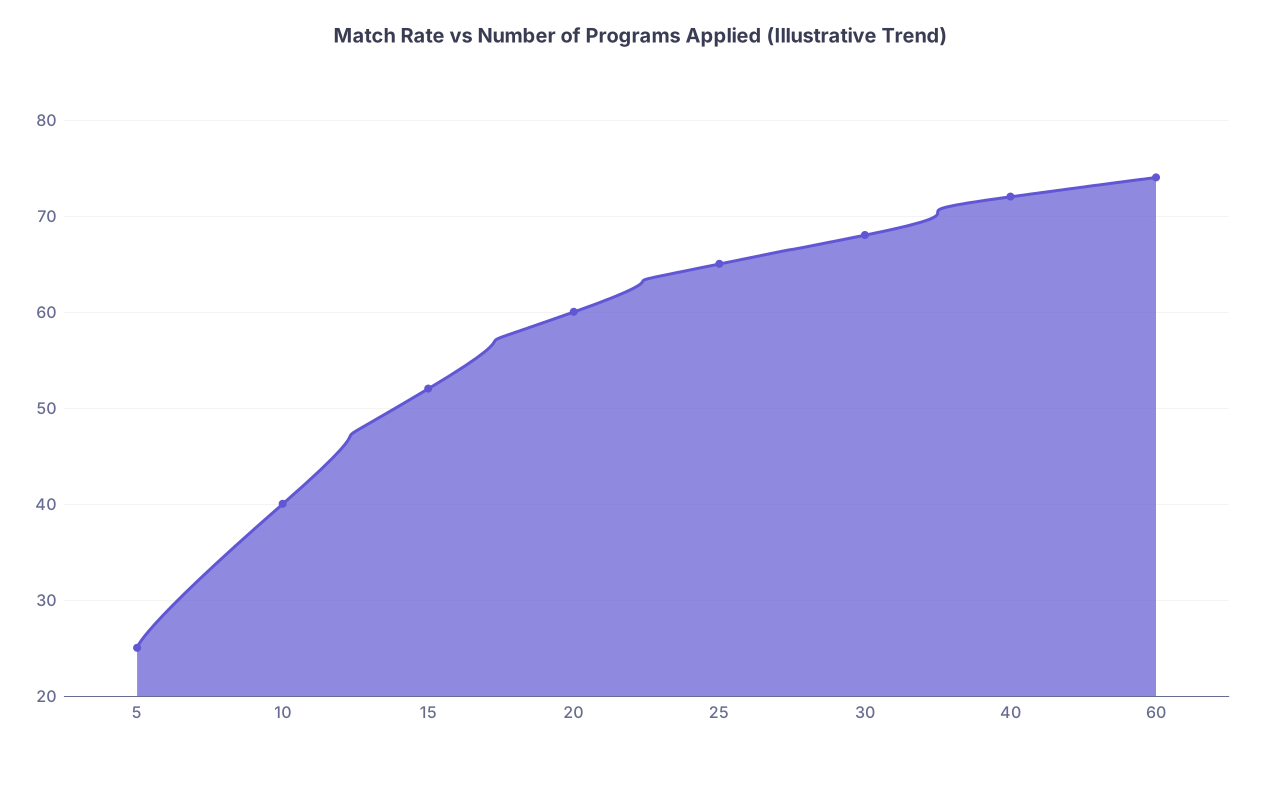
Step 2: Understand the Numbers – How Many Programs to Apply To?
For non-US citizen IMGs, how many programs to apply to is a crucial strategic question. Your answer should depend on:
- Specialty competitiveness
- Your individual profile
- Visa needs
- Budget and time
2.1 General Benchmarks for IMGs
While exact numbers vary by cycle and specialty, these are general ranges for non-US citizen IMGs:
Highly competitive specialties (e.g., categorical Psychiatry at elite academic centers):
60–100+ programs is common if qualifications are average or mixed.Moderately competitive for IMGs (e.g., many Internal Medicine and Family Medicine programs):
40–80 programs depending on your strength and visa needs.Preliminary/TY positions or less IMG-friendly fields:
Could need 80–120+ if your profile has significant weaknesses.
Because you are specifically targeting a pathway into addiction medicine, you must first secure a primary residency. That means:
- If aiming for Psychiatry: err toward a higher number in the range (e.g., 70–100+), especially as a non-US citizen IMG.
- If aiming for Internal Medicine or Family Medicine:
- Very strong applicant: 40–60 programs may be sufficient
- Average or weaker applicant: 60–90 programs may be necessary
These numbers are not rules, but starting points. Adjust based on your profile and constraints below.
2.2 Factors That Should Increase Your Application Count
You should apply to more programs if you have:
- Need for visa sponsorship and:
- Only J-1 eligible OR
- Hoping for H-1B (far fewer programs offer this)
- Older year of graduation (3+ years since graduation without strong, recent clinical work)
- Limited US clinical experience
- Step 1/Step 2 CK scores below the average of matched IMGs in your target specialty
- Multiple exam attempts
- No US letters of recommendation in the specialty
Each of these should push you toward the upper end of the application number ranges.
2.3 Factors That Allow a Lower Application Count
You may cautiously apply to fewer programs if you have:
- Strong exam performance
- High Step 2 CK (and Step 3 if taken)
- No failures, no attempts repeats
- Robust US clinical experience, especially in your target specialty
- Multiple strong US letters of recommendation from faculty known in the field
- Demonstrable addiction medicine interest, such as:
- Addiction research
- Clinical work in substance abuse settings
- Quality improvement focused on substance use
- Graduation within the last 1–3 years
- Fluent English with proof via communication-heavy experiences
Even in these cases, as a non-US citizen IMG, it’s usually not wise to go below 35–40 programs in a new or moderately competitive specialty.
Step 3: Build a Filtered Target List – From Hundreds to a Realistic Set
Most applicants start with an overwhelming number of programs. The key to a smart program selection strategy is to systematically filter and categorize.
3.1 First Filter: Visa and IMG Friendliness
As a foreign national medical graduate, the first question is not: “Do I love this program?”
It is: “Can I legally train there, and do they actually interview people like me?”
Use official sources (program websites, FREIDA, NRMP data, program emails) to check:
- Visa sponsorship:
- J-1 only
- H-1B and J-1
- None
- Recent history of non-US citizen IMGs:
- Look at current residents on program websites
- Check how many IMGs in current and recent classes
- Note: some “IMG-friendly” programs take mostly US-IMGs, not non-citizen IMGs
Actionable filter:
Eliminate programs that:
- Clearly state “No visa sponsorship”
- Explicitly accept only US citizens/permanent residents
Flag programs that:
- Have at least one or more non-US citizen IMG currently or recently in training
- Sponsor the visa type you intend to use
This alone will often reduce your list by 20–50%.
3.2 Second Filter: Alignment with Addiction Medicine Interests
Next, among programs that can legally accept you, identify those that support your addiction-focused career:
Look for the following on program or institution websites:
Addiction medicine fellowship on site
- Even if you may not stay for fellowship, this signals a strong institutional commitment to addiction care and substance abuse training.
Addiction psychiatry fellowship (for psychiatry applicants)
Dedicated addiction rotations:
- Outpatient MAT (medication-assisted treatment) clinics
- Inpatient detox units
- Dual-diagnosis units
- Addiction consult services
Addiction-trained faculty:
- Board-certified in addiction medicine or addiction psychiatry
- Faculty bios showing addiction research, harm reduction, or SUD clinical leadership
Scholarly opportunities:
- Ongoing addiction research projects
- Quality improvement projects on opioid stewardship, alcohol use, tobacco cessation, etc.
Actionable approach:
- Create a simple spreadsheet with columns like:
- Visa: J-1 / H-1B
- Non-US citizen IMGs in current residents? (Yes/No)
- Addiction fellowship (Yes/No)
- Dedicated addiction rotation (Yes/No)
- Addiction research (Yes/No)
- Program type (University / Community / Hybrid)
- Prioritize programs with multiple “Yes” entries in addiction-related columns.
Programs with little or no explicit mention of substance use training are not automatically excluded, but should be ranked lower if you have other options.

Step 4: Stratify Programs into Tiers (Reach, Target, Safety)
Once you have your filtered list of acceptable programs, develop a realistic program selection strategy by classifying them into:
- Reach programs
- Target (mid-range) programs
- Safety programs
4.1 Define Your Applicant Profile Objectively
To tier programs wisely, you must be honest about your profile:
Consider:
- Step scores and attempts
- Year of graduation
- US clinical experience (duration, relevance, quality)
- Research experience (especially in addiction or mental health)
- English communication skills
- Any red flags (gaps, failures, professionalism issues)
Make a brief one-page snapshot of your profile. You’ll compare this against program patterns.
4.2 How to Identify Each Tier
Use publicly available data and program websites:
Reach programs typically:
- Are highly academic or prestigious (top university hospitals)
- Have few or no non-US citizen IMGs
- Have high average USMLE scores
- Offer multiple subspecialty fellowships and intense research focus
Target programs generally:
- Have a balanced mix of US grads and IMGs
- Show consistent acceptance of non-US citizen IMGs
- Have moderate to strong academic resources without being elite
- May have addiction fellowship or strong SUD rotations but not extremely competitive name recognition
Safety programs often:
- Are community-based or hybrid programs
- Regularly accept multiple non-US citizen IMGs per year
- Have less stringent cutoffs and more holistic review
- May or may not have an in-house addiction fellowship, but often serve high-need populations with substantial substance use exposure
4.3 Recommended Tier Distribution
For non-US citizen IMGs, a balanced distribution might look like:
- 20–30% Reach
- 40–50% Target
- 20–40% Safety
Example if applying to 70 programs:
- 15–20 Reach
- 30–35 Target
- 15–25 Safety
If your profile is relatively weak (e.g., older graduation year, modest scores, minimal US experience), increase the safety proportion. If it’s strong, increase the reach proportion modestly but do not eliminate safety programs entirely.
Step 5: Geographic and Personal Factors – Being Strategic, Not Random
Geography matters for two reasons:
- Program behavior: Some regions are more open to non-US citizen IMGs.
- Your long-term life plans: Where you can see yourself living, building networks, and possibly staying for fellowship or practice.
5.1 Regional IMG Patterns
Historically, regions with more IMG representation include:
- Parts of the Northeast
- Midwest
- Some Southern and inner-city urban programs
Regions where IMG spots may be relatively fewer include certain parts of the West Coast and some very competitive metropolitan hubs, though this is not universal.
Study each program’s resident list by year. Count how many residents:
- Graduated from non-US schools
- Are labeled as international graduates
- Appear to be foreign nationals based on biography and visa mention
Programs with a long history of non-US citizen IMG inclusion are safer bets and should be prioritized, especially in your safety and target tiers.
5.2 Balancing Preference vs. Probability
You may prefer certain locations (e.g., big cities, coastal regions), but your program selection strategy must weigh reality:
If your list is heavily concentrated in very desirable cities, broaden it:
- Add more programs in smaller cities or less popular states
- These often offer excellent clinical exposure—especially in addiction—and may interview more IMGs.
If you have family or social support in certain areas:
- Highlight this in your personal statement or geographic preference explanation.
- Apply to a broad range within those areas, not only the top-name institutions.
5.3 Considering Future Addiction Medicine Opportunities
Certain regions and institutions have more established addiction medicine ecosystems:
- States with high opioid overdose burdens often have:
- More MAT clinics
- Greater focus on substance abuse training
- Active public health collaborations
- Large academic centers with public health schools often:
- Host addiction research centers
- Run NIH-funded SUD projects
- Offer dual training (e.g., MPH plus clinical training)
If your long-term goal is an addiction medicine fellowship, look for regions/institutions where:
- There is an in-house addiction fellowship or partnership
- Graduates frequently move into addiction fellowships (check alumni pages)
- There are addiction medicine or addiction psychiatry faculty visible on the website
Step 6: Refining Your Final List and Application Strategy
After filtering, tiering, and considering geographic and addiction-specific factors, you should be ready to set your final list and plan how many programs to apply to in each category.
6.1 Practical Steps to Finalize Your List
Start with your raw filtered list
All programs:- That sponsor your visa
- That have some record of non-US citizen IMGs
- That are acceptable geographically
Score each program (simple 1–5 scale) on:
- Addiction medicine opportunities (clinical + research)
- Visa/IMG friendliness
- Overall training quality (subjective, from reviews, alumni paths)
- Personal/geographic fit
Sort by total score, then assign:
- Top-scoring appropriate programs as Reach or high Target
- Middle-scoring programs as Target
- Lower-scoring (but still acceptable) programs as Safety
Ensure your total numbers:
- Match your budget and time capacity
- Stay within recommended ranges for non-US citizen IMGs in your chosen specialty
6.2 Example: A Realistic Strategy Scenario
Imagine you are a non-US citizen IMG interested in Psychiatry → Addiction Psychiatry/Medicine:
- Step 2 CK: Above average, no failures
- 6 months US clinical psychiatry experience
- 2 US LORs in psychiatry, 1 in internal medicine
- Graduation 2 years ago
- Strong research on substance use in your home country
Reasonable plan:
- Target 80 psychiatry programs
- Strategy:
- 20 Reach (highly academic, addiction fellowships, some IMG presence)
- 40 Target (university-affiliated and hybrid programs with regular non-US citizen IMGs)
- 20 Safety (IMG-heavy community programs with high SUD patient volume, even if no formal addiction fellowship yet)
Then, within this list, highlight 20–30 programs with especially strong addiction exposure for tailored personal statements and more focused communication.
6.3 Monitoring and Adjusting
Even after submitting applications, continue to:
Track:
- Interview invitations by program tier and region
- Patterns (e.g., more invites from certain program types)
Learn:
- Which aspects of your profile get positive responses in interviews
- Which programs ask extensively about your addiction medicine interests
This feedback will help refine your program selection strategy if you need to reapply in future cycles or if you later apply for an addiction medicine fellowship.
Frequently Asked Questions (FAQ)
1. As a non-US citizen IMG, should I only apply to programs that already have an addiction medicine fellowship?
No. Having an in-house addiction medicine fellowship is a strong advantage and should raise a program’s rank on your list, but it is not mandatory. Many physicians:
- Train in primary residency at one institution
- Then match into addiction medicine fellowship elsewhere
What matters is that your residency provides:
- Robust substance abuse training
- Opportunities to work closely with addiction specialists
- Support for scholarly or QI work in addiction
Programs that care for high volumes of patients with substance use disorders, even without a formal fellowship, can still prepare you well.
2. Can I get into addiction medicine fellowship directly as a foreign national medical graduate without US residency?
In practice, for most non-US citizen IMGs, the pathway is:
- Complete a US-accredited residency (usually Internal Medicine, Family Medicine, Psychiatry, or certain other boards)
- Then apply for an ACGME-accredited addiction medicine fellowship (or addiction psychiatry fellowship for psychiatrists)
Without US residency training, your chances of entering an accredited addiction fellowship and practicing independently in the US are extremely limited. Therefore, your primary focus must be on building a strong, realistic residency program list and successfully matching into your base specialty first.
3. Should I prefer Internal Medicine, Family Medicine, or Psychiatry if my main interest is addiction?
All three can lead to an addiction medicine fellowship. Your choice should consider:
Your strengths and interests:
- If you enjoy psychotherapy, severe mental illness, and dual diagnosis → Psychiatry
- If you like complex medical patients with chronic diseases plus SUD → Internal Medicine
- If you want broad scope, community and family context of addiction → Family Medicine
Competitiveness and IMG friendliness:
- Internal Medicine and Family Medicine generally have more positions and can be more open to non-US citizen IMGs.
- Psychiatry is growing and IMG-friendliness varies by region; some programs are very competitive.
From a program selection strategy standpoint, choose the specialty where:
- You are most likely to match, and
- You will genuinely enjoy the clinical work, since addiction-related care will be integrated into that specialty context.
4. How can I demonstrate interest in substance abuse training if I have limited exposure in my home country?
You can strengthen your addiction-focused profile even without formal SUD rotations by:
- Completing online courses or certificates in addiction medicine, motivational interviewing, or harm reduction
- Volunteering or working with:
- Community organizations supporting people with substance use issues
- HIV clinics, mental health NGOs, or shelters where addiction is common
- Undertaking small research or quality improvement projects:
- Audit prescribing practices for opioids/benzodiazepines
- Survey substance use patterns in a local clinic population
- Highlighting your experiences and reflections in:
- Personal statement
- CV (under experiences, research, or volunteering)
- Interviews, with a focus on what you learned and how it shapes your career goals
These activities show programs that your interest in addiction medicine is sincere, sustained, and thoughtful, even if your training environment did not offer formal substance abuse training.
By combining a clear addiction-focused career vision with a data-driven, visa-conscious, and tiered program selection strategy, you can greatly improve your chances of matching into a residency that will open doors to a future in addiction medicine—despite the additional challenges of being a non-US citizen IMG.