Selecting residency programs is one of the most strategic—and high‑stakes—parts of your application journey as a non-US citizen IMG interested in global health. You’re not just asking “Where can I match?” but also “Where can I build a career in international medicine?” This article walks you through a practical, evidence-informed program selection strategy tailored specifically to foreign national medical graduates aiming for a global health residency track.
Understanding Your Unique Position as a Non-US Citizen IMG
Before you decide how to choose residency programs, you need to understand the factors that make your situation distinct.
Key Constraints for Non-US Citizen IMGs
Visa Sponsorship
- Most foreign national medical graduates require a J-1 or H-1B visa.
- Not all programs sponsor visas—and fewer offer H‑1B (which has stricter exam and contract requirements).
- Some programs are IMG-friendly but don’t sponsor visas, which makes them non-viable for you, even if everything else looks perfect.
Licensing and Exam Requirements
- Some states or institutions have:
- Limits on number of attempts for USMLE Step exams.
- Limits on the time since graduation (e.g., must be ≤ 5–7 years).
- Additional requirements for H-1B sponsorship (e.g., Step 3 passed before rank list).
- Some states or institutions have:
Global Health as a Niche Focus
- Global health opportunities vary widely:
- Some programs have a formal global health residency track with defined curricula and funding.
- Others have informal international medicine opportunities or electives.
- Many have no true global health infrastructure, even if a faculty member has an interest in international work.
- You must differentiate marketing language (“global health interest”) from real structural support (track, funding, partnerships).
- Global health opportunities vary widely:
IMG Competitiveness Factors Programs often use filters for:
- USMLE scores and attempts
- Years since graduation
- US clinical experience
- Prior visa status or need for new sponsorship
Your program selection strategy must balance these structural constraints with your personal goals and competitiveness.
Step 1: Clarify Your Priorities in Global Health
Before worrying about how many programs to apply, define what global health actually means for your future career. The term is broad, and not all global health residency programs align with your goals.
Types of Global Health Pathways in Residency
Formal Global Health Residency Track
- Structured curriculum (seminars, didactics, journal clubs).
- Longitudinal global health projects or scholarly work.
- Funded international rotations (e.g., 4–8 weeks abroad).
- Partnerships with international sites or NGOs (often in specific countries).
- Dedicated mentorship from global health faculty.
Programs with Strong Global Health Exposure but No Formal Track
- Regular participation in global health conferences.
- Optional electives abroad (sometimes self-funded).
- Local work with refugee, migrant, or underserved international populations.
Programs with Limited but Emerging Global Health Opportunities
- One or two faculty members with international interests.
- Occasional short-term trips or projects, often resident-initiated.
Aligning Global Health Interests with Your Career Plan
Ask yourself:
What kind of global health work do I want long-term?
- Academic global health (research, teaching, policy).
- Clinical work in low-resource settings.
- Public health/NGO/WHO-type roles.
- Short-term medical missions or periodic work abroad.
How important is structural support vs. flexibility?
- If you want academic global health, aim for programs with:
- A recognized global health residency track.
- Opportunities to publish, attend conferences, and pursue advanced degrees (e.g., MPH).
- If you plan intermittent international work alongside general practice, a program with strong underserved and international patient populations may be enough.
- If you want academic global health, aim for programs with:
Do I care about specific regions or languages?
- Some programs are deeply embedded in partnerships in:
- Sub-Saharan Africa
- Latin America
- South Asia
- Southeast Asia
- Language skills (Spanish, French, Portuguese, etc.) can be an asset—look for programs aligned with your strengths.
- Some programs are deeply embedded in partnerships in:
This clarity will guide which opportunities are “must-have” vs. “nice-to-have” in your program selection strategy.

Step 2: Build a Filtered List: From All Programs to Your Target List
Now you’re ready to move from “any program that will take me” to a structured program selection strategy. This involves three main filters:
- Basic Eligibility & Visa Criteria
- IMG-Friendliness and Competitiveness
- Global Health/International Medicine Fit
1. Filter by Basic Eligibility & Visa Sponsorship
Use FREIDA, program websites, and email inquiries to collect:
- Whether the program accepts non-US citizen IMG applicants.
- Visa types they sponsor:
- J‑1 only
- J‑1 and H‑1B
- No visa sponsorship
- Graduation year limits (e.g., “within 5 years of graduation”).
- Minimum requirements:
- USMLE Step 1/Step 2 CK scores (if stated)
- Number of attempts allowed
- Requirement for Step 3 (especially for H‑1B)
- State-level restrictions on IMGs (check state medical board sites if needed).
Actionable step: Create a spreadsheet with columns:
- Program name
- City/state
- Visa sponsorship (J-1/H-1B/None)
- Accepts non-US citizen IMG? (Yes/No)
- Years since graduation limit
- USMLE score preferences
- Notes on special requirements
Eliminate:
- Programs that do not sponsor any visa.
- Programs that do not accept IMGs or have conditions you cannot meet (e.g., must be a U.S. citizen, or strict time-since-graduation limits you exceed).
2. Evaluate IMG-Friendliness and Competitiveness
Next, refine your list based on how likely they are to interview a foreign national medical graduate with your profile.
Look for:
- Percentage of IMGs among current residents and recent graduates:
- Check program websites, resident bios, LinkedIn, and Doximity.
- Non-US citizen IMG presence:
- Do you see residents specifically from outside the U.S. and Canada?
- This signals a program is not only IMG-friendly, but also comfortable dealing with visa issues.
- Average USMLE scores listed (if provided) vs. your own scores.
- Whether they require or strongly prefer:
- U.S. clinical experience
- Letters from U.S. physicians
- ECFMG certification at time of application.
Self-assessment:
- If your scores are above average and you have strong US clinical experience and research, you may target more competitive programs.
- If your scores are average or slightly below, or if you lack strong U.S. experience, focus more on:
- Community programs
- University-affiliated community hospitals
- Historically IMG-friendly programs
3. Assess True Global Health/International Medicine Fit
Now overlay your global health priorities.
For each shortlisted program, investigate:
- Do they have a formal global health residency track?
- Look for:
- Curriculum pages
- Global health track syllabi
- Dedicated track directors
- Look for:
- What international rotation sites do they offer?
- Countries, length of rotation, funding.
- Are there global health faculty with sustained work abroad?
- Publications
- Grants
- Leadership in global health organizations
- Do residents present at global health conferences (e.g., CUGH, ASTMH)?
- Are there associated degrees or certificates (e.g., MPH, tropical medicine diploma)?
Be critical:
- A single “mission trip photo” or “international missions” statement is not the same as a structured global health program.
- Prefer programs where global health is integrated into residency, not just an optional short trip.
Tag each program in your spreadsheet as:
- GH1: Strong global health infrastructure (formal track, funding, partnerships).
- GH2: Moderate opportunities (electives, some faculty, local international/underserved work).
- GH3: Minimal but possible to build (individual faculty interest, emerging activities).
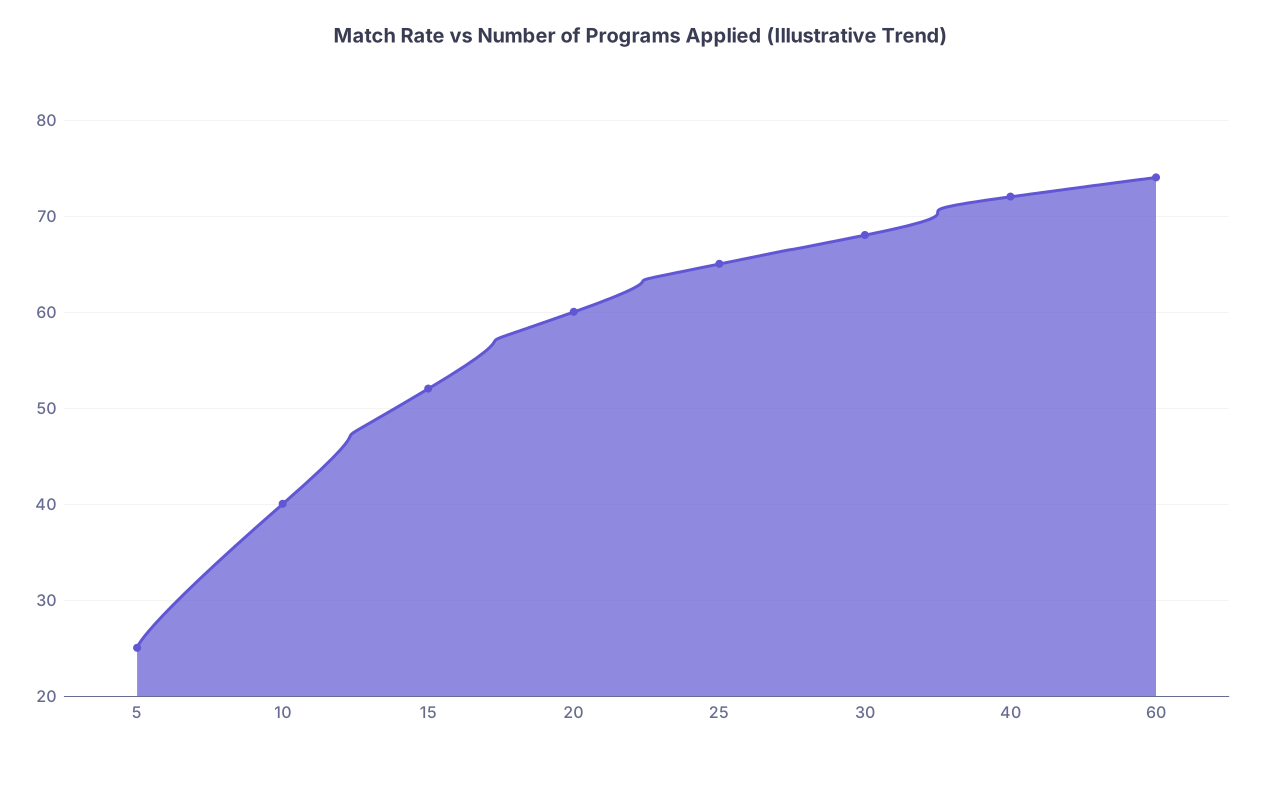
Step 3: Deciding How Many Programs to Apply To as a Non-US Citizen IMG
The question “how many programs to apply?” is critical, especially with the financial and emotional costs involved.
There is no universal number, but you can estimate a range based on:
- Your competitiveness
- Visa needs
- Global health requirements
- Specialty competitiveness (most global health tracks exist in Internal Medicine, Family Medicine, Pediatrics, OB/GYN, Emergency Medicine—with varying competitiveness)
General Ranges for Non-US Citizen IMGs
Below are approximate ranges, assuming you’re applying in a field like Internal Medicine or Family Medicine (where many global health tracks exist):
Highly competitive IMG profile
- Strong USMLE (e.g., Step 2 CK > 250 or equivalent)
- Recent graduation
- Robust U.S. clinical experience
- Global health research/experience
- Recommendation: 30–40 carefully selected programs.
Moderately competitive profile
- Solid scores (e.g., Step 2 CK 235–250)
- Some U.S. clinical experience
- Demonstrated global health interest
- Recommendation: 45–70 programs.
More challenging profile
- Lower scores, attempts on exams, older graduation year, limited U.S. experience
- Still strong motivation and coherent story
- Recommendation: 70–100+ programs, with a wider mix of program types.
For more competitive specialties (e.g., Emergency Medicine with global health tracks, OB/GYN with strong international medicine focus), you may need more applications if your profile is average or below average.
Balancing Global Health vs. Match Probability
As a foreign national medical graduate, you face a strategic tension:
- Fewer programs with true global health residency tracks.
- Higher risk of not matching if you only apply to these programs.
- Need to balance your global health aspirations with the reality of visa and match constraints.
A practical program selection strategy might look like:
- 30–40%: Programs with strong, established global health tracks (GH1).
- 40–50%: IMG-friendly programs with good international or underserved exposure (GH2).
- 10–20%: Programs where global health is minimal but where you could build experience through:
- Local immigrant/refugee care
- Public health partnerships
- Future fellowships or MPH programs after residency (GH3).
This allows you to protect your chance of matching while still giving yourself multiple paths into global health.

Step 4: Tiering and Prioritizing Programs (A, B, C Lists)
Once you know roughly how many programs to apply and have your long list, the next step is to tier your programs. This avoids random mass applications and keeps your strategy intentional.
Creating Tiers
Consider three tiers based on:
- Competitiveness vs. your profile
- Global health strength
- Visa and IMG history
Tier A – Reach but Aligned Programs
- Strong academic or hybrid institutions.
- Well-developed global health residency tracks and international partnerships.
- Historically accept IMGs, including non-US citizen IMG residents (check current rosters).
- Your scores/experience may be slightly below average for them, or you are competitive but the program is highly desirable.
Tier B – Realistic Core Targets
- University-affiliated community programs or mid-tier academic centers.
- Good to moderate global health or international medicine opportunities (GH1 or GH2).
- Clear track record of accepting foreign national medical graduates.
- Your profile is well-matched or slightly above their typical IMG profile.
Tier C – Safety but Still Acceptable
- Community-based programs with some underserved or international population exposure.
- Less structured global health, but possible to carve out a path through local work, electives, or future fellowships.
- Clearly IMG-friendly, with multiple non-US citizen IMGs historically.
- You are likely above their average threshold.
Aim for a distribution like:
- 20–30% Tier A
- 50–60% Tier B
- 15–25% Tier C
This ratio should be adjusted based on:
- Your risk tolerance
- Financial considerations
- How strict you want to be with global health emphasis
Example for a Moderately Competitive IMG
You aim to apply to 60 programs in Internal Medicine with global health focus:
- Tier A (15 programs)
- Academic centers with prestigious global health residency tracks.
- Top university programs with funded international rotations.
- Tier B (30 programs)
- University-affiliated community programs with strong global health electives.
- Systems with partnerships in Africa/Latin America and some research opportunities.
- Tier C (15 programs)
- Mainly community programs with high immigrant/refugee populations.
- Limited formal global health structure but robust local underserved care.
This structure gives you a realistic shot at matching while still preserving a pathway into international medicine.
Step 5: Using Program Selection to Strengthen Your Overall Application
Your program selection strategy should integrate with your entire application, not exist in isolation.
Customize Your Personal Statement for Global Health Programs
For programs with a global health residency track or strong international medicine identity:
- Clearly articulate:
- Your past global health or international experience (clinics abroad, research, NGOs).
- Your long-term goals (e.g., academic global health, policy, capacity building).
- How their specific track and partnerships align with your path.
- Research:
- Named global health leaders or sites (e.g., “partnership in Uganda”).
- Mention them authentically when appropriate (avoid copy–paste templates).
For programs with less formal global health but strong local underserved populations:
- Emphasize:
- Your commitment to underserved care.
- Your interest in caring for diverse, immigrant, and refugee populations.
- How local global health (e.g., within the U.S.) fits into your broader international mission.
Prepare for Interviews with a Strategic Story
Your program selection should reflect a coherent narrative:
- You are a non-US citizen IMG who:
- Has a clear understanding of global health, beyond “medical missions.”
- Is realistic about visa and match constraints.
- Has deliberately chosen programs aligned with your values and abilities.
Prepare to answer:
- “Why are you interested in our program’s global health track?”
- “How do you see your future career in international medicine?”
- “As a foreign national medical graduate, how do you envision balancing global work with U.S. practice/visa responsibilities?”
Highlight:
- Flexibility (willingness to engage in both domestic and international underserved care).
- Commitment (long-term projects, not just short-term voluntourism).
- Sustainability and ethical global health approaches.
Plan for Backup Pathways into Global Health
Even if you match at a program with limited global health options, remember:
- You can still pursue global health through:
- Post-residency fellowships (global health, infectious diseases, emergency medicine, maternal health).
- MPH or other graduate degrees during or after residency.
- Research collaborations with global institutions.
- NGOs and telemedicine initiatives.
- Many global health leaders trained at ordinary programs but built their careers through consistent, focused effort afterward.
So while program selection matters, your long-term commitment and strategy matter even more.
Common Pitfalls and How to Avoid Them
Applying Only to High-Profile Global Health Programs
- Risky for most non-US citizen IMGs.
- You may end with few or no interviews.
- Balance prestige with practicality and IMG-friendliness.
Ignoring Visa Sponsorship Early On
- Wasting applications on programs that will not consider a foreign national medical graduate needing sponsorship.
- Always check visa policies first.
Overestimating or Underestimating Yourself
- Overestimating: Applying only to top-tier academic programs.
- Underestimating: Applying only to low-tier programs when your profile can support more.
- Use objective benchmarks: scores, YOG, clinical experience, research, and feedback from mentors.
Relying on Outdated or Anecdotal Information
- “This program used to take IMGs” may not be true now.
- Always confirm with current residents, websites, or direct contact.
Failing to Differentiate Marketing from True Global Health Infrastructure
- A picture of a mission trip is not enough.
- Look for structured curriculum, partnerships, funding, and faculty.
Putting It All Together: A Practical Action Plan
Weeks 1–2: Research and Long List
- Decide on your specialty (e.g., Internal Medicine with global health focus).
- Use FREIDA and program websites to build a list of all potential programs.
- Filter by: visa sponsorship, non-US citizen IMG policy, graduation year, basic exam cutoffs.
Weeks 3–4: Global Health and IMG-Friendliness Assessment
- Classify programs as GH1, GH2, GH3.
- Check current residents for foreign national medical graduates.
- Eliminate clearly non-viable programs (no visa, no IMGs, incompatible requirements).
Weeks 5–6: Tiering and Final Selection
- Decide your target total number (e.g., 60–80).
- Assign each program to Tier A, B, or C.
- Ensure a balanced distribution of tiers and GH classifications.
Weeks 7–8: Application Customization
- Draft or refine your global health–focused personal statement(s).
- Tailor segments to highlight alignment with global health residency tracks or local underserved focus.
- Prepare a spreadsheet to track application status, interview invites, and notes.
During Interview Season
- Evaluate each program’s global health reality vs. their marketing.
- Ask targeted questions:
- “How many residents actually go abroad each year?”
- “Is funding guaranteed for international electives?”
- “What are examples of recent resident projects in global health?”
- After interviews, re-rank programs based on:
- Fit
- Global health substance
- Visa security
- Resident culture and support.
FAQs: Program Selection Strategy for Non-US Citizen IMGs in Global Health
1. How many programs should I apply to as a non-US citizen IMG interested in global health?
For Internal Medicine or Family Medicine, many non-US citizen IMGs apply to 45–80 programs, depending on their competitiveness. If you are a strong candidate (high USMLE scores, strong US experience, significant global health background), 30–40 well-chosen programs may be sufficient. If your profile is more challenging, consider 70–100+ programs, with a mix of strong global health programs and IMG-friendly community programs where you can still pursue international medicine later.
2. Should I only apply to programs with a formal global health residency track?
No. While a formal global health residency track is ideal for structured training, limiting yourself only to those programs can be risky, especially as a foreign national medical graduate. A balanced strategy includes:
- Some programs with established tracks.
- Others with good international or underserved exposure.
- A few where you could build a global health pathway through electives, local underserved care, and post-residency fellowships.
3. How can I tell if a program truly supports global health and international medicine?
Look for:
- A clearly described global health curriculum or track on the website.
- Named global health faculty and leadership roles.
- Ongoing partnerships with specific countries or organizations.
- Evidence of resident participation in international rotations, conferences, and research (check resident profiles and publications). If a program only shows a few photos of mission trips or vague statements, it may not have deep structural support.
4. As a foreign national medical graduate, should I prioritize J-1 or H‑1B sponsoring programs?
Both visa types can work, but your strategy should be realistic:
- J-1 visas are more commonly sponsored and widely accepted; they come with a home-country return requirement but have established waiver pathways.
- H‑1B visas are less common, often require Step 3 before starting, and are more likely at academic or well-resourced institutions. If you don’t yet have Step 3, or your options are limited, it is usually safer to include many J-1–sponsoring programs in your list and not rely solely on H‑1B–offering institutions.
By approaching this process with a deliberate program selection strategy—grounded in your global health goals, realistic self-assessment, and careful attention to visa and IMG factors—you’ll maximize both your chances of matching and your ability to build a meaningful career in international medicine.