Understanding Your Starting Point as a Non‑US Citizen IMG in Pediatrics
Non-US citizen IMGs and foreign national medical graduates can and do match into pediatrics residency every year, but the path is more competitive and constrained than for US graduates or US citizens trained abroad. A strong program selection strategy is one of the highest-yield steps you control—often more important than obsessing over one extra point on an exam.
Before choosing where to apply, you must understand how your specific profile influences your chances. For pediatrics, programs typically consider:
- Visa status and need (J-1 vs H-1B vs no visa needed)
- USMLE performance (Step 1 – pass/fail but still reviewed; Step 2 CK – critical)
- Year of graduation and clinical currency
- US clinical experience (USCE) – especially supervised pediatrics rotations
- Research and academic productivity
- English proficiency and communication skills
- Red flags (exam failures, gaps in training, professionalism issues)
As a non-US citizen IMG, three structural constraints shape your program selection strategy:
- Visa sponsorship: Not all programs sponsor visas, and some sponsor only J-1 (via ECFMG), while fewer sponsor H-1B.
- Institutional bias/limitations: A portion of pediatrics programs still rarely interview or rank IMGs, even if their website is vague.
- Application volume economics: You shoulder the financial and emotional cost of applying to many programs, but under‑applying can significantly reduce the odds of matching.
A smart strategy balances ambition and realism, factoring in your credentials, visa needs, and resources. The rest of this article walks step-by-step through how to build, refine, and use a powerful program list specifically as a non-US citizen IMG interested in pediatrics.
Key Factors Programs Use to Evaluate Non‑US Citizen IMGs in Pediatrics
Understanding what programs look for helps you pick where to apply and how to interpret “requirements” versus “preferences.”
1. USMLE Scores and Exam History
Although pediatrics is often perceived as more IMG-friendly than some highly competitive specialties, exam performance still matters.
Step 1 (now pass/fail)
- Programs still see numeric scores for earlier takers and may use them for screening, but the weight has decreased.
- A first-attempt pass is important. A failure may not eliminate you but restricts the set of programs realistically within reach.
Step 2 CK
- This is now the most important test score for screening.
- Broad benchmarks (not strict cutoffs, but useful for planning):
- ≥ 245–250: Opens doors to many university and mid-to-large academic community programs.
- 230–244: Competitive for a wide range of community and some university-affiliated programs.
- 220–229: Still viable for pediatrics, especially at IMG‑friendly community programs with explicit IMG histories.
- < 220 or failure: Greatly narrows options; list must be more aggressive and IMG-centered.
You should tailor your program selection strategy so that your “aspirational” tier aligns with your best metrics, and your “safety” tier acknowledges any exam challenges.
2. Visa Type and Sponsorship Realities
For a non-US citizen IMG, visa policy often matters as much as exam scores.
J-1 Visa (most common)
- Sponsored by ECFMG; accepted widely across pediatrics programs.
- Many state/community hospitals sponsor only J‑1.
- Easiest visa to match with but comes with the 2-year home country requirement after training (unless you obtain a waiver).
H-1B Visa
- Less common in pediatrics than in some other specialties.
- Often limited to programs with strong institutional legal support (larger universities, some academic community programs).
- Requires USMLE Step 3 completed before visa filing (ideally before rank list deadlines).
- If you absolutely need H‑1B (e.g., home-country rules, personal reasons), your viable program pool shrinks dramatically; your strategy must be extremely targeted.
Canadian or other special statuses
- Some graduates hold other statuses (e.g., TN for Canadians) that may ease sponsorship. Confirm with each program or institution’s GME office.
Practical tip: When building your list, explicitly label each program by visa type:
- J-1 only
- J-1 + H-1B
- “Requires permanent residency or US citizenship” (avoid)
- Unclear / conflicting info (verify by email or current residents)
3. US Clinical Experience (USCE) and Pediatrics Exposure
Programs want evidence that you can function safely in the US healthcare system and have real interest in pediatrics.
Preferred types of USCE (for peds residency):
- Inpatient pediatrics clerkships or sub‑internships
- Outpatient pediatrics clinic experiences
- NICU or PICU electives
- Pediatric urgent care or ER electives
Less valued (but still useful) experiences:
- Pure observerships without hands-on involvement
- Non-pediatric specialties (helpful for understanding the system but less specialty-specific)
The impact on program selection:
- Strong USCE in pediatrics at a US academic center can make you competitive at similar institutions, especially if you have strong letters from US pediatricians.
- Limited/no USCE should nudge your list toward historically IMG‑friendly community programs and those explicitly open to foreign national medical graduates.
4. Year of Graduation and Clinical Gap
Many pediatrics programs state preferences such as “within 3–5 years of graduation” or “no more than 5 years out of medical school”.
- 0–3 years since graduation: Low concern for most programs.
- 4–7 years out: Must show ongoing clinical activity (home country practice, research, continued education). Choose programs that publicly accept older graduates.
- > 7 years: Significantly shrinks your realistic pool; focus on programs with a reputation for accepting older IMGs and emphasize current clinical competence.
When filtering programs, pay close attention to both stated and implied preferences about graduation year.

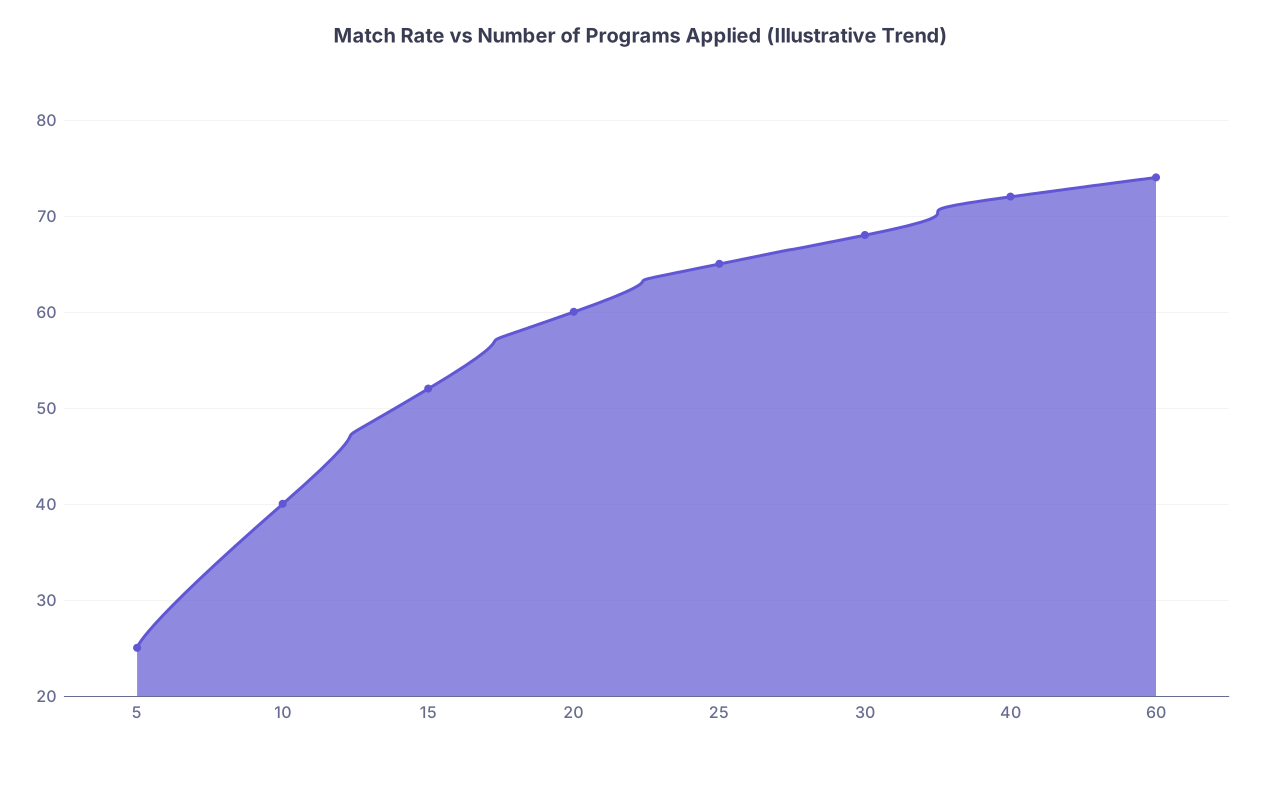
How Many Pediatrics Programs Should a Non‑US Citizen IMG Apply To?
This is one of the most common and anxiety‑provoking questions: how many programs to apply to as a non-US citizen IMG in pediatrics.
There is no single magic number, but there are evidence‑informed ranges based on NRMP data, IMG match reports, and practical experience.
Below is a general guide, assuming you only apply to pediatrics:
1. Strong Non‑US Citizen IMG Profile
- Step 2 CK ≥ 245
- No exam failures
- ≤ 3 years from graduation
- Solid USCE in pediatrics with US letters
- No major visa complications (content with J‑1)
Recommended range:
- 35–50 programs (more if many programs on your list are H‑1B only or highly competitive academic centers)
You can afford to include a larger share of university and university‑affiliated programs, plus a well‑chosen set of community programs.
2. Average Non‑US Citizen IMG Profile
- Step 2 CK ~230–244
- No exam failures (or one minor issue but balanced by strong portfolio)
- Graduation within 5 years
- Some USCE (ideally with at least one US pediatric letter)
- Open to J‑1 sponsorship
Recommended range:
- 60–80 programs
Your list should be heavily weighted toward IMG‑friendly community programs plus a realistic portion of university‑affiliated programs that consistently interview and rank IMGs.
3. Challenged Profile / Higher‑Risk Applicant
- Step 2 CK < 230 or exam failure
5 years from graduation
- Limited or no USCE
- Significant gaps in training
- Require H‑1B only
Recommended range:
- 80–120+ programs
Here, quantity helps offset the smaller fraction of programs likely to interview you. You must prioritize programs:
- With explicit histories of matching non‑US citizen IMGs
- In states/regions known to be more IMG‑friendly
- That have flexible graduation-year policies
Caution: Applying to 150–200 programs is sometimes seen; this can be financially burdensome and psychologically exhausting. It’s more effective to apply to 100 carefully selected programs than 200 random ones.
Balancing Cost and Probability
ERAS fees rise quickly with each additional program. A strategic approach:
- Build a rough master list (e.g., 120–150 programs matching basic criteria like visa sponsorship and pediatrics).
- Apply initial filters based on your profile (exam scores, graduation year, USCE, IMG-friendliness).
- Prioritize to your budget:
- If your budget allows 70 programs and you have 110 on your filtered list, keep the 70 best‑fit programs across all tiers.
- Remember: beyond a certain number (commonly 80–100), additional applications return diminishing marginal benefit, unless your profile is particularly weak.
Building a Targeted Program List: Step‑by‑Step Strategy
This is the core of your program selection strategy: systematically building, filtering, and tiering your pediatrics residency list.
Step 1: Clarify Your Personal Constraints and Preferences
List your non‑negotiables and strong preferences before diving into databases:
- Visa needs: J‑1 acceptable? Need H‑1B?
- Geographic constraints: Family location, cost of living, climate tolerance, need for public transportation.
- Type of program:
- Academic/university vs community
- Size of program (small, medium, large)
- Exposure to subspecialties (NICU, PICU, outpatient variety)
- Personal life factors: Spouse’s career, children’s schooling, support networks.
Your preferences must be realistic: as a foreign national medical graduate, it’s often wise to be flexible on geography and prestige, especially for the first match attempt.
Step 2: Use Data Sources to Create an Initial Long List
Combine multiple tools instead of relying on one:
FREIDA (AMA Residency & Fellowship Database)
Filter by specialty: Pediatrics
Filter for program type and region
Review stated policies:
- Visa sponsorship
- Years from graduation
- Number of positions
- Duration of program and subspecialty exposure
ERAS / Program Websites
- Check each program’s website for:
- Explicit statements about IMGs
- Visa policy (J‑1 only vs J‑1 + H‑1B)
- Minimum USMLE score requirements or cutoffs
- Graduation year limits
- Note that many sites are out of date—cross‑verify with FREIDA and, if needed, with email.
- Check each program’s website for:
NRMP and Institutional Data
- NRMP Program Director Survey (Pediatrics) for insight into how heavily different factors are weighed.
- Some programs list the proportion or number of IMGs in current classes.
Word-of-mouth and Networks
- Speak with current residents (especially IMGs) via LinkedIn, hospital websites, or alumni networks.
- Ask about:
- How many non‑US citizen IMGs in current or recent classes
- Real visa practices vs official wording
- Culture and support for IMGs
As you collect this information, maintain a spreadsheet with columns such as:
- Program name & ACGME code
- City/state
- University vs community
- Visa types sponsored
- IMG‑friendliness rating (you assign: High/Medium/Low)
- Minimum USMLE requirements
- Max years since graduation
- Notes from residents/website
- Personal fit/reasons to apply
Step 3: Filter for Visa and IMG‑Friendliness
Eliminate programs that:
- Explicitly require US citizenship or green card
- State “no visa sponsorship”
- Have zero IMGs and a history of not taking any, especially if visa policies are restrictive
Prioritize:
- Programs that historically have multiple IMGs in their current classes
- Programs that explicitly mention supporting non‑US citizen IMGs or J‑1 sponsorship
Your goal at this stage is to create a realistic long list of programs where your application stands a non-trivial chance of being read and considered.
Step 4: Align Program Expectations with Your Profile
For each program on your long list, compare your metrics with their published or implied expectations:
- If a program site or FREIDA states “Step 2 CK minimum 240” and you have 232, that program may be low yield unless other factors are very strong.
- If you are 8 years from graduation and the program writes “within 5 years,” consider it low priority, unless you know of recent exceptions.
Group programs into three broad tiers:
Reach / Aspirational Programs
- Slightly above your metrics or more competitive (prestigious university or top children’s hospital).
- Good to include 10–20% of your final list here.
Target / Match‑Range Programs
- Your scores, graduation year, and USCE match or exceed typical residents’ profiles.
- These should form the bulk (about 50–70%) of your applications.
Safety / IMG‑Heavy Programs
- Programs with strong history of non‑US citizen IMGs, slightly lower typical scores, and more flexible policies.
- Allocate about 20–30% of your list here.
For a peds match as a non-US citizen IMG, safety programs are not beneath you; they are your insurance, especially for your first match attempt.
Step 5: Consider Geography and Lifestyle—But Remain Flexible
It’s reasonable to have preferences (e.g., East Coast vs Midwest, urban vs rural). However:
- Some of the most IMG‑friendly pediatrics programs are in less popular locations (Midwest, South, smaller cities).
- Overly narrowing geography (e.g., “only California and New York”) can severely reduce interview chances, especially if your profile is average or weaker.
A practical compromise:
- Define preferred regions but allow 30–40% of your list in other areas that are historically IMG‑friendly.
- Give extra weight to locations where you have some connection:
- Extended family or close friends
- Prior clinical or research experience
- Long‑term plans (e.g., spouse’s work prospects)
Step 6: Finalize Numbers Based on Budget and Risk Tolerance
Once you have a filtered, tiered list:
- Decide on your maximum ERAS budget and translate that into a maximum number of programs.
- Start filling from:
- Highest‑fit target programs
- Then safety programs
- Then aspirational programs
Example for an average-profile non-US citizen IMG with budget for 70 applications:
- 40 Target programs (balanced, IMG‑friendly, realistic scores)
- 20 Safety programs (strong IMG track record, flexible policies)
- 10 Aspirational programs (select university programs with some IMG presence)
This structure maximizes your chance of multiple interviews while leaving room for ambition.

Advanced Tips to Strengthen Your Program Selection Strategy
Beyond the basics, several nuances can further refine your peds match strategy.
1. Use Your Personal Story as a Strategic Filter
Your unique background can make you a better fit for some programs:
- Multilingual abilities: Programs serving diverse immigrant communities value residents who can communicate in patients’ native languages.
- Home‑country training in pediatrics: Programs in underserved areas might appreciate your prior pediatric experience.
- Research niche: If you have research in specific pediatric conditions (e.g., asthma, neonatology), identify programs with matching faculty interests.
When reviewing programs, look for:
- Community demographics that match your language skills
- Faculty profiles overlapping your research or interests
- Mission statements emphasizing diversity, global health, or underserved populations
Programs aligned with your story may be more enthusiastic about your application, even if your metrics are average.
2. Investigate Program Culture Toward IMGs
Numbers alone (e.g., “X% of residents are IMGs”) don’t tell the whole story. Try to understand:
- How integrated are IMGs in leadership positions? Chief residents? Committee roles?
- Do current IMGs seem supported and happy? You can sometimes infer this from social media, resident bios, or conversations.
- Has the program recently reduced or increased IMG intake?
Reach out politely to current or recent residents via email or LinkedIn, especially those who are non-US citizen IMGs, and ask concise questions:
- “How supportive is the program in terms of visa issues?”
- “Do you feel IMGs are treated equally to US graduates?”
- “Would you recommend this program to a foreign national medical graduate interested in pediatrics?”
Their input can help you decide whether to rank a program highly, not just whether to apply.
3. Time Your Application and Document Readiness
Your program selection strategy should be synchronized with your application readiness:
- Apply as close to ERAS opening as possible with:
- Finalized personal statement tailored to pediatrics
- USMLE Step 2 CK score reported
- ECFMG certification in process or completed
- All LORs uploaded (aim for at least 3, including 2+ from pediatricians, ideally US‑based)
Programs tend to review early applications more thoroughly. Late applications, even to IMG‑friendly programs, may not be seen if interview slots fill quickly.
4. Adjusting Strategy If You Don’t Match
If you go unmatched, your program selection strategy for the next cycle should evolve, not repeat:
Analyze your previous list:
- Which tiers produced interviews?
- Were your aspirational programs overly ambitious?
- Did any “safety” programs yield interest?
Strengthen your profile during the interim year:
- USCE in pediatrics
- Research or quality improvement projects
- Step 3 completion (useful if aiming for H-1B or demonstrating readiness)
Then, in the next cycle:
- Increase the proportion of safety and IMG‑heavy programs.
- Consider broadening geography.
- Re‑evaluate H‑1B vs J‑1 requirements if they significantly limited your options.
Frequently Asked Questions (FAQ)
1. As a non-US citizen IMG, is pediatrics a good choice for the residency match?
Yes. Pediatrics is generally more accessible to IMGs than extremely competitive specialties like dermatology or plastic surgery. Many pediatrics programs value diversity, multilingual abilities, and global health perspectives—areas where foreign national medical graduates often excel. However, you still must be strategic with how to choose residency programs, especially regarding visa sponsorship and IMG‑friendliness.
2. Should I apply only to “IMG‑friendly” pediatrics programs?
Not exclusively. Many candidates over‑restrict themselves to a short list of famous “IMG‑friendly” programs. A better approach is to:
- Include a core of clearly IMG‑friendly programs (your safety tier).
- Add target programs that may not be heavily IMG‑dominated but demonstrate some recent non-US citizen IMG residents.
- Apply to a smaller number of aspirational programs where your profile is strong and mission fit is clear.
This balanced strategy improves your overall peds match odds while still allowing some reach.
3. I need an H‑1B visa. How does this change my program selection strategy?
Requiring H‑1B significantly narrows your options in pediatrics. Your strategy should:
- Start with an explicit filter: only programs that officially sponsor H‑1B.
- Confirm actual practice by emailing program coordinators or residents (policies can change year to year).
- Take Step 3 as early as you can so it’s completed before rank list deadlines.
- Expect to apply to more programs (often 80–120) because your eligible pool is smaller.
If possible, remain open to J‑1 to broaden your choices, unless there are strict reasons you cannot.
4. How many pediatrics programs should I apply to if my budget is very limited?
If you can only afford, for example, 30–40 applications:
- Prioritize programs that:
- Sponsor your needed visa
- Have clear evidence of matching non-US citizen IMGs recently
- Match your Step 2 CK range and graduation year
- Align with your language skills or unique strengths
Within those 30–40:
- 50–60% should be strong match‑range programs
- 30–40% clear safety/IMG‑heavy programs
- 10–20% carefully chosen aspirational ones
With a smaller application volume, the quality of your program selection and application materials becomes even more critical.
By intentionally mapping your program selection strategy, you transform the pediatrics residency application from an overwhelming guessing game into a structured, data-informed process. As a non-US citizen IMG, you face additional barriers, but with a smartly curated list, strong documentation, and thoughtful self‑assessment, you can significantly increase your chance of a successful peds match.