Understanding the Unique Challenges for Non‑US Citizen IMGs in Anesthesiology
If you are a non-US citizen IMG (international medical graduate) aiming for anesthesiology residency in the United States, your program selection strategy is just as important as your USMLE scores, letters, and clinical experience. Anesthesiology has become increasingly competitive, and foreign national medical graduates face additional filters: immigration status, visa sponsorship, “IMG-friendliness,” and institutional preferences.
This article focuses on how to choose residency programs wisely, how to think about how many programs to apply to, and how to create a realistic, customized anesthesia match list as a non-US citizen IMG.
Key principles you’ll learn:
- How anesthesiology programs view non-US citizen IMGs
- How to research programs systematically (beyond just “IMG-friendly lists”)
- How many anesthesiology residency programs to apply to, based on your profile
- How to build a balanced list of “reach,” “target,” and “safety” programs
- How to adapt if you have red flags, low scores, or limited US experience
Step 1: Know Where You Stand as a Non‑US Citizen IMG
Before deciding where to apply, you must do an honest, structured assessment of your applicant profile. This is especially critical for a foreign national medical graduate because competition for limited visa-sponsoring spots is intense.
1. Academic Metrics: USMLE and Medical School Performance
Key elements:
- USMLE Step 1: Now pass/fail, but program directors still care about:
- First-attempt pass or fail
- Whether you needed multiple attempts
- USMLE Step 2 CK:
- Often the primary numeric filter now
- A strong Step 2 CK can significantly offset lack of US school pedigree
As a non-US citizen IMG in anesthesiology, Step 2 CK is especially important. While exact cutoffs vary, you can think in general bands (not absolute rules):
- ≥250: Highly competitive; opens many doors, including moderately academic programs
- 240–249: Competitive; strong profile for community and some university programs
- 230–239: Viable, especially if other parts of your application are strong (USCE, LORs)
- <230: More challenging; program selection must be very strategic and IMG-focused
Also factor in:
- Class rank or decile (if provided by your school)
- Honors/awards, especially in anesthesia, internal medicine, surgery, or critical care rotations
2. US Clinical Experience (USCE) and Anesthesia Exposure
Programs want evidence that you understand the US healthcare system and anesthesiology specifically.
Strength hierarchy (top to bottom):
- US anesthesiology electives/away rotations with strong performance and letters
- Substantial US hospital-based rotations (medicine, surgery, ICU) with letters
- Observerships in anesthesiology at reputable hospitals
- Shadowing and shorter observer experiences
- No USCE (most challenging scenario)
If you are a non-US citizen IMG without USCE, you will likely need to:
- Apply more broadly
- Emphasize research, home-country clinical experience, and any procedural/critical care exposure
3. Visa Requirements: The First Hard Filter
As a foreign national medical graduate, visa sponsorship is non-negotiable. You must clearly know:
- Do you need a J-1 visa?
- Are you aiming for or needing H-1B sponsorship?
- Are you already on another US visa category (e.g., F-1 with OPT, pending green card)?
Implications for program selection:
- Many programs accept J-1 only (via ECFMG).
- A smaller subset sponsors H-1B; these programs often have higher academic and USMLE expectations.
- Some programs do not sponsor any visas—these should be excluded from your list.
You cannot afford to waste applications on programs that categorically cannot train you.
4. IMG Status and Graduation Year
Programs often look at:
- IMG-friendliness: Do they routinely take IMGs? Particularly non-US citizens?
- Year of Graduation (YOG): Many programs prefer recent graduates (usually within 3–5 years).
If your YOG is older (e.g., >5 years), or you had career interruptions, you’ll need:
- Strong recent clinical activity (ICU, OR, hospitalist, anesthesia in home country)
- Clear explanation in your personal statement or interviews
- More emphasis on IMG-friendly programs with a history of accepting older grads
Step 2: Researching Programs Systematically (Not Randomly)
Once you understand your profile, you can start building a data-driven approach for program selection strategy in anesthesiology.
1. Use the Right Data Sources
Combine several sources to build a reliable picture:
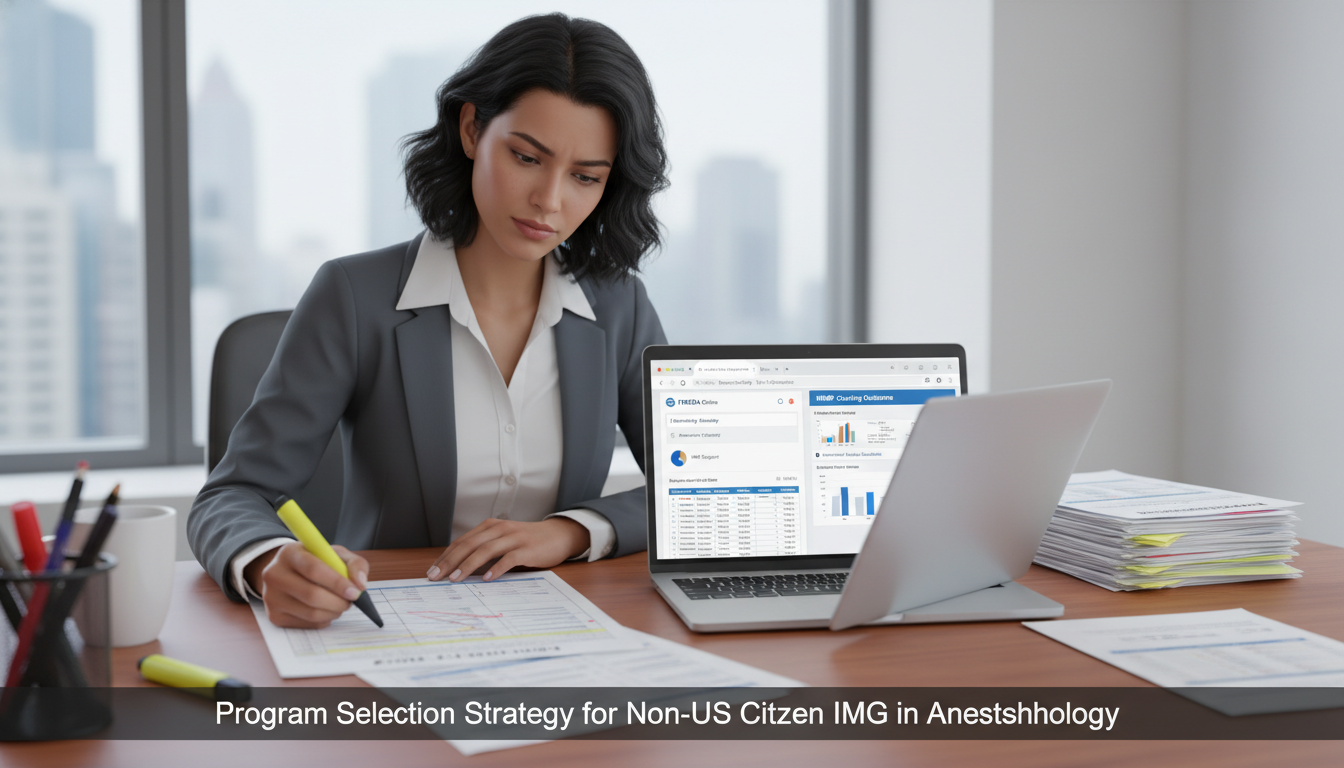
FREIDA (AMA)
- Check:
- Visa sponsorship (J-1, H-1B, none)
- Program size and number of positions
- Academic vs community setting
- Contact information and website
- Check:
Program Websites
- Often more up-to-date than FREIDA
- Look for:
- Explicit statements about IMGs
- Visa policies
- Resident roster—do current residents include IMGs, non-US citizens, or graduates from your region?
- Rotations (ICU, pain, cardiac, etc.) and case volume
NRMP and Charting Outcomes in the Match
- Use overall anesthesiology data to understand competitiveness:
- Match rates for IMGs
- Mean Step 2 CK scores
- Number of programs ranked vs match probability
- Use overall anesthesiology data to understand competitiveness:
Program-Specific Data from Forums / Alumni / Social Media
- Ask recent matched anesthesiology residents (especially non-US citizen IMGs) about:
- How welcoming the program is to IMGs
- Realistic score filters
- Culture, workload, and support
- Ask recent matched anesthesiology residents (especially non-US citizen IMGs) about:
2. Identify IMG-Friendliness
A key part of how to choose residency programs as a non-US citizen IMG is estimating IMG-friendliness:
Indicators of IMG-friendliness:
- At least 20–30% of current residents are IMGs
- There are recent graduates from non-US schools (not just Caribbean)
- Website or PD (program director) statements explicitly welcome IMGs
- Program regularly sponsors visas
You can create a simple spreadsheet with columns:
- Program name
- State/city
- Visa type (J-1 only, J-1 + H-1B, none)
- % IMG among residents (rough estimate)
- Average Step 2 CK expectations (from forums or alumni insights)
- Program type (university, university-affiliated, community)
- Personal feel (green/yellow/red)
3. Don’t Over-Rely on “Top 10 IMG-Friendly” Lists
These lists are often:
- Outdated
- Based on very small sample sizes
- Focused on absolute numbers of IMGs, not competitiveness
Instead, generate your own customized list based on:
- Visa compatibility
- Score bands
- IMG presence
- Your geographic preferences (broad at first, then narrow)
Step 3: How Many Programs Should You Apply to in Anesthesiology?
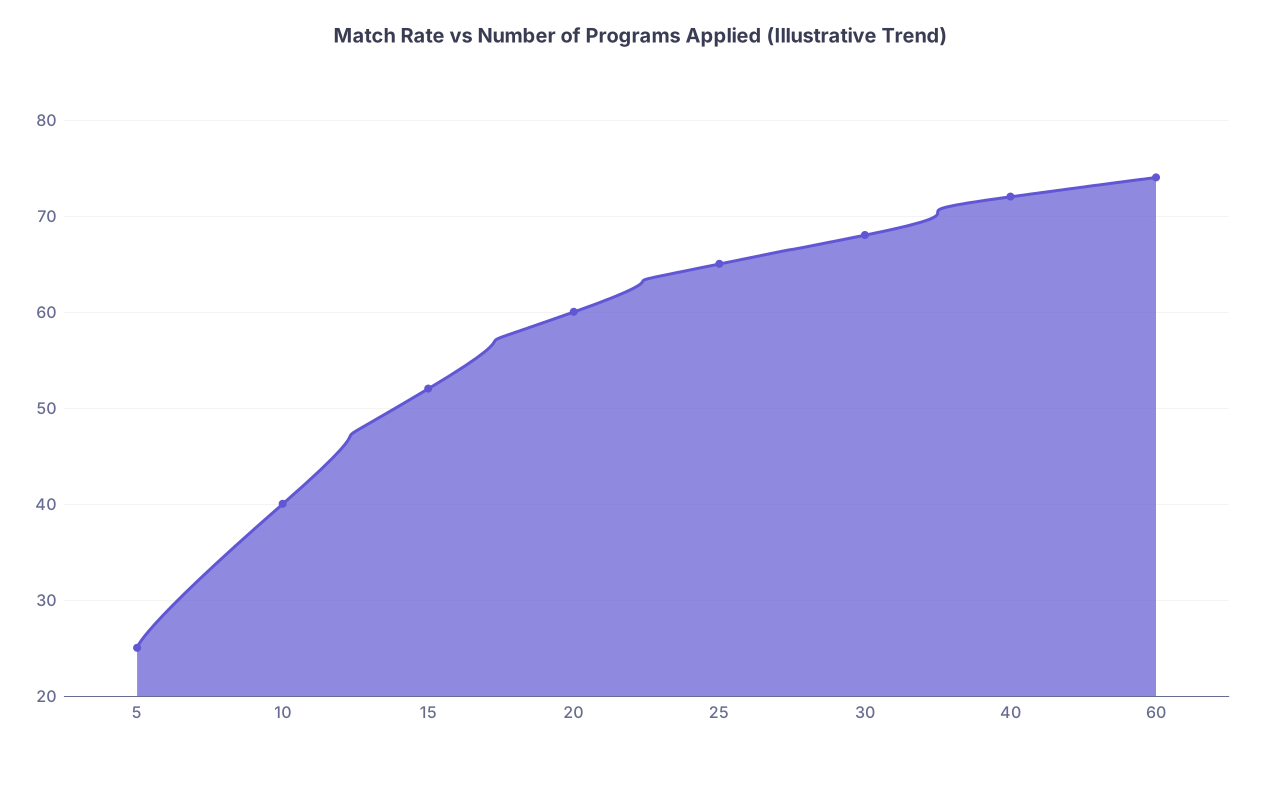
For a non-US citizen IMG, the question of how many programs to apply to is critical and often misunderstood.
1. General Ranges for Non-US Citizen IMGs
Numbers will shift with the competitiveness of a given year, but for anesthesiology:
Highly competitive non-US citizen IMG (Step 2 CK ≥250, strong USCE, recent grad, no failures):
- Typical range: 40–60 programs
- May target more academic and mid-tier university programs, plus solid community programs
Moderately competitive profile (Step 2 CK 235–249, some USCE, maybe 1 attempt issue or older YOG but with strong activity):
- Typical range: 60–90 programs
- Mix of university-affiliated and community programs, heavily IMG-friendly
More challenging profile (Step 2 CK <235, attempts, limited USCE, older YOG):
- Typical range: 90–120+ programs
- Focus heavily on IMG-friendly community programs and smaller university-affiliated programs, plus prelim/transitional years if considering backup strategies
These are guidelines, not guarantees. The right number for you also depends on:
- Budget for ERAS fees
- Whether you’re applying to multiple specialties
- Strength of networking and personal connections
2. Avoid Two Common Extremes
Applying too few programs
- Risky given visa limitations and filters on non-US schools
- Even strong IMGs can be filtered out automatically
Applying to nearly every program
- Wastes money and dilutes your effort to tailor applications
- Many programs don’t sponsor visas or haven’t taken IMGs in years
Aim for an optimized, not maximal list: broad but deliberate.
3. Adjusting Based on Response
After ERAS submission:
- Monitor interview invitations
- If by mid-season you have very few anesthesia interviews, examine:
- Whether your list was too ambitious (too many university-heavy, H-1B-only, or non-IMG-friendly programs)
- Whether it makes sense to add more programs that are still accepting applications (late additions sometimes help)
- If you should lean more heavily on a backup specialty for that season or the next cycle
Step 4: Building a Balanced Application List (Reach, Target, Safety)
Once you know how many programs to apply to in your case, the next step is how to choose residency programs across different competitiveness tiers.

1. Define Your Tiers
For a non-US citizen IMG in anesthesiology, tiers are less about prestige rankings and more about match probability.
You might define:
Reach programs
- Historically less IMG-heavy, more academic or big-name university centers
- Higher average Step 2 CK expectations (245+ range)
- May sponsor H-1B but with strict filters
- Still realistically within your score and profile range (not pure fantasy)
Target programs
- Reasonably IMG-friendly (some IMGs in the last 3–5 years)
- Visa sponsorship clearly stated
- Step 2 CK averages likely around your range
- Balanced workload, reasonable case volume
Safety programs
- Strong track record of non-US citizen IMGs
- J-1 sponsorship at minimum
- Located in less competitive regions (e.g., smaller cities, rural states)
- Not strongly research- or prestige-driven
2. Example Distribution by Applicant Type
For a moderately competitive non-US citizen IMG applying to 80 programs, a possible distribution:
- Reach: 15–20 programs
- Target: 35–40 programs
- Safety: 20–25 programs
You can then categorize each program in your spreadsheet as R, T, or S based on:
- IMG percentage
- Visa sponsorship
- Location and competition
- Your perception of how you stack up
3. Geographic Strategy
Location preferences can inadvertently hurt non-US citizen IMGs if too narrow.
Stronger strategy:
- Be flexible with location, especially in your first match attempt.
- Include:
- Less competitive regions (Midwest, some Southern states)
- Mix of urban, suburban, and semi-rural programs
If you limit yourself to “California and New York only,” you eliminate a large portion of IMG-friendly, visa-sponsoring anesthesiology programs.
4. Program Type Strategy
Consider diversification across:
University programs
- Pros: Academic environment, subspecialties, research
- Cons: More competitive, may favor US grads
University-affiliated community programs
- Often ideal for IMGs: structured training + some academic resources, but more open to IMGs
Pure community programs
- Often more IMG-friendly, may have fewer research expectations
- Great exposure to bread-and-butter anesthesia and high case volume
A strong list includes all three, with a heavier weight on university-affiliated and community programs for most non-US citizen IMGs.
Step 5: Program-Specific Fit and Red Flags
Beyond raw competitiveness, ask: Where will I actually thrive and succeed? This matters both for matching and for your future as an anesthesiologist.
1. Clinical Exposure and Case Mix
Look for:
- Balanced exposure to:
- General surgery
- OB anesthesia
- Cardiothoracic cases
- Neuroanesthesia
- Regional anesthesia
- ICU/critical care rotations
- Accreditation status and outcomes (no warnings or probation)
You want solid, broad clinical training. Prestige is less important than the quality and volume of cases.
2. Support for IMGs and Visa Holders
Subtle but crucial:
- Is there a GME office that understands J-1/H-1B processes?
- Do existing residents mention:
- Guidance with licensing, exams, and visa renewals?
- Support during transitions (arrival, housing, onboarding)?
Programs with multiple foreign national medical graduates usually have smoother systems for visa logistics.
3. Red Flags to Watch For
Be cautious with programs that:
- Recently lost ACGME accreditation or had major issues
- Have very high resident attrition (many leaving or not promoted)
- Are vague or inconsistent about visa policies
- Appear to have chaotic schedules or persistent resident complaints on multiple platforms
As a non-US citizen IMG, switching programs or leaving training early can carry major immigration and career consequences. Avoid unstable environments.
Step 6: Tailoring Your Application to Your Program List
Once your anesthesiology program list is ready, refine how you present yourself to maximize interview invitations.
1. Align Your Personal Statement and Experiences
For anesthesiology specifically, highlight:
- OR experience, critical care, physiology, pharmacology interest
- Calm, detail-oriented personality; ability to function in high-stress, time-sensitive environments
- Evidence of teamwork with surgeons, nurses, CRNAs, and other specialists
If you are applying widely, you do not need a different personal statement for every program, but you should:
- Have a core anesthesia PS that fits most programs
- Slightly adjust for a small subset of programs (e.g., heavy in regional, critical care, or academic research) if you have strong matching interests
2. Highlight USCE and References Strategically
Align your application emphasis with your program list:
If many programs are community-based:
- Emphasize strong clinical productivity, autonomy, and bedside skills
If many are academic/university:
- Emphasize research, scholarly activities, presentations, or teaching
Ensure your letters of recommendation:
- At least one from anesthesiology if possible
- Others from fields showing critical care, acute care, or procedural abilities (ICU, internal medicine with ICU exposure, surgery)
3. Communicating Geographic or Program Ties
If you have legitimate connections to certain regions or institutions:
- Mention them in your personal statement or ERAS geographic preference section
- Strong ties can slightly improve chances for interviews, especially in moderate or cold-weather locations where recruitment is harder
Step 7: Backup Strategies and Contingencies
Even with a well-crafted program selection strategy, the anesthesia match is competitive. It’s wise to plan for contingencies.
1. Considering a Backup Specialty
Some non-US citizen IMGs choose to apply to:
- Internal medicine
- Family medicine
- Pediatrics
- Preliminary medicine or surgery year
If you choose this route:
- Avoid diluting your anesthesiology application; maintain a clearly primary focus on anesthesia when applying to anesthesia programs.
- Create a separate personal statement for your backup specialty.
- Allocate enough applications to your backup to be realistic (e.g., 30–60+ programs depending on specialty and competitiveness).
2. Improving for a Future Match Cycle
If you don’t match in anesthesiology, your next-phase strategy may include:
- Doing a prelim year in IM or surgery with strong US performance
- Securing research positions in anesthesiology (particularly with publications or conference presentations)
- Expanding USCE and recommendation letters in anesthesia-related departments
In the next cycle, your program list should adjust:
- Fewer purely academic reach programs
- More IMG-heavy, community-based anesthesia programs
- Possibly broader geographic range
FAQs: Program Selection Strategy for Non‑US Citizen IMGs in Anesthesiology
1. As a non-US citizen IMG, how many anesthesiology residency programs should I apply to?
It depends on your profile, but approximate ranges:
- Strong profile (Step 2 CK ≥250, strong USCE, recent grad, no failures): 40–60 programs
- Average/moderate profile (Step 2 CK 235–249, some USCE, maybe older YOG or minor issues): 60–90 programs
- More challenging profile (Step 2 CK <235, attempts, limited USCE, older YOG): 90–120+ programs
These numbers assume you are primarily targeting anesthesiology. If you also apply to a backup specialty, you may somewhat reduce anesthesia applications but still keep them broad due to visa-related filters.
2. Should I only apply to “IMG-friendly” anesthesiology programs?
Focus mostly on programs with a track record of taking non-US citizen IMGs, but don’t limit yourself exclusively to the most obvious “IMG magnets.” A balanced list might be:
- Majority: clearly IMG-friendly, visa-sponsoring programs
- Minority: a smaller number of slightly more competitive university programs where your scores and experiences fit well
Use resident rosters, program websites, and FREIDA to determine IMG presence and visa policies.
3. Is H-1B sponsorship essential, or is J-1 enough for anesthesiology?
For most non-US citizen IMGs, J-1 sponsorship is sufficient to complete anesthesiology residency and often fellowship training. H-1B offers more long-term flexibility, but:
- Fewer programs sponsor H-1B
- Those that do are often more selective and may require higher scores and US experience
If you are flexible, include both J-1 and H-1B programs. If you absolutely require H-1B, you must apply very broadly and accept higher competition.
4. Can a strong Step 2 CK compensate for lack of US clinical experience?
A high Step 2 CK (especially ≥245–250) helps considerably, but it rarely fully compensates for no USCE. Programs still worry about adaptability to the US system and communication with teams and patients.
If you lack USCE:
- Apply more broadly than your score alone would suggest
- Prioritize programs that have matched IMGs without extensive USCE historically
- Try to secure observerships or remote research/clinical collaboration before and during the application cycle
By approaching program selection as a structured, data-driven process—rather than guessing or copying someone else’s list—you significantly improve your anesthesia match prospects as a non-US citizen IMG. Your scores and experiences matter, but where and how you apply often makes the difference between a season with few interviews and a season that leads to a successful anesthesiology residency match.