Choosing where to apply is one of the most strategic—and stressful—parts of the surgery residency match, especially for a non-US citizen IMG aiming for general surgery. Thoughtful planning can dramatically increase your chances of matching while avoiding wasted time, money, and emotional energy.
Below is a detailed, step-by-step program selection strategy tailored specifically for the foreign national medical graduate targeting a general surgery residency in the US.
Understanding Your Starting Point as a Non-US Citizen IMG
Before you can decide how to choose residency programs or how many programs to apply, you need an honest understanding of where you stand in the current match environment.
1. Key Risk Factors for Non-US Citizen IMGs in Surgery
General surgery is competitive for all applicants and especially challenging for a non-US citizen IMG. Common risk factors include:
- Non-US medical school (especially if lesser-known to US faculty)
- No or limited US clinical experience (USCE) in surgery
- Lower-than-average USMLE scores or failed attempts
- Visa requirement (J‑1 or H‑1B), especially H‑1B
- No recent clinical activity or long gaps since graduation
- Limited research in surgery or lack of US-based publications
- Weak or generic letters of recommendation (LORs)
A realistic program selection strategy starts by recognizing which of these apply to you.
2. Self-Assessment: Build a Snapshot of Your Profile
Create a one-page summary for yourself with:
- USMLE Step scores and attempts (and Step 3 if taken)
- Year of graduation and total gap duration (if any)
- USCE details: type (electives, observerships, externships), duration, and setting
- Research: projects, publications, presentations, especially in surgery
- LORs: who they are from (US vs non-US, surgeons vs others), strength level
- English proficiency and communication strengths
- Visa status: need J‑1, H‑1B, or have another immigration status (e.g., green card)
This “profile snapshot” will guide decisions about program selection strategy and application volume.
Clarifying Your Priorities and Constraints
Your program list should reflect your real-world constraints, not just dreams. As a foreign national medical graduate, your choices are shaped by both career goals and immigration realities.
1. Define Your “Non-Negotiables”
Ask yourself which of these are essential vs flexible:
- Visa sponsorship
- Are you open to J‑1 only?
- Do you strongly prefer H‑1B (more restrictive, fewer programs)?
- Geographic constraints
- Do you have family in a specific area?
- Avoiding certain climates or extremely high cost-of-living areas?
- Type of program
- Academic university program vs community-based university-affiliated vs pure community
- Desire for strong research infrastructure or okay with clinically heavy, non-research programs?
Write down 3–5 “must-have” and 3–5 “nice-to-have” factors. Examples:
- Must-have:
- Will sponsor J‑1 visa
- Accepts non-US citizen IMG
- Not in extremely high-cost urban area
- Nice-to-have:
- Has recent IMG graduates
- Provides research opportunities
- Located near family
2. Set Realistic Outcome Goals
Decide your primary goal for this cycle:
- Goal A: Match into any ACGME-accredited categorical general surgery residency, regardless of prestige
- Goal B: Match into a categorical spot with solid academic exposure and fellowship potential
- Goal C: Match into preliminary surgery as a stepping stone (if categorical is unlikely)
Your goal will strongly influence how many programs to apply and what competitiveness level of programs you target.

Researching Programs: From Broad List to Strategic Shortlist
This is where you transform “apply everywhere” into a targeted, high-yield list using a structured program selection strategy.
1. Start with a Broad Master List
Use multiple sources:
- FREIDA (AMA) – filter for general surgery programs
- NRMP Charting Outcomes – understand competitiveness benchmarks
- Individual program websites
- IMG-focused resources and forums (interpret cautiously)
- NRMP/ERAS program directory filters
Create a spreadsheet with at least:
- Program name and ACGME ID
- Location and type (university, university-affiliated, community)
- Categorical vs preliminary positions
- Visa sponsorship (J‑1, H‑1B, or none)
- IMG friendliness indicators (details below)
- Application requirements (Step cutoffs, years since graduation limits, etc.)
2. Identify IMG-Friendly and Visa-Friendly Programs
For a non-US citizen IMG, two filters matter immediately:
Visa Sponsorship
- Check whether the program:
- Explicitly states J‑1 sponsorship
- Mentions H‑1B eligibility (usually requires Step 3 before starting)
- Some programs that “don’t sponsor visas” might still rank green card holders or citizens who trained abroad, but not foreign nationals.
- Check whether the program:
IMG-Friendliness Look for:
- Website statements like “We welcome international medical graduates”
- Lists of current residents or alumni with IMG backgrounds
- NRMP/ERAS filters showing prior international graduates
- Social media photos or profiles indicating diverse backgrounds
Programs that have matched non-US or IMG graduates in the last 3–5 years are significantly more promising.
3. Group Programs by Competitiveness Tier
You can’t reliably rank every program, but you can group them into broad tiers relative to your profile.
Consider:
- Reputation and brand (top-tier academic vs mid-tier vs community)
- Median USMLE scores if known (some programs publish cutoffs)
- Recent match trends (how many positions, how often filled by IMGs)
- Your own competitiveness:
- Strong: high USMLE scores, solid USCE, US surgery LORs, research
- Moderate: average scores, some USCE, mixed LORs
- High-risk: low scores, attempts, no USCE, older YOG, visa needs
Tiers can be:
- Reach programs – slightly above your profile (e.g., major academic centers)
- Target programs – align with your profile and accept non-US citizen IMGs
- Safety programs – typically community or IMG-heavy programs with a track record of sponsoring visas
Aim for a pyramid distribution: a few reach, a large core of target, and a fair number of safer options.
4. Check for Hard Filters and Automatic Rejections
To avoid wasting applications, look for firm exclusion criteria:
- Minimum or cutoff USMLE scores (e.g., Step 2 ≥ 240; Step 1 pass on first attempt)
- Maximum years since graduation (often 3–5 years)
- No visa sponsorship or citizens/green card holders only
- Only US or LCME-accredited schools accepted
- Requirement for US clinical experience of specific type/length
If a program clearly states a firm rule that you do not meet (e.g., “We do not sponsor visas”), remove it from your list. Exceptions are rare.
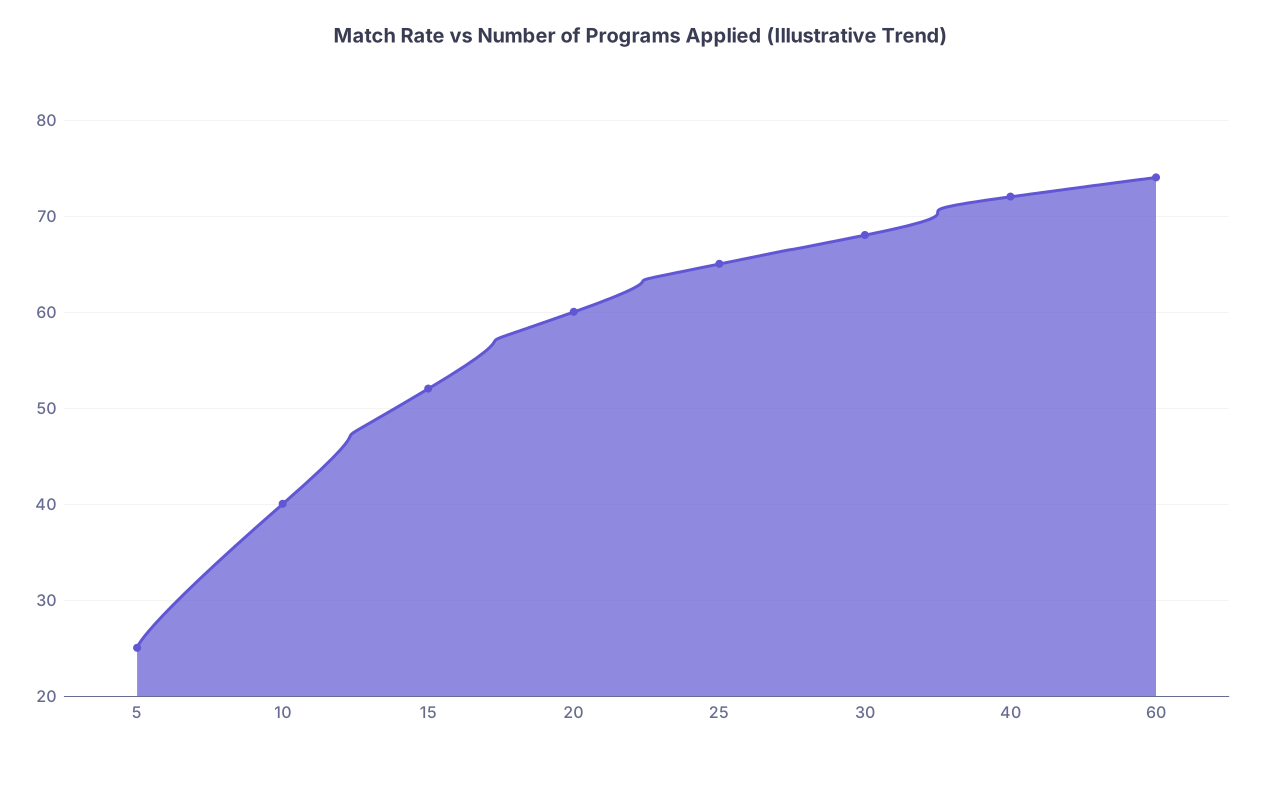
How Many Programs Should a Non-US Citizen IMG Apply to in General Surgery?
This is the central tactical question: how many programs to apply to in order to maximize match chances without unnecessary cost.
1. General Ranges for Non-US Citizen IMGs in General Surgery
Numbers vary by year, but for categorical general surgery:
- Highly competitive non-US citizen IMGs (strong profile)
- Typically: 40–70 categorical programs
- Plus: 10–20 preliminary programs (optional but often wise)
- Moderate profiles (average scores, some deficits)
- Often: 70–120 categorical programs
- Plus: 20–40 prelim programs
- High-risk profiles (low scores, attempts, older YOG, minimal USCE, require visa)
- Sometimes: 120–180+ programs total (categorical + prelim)
- With a realistic willingness to interview widely and consider prelim spots
For many non-US citizen IMGs, especially first-time applicants, an application range of 80–120 programs (mostly categorical, some prelim) is common and rational, assuming you have the financial ability.
2. Balancing Cost vs Benefit
ERAS fees increase with the total number of applications. To decide how many programs to apply, weigh:
- Financial reality (you may be paying in foreign currency)
- Likelihood of interviews based on:
- Scores
- YOG
- USCE and LORs
- Visa need
If you have multiple major risk factors (e.g., low Step scores, no USCE, and older graduation year), applying to only 40–50 programs in general surgery is usually not enough.
However, more applications do not automatically mean more interviews. A focused strategy targeting programs likely to consider your profile is better than blindly applying to all 300+ programs.

Building and Refining Your Program List: Step-by-Step
Now we combine all of this into a concrete, repeatable process for your program selection strategy.
Step 1: Generate a Maximal Eligible List
Starting from FREIDA and program websites:
- Include all general surgery programs.
- Remove:
- Programs that do not sponsor visas (if you need one).
- Programs that clearly state they do not consider IMGs.
- Programs with rigid criteria you do not meet (e.g., “within 3 years of graduation” when you’re 8 years out).
This gives you your maximal eligible list.
Step 2: Categorize by Program Type and Tier
Label each program:
Type:
- U (University academic)
- UA (University-affiliated community)
- C (Community)
Tier (subjective, based on your profile and resources):
- R (Reach)
- T (Target)
- S (Safety/IMG-friendly)
A well-balanced list for a non-US citizen IMG might look like:
- 10–20 University (mix of Reach/Target)
- 40–70 University-affiliated (mostly Target)
- 30–60 Community (many Safety)
Step 3: Apply an IMG- and Visa-Friendliness Filter
Within the maximal list, highlight:
- Programs with current foreign national IMGs
- Explicit website language welcoming IMGs
- Previously matched J‑1 or H‑1B residents
- Programs with a high proportion of IMGs historically
Prioritize these over those with little to no IMG representation.
Step 4: Align With Your Personal Priorities
From what remains:
- Cross off locations you truly cannot live in (for family, health, or legal reasons).
- Flag your top 10–15 “dream but realistic” programs (even if some are reach).
- Identify a core group of 40–60 programs where your profile is well within their typical range and which are IMG-friendly.
Step 5: Add Safety and Preliminary Programs Strategically
Given the competitiveness of general surgery:
- Add more community and IMG-heavy programs to reach your target total application number.
- Consider applying to preliminary surgery positions at programs where:
- You might later have a chance to convert to categorical.
- You’ll get solid operative and US clinical experience, even if you need to reapply later.
For many non-US citizen IMGs, a mix like:
- 70–90 categorical
- 20–30 preliminary
is a practical, balanced approach.
Maximizing Interview Yield from Your Program List
Choosing programs is only half the battle. You must also ensure your application makes sense for those programs.
1. Tailor Your Application to Surgery
Make all aspects of your application tell a coherent “surgery story”:
- Personal statement: focused on general surgery, not generic medicine
- CV: highlight surgery rotations, surgical skills exposure, procedures seen or assisted
- Research: emphasize surgical topics or perioperative care if applicable
- LORs: ideally from US surgeons or from surgical faculty who know you well
Programs want to see commitment to surgery, not a backup plan.
2. Use Signals and Communication Wisely (If Applicable)
If ERAS/NRMP offer program signaling for general surgery in your cycle:
- Signal a mix of:
- A few reach programs where you might realistically interview
- Several core target programs that are IMG-/visa-friendly
- Avoid wasting signals on programs unlikely to consider non-US citizen IMGs.
Professional, concise emails to programs (after applications are submitted) may help slightly, especially to:
- Clarify visa eligibility (e.g., you have Step 3 for H‑1B)
- Highlight recent updates (e.g., new US surgical observership, new publication)
3. Prepare for the Interview Wave
A strong program selection strategy also includes being ready when interviews arrive:
- Respond quickly to interview offers; popular dates fill fast.
- Track invites in your spreadsheet (program, date, platform, interviewer names).
- Be flexible with scheduling; general surgery programs often have limited slots.
Aim for:
- At least 10–12 categorical interviews to have a reasonable chance to match in surgery.
- If you cannot reach that number, consider:
- More preliminary programs
- Parallel plans (e.g., research fellowship, another specialty) if needed.
Special Considerations for High-Risk Non-US Citizen IMGs
If your profile has significant weaknesses, your program selection strategy needs additional layers.
1. If Your Scores Are Low or You Have Attempts
- Focus heavily on IMG-friendly community and university-affiliated programs.
- Apply to a larger number of programs (often >120 total).
- Strongly consider:
- Taking Step 3 early if you’re targeting H‑1B programs.
- Gaining robust USCE in general surgery before the next cycle if you’re reapplying.
2. If You Are Several Years Out from Graduation
- Prioritize programs that:
- Do not state strict year-of-graduation limits, or
- Have current residents with older graduation years.
- Compensate with:
- Continuity of clinical work (show you have remained clinically active)
- Strong recent LORs
- Additional credentials (e.g., MPH, research, clinical fellowships)
3. If You Lack US Clinical Experience
- Before or concurrent with applying, seek:
- US electives (if still eligible)
- Observerships or externships in general surgery
- Highlight any significant home-country surgical experience with clear responsibilities and procedures.
If you will have new USCE after ERAS submission, plan to update programs with a concise email plus updated CV or LORs.
Putting It All Together: A Sample Strategy
Imagine you are a non-US citizen IMG with:
- Step 2: 238; Step 1: Pass (first attempt)
- Graduation: 3 years ago
- 3 months USCE in general surgery (observerships)
- Strong LORs from 2 US surgeons, 1 home-country surgeon
- Need J‑1 visa
A reasonable program selection strategy could be:
- Generate list of all general surgery programs that:
- Sponsor J‑1
- Accept IMGs
- Eliminate programs with strict recent YOG limits (<3 years) if any.
- Classify:
- 15 Reach (mix of academic and strong UA)
- 55–65 Target (mostly UA and community with some academic)
- 30–40 Safety (mostly community/state or IMG-heavy)
- Decide how many programs to apply:
- 90–100 categorical positions
- 20–25 preliminary positions (especially at places you’d like to train, even prelim)
- Use signaling (if available):
- 3–4 reaches you would love to join
- 5–7 strong target programs with solid IMG history
You submit ~115–120 applications total. This is a rational, defensible plan for your profile.
FAQs: Program Selection Strategy for Non-US Citizen IMGs in General Surgery
1. As a non-US citizen IMG, is it realistic to match into a categorical general surgery residency?
Yes, but it is challenging. Success typically requires:
- Competitive USMLE scores (or strong compensatory strengths)
- Focused commitment to surgery (USCE, research, LORs from surgeons)
- A broad but strategic application to many programs
- Willingness to consider community and university-affiliated programs, not just big-name academic centers
Many foreign national medical graduates match into general surgery each year, but they usually apply widely and strategically.
2. How many general surgery programs should I apply to if I require a visa?
For most non-US citizen IMGs, especially first-time applicants:
- 80–120 programs (categorical + prelim) is a common and sensible range.
- If you have multiple risk factors (low scores, older YOG, minimal USCE), you may need to be closer to the higher end or beyond.
- If you have a strong profile (high scores, strong USCE, research), you might succeed with fewer applications, but many still apply to at least 50–70 categorical programs.
Always adjust number and program type to your financial limits and realistic chances.
3. Should I apply to preliminary surgery programs, or focus only on categorical spots?
For many non-US citizen IMGs, especially those with moderate or high-risk profiles, applying to both can be wise:
- Categorical spots are the goal (long-term training in one program).
- Preliminary spots:
- Provide US surgical experience and networking.
- Sometimes lead to categorical conversion (but never guaranteed).
- Strengthen your profile for a reapplication if needed.
If you are set on surgery and can afford it, include a deliberate selection of prelim programs, particularly at institutions you might want to join long-term.
4. How do I know if a program is truly IMG-friendly?
Look for concrete evidence:
- Current or recent residents are IMGs, especially non-US citizens.
- Program website explicitly welcomes international graduates.
- Publicly available rosters show diverse training backgrounds.
- Former IMG residents have successfully matched into fellowships or academic paths.
If a program has never (or almost never) matched IMGs, and says little about IMGs on their site, it is likely lower yield for a foreign national applicant needing a visa.
A thoughtful program selection strategy—anchored in honest self-assessment, clear priorities, and data-driven research—can turn a daunting process into a manageable, strategic campaign. As a non-US citizen IMG, you face additional barriers in the surgery residency match, but with targeted choices about how to choose residency programs and how many programs to apply to, you improve your chances of not just matching, but finding a program where you can truly thrive as a future general surgeon.