Understanding the Landscape: Radiation Oncology for Caribbean IMGs
Radiation oncology is one of the most competitive specialties in the NRMP, and it presents unique challenges for any international medical graduate (IMG)—including those from Caribbean medical schools like SGU, AUC, Ross, Saba, and others. As a Caribbean IMG, your program selection strategy is just as important as your personal application strength; in many cases, it is the primary determinant of whether you match at all.
Unlike some other specialties where “just apply broadly” is often enough guidance, a rad onc match requires very targeted, data-driven decisions. This includes:
- Understanding how your Caribbean medical school background affects your competitiveness
- Knowing which program tiers to target
- Deciding how many programs to apply to
- Prioritizing programs where Caribbean IMGs (and specifically SGU residency match outcomes and similar data) have historically had success
- Aligning your application with program-specific priorities (research, board scores, geographic factors, etc.)
This article will walk you through a step-by-step program selection strategy specifically designed for a Caribbean IMG aiming for a radiation oncology residency in the United States.
Step 1: Honestly Assess Your Competitiveness as a Caribbean IMG
Before you decide how many programs to apply to and which ones to target, you must realistically understand where you stand. Program selection is not one-size-fits-all, especially for radiation oncology.
Core Components of Competitiveness
USMLE Scores (or Step-equivalents if taken abroad)
While rad onc has seen declining applicant numbers, the programs that still participate generally maintain high academic expectations. For Caribbean medical school graduates, strong board scores are particularly important because they help offset bias against non–U.S. MD schools.- Step 1: Now pass/fail, but a strong pass on the first attempt is essential.
- Step 2 CK: A high Step 2 CK (ideally ≥ 245–250, higher is better) significantly improves your odds.
- Retakes or failures: Any failure will require a more conservative program selection strategy and broader application list.
Radiation Oncology–Specific Research and Experience
- First-author or co-author publications, posters, or abstracts in rad onc or oncology are highly valued.
- Substantial research time (dedicated research year, masters, PhD) can offset being a Caribbean IMG in some cases.
- Home or away rotations in radiation oncology with strong letters of recommendation strengthen your case considerably.
Clinical Performance
- Honors or high passes in core clinical rotations.
- Strong performance in oncology-adjacent fields (internal medicine, surgery, neurology) demonstrates consistency.
- U.S. clinical experience is critical; U.S.-based letters carry more weight than non-U.S. letters.
Caribbean IMG–Specific Factors Residency program directors know that Caribbean medical school residency applicants vary widely. They will look for:
- Evidence that you thrived in a competitive environment despite the perceived disadvantages.
- Clear indications of professionalism, resilience, and strong reasons for choosing radiation oncology.
- Residency match histories from your specific school (for example, your school’s data on SGU residency match outcomes, if you are from SGU).
Self-Categorize Your Applicant Profile
To create an effective program selection strategy, honestly place yourself into one of these broad categories:
Category A – Highly Competitive Caribbean IMG for Rad Onc
- Step 2 CK ≥ 250
- Multiple rad onc or oncology publications
- At least one U.S.-based rad onc elective with a strong letter
- Honors in several core clerkships
Category B – Solid but Not Top-Tier
- Step 2 CK 235–249
- Some research (not all rad onc, maybe general oncology or related)
- At least one U.S. rad onc rotation or strong related letters
- Good but not perfect clinical performance
Category C – Underpowered/Red Flags
- Step 2 CK < 235 or any exam failures
- Limited or no rad onc research
- Minimal oncology exposure
- Gaps in training or professionalism concerns
Your category will drive decisions about how many programs to apply and which tiers of programs should be your primary focus.

Step 2: Understand Program Types and Tiers in Radiation Oncology
Not all radiation oncology programs view Caribbean IMGs the same way. Some programs have a history of welcoming IMGs; others rarely or never rank them. A smart program selection strategy involves identifying where you are most likely to be genuinely considered.
Program Tiers (From a Caribbean IMG Perspective)
This is not an official ranking, but a practical way to think about programs:
Tier 1: Research-Intensive, “Elite” Academic Programs
- Features: NCI-designated cancer centers, heavy research focus, large faculty, advanced technology.
- Characteristics:
- Historically favor U.S. MDs, often from top-20 schools.
- May occasionally take IMGs, but often those with exceptional research portfolios (PhD, strong grants, multiple oncology publications).
- Caribbean IMG outlook:
- Possible only for Category A candidates with stellar research and networking.
- Even then, should not be the majority of your application list.
Tier 2: Strong Academic Programs with Variable IMG History
- Features: University-affiliated, active research, but somewhat less competitive than top-tier.
- Characteristics:
- May have occasional IMGs, often those with meaningful research or strong U.S. connections.
- Often more open to applicants with compelling stories and solid objective metrics.
- Caribbean IMG outlook:
- Attainable for Category A and select Category B applicants who have rad onc exposure and good Step 2 CK scores.
Tier 3: Mid-Sized Academic or Hybrid Community-Academic Programs
- Features: Balanced clinical and academic missions, moderate research.
- Characteristics:
- More likely to accept and rank IMGs if they meet baseline standards.
- Often located in less competitive regions or non-coastal areas.
- Caribbean IMG outlook:
- Core target for Category B applicants and realistic options for Category A with broader lists.
Tier 4: Smaller or Community-Oriented Rad Onc Programs
- Features: May be more clinically focused; fewer residents per year; sometimes newer programs.
- Characteristics:
- More variable resources but often more open to motivated IMGs.
- Relationship-based: strong fit and geographic ties may matter more.
- Caribbean IMG outlook:
- Crucial for Category B and C applicants who need a wide net to secure interviews.
How to Identify IMG-Friendly Radiation Oncology Programs
For each program on your list, ask:
- Have they matched any Caribbean medical school residency candidates recently?
- Have they matched IMGs in radiation oncology in the last 3–5 years?
- Is there any public data indicating Caribbean IMGs (SGU, Ross, AUC, Saba, etc.) matched into their program?
- Does the program state “We sponsor visas” (important if you need J-1/H-1B)?
Where to find this information:
- Program websites (resident bios and alumni lists)
- FREIDA and NRMP reports
- School match lists (e.g., SGU residency match data and similar from other Caribbean schools)
- LinkedIn searches for “Radiation oncology resident [Program Name] MD.”
Prioritize programs where you see at least some precedent for IMGs, and especially Caribbean IMGs.
Step 3: Deciding How Many Programs to Apply To
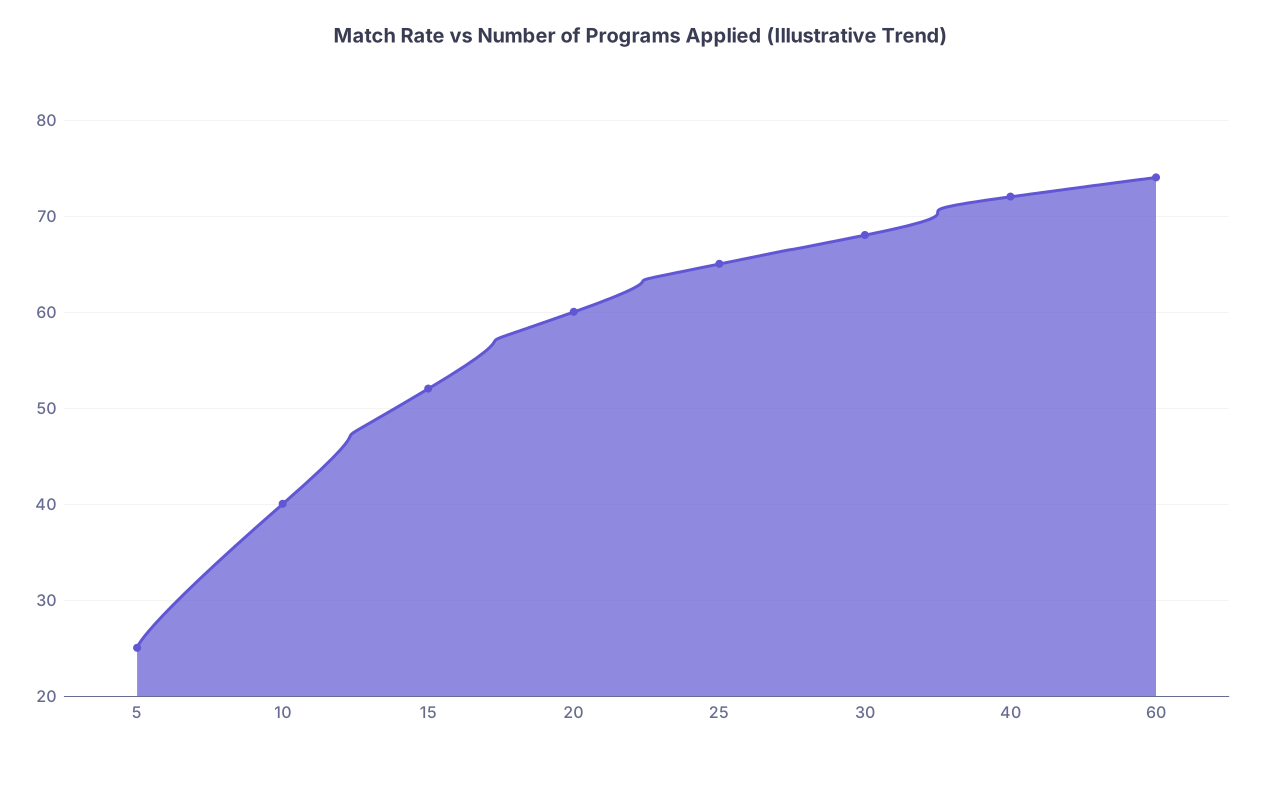
One of the most common questions is: how many programs to apply for a radiation oncology residency as a Caribbean IMG?
General Targets by Applicant Category
Given the competitiveness of rad onc and the additional hurdle of being a Caribbean IMG, conservative estimates are smart:
Category A (Highly Competitive Caribbean IMG)
- Target: 40–60 programs
- Distribution:
- 10–15 Tier 1 (reach)
- 15–25 Tier 2
- 10–20 Tier 3 and 4 (safeties/realistic targets)
Category B (Solid but Not Top-Tier)
- Target: 50–80 programs
- Distribution:
- 5–10 Tier 1 (long-shot reach)
- 15–25 Tier 2
- 20–30 Tier 3
- 10–15 Tier 4
Category C (Underpowered/Red Flags)
- Target: 60–100 programs (if finances allow)
- Distribution:
- 0–5 Tier 1 (only if special research connections)
- 10–20 Tier 2 (carefully selected, IMG-friendly)
- 25–40 Tier 3
- 20–30 Tier 4
Because rad onc has fewer total programs and smaller class sizes, even very strong Caribbean IMGs cannot count on many interviews. Over-applying is safer than under-applying, especially when your career goal is tightly focused on this specialty.
Financial and Practical Realities
Application fees add up quickly. Consider:
- ERAS fees for 40–80+ programs
- Travel or virtual interview logistics
- Time for tailored personal statements (you can create 2–3 versions: academic-heavy, community-focused, research-focused)
If budget is a major constraint, prioritize:
- Programs with proven IMG matches
- Programs in regions you can realistically see yourself living in
- Programs where you have geographic ties, prior rotations, or research connections
Step 4: Building a Smart, Tiered Program List
Now that you understand how many programs to apply to, you need a structured program selection strategy that maximizes your chance at a rad onc match without wasting applications.
Step 4A: Start with Objective Filters
Use FREIDA, program websites, and NRMP data to initially screen programs by:
- Visa sponsorship
- Eliminate programs that explicitly do not sponsor visas if you require one.
- Minimum score requirements
- Some programs list minimum Step 2 CK scores or rules about exam failures—honor these.
- IMG policy
- If a program clearly states “We do not consider IMGs,” remove it.
- Location limitations
- Remove locations that you cannot see yourself living in, unless the program is uniquely valuable.
This initial filter may already remove 15–30% of programs.
Step 4B: Evaluate IMG-Friendliness and Caribbean Precedent
Next, rate each program 1–3 on IMG-friendliness:
- Score 1: Unfavorable
- No visible IMGs in the last 5 years.
- Strong wording against IMG applicants or lack of visa sponsorship.
- Score 2: Neutral/Possible
- Occasional IMGs; no clear bias for or against Caribbean grads.
- Score 3: Favorable
- Clear history of matching IMGs, including Caribbean grads.
- Explicitly states openness to IMGs/visa sponsorship.
Focus your main efforts on programs scoring 2 or 3, unless you have a strong personal connection to a more restrictive program.
Step 4C: Align with Your Strengths
Align each program with your profile:
- Heavy research programs if:
- You have strong oncology or rad onc research, publications, or a research year.
- Clinically focused programs if:
- Your strongest assets are clinical grades, patient care, and strong clinical letters.
- Geographic preference:
- Give higher priority to programs in states or cities where you have ties—programs value geographic interest and stability.
Use a simple spreadsheet with columns like:
- Tier (1–4)
- IMG-friendly score (1–3)
- Visa (Y/N)
- Research intensity (Low/Moderate/High)
- Geographic fit (Low/High)
- Connection (Rotation, Alumni, Research, None)
Then assign each program a priority level (High/Medium/Low). Your application strategy should ensure:
- All High-priority programs receive a tailored, thoughtful application.
- Medium-priority programs get a solid generic application.
- Low-priority programs are backups, used only if you need to increase your list size.

Step 5: Strategic Considerations Unique to Caribbean IMGs
As a Caribbean IMG, your program selection strategy should proactively address concerns program directors may have while leveraging any advantages you possess.
5.1 Use School Match Data as a Guide (e.g., SGU Residency Match)
If you are from a larger Caribbean medical school (SGU, AUC, Ross, Saba), your school likely publishes yearly match lists. These are invaluable:
- Identify which programs have previously taken Caribbean IMGs from your specific school.
- highlight clusters of rad onc matches (e.g., “X University Radiation Oncology has taken SGU grads twice in 5 years”).
- Emphasize these programs in your list; they have already decided that Caribbean IMGs can succeed in their environment.
You can even mention in your personal statement or interviews:
- “I was encouraged to apply here after speaking with a recent graduate from my school who matched into your program.”
5.2 Prioritize U.S. Rotations and Letters
Programs often worry about variability in training quality for Caribbean medical school residency applicants. You can mitigate this by:
- Doing at least one radiation oncology elective in the U.S., ideally at an academic center.
- Getting strong U.S.-based letters that specifically comment on:
- Your knowledge base
- Work ethic
- Ability to integrate with the team
- Communication and professionalism
When selecting programs, slightly increase priority for:
- Programs where you rotated or did research
- Institutions where your letter writers have connections
5.3 Consider a Parallel Plan (Backup Specialty or Transitional Year)
Radiation oncology has a limited number of positions nationwide. As a Caribbean IMG, you must decide upfront whether to:
- Go all in on rad onc (high risk, high reward)
- Apply in rad onc with a backup specialty (e.g., internal medicine, prelim medicine, transitional year)
- Spend a year in research to strengthen your rad onc candidacy and reapply
Your program selection strategy should integrate this decision:
- If you have a strong backup specialty plan, you can be more selective in rad onc.
- If rad onc is the only acceptable outcome for you, your rad onc list should be as broad and strategically constructed as possible.
Step 6: Application Execution and Post-Application Adjustments
Once your list is set and applications are submitted, your strategy isn’t over.
Tailor Personal Statements by Program Type
Consider creating 2–3 tailored versions of your personal statement:
- Research-focused: For Tier 1 and strong Tier 2 programs with heavy research emphasis.
- Clinical/community-focused: For Tier 3 and 4 programs that emphasize patient care and local community impact.
- Geographically tailored: For regions where you have strong ties (family, prior education, spouse’s job).
Do not send a generic, copy-paste statement to every program; this is one of the most practical ways to stand out as a Caribbean IMG.
Tracking Interview Invites and Adjusting Expectations
As the season progresses:
- Track:
- Number of rad onc interviews received
- Which tiers are responding
- Whether IMG-friendly programs were more likely to respond
If you receive few or no interviews early:
- Reach out politely to programs where you have a genuine connection (prior rotation, research).
- Ask mentors if a brief letter of interest might help at selected programs.
- Intensify your backup plans (e.g., focus more on the backup specialty interview season, or consider a research year following graduation).
Interview-to-Rank Strategy
For each interview you receive:
- Research the program in detail: case mix, faculty interests, prior IMG matches, and typical resident profiles.
- Prepare to specifically address how your Caribbean medical education prepared you:
- Discuss adaptability, resilience, multicultural experience, and clinical volume.
- On your rank list:
- Prioritize fit and environment over perceived “prestige,” especially if you are offered a solid, supportive program that clearly values its residents.
Remember: for a Caribbean IMG in radiation oncology, one well-matched program is worth more than a long list of dream programs that don’t rank you.
Frequently Asked Questions (FAQ)
1. As a Caribbean IMG, is a radiation oncology residency realistic for me?
Yes, but it is inherently challenging. Your chances improve significantly if you have:
- Strong Step 2 CK (ideally ≥ 240–245+)
- U.S.-based rad onc or oncology research and at least one related publication or presentation
- U.S. clinical experience with strong letters
- A broad, data-driven program selection strategy targeting IMG-friendly programs
Caribbean medical school residency data (e.g., SGU residency match lists) show that rad onc matches do happen—but almost always in applicants with exceptional preparation and focused applications.
2. How many radiation oncology programs should I apply to if I’m from a Caribbean school like SGU or Ross?
For most Caribbean IMGs aiming for a rad onc match:
- Strongest applicants (Category A): 40–60 programs
- Solid but less stellar applicants (Category B): 50–80 programs
- Applicants with red flags (Category C): 60–100 programs, if finances allow
You should adjust this based on your own profile, budget, and whether you are applying to a backup specialty.
3. Should I apply mostly to community or academic radiation oncology programs?
You should apply to a mix, but the proportion depends on your strengths:
- If you have major research experience and publications: more strong academic programs.
- If your strengths are clinical performance and communication, and you lack heavy research: more mid-sized academic and community-oriented programs.
For most Caribbean IMGs, Tier 2–4 programs (mid-level academic and community-academic) will be the backbone of a practical program selection strategy.
4. If I don’t match into radiation oncology as a Caribbean IMG, what are my options?
Common options include:
- Pursuing a research year in radiation oncology or oncology and reapplying with a stronger profile
- Matching into a related field (e.g., internal medicine, prelim/transitional year) and then reconsidering your long-term path
- Strengthening your application with targeted publications, additional U.S. clinical experience, and a refined program selection strategy for the next cycle
Working closely with mentors, including any rad onc faculty who know you well, is critical in deciding the best path forward.
By combining an honest self-assessment, careful understanding of program tiers, strategic decisions about how many programs to apply, and focused targeting of IMG-friendly programs, you can dramatically improve your odds of matching into a radiation oncology residency as a Caribbean IMG. Your program selection strategy is not just a list—it is a deliberate plan that aligns your strengths with the realities of the rad onc match.