Understanding Your Unique Position as a US Citizen IMG in Neurology
Choosing where and how many neurology residency programs to apply to is one of the most strategic decisions you’ll make as a US citizen IMG and American studying abroad. Your status is both a challenge and an advantage:
- You are an IMG, so some programs may be more selective.
- You are a US citizen, which removes visa barriers and immediately makes you more attractive than non–US citizen IMGs for many institutions.
- Neurology is a moderately competitive specialty, with a relatively IMG‑friendly profile compared to fields like dermatology or plastic surgery.
Before building a program list, you need three things clear:
- An honest assessment of your application strength
- Basic understanding of neurology residency competitiveness and IMG friendliness
- A structured program selection strategy that answers: how to choose residency programs and how many programs to apply
Key Competitiveness Factors in Neurology for US Citizen IMGs
Programs will weigh your application across several domains. For program selection, think of yourself as “Strong,” “Average,” or “At‑Risk” along these axes:
USMLE Scores
- Step 1: Now Pass/Fail, but failures can be a red flag.
- Step 2 CK: Critical for IMGs; many programs use score thresholds.
- 250+: Strong
- 235–249: Solid / Average to Above Average
- 220–234: Competitive but need strategic list
- <220 or any failures: At‑Risk, need broad, IMG‑heavy strategy
Clinical Experience in the US
- Neurology electives/sub‑internships in the US are extremely valuable.
- At least 1–2 months of US neurology experience is ideal.
- Pure observerships help but are weaker than hands‑on clerkships.
Letters of Recommendation (LoRs)
- Aim for 3–4 strong letters, at least 2 from US neurologists.
- A letter from a program director or department chair carries extra weight.
Research and Academic Productivity
- Neurology values scholarly activity, but the importance varies by program.
- Tier 1 academic programs care more about:
- Neurology‑related publications
- Posters at AAN, other neurology meetings
- Community programs care more about clinical reliability and fit than research volume.
Red Flags
- Multiple attempts or failures on USMLE or COMLEX
- Extended gaps in training (>6–12 months)
- Poor communication skills, weak personal statement
- Very late graduation year (e.g., >5–7 years from graduation for many programs)
Knowing where you stand on these factors is the foundation of any effective program selection strategy.
Step 1: Define Your Profile and Risk Level
Before asking how many programs to apply, clarify: What kind of programs are likely to consider me? That depends on your risk category.
1. Strong US Citizen IMG Profile (Low to Moderate Risk)
Typical characteristics:
- Step 2 CK: 245–255+
- No USMLE failures
- 1–2+ US neurology rotations with strong letters
- Recent graduate (within 2–3 years)
- Some research or at least a poster/abstract in neurology or related field
- Fluent communication, compelling personal statement
Implications for program selection:
- Can target a mix of mid‑tier academic, strong community, and some higher‑tier academic programs.
- Still should use an IMG‑aware strategy, but has realistic access to a wide range of neurology residency programs.
2. Average US Citizen IMG Profile (Moderate Risk)
Typical characteristics:
- Step 2 CK: 230–245
- No failures, or one minor blemish balanced by strengths
- 1 US neurology rotation, perhaps some US internal medicine
- Decent but not outstanding research or extracurriculars
- Graduation within the last 4–5 years
Implications:
- Competitive for many community and community‑university affiliated neurology programs.
- Some IMG‑friendly university programs are possible, but very top‑tier academic programs are less likely.
- Needs a broad yet targeted neuro match strategy.
3. At‑Risk US Citizen IMG Profile (High Risk)
Typical characteristics:
- Step 2 CK: <230, or multiple attempts
- Failed Step 1 or Step 2 CK (even with later pass)
- Limited or no US clinical experience in neurology
- Older graduation date (5–10+ years since graduation)
- Gaps in CV without strong explanation
Implications:
- Must rely heavily on IMG‑friendly and community‑based neurology programs.
- Needs a very expansive program list and may consider applying to Preliminary/Internal Medicine, transitional year, or a dual‑application approach (e.g., neurology + internal medicine).

Step 2: Researching Programs: Beyond “IMG-Friendly Lists”
As an American studying abroad, it’s tempting to use generic “IMG‑friendly neurology programs” lists you find online. Those lists are a starting point—but not enough. A strong program selection strategy requires more granular filters.
Core Filters for Neurology Program Selection
When deciding how to choose residency programs, consider these dimensions:
Visa Policies and IMG Acceptance
- You don’t need visa sponsorship as a US citizen IMG, which is a major advantage.
- However, past IMG intake still matters:
- Look at current residents: Are there IMGs in each PGY class?
- Does the program website mention IMGs positively?
- A program that historically takes IMGs is more likely to be open to your application.
Program Type and Setting
- University‑Based / Academic Neurology
- Strong in subspecialties, research, fellowships.
- Often more competitive; some prefer US MDs.
- Better for those interested in academic careers or subspecialty fellowship.
- Community‑Based with University Affiliation
- Often more IMG friendly.
- Good mix of academic exposure and hands‑on clinical volume.
- Pure Community Programs
- Often very IMG and DO friendly.
- Heavy clinical workload; research sometimes limited but not always.
- University‑Based / Academic Neurology
Program Size
- Larger programs (taking 6–12 residents per year) may be:
- More flexible
- More likely to have at least a few IMG spots
- Very small programs (2–3 spots/year) may be:
- Either IMG‑friendly or very selective; must examine history.
- Larger programs (taking 6–12 residents per year) may be:
Location
- Metropolitan vs. rural
- Coasts vs. Midwest/South
- Many IMGs cluster their applications on the coasts, making them more competitive.
- Hidden gems often exist in smaller cities or less “popular” locations.
USMLE Score Filters
- Some programs publish:
- Minimum Step 2 CK score
- “We do not consider applicants with any USMLE failures.”
- Be honest: don’t waste applications on programs that clearly exclude your profile.
- Some programs publish:
Neurology Department Strength and Culture
- Does the program have:
- Subspecialty clinics (stroke, epilepsy, movement, neuromuscular)?
- A stroke center, neuro‑ICU, or advanced imaging?
- A collegial, supportive atmosphere (check resident reviews, not just glossy websites)?
- For a US citizen IMG, culture and mentorship often matter more than big-name prestige.
- Does the program have:
Practical Tools for Research
- FREIDA (AMA Residency & Fellowship Database)
- ERAS program list plus each program’s own website
- Program Instagram/X (Twitter)/LinkedIn – often show culture and day‑to‑day life
- Current residents – especially IMGs; reach out politely via LinkedIn or email
- NRMP Charting Outcomes and Program Director Surveys – to understand trends in neurology
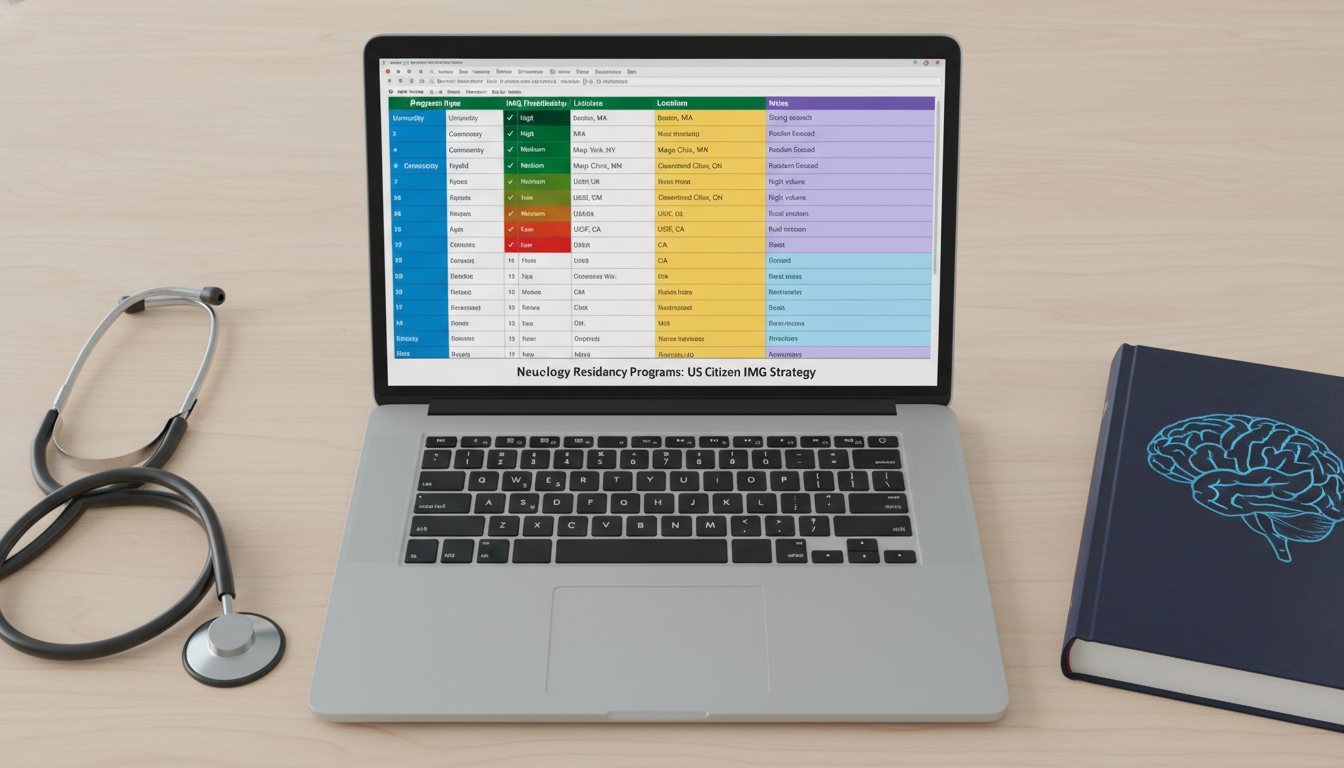
Create a spreadsheet with:
- Program name, city, state
- Program type (academic / community / hybrid)
- Current IMG presence
- Published score cutoffs
- Notes on visa policy (for IMGs in general)
- Your estimated chance: “Reach / Reasonable / Safety”
Step 3: How Many Neurology Programs Should a US Citizen IMG Apply To?
The question “how many programs to apply” cannot be answered with a single number, but for neurology and US citizen IMGs, we can give realistic ranges.
General Ranges for Neurology (US Citizen IMG)
Assuming you’re applying only to neurology (or neurology plus a small backup plan):
Strong US citizen IMG
- Typical range: 40–60 neurology programs
- If you have strong US neurology rotations and solid Step 2 CK (245–255+), 40–50 well‑chosen programs can be sufficient.
- If you are aiming for some more competitive academic centers, consider 50–60.
Average US citizen IMG
- Typical range: 60–90 neurology programs
- Closer to 60–70 if your profile closely matches most program requirements.
- Up to 80–90 if you have some weaker areas (e.g., limited US clinical exposure, only 1 neurology letter, or CK in low 230s).
At‑Risk US citizen IMG
- Typical range: 80–120+ programs (neurology + possibly a backup specialty)
- Over 100 programs may be reasonable if:
- You have any USMLE failures
- Older graduation date
- Nearly no US neurology experience
- Combine neurology with a backup specialty like internal medicine if matching in neurology appears uncertain.
Balancing Cost vs. Benefit
ERAS fees increase as you add more programs. You need to weigh:
- Marginal benefit of each additional program:
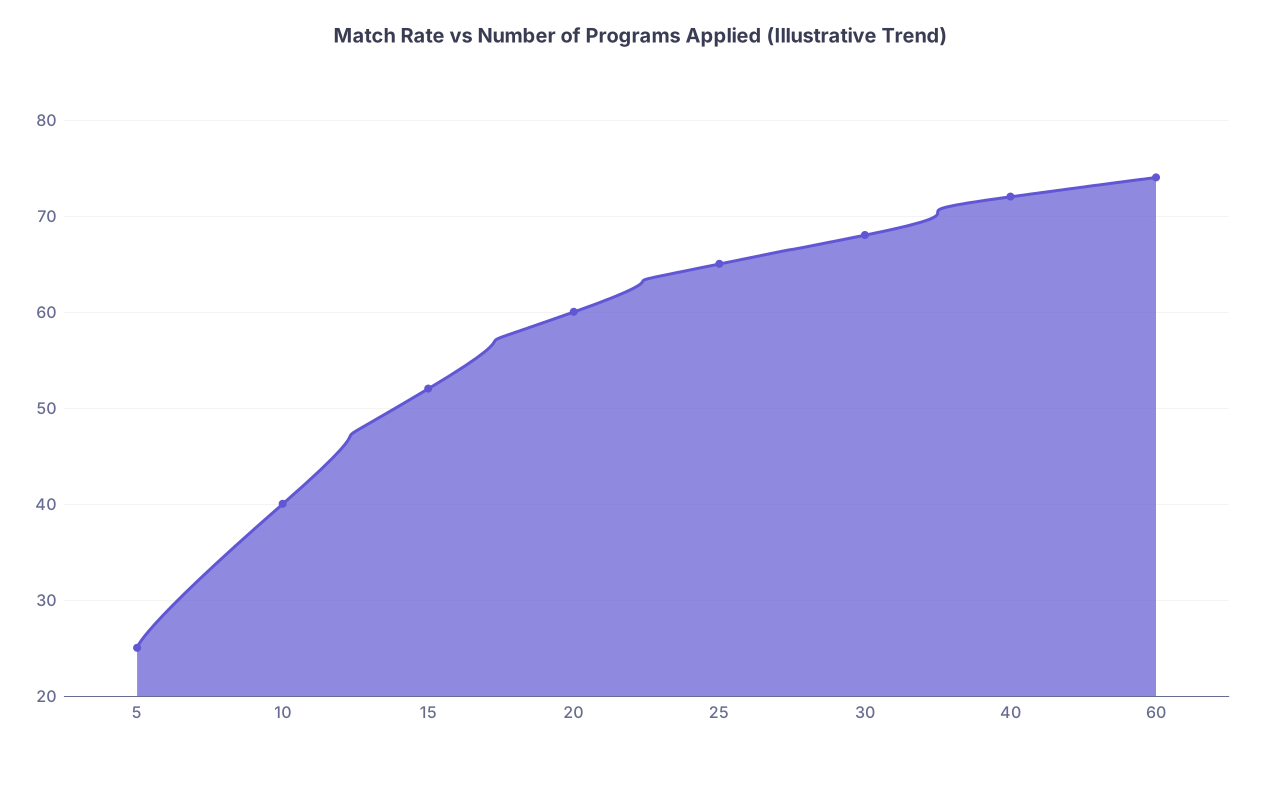
- Early additions (up to 40–50) significantly increase interview chances.
- Beyond 80–100, each extra program yields much smaller added benefit.
- Personal budget:
- Include ERAS fees, US travel (if in‑person), and time for interview season.
- A rational approach:
- Decide on a maximum financial budget for application.
- Reverse‑engineer: “Given this budget, how many total programs can I apply to?”
- Allocate the majority of that to neurology, with some for backups if needed.
Step 4: Building a Smart, Tiered Program List
A robust program selection strategy for neurology is not just about how many programs to apply; it’s also about which tiers and the proportions.
Tiered Approach: Reach, Reasonable, and Safety
For US citizen IMGs, a balanced neuro match list might look like this:
Reach Programs (10–20%)
- Highly academic university programs with:
- Limited or no IMGs currently
- Very strong fellowship placement
- Strong research expectations
- Apply here if:
- You have strong scores and some research
- You’re comfortable with likely low interview yield
- Highly academic university programs with:
Reasonable/Target Programs (50–70%)
- University‑affiliated or mid‑tier academic centers that:
- Regularly rank IMGs
- Have a mix of US grads and IMGs
- Are in moderately competitive cities or regions
- This tier should form the core of your neurology application strategy.
- University‑affiliated or mid‑tier academic centers that:
Safety/IMG‑Friendly Programs (20–30%)
- Community‑based programs
- University‑affiliated programs with a strong track record of taking IMGs
- Programs in less popular geographic areas
- These help protect against the unpredictability of the match.
Example Breakdown: Average US Citizen IMG Applying to 70 Neurology Programs
- 10 “Reach” programs:
- Large, research‑intensive universities; limited IMGs; top fellowship outcomes.
- 40 “Reasonable” programs:
- Mix of academic and community‑affiliated neurology programs with prior IMGs.
- 20 “Safety/IMG‑Friendly” programs:
- Primarily community and smaller academic centers, historically IMG‑friendly.
Adjusting Based on Risk Category
- Stronger profile:
- Slightly more reach programs (maybe 15–20%).
- At‑Risk profile:
- Heavily skew toward safety and IMG‑friendly:
- Only a handful of reaches
- Majority in reasonable and safety
- Heavily skew toward safety and IMG‑friendly:
Region and Location Strategy
When you’re an American studying abroad, it’s easy to focus only on “desirable” US cities. But to increase your chances in neurology:
- Include a broad geographic distribution:
- East Coast, Midwest, South, West
- Urban, suburban, and a few smaller cities
- You can still highlight preferences, but don’t self‑eliminate from potentially match‑friendly locations.
Step 5: Strategy for the Neuro Match as a US Citizen IMG
Once you’ve built your program list, think beyond just getting interviews—think about the overall neuro match strategy.
1. Strengthen Your Application While You Apply
Even while applications are pending:
- Continue clinical work (especially in neurology or internal medicine).
- Update programs with:
- New publications or presentations
- Additional US clinical experiences
- Improved CV items
2. Craft a Neurology‑Focused Personal Statement
For neurology:
- Tell a coherent story of why neurology:
- Clinical experiences that led you to neurology
- Any exposure to stroke, epilepsy, neuro‑ICU, movement disorders, etc.
- As a US citizen IMG, explicitly:
- Explain your path as an American studying abroad and returning home.
- Reassure them of your commitment to US training and long‑term neurology practice.
Avoid:
- Generic “I love the brain” statements without depth.
- Overly dramatic or cliché stories that don’t add to your credibility.
3. Communicate Fit as a US Citizen IMG
During interviews and correspondence:
- Emphasize:
- Familiarity with US healthcare system (if you’ve had US rotations).
- Flexibility regarding location.
- Teamwork and communication skills.
- Be ready to discuss:
- Why you chose to study abroad.
- How that experience prepared you uniquely for neurology training.
- Your long‑term goals (e.g., subspecialty fellowship, academic vs community practice).
4. Consider Backup Strategies
For At‑Risk or borderline applicants:
- Combine neurology with:
- Internal Medicine Categorical (if you’d be content with IM)
- Or Preliminary/Internal Medicine plus Neurology Categoricals (some neurology programs are advanced positions).
- Rank order:
- Neurology programs first (where you truly would train happily).
- Followed by acceptable backup categorical/Prelim options.
5. Post‑Interview Communication
Within NRMP rules and program policies:
- Send thank‑you emails when appropriate.
- If allowed, express genuine interest—but:
- Avoid promising to rank first unless you truly mean it.
- Avoid mass generic emails; personalize to each program.
Putting It All Together: A Sample Strategy for a US Citizen IMG in Neurology
Imagine you are:
- Step 2 CK: 238
- No failures
- 2 US neurology electives with good letters
- 1 poster at a neurology conference
- Graduated 2 years ago
- No major red flags
A realistic program selection strategy could be:
Apply to ~70 neurology programs:
- 8–10 large, academic centers (Reach)
- 40–45 mid‑tier/university‑affiliated programs with some IMGs (Reasonable)
- 15–20 community/IMG‑friendly programs (Safety)
Geographic distribution:
- 25–30 on East Coast
- 20–25 in Midwest
- 10–15 in South
- 5–10 on West Coast / Mountain states
Backup plan (optional, depending on your risk tolerance):
- 10–15 Internal Medicine categorical programs, mostly IMG‑friendly.
Ongoing optimization:
- Track interview invites; if by late October you have very few invites, consider:
- Proactive interest emails
- In future cycles, expanding list or strengthening application further.
- Track interview invites; if by late October you have very few invites, consider:
This structured approach transforms a vague “apply widely” mindset into a targeted, data‑informed neurology residency program selection strategy tailored to a US citizen IMG.
FAQs: Program Selection Strategy for US Citizen IMG in Neurology
1. As a US citizen IMG, do I still need to worry about visa policies?
You personally do not need visa sponsorship, which removes a major barrier. However, programs that are comfortable hiring IMGs at all (regardless of citizenship) will still matter to you. Look for programs that consistently match IMGs—even if many of them are on J‑1 or H‑1B visas—because it signals they are open to non‑US‑school graduates. Programs that state “we rarely consider IMGs” may still be harder for you, even as a US citizen.
2. Is it realistic for a US citizen IMG to match into a strong academic neurology residency?
Yes, it is possible, especially with:
- Solid Step 2 CK (ideally >245),
- Strong US neurology letters,
- Some research or academic involvement,
- Recent graduation and no red flags.
However, most US citizen IMGs match into a mix of mid‑tier academic and community‑affiliated programs, not the absolute top‑tier university departments. You should include a few strong academic reaches, but the majority of your list should be realistic, IMG‑aware programs.
3. If I have a Step 1 or Step 2 CK failure, how many neurology programs should I apply to?
With any USMLE failure, especially as an IMG, neurology becomes more challenging but not impossible. In that situation:
- Consider applying to 80–120 neurology programs.
- Emphasize IMG‑friendly and community‑based programs.
- Strongly consider a backup plan (e.g., internal medicine categorical or preliminary). You should also address the failure in your application and be prepared to explain what changed and how you improved.
4. Do I need neurology research to match into neurology as a US citizen IMG?
Neurology research is helpful but not strictly required for many programs—especially community and community‑affiliated ones. For top academic centers, research helps a lot. As an American studying abroad, you can compensate for limited research with:
- Excellent US neurology rotations and letters,
- Strong Step 2 CK,
- Evidence of sustained interest in neurology (case reports, elective choices, neurology interest group involvement, etc.).
If you have time before applying, even a small project—a case report with a neurology attending, a poster at a neurology conference—can strengthen your neuro match profile.
By approaching neurology residency applications with a structured program selection strategy, honest self‑assessment, and a realistic sense of how many programs to apply, you greatly improve your chances as a US citizen IMG. Your path as an American studying abroad can be a compelling asset—if you pair it with a disciplined, data‑informed approach to the neuro match.