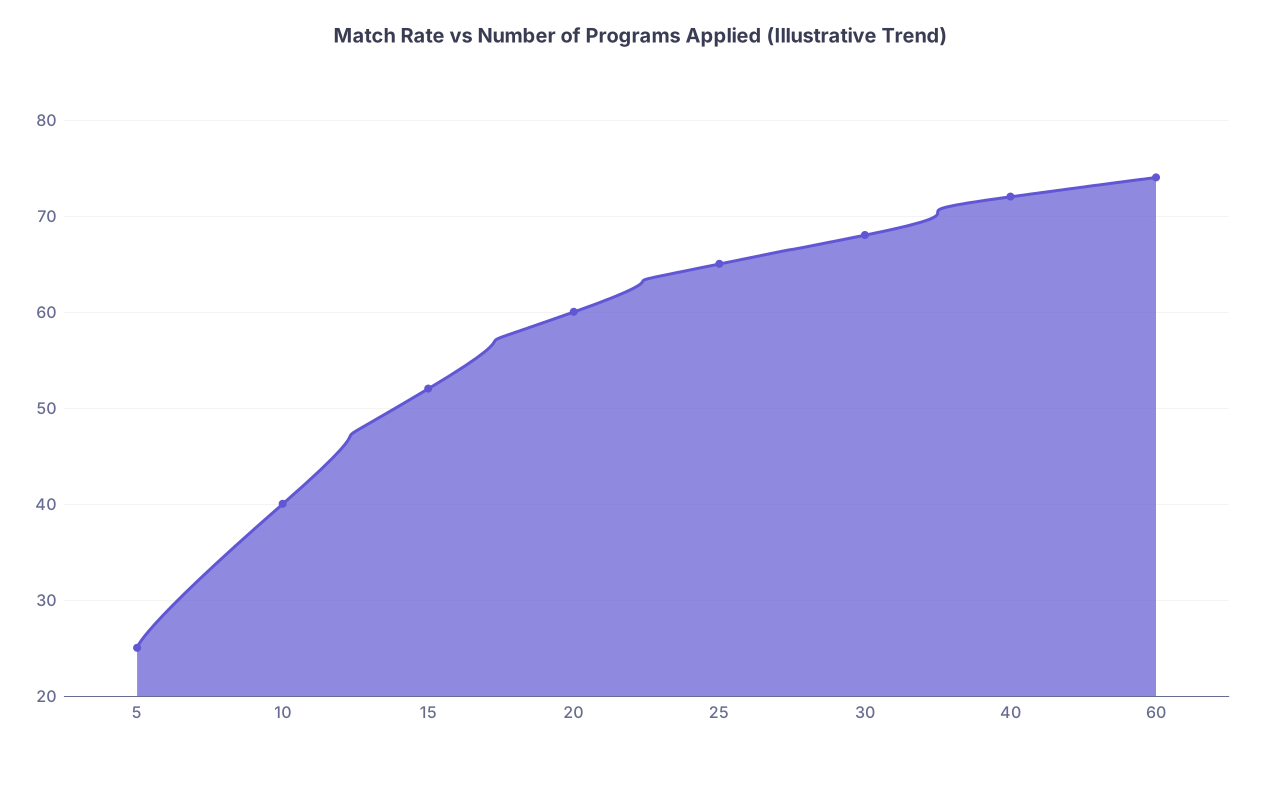
As a US citizen IMG interested in a preliminary surgery year, your program selection strategy can be the difference between matching into a solid prelim surgery residency versus going unmatched or landing in a program that doesn’t support your long‑term goals. This article breaks down, in practical detail, how to choose residency programs, how many programs to apply to, and how to tailor your list as an American studying abroad.
Understanding the Preliminary Surgery Year as a US Citizen IMG
Before building a program list, you need absolute clarity on what a preliminary surgery year is and how it fits into your trajectory.
What is a preliminary surgery residency?
A prelim surgery residency is a one-year non-categorical position in general surgery (PGY‑1), usually with no guaranteed continuation to PGY‑2 in surgery. There are three major flavors of prelim positions:
Prelim Surgery (Traditional Non-Categorical)
- 1-year contract
- Designed for:
- Applicants who hope to reapply to categorical general surgery
- Those aiming for other specialties that value a surgical intern year (e.g., radiology, anesthesiology, PM&R, dermatology, ophthalmology in some rare cases)
- Applicants who want strong clinical experience while improving their application
Prelim Surgery Linked to Another Specialty
- For example, a prelim surgery year for urology, interventional radiology, or sometimes neurosurgery
- Your spot may be “reserved” if you have already matched into that advanced specialty
- If you’re only applying to stand-alone prelim spots, this usually doesn’t apply; but you’ll see these listed in program descriptions
Transitional Year vs Prelim Surgery
- Transitional Year (TY) is broader (mix of medicine, surgery, electives)
- Prelim Surgery is more OR-based, high-intensity, and heavily procedural
- Both can serve as a bridge year, but prelim surgery is better if you’re leaning toward procedural or surgical fields, or want strong operative and ICU exposure
Why US citizen IMGs consider a preliminary surgery year
As a US citizen IMG or American studying abroad, prelim surgery may be appealing if:
- You didn’t match categorical general surgery on the first attempt
- Your Step scores, clinical experience, or letters aren’t yet competitive for categorical programs
- You want to:
- Prove yourself in a US academic environment
- Strengthen letters of recommendation from surgeons
- Gain US clinical experience with high responsibility
- Reapply more competitively to general surgery or another specialty
However, you must approach prelim programs strategically. Many have high workloads, variable support, and limited opportunity to convert to categorical spots.
The rest of this article focuses on program selection strategy, how to choose residency programs, and how many programs to apply to as a US citizen IMG targeting prelim surgery.
Clarifying Your Goals: The Foundation of Your Program List
Before opening ERAS or FREIDA, you need to be brutally honest with yourself about your end game. This immediately shapes which prelim programs belong on your list.
Step 1: Define your long-term career goal
Ask yourself:
- Do I want to ultimately become a board-certified general surgeon?
- Am I planning to switch into or apply to another specialty after intern year (e.g., anesthesia, radiology, EM, urology)?
- Am I using this year primarily to:
- Build US experience and strong letters?
- Strengthen my application for a second Match cycle?
- Keep my clinical skills sharp while waiting for a visa or exam completion? (Less applicable for US citizens but sometimes relevant if you’re delayed with Step 3 or other logistics.)
Your answer affects what to prioritize:
- Goal: Categorical General Surgery (Reapplication)
- Prioritize prelim programs with:
- Documented success in helping prelims match into categorical gen surg (at that institution or elsewhere)
- Research opportunities in surgery
- Faculty who are invested in prelim residents
- Prioritize prelim programs with:
- Goal: Other Specialty (e.g., Anesthesia, Radiology, EM)
- Look for programs with:
- Balanced prelim surgery curriculum (some ICU, some floor, some OR)
- Reasonable schedule that allows for interviews, studying, and networking
- Known history of prelims entering non-surgical fields
- Look for programs with:
- Goal: Undecided but interested in procedural fields
- Choose prelim programs that:
- Offer broad exposure: trauma, ICU, acute care surgery
- Provide time and mentorship for exploring multiple paths
- Choose prelim programs that:
Step 2: Be realistic about your competitiveness as a US citizen IMG
Compared to non-US IMGs, US citizen IMGs often have slightly better odds, but you are still at a disadvantage relative to US MD/DO graduates for categorical surgery. For prelim surgery, however, programs are often more open to IMGs.
Consider:
- USMLE/COMLEX scores (Step 1 Pass/Fail limits differentiation; Step 2 CK is critical)
- Number and quality of US clinical experiences (especially surgery rotations, sub-Is, externships)
- Letters of recommendation from US surgeons
- Any red flags:
- Exam failures
- Gaps in training
- Disciplinary actions
If you have significant red flags, you will likely need to:
- Apply more broadly
- Consider a larger proportion of community-based prelims
- Lower your emphasis on high-prestige academic centers
Being honest at this stage helps you determine how many programs to apply to and which tiers of programs to target.
How Many Programs Should You Apply To for Prelim Surgery?
For an American studying abroad targeting a preliminary surgery residency, the safe number of applications is usually higher than for categorical applicants, but slightly lower than for highly competitive specialties.
General application volume guidance
While there is no perfect number, these ranges are reasonable for US citizen IMGs (assuming no major red flags):
- Highly competitive US citizen IMG (strong Step 2 CK, strong US letters)
- Rough guideline: 25–40 prelim surgery programs
- Plus: Categorical general surgery applications if you are also attempting categoricals (often 40–60+ programs)
- Moderate competitiveness (average scores, decent but not top-tier letters, limited US rotations)
- Rough guideline: 40–60 prelim surgery programs
- Lower competitiveness (exam failure, significant gaps, weak US experience)
- Rough guideline: 60–80 prelim surgery programs, possibly including:
- Community programs
- Smaller or newer academic programs
- Programs in less desirable geographic areas
- Rough guideline: 60–80 prelim surgery programs, possibly including:
Remember:
- These are estimates, not guarantees.
- If funding allows, err on the side of more programs for prelim surgery, especially if you have significant application weaknesses.
Balancing prelim and categorical applications
Many US citizen IMGs apply to a mix of categorical general surgery and prelim surgery:
- If you realistically want a categorical position:
- Apply broadly to categorical programs (often 60–80+ for IMGs).
- Add 25–50 prelim programs to secure an internship year if categorical match fails.
- If your primary goal is just securing a prelim year:
- Focus your resources on 40–60 prelim programs, well-targeted to your profile and goals.
Practical constraints: Time, money, and sanity
Application fees, time for personalizing applications, and interview travel (if in-person) are real constraints.
Consider:
- ERAS costs climb quickly with more programs
- Your bandwidth to attend interviews (virtual or in-person)
- Your ability to:
- Write tailored program-specific communications
- Prepare for multiple interviews in a short timeframe
A better strategy than blindly applying to 80+ programs is to:
- Use a tiered program selection strategy (explained next)
- Be thoughtful about program fit, not just volume
Building Your Program List: A Tiered Strategy for US Citizen IMGs
A structured program selection strategy helps you balance ambition with safety and fit.

Step 1: Understand key program types
Academic university programs
- Typically affiliated with large medical schools
- Pros:
- Strong research environment
- High surgical volume, subspecialty exposure
- Good for letters and networking
- Cons:
- Often prioritize US MDs for categorical spots
- Prelims may have heavy workload with less institutional “ownership”
- Advancement from prelim to categorical can be competitive and rare
Large community programs with academic affiliations
- Regional hospitals with university ties
- Pros:
- Often more IMG-friendly
- Good operative volume
- Sometimes more supportive environment for prelims
- Cons:
- Less name recognition than elite academic centers
- Research infrastructure may be limited
Pure community programs
- Independent hospitals without major academic centers
- Pros:
- Often more open to US citizen IMGs
- Strong clinical autonomy
- Cons:
- Less research
- Fewer subspecialty services
- May be located in less desirable regions
Step 2: Categorize programs into Reach, Target, and Safety
For a US citizen IMG in prelim surgery:
Reach programs:
- Prestigious university or high-profile academic centers
- Historically low percentage of IMGs
- High USMLE score expectations
- You apply for upside potential but don’t rely on them to match
Target programs:
- Mix of university-affiliated and strong community programs
- Regularly accept US citizen IMGs
- Your metrics (Step 2 CK, experiences) are near or slightly below their averages
- Reasonable risk, good potential for fit
Safety programs:
- Historically very IMG-friendly
- Located in less competitive regions (Midwest, some Southern states, smaller cities)
- You are above their average applicant profile
- You should be highly likely to at least receive interviews
A balanced list might look like:
- 15–20% Reach
- 40–60% Target
- 25–40% Safety
For example, if applying to 50 prelim programs:
- 8–10 Reach
- 20–30 Target
- 12–18 Safety
How to Choose Residency Programs: Filters That Matter for Prelim Surgery
Now that you know how many and how to tier them, you need to decide which specific programs deserve your ERAS fee.
1. IMG-friendliness (especially US citizen IMG–friendly)
As an American studying abroad, your first filter should be: Does this program actually interview and match IMGs?
Actions:
- Use tools like FREIDA, program websites, and alumni networks
- Look at:
- Recent or past residents’ bios (do they include IMGs, especially US citizens?)
- Any explicit statement about IMGs being welcome or not
- Ask:
- Does the program require USMLE Step 1/2 CK minimums?
- Are there any citizenship/visa restrictions? (You’re a US citizen, so visa is not an issue, which is a plus.)
Programs that consistently take IMGs—especially US citizen IMGs—should move to your Target or Safety categories.
2. Prelim-to-categorical transition opportunities
If your goal is eventual categorical general surgery, this is critical.
Look for:
- Statements like:
- “We occasionally promote prelims to categorical positions when spots open.”
- “Recent prelims have successfully matched into categorical surgery at our program or elsewhere.”
- Program director letters or open discussion during information sessions
- Data points:
- Number of prelims vs categoricals
- History of any PGY‑2 openings filled by prelims
Be cautious:
- Some programs explicitly say “no advancement from prelim to categorical”
That doesn’t make them useless, but you should know this going in.
3. Work environment, culture, and support for prelims
Prelim residents can sometimes be treated as “service-only” workers. You want a program that still invests in your education.
Red flags:
- No mention of prelims on the website
- No scheduled didactics that include prelim residents
- Stories (from residents, online forums, or alumni) of:
- Burnout
- Lack of mentorship
- Prelims doing only floor work with no OR exposure
Positive signs:
- Named prelim coordinator or explicit mention of prelim residents in leadership
- Clear curriculum and rotations listed for prelims
- Testimonials indicating:
- “Prelims are integrated into the team.”
- “Our prelims go to conferences and are supported in re-applying.”
4. Surgical case volume and clinical exposure
You want a prelim year where you actually learn and grow.
Look for:
- High case volume in:
- Trauma
- General surgery
- Acute care
- Exposure to:
- ICU rotations
- Night float
- Emergency general surgery
For those aiming at other specialties (anesthesia, EM, radiology), a rich mix of:
- OR time
- ICU
- Floor work prepares you well.
Geographic and Personal Considerations for US Citizen IMGs
Location matters—for your happiness, support network, and future targeting of particular regions.

1. Strategy vs preference: Big cities vs smaller regions
For US citizen IMGs, match odds are often better if you are flexible with geography:
- Big coastal cities (NYC, Boston, LA, SF, Miami):
- Highly desired, very competitive
- Many applicants; programs can be selective
- Midwest, South, and smaller cities:
- Often more IMG-friendly
- May have less competition for prelim spots
- More community-based or hybrid programs
Consider prioritizing:
- Regions where you can realistically build a network and possibly settle
- States with multiple programs so you can apply regionally (e.g., Ohio, Pennsylvania, Texas, Michigan)
2. Family, support, and finances
Burnout is common during intern year, especially in prelim surgery. Consider:
- Proximity to family or close friends
- Cost of living (your salary will be limited)
- Availability of housing, safety, and commuting options
If you have minimal local support, a program with a supportive culture and resident camaraderie may matter more than prestige or name recognition.
3. Long-term regional plans
If you ultimately want to practice or train further in a particular area, doing your prelim year in that region can help:
- Build relationships with attendings and PDs
- Attend regional conferences or networking events
- Facilitate future applications to categorical or advanced programs in that area
Practical Steps to Research and Shortlist Programs
Step 1: Start from official databases
Use:
- FREIDA, NRMP, and program websites to:
- Identify all programs with preliminary surgery positions
- Note their number of prelim vs categorical spots
- Gather any stated criteria for IMGs and USMLE cutoffs
Create a spreadsheet with columns such as:
- Program name
- City/state
- Type (Academic / Community / Hybrid)
- IMG-friendly? (Yes/No/Unclear)
- US citizen IMG residents? (If visible)
- Prelim-to-categorical pathway? (Yes/No/Unknown)
- Case volume indicators (if listed)
- Personal notes
Step 2: Use informal sources cautiously
Forums, Reddit, and word-of-mouth can provide:
- Insights into work environment
- How prelims are treated
- Call structure, schedules, and culture
But remember:
- Experiences are subjective
- A single bad review doesn’t necessarily reflect the whole program
- Cross-check with multiple sources when possible
Step 3: Reach out to current or former residents
As a US citizen IMG, networking matters:
- Ask your school’s alumni network if anyone has:
- Done prelim surgery in the US
- Matched categorical after a prelim year
- Use LinkedIn or hospital websites to find:
- Residents with international/IMG backgrounds
- US citizens who studied abroad and are now in surgery
- Politely reach out with:
- Brief introduction
- Clear questions (e.g., “How supportive is your program of prelims re-applying?” “How much OR exposure do prelims get?”)
Application and Interview Strategy Tailored to Prelim Surgery
Once your list is built, you need to apply and interview in a way that reinforces your program selection strategy.
Tailoring your ERAS application for prelim surgery
In your personal statement and ERAS content:
- Make your goals explicit:
- If you want eventual categorical surgery, say so while emphasizing your commitment to working hard as an intern.
- If you plan for another specialty, frame the prelim year as a way to develop strong clinical and procedural skills.
- Highlight:
- US clinical experience, especially surgery
- Any research or quality improvement projects
- Strong work ethic, resilience, and team orientation
- For US citizen IMGs:
- Emphasize advantages:
- No visa issues
- Often greater familiarity with US healthcare and communication norms
- Reassure programs about:
- Your long-term commitment to training in the US
- Your readiness to handle the workload
- Emphasize advantages:
During interviews: Questions that align with your strategy
Ask targeted questions such as:
- “How are prelim residents integrated into educational conferences and didactics?”
- “What is the typical OR exposure like for prelims versus categoricals?”
- “Have recent prelims been successful in matching into categorical surgery or other specialties?”
- “How does the program support prelims who are reapplying to the Match?”
Their answers will often reveal whether the program sees prelims as valued team members or just extra manpower.
Common Pitfalls for US Citizen IMGs in Prelim Surgery Program Selection
Over-focusing on prestige
- A famous name does not always help if you have:
- Little OR time
- Minimal faculty interaction
- Poor letters
- A mid-tier, IMG-friendly community or hybrid program may give you better mentorship and outcomes.
- A famous name does not always help if you have:
Underestimating workload and burnout
- Prelim surgery intern years can be brutal.
- A program that overworks prelims without meaningful education may not help your long-term goals.
Ignoring prelim-to-categorical data
- If your primary goal is categorical surgery, don’t ignore:
- Whether any prelims have advanced
- How often categorical spots open
- If your primary goal is categorical surgery, don’t ignore:
Applying too narrowly geographically
- As a US citizen IMG, being flexible with location often improves your match odds.
- Don’t apply only to New York, California, or Florida unless your profile is very strong and you understand the risk.
Not applying to enough programs
- A common question is how many programs to apply to.
- Especially with any red flags, err on the side of more (40–60+ prelim programs), diversified across tiers and geography.
Putting It All Together: A Sample Strategy for a US Citizen IMG
Consider a hypothetical US citizen IMG:
- Step 1: Pass on first attempt
- Step 2 CK: 236
- Two US surgery rotations with strong letters
- One year of research but no publications yet
- Wants categorical general surgery long term
A reasonable strategy:
- Categorical applications:
- Apply to 60–80 categorical gen surg programs (heavily community and hybrid, plus a few academic reach programs).
- Prelim applications:
- Apply to 40 prelim surgery programs, with:
- 8 Reach (well-known academic centers)
- 20 Target (university-affiliated and community programs with clear IMG-friendliness)
- 12 Safety (IMG-heavy community or hybrid programs in less competitive regions)
- Apply to 40 prelim surgery programs, with:
- Selection filters:
- Strong preference for programs with:
- Documented history of prelims advancing to categorical or matching elsewhere
- Robust operative and ICU exposure
- Strong preference for programs with:
- Interview priorities:
- Rank higher those programs where:
- Faculty show genuine interest in prelims
- Prelims attend conferences and get meaningful OR time
- PDs are open about writing strong letters and supporting re-applicants
- Rank higher those programs where:
This integrated approach balances ambition with realism and aligns every step with the applicant’s long-term goal.
FAQs: Program Selection Strategy for US Citizen IMGs in Preliminary Surgery
1. As a US citizen IMG, do I really need a prelim year to get into categorical general surgery?
Not always. Some US citizen IMGs match directly into categorical general surgery, especially with strong scores, solid US rotations, and good letters. However, if you have:
- Borderline or modest Step 2 CK
- Limited US clinical experience
- A previous unsuccessful Match attempt
a prelim surgery year can be a powerful way to strengthen your application—provided you choose a program that values prelims and helps them advance.
2. How many prelim surgery programs should I apply to if I have a Step 2 CK below 230?
If your Step 2 CK is below 230, consider yourself in a moderate-to-lower competitiveness group. A reasonable plan is:
- 40–60 prelim surgery programs if prelim is your main goal
- Or 25–40 prelim programs plus a very broad categorical application list if you are attempting both You’ll want to focus heavily on IMG-friendly community and hybrid programs and be geographically flexible.
3. Can I match into another specialty after a prelim surgery year?
Yes. Many applicants use a preliminary surgery residency as a stepping stone into:
- Anesthesiology
- Radiology
- Emergency Medicine
- PM&R, in some cases
To make this work:
- Choose prelim programs that are not overwhelmingly malignant or service-only
- Ensure you have time, mentorship, and support to:
- Prepare applications
- Attend interviews
- Secure strong letters tailored to your target specialty
4. What’s the biggest difference in program selection strategy between a prelim surgery year and a transitional year?
For a prelim surgery year:
- You prioritize surgical exposure, OR time, and ICU experience.
- Programs may be more intense and procedure-driven.
- Best if you’re leaning toward surgical or procedural fields.
For a Transitional Year:
- Broader rotations (medicine, surgery, electives)
- Often more flexible schedules and electives
- Better if your target specialty doesn’t require or strongly value heavy surgical exposure.
Your program selection strategy should start with your long-term specialty goal, then decide whether prelim surgery or TY (or both) is most aligned—and then apply the same structured approach: right number of programs, balanced tiers, IMG-friendliness, and supportive culture.
By approaching your prelim surgery residency search with a clear program selection strategy, understanding how to choose residency programs, and deciding early on how many programs to apply to, you significantly improve your odds of not only matching, but matching into a prelim position that genuinely advances your long-term goals as a US citizen IMG.